

Research Guide: Steps, Methods, and Writing Tips for Students
This research guide breaks down the entire academic research process into clear, manageable steps, from choosing a topic and building your methodology to collecting data, writing your research paper, and referencing correctly.
Whether you're a first-year student writing your first paper or tackling a dissertation, this step-by-step resource gives you the research skills to work with confidence and produce work that stands up to academic scrutiny.
What Is Research? A Simple Definition for Students
At its core, research is a structured, systematic way of investigating a question to discover new knowledge, confirm existing knowledge, or solve a problem. Instead of relying on guesses or opinions, research uses evidence, careful methods, and logical reasoning to reach conclusions you can trust and defend.
For students, this research guide exists to demystify a process that often feels overwhelming. Academic research isn't about knowing everything before you start; it's about following a reliable process that takes you from a vague idea to a well-supported, credible piece of work. Every subject, from Business and Nursing to Engineering, Psychology, and Law, relies on the same fundamental research skills.
Good research answers a clear question, uses appropriate methods, draws on credible sources, and presents findings honestly. If you can master those four ideas, you can research almost anything.
Why Research Matters
Research is the engine behind almost every academic assignment and professional field. It teaches you to evaluate evidence critically, distinguish reliable information from noise, and build arguments grounded in facts rather than assumptions. These skills matter far beyond the classroom, in careers, decision-making, and everyday life.
In academic settings specifically, strong research is what separates an average grade from an excellent one. Markers reward work that demonstrates independent thinking, engagement with credible sources, and a clear methodology. Learning to research well is one of the highest-return skills you can develop as a student.
Research Fundamentals: The Building Blocks
Before diving into the research process steps, it helps to understand a few core concepts that appear again and again throughout your academic career. These fundamentals form the vocabulary of academic research.
Characteristics of Good Research
Not all research is equal. High-quality academic research shares a set of recognizable characteristics:
- Systematic: It follows a logical, planned sequence rather than a random approach.
- Objective: It minimizes bias and lets the evidence guide conclusions.
- Verifiable: Others can check your methods and reproduce or challenge your findings.
- Ethical: It respects participants, avoids plagiarism, and maintains academic integrity.
- Evidence-based: Claims are backed by data, scholarly articles, or peer-reviewed sources, not opinion.
Types of Research
Research can be classified in several ways, and understanding these categories helps you choose the right approach for your project.
| Type of Research | Purpose | Common Example |
|---|---|---|
| Basic (Pure) Research | Expand knowledge without immediate application | Studying how memory forms in the brain |
| Applied Research | Solve a specific practical problem | Testing a new teaching method's effectiveness |
| Descriptive Research | Describe characteristics of a group or phenomenon | Surveying student study habits |
| Exploratory Research | Investigate a new or poorly understood topic | Early study of an emerging technology's impact |
| Explanatory Research | Explain cause-and-effect relationships | Why a policy change affected outcomes |
Academic vs Scientific Research
Students often confuse these terms. Academic research is the broad category covering scholarly investigation across all disciplines, including the humanities, social sciences, and sciences. Scientific research is a subset that specifically uses the scientific method, forming a hypothesis, testing it through experiments or observation, and drawing conclusions from measurable data. All scientific research is academic, but not all academic research is strictly scientific.
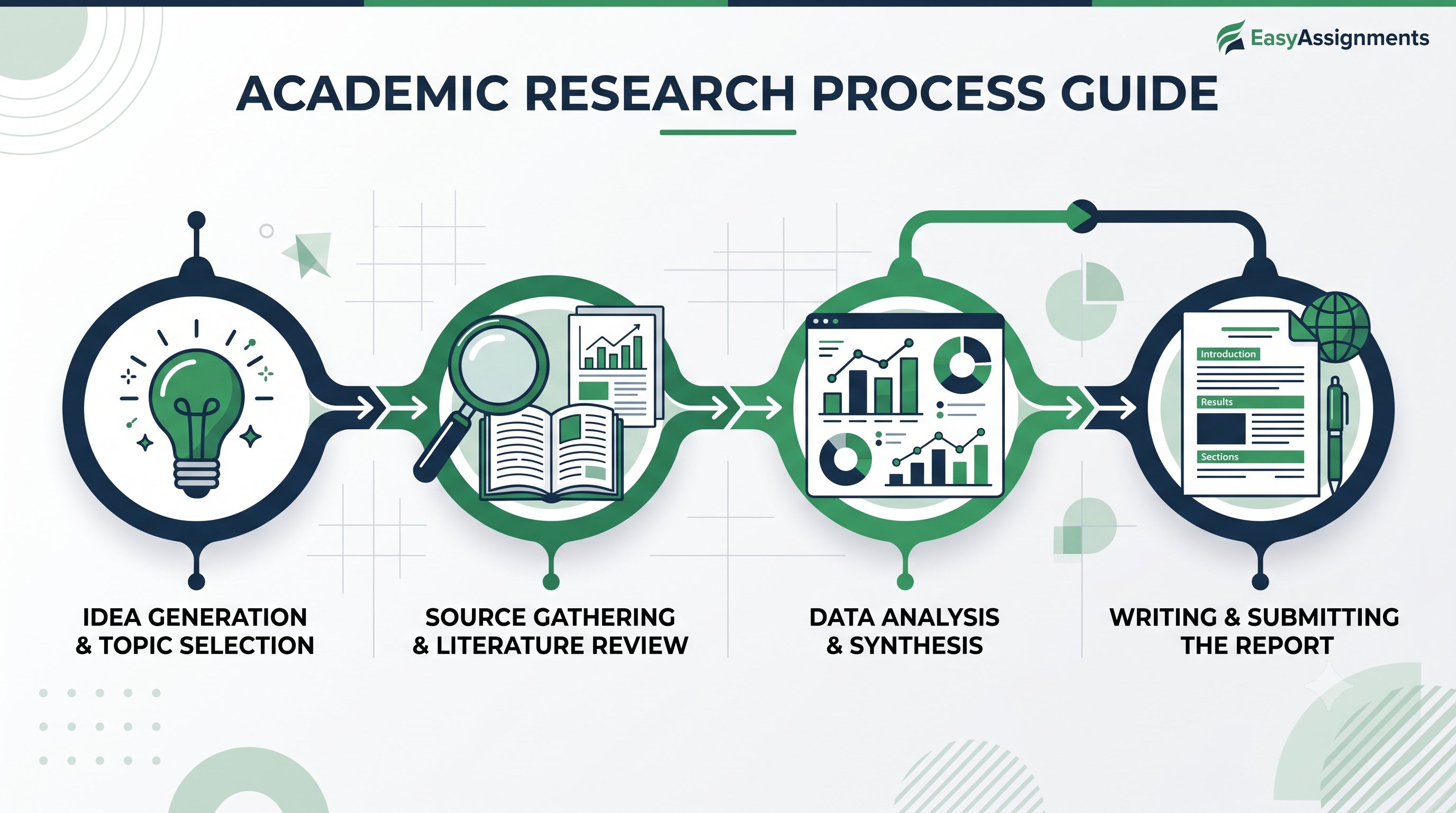
The Research Process: Steps in the Research Process
One of the most common questions students ask is: what are the steps in the research process? While different fields use slightly different language, almost all academic research follows the same core sequence. Understanding these research process steps turns an intimidating project into a series of manageable tasks.
- Choose and narrow your topic — move from a broad area to a focused, researchable subject.
- Develop a research question — define exactly what you want to find out.
- Set objectives and (if needed) a hypothesis — clarify your goals and predictions.
- Review the literature — understand what's already known.
- Choose your methodology — decide how you'll gather and analyze evidence.
- Collect data — run surveys, interviews, experiments, or gather sources.
- Analyze your findings — interpret what the data actually tells you.
- Write and structure your paper — communicate your findings clearly.
- Reference and proofread — cite sources correctly and polish the final draft.
The rest of this research guide expands each of these stages so you know exactly what to do at every step.
Planning Your Research
Strong research starts long before you gather any data. The planning phase determines whether your project is focused and achievable or vague and unmanageable. Time invested here saves hours of frustration later.
Choosing a Research Topic
A good research topic sits at the intersection of three things: genuine interest, academic relevance, and feasibility. Choose something too broad ("social media") and you'll drown in material; choose something too narrow or obscure and you may struggle to find sources. Start broad, then narrow using questions like who, what, where, when, and why.
For example, "social media" becomes "the effect of Instagram use on the sleep quality of undergraduate students," a topic that is specific, researchable, and interesting.
Writing Research Questions
Your research question is the single most important sentence in your project. It defines your scope, guides your methodology, and shapes your conclusion. A strong research question is focused, answerable within your time and resources, and non-trivial (it shouldn't have an obvious yes/no answer).
Setting Objectives
Objectives break your research question into concrete, measurable goals. Where the research question asks "what do I want to know?", objectives answer "what specific steps will I take to find out?" Well-written objectives usually begin with action verbs such as identify, examine, compare, evaluate, or determine.
Developing a Hypothesis
Not every project needs a hypothesis, but quantitative and scientific studies usually do. A hypothesis is a testable, predictive statement about the relationship between two or more variables, for example, "Students who study in silence score higher on recall tests than those who study with background music." Your research then sets out to support or reject that prediction using evidence.
Stuck at the Planning Stage?
Refining a research question or building objectives is where many projects stall. Our academic experts can help you sharpen your topic, structure your proposal, and plan your methodology.
Research Methodology: Choosing Your Approach
Research methodology is the overall strategy you use to answer your research question. It explains not just what you did, but why those methods were the right choice. Getting your methodology right is essential, because it determines how credible and defensible your findings will be. There are three broad approaches.
Qualitative Research
Qualitative research explores meaning, experiences, and perspectives. It answers "why" and "how" questions and produces non-numerical data such as words, themes, and descriptions. Common qualitative methods include interviews, focus groups, and observation. It's ideal when you want depth and rich understanding rather than statistics.
Quantitative Research
Quantitative research deals with numbers and measurable data. It answers "how many," "how much," and "how often" questions, and relies on statistical analysis to identify patterns and test hypotheses. Surveys with closed questions, experiments, and existing datasets are typical sources. It's ideal when you need objectivity, large samples, and generalizable results.
Mixed Methods Research
Mixed methods research combines qualitative and quantitative approaches in a single study. For example, you might run a survey (quantitative) to identify a trend, then conduct interviews (qualitative) to understand why it happens. This approach gives you both breadth and depth, though it requires more time and careful design.
| Feature | Qualitative | Quantitative |
|---|---|---|
| Data type | Words, themes, descriptions | Numbers, statistics |
| Question type | Why? How? | How many? How much? |
| Sample size | Smaller, in-depth | Larger, generalizable |
| Common methods | Interviews, observation | Surveys, experiments |
| Analysis | Thematic, interpretive | Statistical |
Data Collection Methods
Once you've chosen a methodology, you need to gather your data. The data collection method you choose must fit your research question, your approach, and your available time and resources. Below are the most common methods used in student research.
Surveys and Questionnaires
Surveys and questionnaires collect data from many people quickly and are ideal for quantitative research. Good questionnaire design is crucial: keep questions clear and unbiased, mix closed questions (for easy analysis) with a few open ones (for depth), and always pilot your survey on a small group first to catch confusing wording.
Interviews
Interviews provide rich, detailed qualitative data. They can be structured (fixed questions), semi-structured (a flexible guide), or unstructured (a free-flowing conversation). Semi-structured interviews are the most popular in student research because they balance consistency with the freedom to follow interesting responses.
Observation
Observation involves systematically watching and recording behavior or events as they naturally occur. It's valuable when you want to study what people actually do rather than what they say they do. Observation can be participant (you're involved) or non-participant (you watch from the outside).
Experiments
Experiments test cause-and-effect by manipulating one variable and measuring its effect on another while controlling other factors. They're the gold standard for establishing causation and are central to scientific research, but they require careful design and control to be valid.
Literature Review: Standing on the Shoulders of Others
A literature review surveys and evaluates existing research on your topic. It shows what's already known, identifies gaps your study can fill, and positions your work within the wider academic conversation. A strong literature review is not just a summary, it critically analyzes and synthesizes sources to build an argument.
Finding Scholarly Sources
Credible research depends on credible sources. Prioritize peer-reviewed journals, academic books, and reputable institutional reports over blogs or general websites. Peer-reviewed means other experts have checked the work before publication, a strong signal of reliability.
Using Google Scholar and Databases
Google Scholar is an excellent free starting point for finding scholarly articles across disciplines. For deeper searching, use your university's library databases such as JSTOR, PubMed, Scopus, or ProQuest. Learn to use search operators and filters to narrow results by date, subject, and peer-review status.
Evaluating Sources
Not every source deserves a place in your work. Evaluate each one using criteria like the author's credentials, the publication's reputation, the recency of the information, and whether claims are supported by evidence. The CRAAP test (Currency, Relevance, Authority, Accuracy, Purpose) is a handy checklist for judging source quality.

Research Writing: Structuring Your Paper
Once your research is done, you need to communicate it clearly. Most academic research papers follow a recognizable structure. Knowing this structure makes writing far less intimidating because you know exactly what belongs in each section.
Research Paper Structure
- Title & Abstract: A concise summary of your study and its findings.
- Introduction: Your topic, research question, and why it matters.
- Literature Review: Existing research and the gap you address.
- Methodology: How you conducted the research.
- Results: What you found, presented objectively.
- Discussion: What your findings mean and their implications.
- Conclusion: A summary of key points and future directions.
- References: A full, correctly formatted list of sources.
Writing an Introduction
Your introduction should move from broad to specific: introduce the general topic, narrow to your specific focus, state your research question or objectives, and briefly outline your paper's structure. A strong introduction makes the reader want to continue and understand exactly what to expect.
The Methodology Section
This section explains how you conducted your research in enough detail that someone could replicate it. Describe your research design, participants or sample, data collection methods, and analysis approach, and justify why each choice was appropriate for your research question.
Results and Discussion
The results section presents your findings objectively, using tables, charts, and clear description, without interpreting them. The discussion section is where interpretation happens: you explain what the results mean, connect them back to your literature review, acknowledge limitations, and consider implications.
Writing a Conclusion
Your conclusion restates your key findings, answers your original research question, and highlights the significance of your work. It should not introduce new information but instead leave the reader with a clear sense of what you discovered and why it matters. Suggesting directions for future research is a strong way to finish.
Referencing and Academic Integrity
Correct referencing is non-negotiable in academic research. It gives credit to original authors, lets readers trace your sources, and protects you from accusations of plagiarism. Different disciplines use different styles, so always check which one your course requires.
APA Referencing
APA referencing is widely used in psychology, education, and the social sciences. It uses an author-date format for in-text citations (e.g., Smith, 2023) and a detailed reference list at the end. Consistency and accuracy are essential. For full details, see our APA Referencing Guide.
Harvard Referencing
Harvard referencing is another popular author-date system used across many disciplines, especially in the UK and Australia. It's similar to APA but with formatting differences. Our Harvard Referencing Guide explains the rules with clear examples.
Avoiding Plagiarism
Plagiarism, presenting someone else's work or ideas as your own, is one of the most serious academic offenses and can carry severe penalties. Avoid it by citing every source, using quotation marks for direct quotes, paraphrasing genuinely rather than swapping a few words, and keeping careful notes of where each idea came from. Learn more in our guide on how to avoid plagiarism.
Data Analysis: Making Sense of Your Findings
Collecting data is only half the job, data analysis turns raw information into meaningful insight. Your analysis approach depends on whether your data is qualitative or quantitative.
SPSS Basics
SPSS is a powerful statistical software package widely used for quantitative analysis in the social sciences. It handles everything from basic descriptive statistics to complex tests like t-tests, ANOVA, and regression. If you're new to it, our SPSS Assignment Help can guide you through setup and analysis.
Using Excel
For smaller datasets, Microsoft Excel is an accessible tool for organizing data, running basic calculations, and creating charts. It's a great starting point before moving to specialized software and is more than adequate for many undergraduate projects.
Charts and Graphs
Visualizing data through charts and graphs makes patterns easier to see and your results more persuasive. Choose the right chart for your data: bar charts for comparisons, line graphs for trends over time, and pie charts for proportions. Always label axes clearly and keep visuals uncluttered.
Final Submission: Polishing Your Work
The final stage is where good research becomes a great submission. Rushing this phase can undermine weeks of hard work, so give yourself time to review carefully.
Editing and Proofreading
Editing improves the substance of your writing, clarity, structure, argument flow, and logical consistency. Proofreading catches surface errors like typos, grammar mistakes, and formatting inconsistencies. Do them as separate passes, and read your work aloud to catch awkward phrasing. Our Editing & Proofreading Services can give your work a professional final check.
Submission Checklist
- Does the paper answer your research question?
- Is every section complete and in the correct order?
- Are all sources cited in-text and in the reference list?
- Is your referencing style consistent throughout?
- Have you checked word count and formatting requirements?
- Have you run a plagiarism check?
- Have you proofread at least twice?
Common Research Mistakes to Avoid
Even capable students lose marks to avoidable errors. Watch out for these common research mistakes:
- A vague research question that's too broad to answer well.
- Relying on weak sources like blogs instead of peer-reviewed articles.
- Skipping the literature review and missing what's already known.
- Mismatched methodology that doesn't fit the research question.
- Poor time management that leaves no room for editing.
- Inconsistent referencing that risks plagiarism accusations.
Frequently Asked Questions
What is academic research?
Academic research is a systematic, evidence-based investigation carried out to answer a question, test a theory, or solve a problem within a scholarly discipline. It relies on credible sources, appropriate methods, and honest reporting, and forms the foundation of most university assignments.
What are the steps in the research process?
The main research process steps are: choosing and narrowing a topic, developing a research question, setting objectives and a hypothesis, reviewing the literature, choosing a methodology, collecting data, analyzing findings, writing the paper, and referencing and proofreading. This research guide covers each step in detail above.
How do you start research?
Start by choosing a topic that interests you and narrowing it into a focused, researchable question. Then do some preliminary reading to understand what's already known before committing to a methodology. Solid planning at the start makes every later stage easier.
What is the difference between qualitative and quantitative research?
Qualitative research explores meaning and experience using non-numerical data like interviews and observations, answering "why" and "how." Quantitative research uses numbers and statistics to answer "how many" and "how much." Mixed methods combine both for greater depth and breadth.
What is a literature review?
A literature review is a critical survey of existing research on your topic. It summarizes and evaluates what's already known, identifies gaps your study can address, and situates your work within the wider academic field. It's a required section in most research papers and dissertations.
How do you write a research paper?
A research paper typically follows this structure: introduction, literature review, methodology, results, discussion, conclusion, and references. Start with a clear research question, support every claim with evidence, and reference all sources correctly. The research writing section above breaks down each part.
What are primary and secondary sources?
Primary sources are original materials, raw data, interviews, experiments, or firsthand accounts. Secondary sources analyze or interpret primary material, such as review articles or textbooks. Strong research usually draws on both, using primary sources for evidence and secondary sources for context.
How long should a research paper be?
Length depends entirely on your assignment. Undergraduate papers often range from 1,500 to 5,000 words, while dissertations and theses run much longer. Always follow your specific brief, quality and depth matter far more than hitting an arbitrary word count.
Need Help With Any Stage of Your Research?
From refining your research question to data analysis, writing, and referencing, EasyAssignments connects you with subject experts who understand the academic research process. Get a free, no-obligation quote today.
Start Your Research With Confidence
Every great paper begins with a clear process and the right support. Whether you need help planning, researching, analyzing, or writing, EasyAssignments is here to guide you every step of the way.