APA Referencing Guide (7th Edition): Format, Examples, and Citation Rules
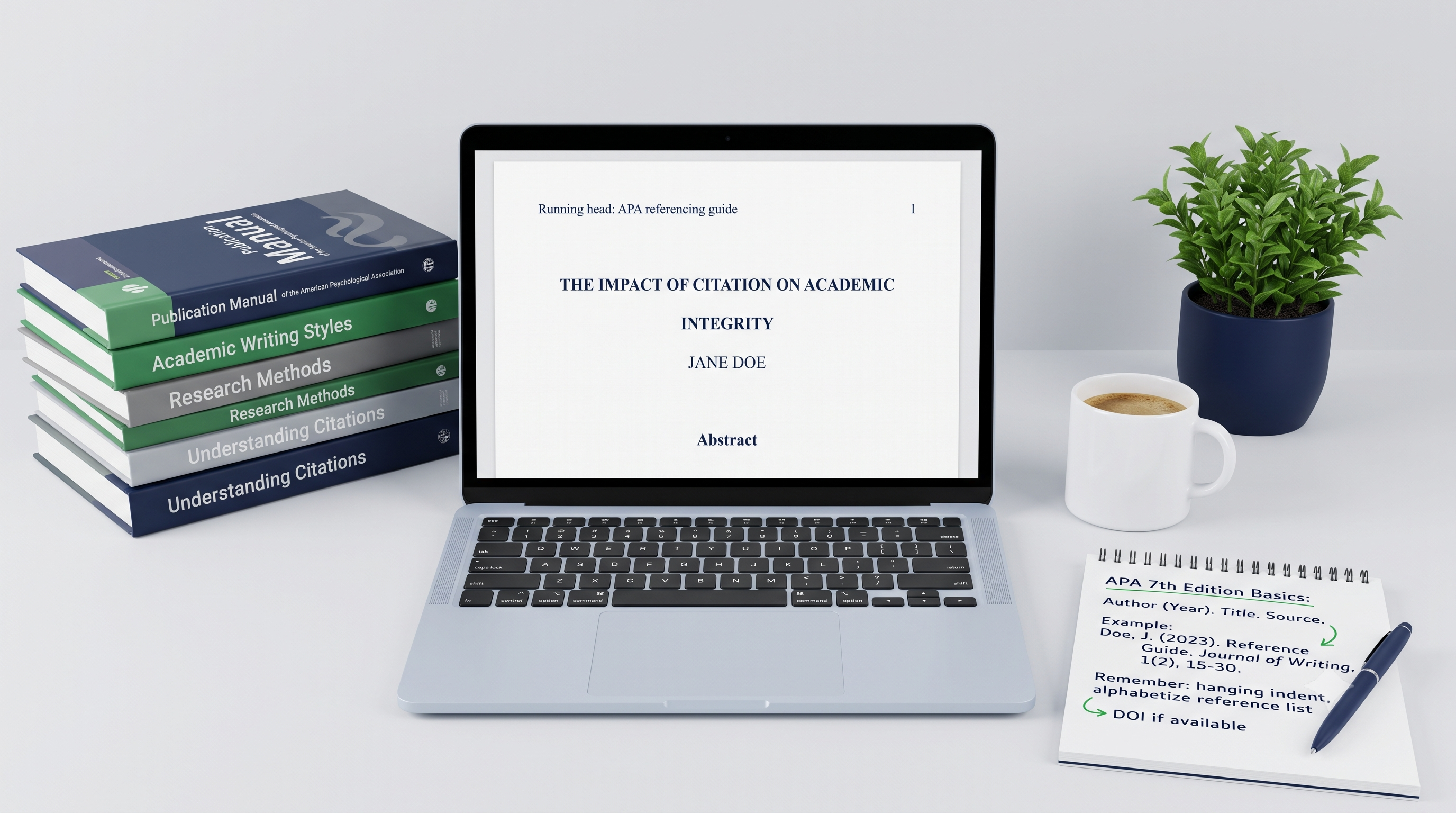
This complete APA referencing guide breaks down APA format, in-text citations, and reference list rules with clear examples for students. Whether you are writing an essay, research paper, or dissertation, you will learn exactly how to cite sources correctly.
Confusing citation rules cost students easy marks and risk accidental plagiarism. Use this APA style guide to reference every source with confidence and keep your academic writing clean and professional.
What Is APA Referencing?
APA referencing is a widely used citation style created by the American Psychological Association to help writers credit their sources in a consistent, transparent way. When you use this APA referencing guide, you are learning a system that tells your reader exactly where your ideas, data, and quotations come from. It is the standard citation format for psychology, education, nursing, business, and many social science subjects across universities in the USA and around the world.
At its core, APA referencing has two connected parts that always work together: the in-text citation that appears inside your writing, and the full reference entry that appears in your reference list at the end. Every in-text citation must match an entry in the reference list, and every reference list entry must be cited somewhere in your text. This pairing is what makes APA style trustworthy and easy for readers to follow.
APA uses what is called an author–date system. This means that whenever you refer to a source, you include the author's surname and the year of publication. This simple pattern makes it quick for a reader to see who created the information and how recent it is, which matters a great deal when you are evaluating scholarly sources and building a credible research paper.
Quick definition: APA referencing is an author–date citation system that credits your sources both inside your text (in-text citation) and in a full reference list at the end of your document. Doing it correctly supports academic integrity and helps you avoid plagiarism.
Why APA Referencing Matters for Students
Correct referencing is not just a formatting chore. It is a core academic skill that markers actively look for. Using APA style properly shows that you have read widely, engaged with credible sources, and respected the work of other researchers. It also protects you from accusations of plagiarism, which can carry serious penalties.
Here are the main reasons this APA citation guide is worth mastering early in your studies:
- Academic integrity: Referencing gives credit to original authors and shows your work is honest and well-researched.
- Plagiarism prevention: Clear citations separate your ideas from borrowed ideas, which keeps your work original.
- Credibility: A clean reference list signals that your arguments are backed by scholarly sources rather than guesswork.
- Higher marks: Many rubrics award marks specifically for accurate referencing and formatting.
- Reader trust: Readers can follow your citations to check facts and explore your sources further.
A Brief History of APA Style
APA style began in 1929, when a group of psychologists, anthropologists, and business managers set out to create a simple set of writing rules that would make scientific communication clearer and more consistent. What started as a short article grew, over the decades, into a full publication manual used across dozens of academic disciplines.
Since then, the American Psychological Association has released several editions, each one updating the rules to reflect new types of sources and changing writing habits. The move from print-heavy research to digital sources, for example, led to major updates in how websites, online journals, and DOIs are handled. Today the current standard is the 7th edition, released in 2019, which simplified many older rules that students used to find confusing.
Struggling With Your Reference List?
If APA formatting is eating into your study time, our academic experts can help you check citations, fix formatting, and polish your reference list before you submit.
APA 7th Edition Overview: What Changed
The APA 7th edition referencing guide introduced several student-friendly updates that make citing sources faster and less stressful. If you learned an older version of APA, or you are comparing guides online, it helps to know what is different now so you do not accidentally follow outdated rules.
Here are the most important APA 7 referencing changes to keep in mind:
| Element | Old Rule (6th) | New Rule (7th) |
|---|---|---|
| Running head | Required on every page for all papers | Only required for professional papers, not student papers |
| Number of authors | List up to 7 authors in the reference | List up to 20 authors before using an ellipsis |
| In-text citations (3+ authors) | List all authors the first time | Use the first author plus "et al." from the first citation |
| Publisher location | City and state required | Publisher location is no longer needed |
| DOI format | "doi:" prefix | Full URL format, e.g. https://doi.org/xxxxx |
| Website label | "Retrieved from" before URLs | URL listed directly, no "Retrieved from" unless a date is needed |
Watch out: Many free templates and older lecture notes still use APA 6th edition rules. Always confirm you are following APA 7th edition unless your instructor specifically asks for an earlier version.
APA Paper Format: General Rules
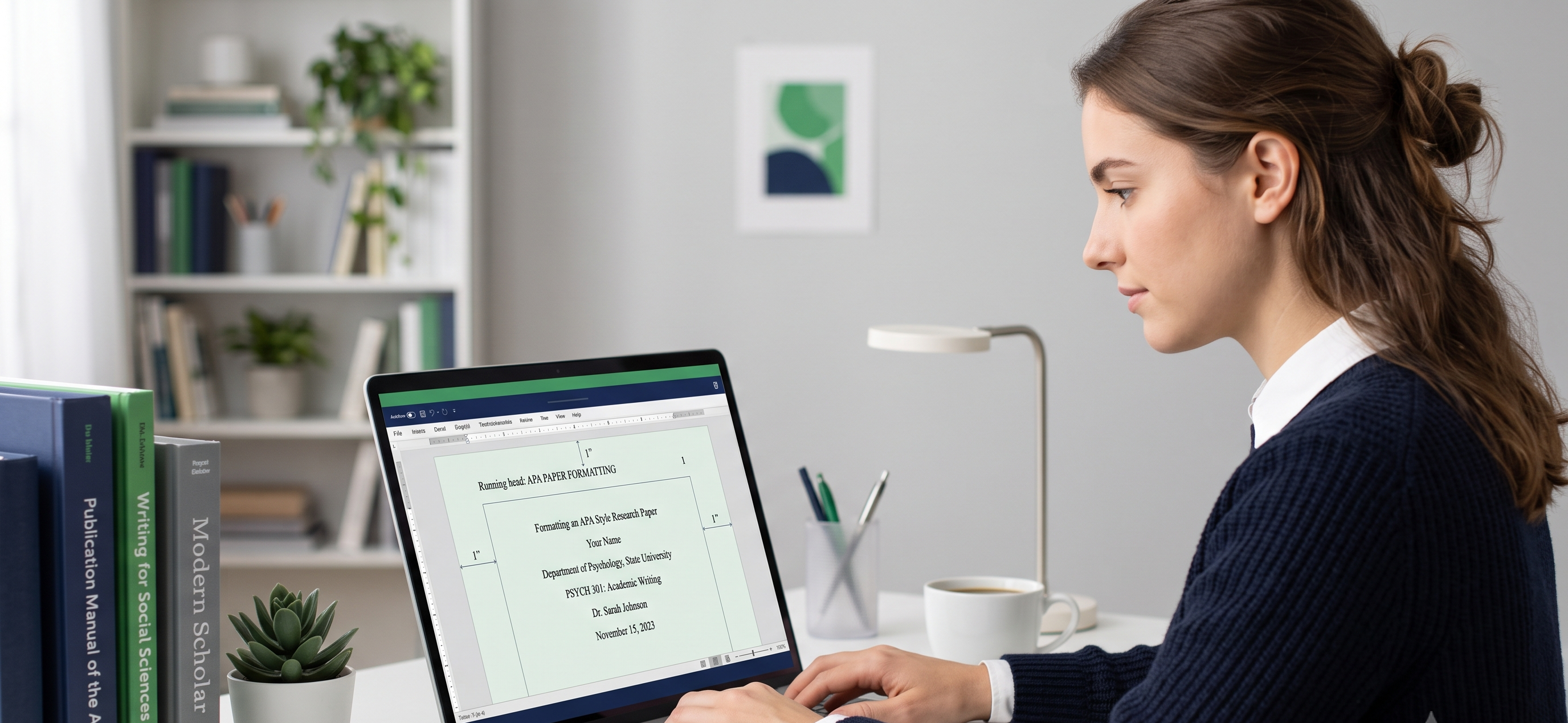
Before you worry about individual citations, it helps to get the overall APA paper format right. These formatting guidelines apply to most student papers and give your assignment a clean, professional look that markers expect.
Page and Layout Settings
- Margins: Use 1-inch (2.54 cm) margins on all four sides of the page.
- Font: A readable font such as 12-point Times New Roman, 11-point Calibri, or 11-point Arial is acceptable.
- Spacing: Double-space the entire document, including the reference list.
- Alignment: Left-align your text and leave the right edge ragged (not justified).
- Page numbers: Place a page number in the top-right corner of every page.
- Paragraph indent: Indent the first line of each paragraph by 0.5 inches.
Title Page
A student title page in APA 7 usually includes the title of your paper, your name, your institution, the course name and number, the instructor's name, and the due date. The title should be bold, centered, and positioned in the upper half of the page. Unlike professional papers, student papers generally do not need a running head.

APA In-Text Citations Explained
An APA in-text citation is a short note inside your writing that points the reader to the full reference at the end. Every time you quote, paraphrase, or use an idea from a source, you need one. Getting these right is the single most common referencing task you will do, so it is worth understanding the patterns clearly.
APA in-text citations come in two main forms: parenthetical and narrative.
Parenthetical Citations
In a parenthetical citation, the author and year sit together inside brackets at the end of the sentence. This is useful when the source itself is not the focus of your sentence.
Regular study routines can improve long-term memory retention (Smith, 2021).
Narrative Citations
In a narrative citation, the author's name appears as part of your sentence, with the year in brackets right after it. This works well when you want to highlight the researcher.
Smith (2021) found that regular study routines can improve long-term memory retention.
Direct Quotations
When you quote exact words, you must also include the page number (or paragraph number for sources without pages). Short quotes of fewer than 40 words go in quotation marks within your sentence.
According to Smith (2021), "consistent revision strengthens recall over time" (p. 45).
Quotations of 40 words or more are formatted as a block quote: start on a new line, indent the whole block 0.5 inches, and place the citation after the final punctuation without quotation marks.
Multiple Authors in In-Text Citations
The number of authors changes how you write the citation. Here is a quick reference table for APA in-text citation examples with different author counts.
| Authors | Parenthetical | Narrative |
|---|---|---|
| One author | (Smith, 2021) | Smith (2021) |
| Two authors | (Smith & Jones, 2021) | Smith and Jones (2021) |
| Three or more | (Smith et al., 2021) | Smith et al. (2021) |
| Group author | (World Health Organization, 2021) | The World Health Organization (2021) |
| No author | ("Title of Article," 2021) | The article "Title of Article" (2021) |
How to Create an APA Reference List
The APA reference list is the alphabetical list of all your sources at the end of your paper. It gives readers the full details they need to find each source themselves. A well-built reference list is one of the clearest signs of careful academic work, so follow these rules closely.
Reference List Formatting Rules
- Heading: Start a new page and title it "References," centered and bold at the top.
- Order: Arrange entries alphabetically by the first author's surname.
- Hanging indent: The first line of each entry is flush left, and all following lines are indented 0.5 inches.
- Spacing: Double-space the entire list with no extra spaces between entries.
- Capitalization: Use sentence case for article and book titles, capitalizing only the first word, the first word after a colon, and proper nouns.
- Italics: Italicize book titles, journal names, and volume numbers.
The Basic Reference Structure
Most APA references follow the same four-part pattern: Author, Date, Title, and Source. Once you understand this structure, citing almost any source becomes far more manageable.
Author, A. A. (Year). Title of the work. Source (Publisher, journal, or URL).
Memory tip: Ask yourself four questions for every source Who wrote it? When? What is it called? Where can I find it? That is Author, Date, Title, Source.
How to Cite a Book in APA
Books are one of the most common sources you will reference. The basic format lists the author, publication year, the italicized book title in sentence case, and the publisher. Remember that in APA 7, you no longer include the publisher's city or state.
Author, A. A. (Year). Title of book: Subtitle (Edition). Publisher. Kotler, P., & Keller, K. (2016). Marketing management (15th ed.). Pearson.
For an edited book chapter, you cite the chapter author first, then the editors and the book. For an e-book, the format is nearly identical to a print book, though you may add a DOI or URL if one is available.
How to Cite a Journal Article in APA
Journal articles are the backbone of most research papers, so knowing this format well is essential. An APA journal reference includes the author, year, article title in sentence case, the italicized journal name, the volume and issue, page range, and a DOI where one exists.
Author, A. A. (Year). Title of the article. Journal Name, Volume(Issue), pages. https://doi.org/xxxx Nguyen, T. (2020). Motivation and academic performance. Journal of Educational Psychology, 112(3), 455–470. https://doi.org/10.1037/edu0000399
About DOIs: A DOI (Digital Object Identifier) is a permanent link to a source. In APA 7, always present it as a full URL beginning with https://doi.org/ and never add the word "Retrieved from" before it.
How to Cite a Website in APA
Website citations trip up many students because the details are less standardized than books or journals. Still, the same Author–Date–Title–Source logic applies. You need the author or organization, the publication date, the page title in italics, the site name, and the URL.
Author, A. A. (Year, Month Day). Title of the page. Site Name. URL American Psychological Association. (2020, June 1). Publication manual basics. APA. https://www.apa.org/example
When a website has no clear author, move the title to the author position. When there is no date, use "n.d." (meaning "no date") in place of the year. If the content is likely to change over time, such as a live statistics page, include a retrieval date.
How to Cite Videos and YouTube in APA
Multimedia sources are increasingly common in assignments, and APA has clear rules for them. For a YouTube video, the person or channel that uploaded the video is treated as the author. Include the upload date, the italicized video title, the label [Video], the platform name, and the URL.
Uploader Name. (Year, Month Day). Title of video [Video]. YouTube. URL TED. (2019, April 10). How to learn anything faster [Video]. YouTube. https://www.youtube.com/example
The same general approach applies to films, TED talks, podcasts, and streaming media: identify who is responsible, when it was released, what it is called, and where it can be found, then add a bracketed description of the medium.
How to Cite AI Tools Responsibly in APA
As generative AI tools become more common in research, students often ask how to reference them. APA treats the output of an AI tool as something to cite transparently rather than hide. If your instructor permits AI use, you should acknowledge it clearly and follow your institution's academic integrity policy first and foremost.
In general, APA guidance suggests treating a large language model as the author's tool: name the company that created the model, the year, the model name in italics with a bracketed description, and the URL. You should also explain in your text how you used the tool.
Company. (Year). Model name (Version) [Large language model]. URL
Important: Always check your university's rules before using AI tools in graded work. Some courses prohibit them entirely, and undisclosed use can count as academic misconduct. When in doubt, ask your instructor and read our guide on how to avoid plagiarism.
Common APA Referencing Mistakes to Avoid
Even careful students lose marks to small, repeated errors. Knowing the most common APA referencing mistakes helps you catch them before you submit. Review your work against this list every time.
Mismatched citations
An in-text citation with no matching reference entry, or a reference with no in-text citation. Every source must appear in both places.
Wrong capitalization
Using title case instead of sentence case for article and book titles is one of the most frequent formatting slips.
Missing hanging indent
Forgetting the 0.5-inch hanging indent makes the reference list look messy and non-compliant.
Incorrect author order
Reference lists must be alphabetical by surname, not in the order sources appear in your paper.
Old DOI format
Using the outdated "doi:" prefix instead of the full https://doi.org/ URL required in APA 7.
Missing page numbers
Direct quotations must include a page or paragraph number, which students often forget to add.
APA Formatting Checklist
Use this quick APA formatting checklist as a final review before you hand in any assignment. Running through it takes only a few minutes and catches most easy-to-fix errors.
- Double-spacing is applied throughout, including the reference list.
- Margins are set to 1 inch on all sides.
- Every in-text citation has a matching reference entry.
- The reference list is alphabetical with a hanging indent.
- Titles use sentence case; journals and book titles are italicized.
- DOIs appear as full https://doi.org/ links.
- Page numbers are included for all direct quotations.
- The title page follows the student paper format.
- You are using APA 7th edition rules, not an older edition.
Want to go deeper on structure and style beyond referencing? Pair this guide with our Academic Writing Guide and compare styles using our Harvard Referencing Guide to see how the two differ.
APA vs Harvard Referencing: Quick Comparison
Students often mix up APA and Harvard because both use an author–date system. The key differences lie in punctuation, capitalization, and formatting details. This short comparison should help you tell them apart.
| Feature | APA | Harvard |
|---|---|---|
| System type | Author–date | Author–date |
| Common fields | Psychology, nursing, education, business | Business, humanities, sciences (varies by university) |
| Governing body | American Psychological Association | No single official authority; varies by institution |
| Reference list title | References | Reference List or Bibliography |
| Title capitalization | Sentence case | Often varies by institution |
Because Harvard rules can vary between universities, always check your course handbook. If you are unsure which style to use for a specific module, our team can review your brief and confirm the correct format for you.
When Should You Use APA Referencing?
You should use APA referencing whenever your course, department, or instructor specifies it as the required style. It is most common in the social sciences, but many programs across disciplines have adopted it because of how clear and consistent it is. If your assignment brief mentions "APA," "APA 7," or "American Psychological Association," this APA style guide is the one to follow.
If your brief does not specify a style, ask your instructor before you start writing. Switching referencing styles midway through a long paper is time-consuming and error-prone, so it pays to confirm early. For longer projects, our Research Guide can help you organize sources from the very beginning.
Frequently Asked Questions
What is APA referencing?
APA referencing is an author–date citation style created by the American Psychological Association. It credits sources through short in-text citations within your writing and full entries in a reference list at the end, helping you avoid plagiarism and support academic integrity.
How do you reference in APA style?
You reference in APA style by adding an in-text citation (author and year) wherever you use a source, then listing the full details of that source in an alphabetical reference list. Each in-text citation must match a full reference entry.
What is APA 7th edition?
APA 7th edition is the current version of the APA publication manual, released in 2019. It simplified several rules, such as removing publisher locations, updating DOI formatting, and separating student paper requirements from professional paper requirements.
How do you create an APA reference list?
Start a new page titled "References," list every source alphabetically by author surname, apply a 0.5-inch hanging indent, double-space throughout, and follow the Author–Date–Title–Source structure for each entry.
What is an APA in-text citation?
An APA in-text citation is a short reference within your text that includes the author's surname and the publication year, and a page number for direct quotes. It links your writing to the full entry in your reference list.
How do you cite a website in APA?
To cite a website in APA, list the author or organization, the date, the page title in italics, the site name, and the URL. If there is no author, move the title first; if there is no date, use "n.d."
How do you cite a book in APA?
List the author, publication year, the italicized book title in sentence case, the edition if relevant, and the publisher. In APA 7, you no longer include the publisher's city or state.
How do you cite a journal article in APA?
Include the author, year, article title, the italicized journal name, the volume and issue, the page range, and a DOI as a full https://doi.org/ link where one is available.
What are common APA referencing mistakes?
Common mistakes include mismatched in-text and reference entries, using title case instead of sentence case, missing hanging indents, incorrect alphabetical order, old DOI formatting, and missing page numbers for quotations.
What is the difference between APA and Harvard referencing?
Both use an author–date system, but APA is governed by the American Psychological Association with fixed rules, while Harvard varies between universities. They also differ in punctuation, capitalization, and reference list formatting details.
Need Help With APA Referencing?
From in-text citations to a fully formatted reference list, our academic experts can help you get every source right. Get clear, confidential support tailored to your assignment.
Get Your APA References Done Right
Don't lose easy marks to citation errors. Let EasyAssignments help you format, check, and perfect your APA referencing so you can submit with confidence.