How to Avoid Plagiarism: A Complete Guide for Students with Examples
Plagiarism is one of the fastest ways to lose marks, damage your academic record, or even fail a course and most students who commit it never meant to. Learning how to avoid plagiarism is a core research skill that protects your grades and your reputation.
This guide breaks down what plagiarism really is, the different types you need to watch for, and the exact paraphrasing, quoting, and citation habits that keep your assignments original and honest from first draft to final submission.
What Is Plagiarism? A Clear Definition for Students
Before you can learn how to avoid plagiarism, you need a precise understanding of what it is. Plagiarism means presenting someone else's words, ideas, data, or creative work as your own without proper credit. It doesn't matter whether you copied a full paragraph or borrowed a single unique idea if the source isn't acknowledged, it counts as plagiarism.
The plagiarism meaning most universities use is broad on purpose. It covers copying text, reusing images or figures, paraphrasing too closely, using a friend's assignment, and even recycling your own previously submitted work. In short, plagiarism is any failure to give credit where credit is due.
Academic institutions treat originality as a matter of trust. When you submit an assignment, you're making a promise that the analysis, argument, and writing are genuinely yours, supported by properly credited sources. Understanding that promise is the foundation of academic honesty and the first real step toward preventing plagiarism.
Why Academic Integrity Matters
Academic integrity is the set of values honesty, trust, fairness, respect, and responsibility that make education meaningful. When you avoid plagiarism, you're not just following rules; you're protecting the credibility of your own degree and the reputation of your institution.
There are practical reasons to take this seriously too. Plagiarism is treated as academic misconduct, and the consequences scale with the severity of the offence and the level of study.
- Grade penalties: A capped mark, a zero on the assignment, or a failed module.
- Formal records: A misconduct note that can appear in your academic file.
- Course-level consequences: Suspension or, in serious repeat cases, expulsion.
- Professional impact: Damage to references, scholarships, and future study or job applications.
Beyond penalties, academic integrity builds the research skills you'll rely on for your whole career. Learning to synthesize sources, credit others fairly, and express ideas in your own voice is exactly what employers and graduate programs value. If you ever feel stuck balancing originality with tight deadlines, our academic writing help team can guide you toward doing it the right way.

Different Types of Plagiarism Explained
One reason students plagiarize by accident is that they only recognize the most obvious form copy and paste. In reality, there are several types of plagiarism, and knowing each one helps you spot risks in your own work before a plagiarism checker does.
| Type of Plagiarism | What It Means | Common Example |
|---|---|---|
| Direct plagiarism | Copying a source word-for-word with no quotation marks or citation. | Pasting a paragraph from a website into your essay. |
| Mosaic (patchwork) | Mixing copied phrases with your own words without full credit. | Swapping a few words in a sentence but keeping the structure. |
| Paraphrasing plagiarism | Rewording a source too closely and not citing it. | Changing synonyms while keeping the same idea and order. |
| Self-plagiarism | Reusing your own earlier work without permission or citation. | Submitting last semester's essay for a new module. |
| Accidental plagiarism | Forgetting a citation or misquoting a source by mistake. | Losing track of which notes were quotes vs. your own ideas. |
| Source-based plagiarism | Citing incorrect, fake, or secondary sources as originals. | Citing a study you never read, found only in another paper. |
Notice how many of these are subtle. Paraphrasing plagiarism and mosaic plagiarism catch out even hardworking students because the intent to cheat isn't there the citation habit simply wasn't. That's why prevention is about process, not just honesty.
Real Examples of Plagiarism for Students
Definitions are useful, but plagiarism examples make the rules concrete. Below is a short original source sentence followed by how different students might handle it correctly and incorrectly.
ORIGINAL SOURCE:
"Regular sleep improves memory consolidation and boosts
academic performance in university students."
Incorrect: Direct plagiarism
The student writes: Regular sleep improves memory consolidation and boosts academic performance in university students. copied word-for-word, no quotation marks, no citation. This is direct plagiarism.
Incorrect: Paraphrasing plagiarism
The student writes: Consistent sleep enhances memory consolidation and improves academic results in college students. the words are swapped, but the sentence structure and idea are identical, with no citation. This is still plagiarism.
Correct: Genuine paraphrase with citation
The student writes: Getting enough sleep on a regular schedule helps students retain what they study and perform better in exams (Smith, 2022). the idea is expressed in a new structure and credited to its source. This is original, ethical writing.
Intentional vs Unintentional Plagiarism
It helps to separate plagiarism into two mindsets, because the solutions differ.
Intentional plagiarism is deliberate buying an essay, copying a classmate, or knowingly pasting text without credit. This is clear academic misconduct and is almost always penalized heavily when detected.
Unintentional plagiarism happens by accident: sloppy note-taking, forgetting a citation, paraphrasing too closely, or misunderstanding referencing rules. Universities still treat it as plagiarism, because the outcome uncredited work is the same. The good news is that unintentional plagiarism is almost entirely preventable with better research and writing habits.
Running out of time on your assignment?
Deadline pressure is when accidental plagiarism happens most. Get original, properly referenced work from real academic experts instead of risking your grade.
How to Avoid Plagiarism: 8 Practical Steps
Here is the core of how to avoid plagiarism in assignments, essays, and research papers. Treat these as a repeatable workflow you use for every piece of academic writing.
1. Start with strong note-taking
Most accidental plagiarism begins at the research stage. As you read, clearly separate three things in your notes: direct quotes (in quotation marks), your paraphrases, and your own ideas. Record the author, year, and page number every time so you never have to guess later.
2. Understand the source before you write
You can only paraphrase well when you actually understand the idea. Read the passage, close the source, and explain it out loud in your own words. Then write from your understanding not by staring at the original sentence and swapping words.
3. Paraphrase properly, not superficially
A real paraphrase changes both the vocabulary and the sentence structure while keeping the meaning. Even a perfect paraphrase still needs a citation, because the idea belongs to someone else.
4. Use quotations for exact wording
When the original phrasing matters a definition, a legal line, a memorable statement quote it directly inside quotation marks and cite it. Keep quotations short and use them sparingly; your assignment should be mostly your own analysis.
5. Cite every source, every time
In-text citations plus a full reference list are your strongest protection. If an idea, statistic, or fact isn't common knowledge and didn't originate in your own head, it needs a citation.
6. Build your reference list as you go
Don't leave referencing until the end. Add each source to your bibliography the moment you use it. Citation management tools like Zotero or Mendeley can automate this and reduce formatting errors.
7. Don't reuse your own past work
Reusing a previous essay is self-plagiarism unless your instructor allows it and you cite yourself. When in doubt, ask before recycling any content.
8. Run a plagiarism checker before submitting
A plagiarism checker like Turnitin is your final safety net, not your first line of defense. Use it to catch missed citations and accidental overlaps then fix them before you hand the work in.

How to Paraphrase Without Plagiarizing
Paraphrasing is the single most valuable skill for avoiding plagiarism, and also the one students get wrong most often. Follow this four-step method:
- Read and understand the full idea, not just one sentence.
- Look away from the source and write the idea in your own words.
- Compare your version to the original if phrases or structure match, rewrite.
- Cite the source even though the words are now yours.
How to Quote Sources Properly
Quoting is legitimate and useful as long as you do it correctly. A proper quotation has three parts: quotation marks around the exact words, an accurate reproduction of the original, and a citation with the location (usually a page number).
Use quotations when the exact wording carries meaning that a paraphrase would lose. Avoid stacking long block quotes to fill word count; markers reward your own critical analysis far more than another author's sentences.
How to Cite Sources Correctly (APA & Harvard Overview)
Citations are the mechanism that turns borrowed ideas into ethical writing. Two of the most common styles for students are APA referencing and Harvard referencing. Always confirm which style your department requires before you begin.
| Element | APA Style (7th ed.) | Harvard Style |
|---|---|---|
| In-text citation | (Smith, 2022, p. 14) | (Smith 2022, p. 14) |
| Author name | Surname, Initials. | Surname, Initials. |
| Reference list title | References | Reference List |
| Common fields | MLA, Chicago also widely used | Popular in UK & Australia |
Other styles you may meet include MLA style (common in the humanities) and Chicago style (history and some social sciences). The principle is identical across all of them: every borrowed idea gets an in-text citation and a matching entry in your reference list or bibliography. For step-by-step formatting, see our APA Referencing Guide and Harvard Referencing Guide.
Plagiarism vs Paraphrasing vs Quoting
Students often blur these three, so here's a clear comparison of what's happening in each and whether it's acceptable.
| Approach | What You Do | Citation Needed? | Acceptable? |
|---|---|---|---|
| Plagiarism | Use words/ideas without credit | Missing | No misconduct |
| Paraphrasing | Restate an idea in your own words | Yes | Yes, when cited |
| Quoting | Reproduce exact words in quotes | Yes | Yes, used sparingly |
Best Plagiarism Checkers for Students
A plagiarism checker compares your text against published sources and databases, then reports a similarity score. It's a diagnostic tool it flags overlaps so you can fix missed citations, but it doesn't judge intent. Popular options include:
- Turnitin the standard at most universities; often built into your submission portal.
- Grammarly includes a plagiarism scan alongside grammar checking.
- Quetext and Scribbr useful for self-checks before submission.
How Much Similarity Is Acceptable?
There's no universal magic number. Many institutions treat under 15–20% as generally acceptable, but the context matters far more than the percentage. Ten percent of copied uncited text is a serious problem; twenty percent made up of correctly quoted and referenced material may be perfectly fine. Always check your own institution's policy.
AI Writing and Plagiarism: What Students Should Know
AI writing tools have changed the academic landscape, and students frequently ask whether AI-generated content counts as plagiarism. The answer depends on your institution's rules, but a few principles are becoming standard.
Submitting AI-generated text as your own original work is treated as academic dishonesty at most universities, similar to buying an essay. Even when the words are technically "new," you're presenting work you didn't produce as your own which breaks the same trust that plagiarism does. Many institutions now require disclosure of any AI assistance.
Used ethically and within your institution's policy, AI tools can help you brainstorm, outline, or understand a concept. The line is simple: the analysis, argument, and final writing must be genuinely yours, and you must follow your university's specific guidance on AI use.
Common Plagiarism Mistakes to Avoid
Even careful students slip up in predictable ways. Watch for these:
Synonym swapping
Replacing a few words while keeping the original structure. This is paraphrasing plagiarism.
Forgetting page numbers
Direct quotes need a location. Missing page numbers weaken your citation and can flag as misconduct.
Citing what you didn't read
Copying a citation from another paper without reading the original source is source-based plagiarism.
Reusing old essays
Submitting your previous work again is self-plagiarism unless permitted and cited.
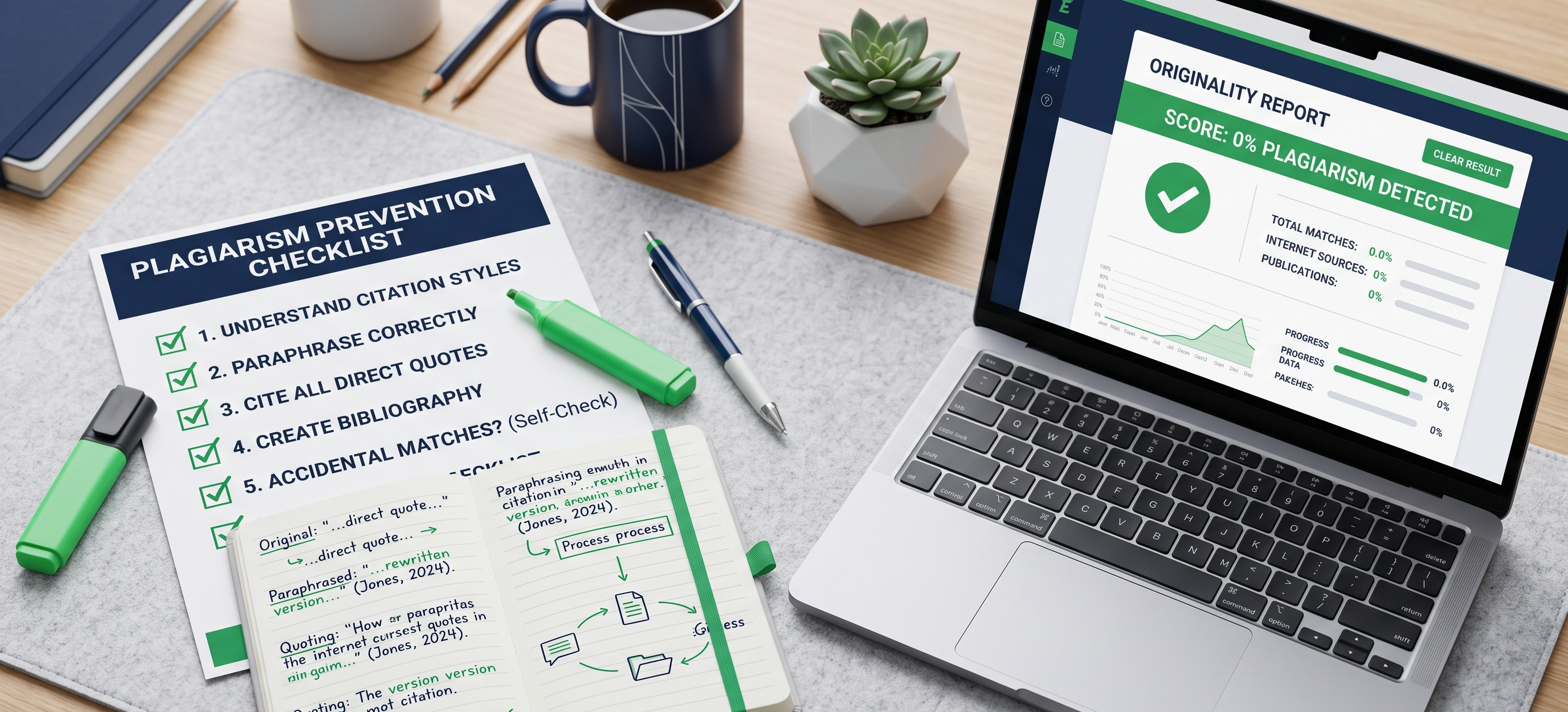
Plagiarism Prevention Checklist
Before you submit any assignment, run through this quick plagiarism checklist. If you can tick every box, your work is on solid ground.
- Every quote is in quotation marks with a citation and page number.
- Every paraphrase is genuinely in my own words and cited.
- Every borrowed idea, statistic, or figure has an in-text citation.
- My reference list matches every in-text citation exactly.
- I used the correct referencing style (APA, Harvard, MLA, or Chicago).
- I haven't reused past work without permission.
- I followed my institution's rules on AI assistance.
- I ran a plagiarism checker and fixed any real overlaps.
Frequently Asked Questions About Plagiarism
What is plagiarism?
Plagiarism is presenting someone else's words, ideas, data, or work as your own without proper credit. It includes copying, close paraphrasing without citation, reusing your own past work, and using uncredited sources.
How can students avoid plagiarism?
Take careful notes that separate quotes from your own ideas, paraphrase properly in your own words and structure, cite every source with in-text citations and a reference list, and run a plagiarism checker before submitting.
Why is plagiarism considered academic misconduct?
Because it breaks the trust at the heart of education. Submitting uncredited work misrepresents your abilities, is unfair to honest students, and undermines the credibility of your degree and institution.
What are the different types of plagiarism?
The main types are direct plagiarism, mosaic (patchwork) plagiarism, close paraphrasing, self-plagiarism, accidental plagiarism, and source-based plagiarism.
How do you paraphrase correctly?
Read and understand the idea, look away from the source, write it in your own words and sentence structure, compare it to the original to make sure it's not too close, and always add a citation.
What is self-plagiarism?
Self-plagiarism is reusing your own previously submitted work in whole or in part for a new assignment without permission or citation. Universities generally treat it as misconduct.
What happens if you plagiarize in university?
Consequences range from a reduced or zero grade to a formal misconduct record, module failure, suspension, or in serious repeated cases, expulsion. The severity depends on intent, extent, and your institution's policy.
Can AI-generated content be considered plagiarism?
At most universities, submitting AI-generated text as your own original work is treated as academic dishonesty. Always follow your institution's specific policy and disclose any AI assistance you use.
How much similarity is acceptable on a plagiarism checker?
There's no universal figure, but many institutions consider under 15–20% acceptable. Context matters more than the number correctly quoted and cited material can be fine even at higher scores. Check your own institution's rules.
Submit Original, Confident Work Every Time
Whether you need a properly referenced essay, coursework, or a full dissertation, EasyAssignments helps you meet deadlines without ever risking plagiarism. Every order is written from scratch and quality-checked.