
Time Management for Students: 25 Proven Tips to Study Smarter and Stay Organized
Between lectures, assignments, part-time jobs, and a social life, it can feel like there is never enough time in the day. The good news? Time management for students is a skill you can learn and this guide shows you exactly how.
Discover practical techniques like the Pomodoro Method and the Eisenhower Matrix, ready-to-use study schedules, and a simple checklist to help you beat procrastination and hit every deadline with confidence.
If you have ever pulled an all-nighter to finish an essay, forgotten a deadline until the last minute, or watched your to-do list grow faster than you can cross things off, you are not alone. Most students struggle with time - not because they are lazy, but because they were never taught how to manage it. Time management for students is one of the most valuable skills you can build, and it pays off in better grades, lower stress, and more free time.
In this complete guide, we break down what time management really means, why it matters so much in college and university, and 25 practical tips you can start using today. You will also get proven frameworks, a daily study schedule example, a weekly planner template, and a checklist you can follow every week. Let's get started.
Quick takeaway: Good time management is not about doing more it is about doing the right things at the right time. Small, consistent habits beat last-minute cramming every single time.
What Is Time Management for Students?
Time management for students is the process of planning, organizing, and controlling how you spend your hours across studying, classes, assignments, work, and personal life. It means deciding what matters most, scheduling your tasks intentionally, and following through instead of letting deadlines control you.
At its core, student time management combines three things: prioritization (knowing what to do first), planning (deciding when to do it), and self-discipline (actually doing it). When these work together, you spend less time stressed and more time making real progress.
Think of your time as a budget. Just as you would not spend your entire month's money in one day, you should not spend all your energy on low-value tasks while important assignments pile up. Effective time management helps you "spend" your hours where they count most.
Why Time Management Matters for Students
Strong time management skills are directly tied to academic success. When you manage your time well, you are able to prepare properly for exams, submit assignments before deadlines, and still protect time for rest and relationships. Here is why it is so important during your studies:
- Better grades: Planned, consistent study beats last-minute cramming and leads to deeper understanding.
- Lower stress: When you know what's coming and have a plan, deadlines feel manageable instead of terrifying.
- More free time: Ironically, being organized gives you more guilt-free downtime, not less.
- Stronger habits: The discipline you build now carries directly into your career and adult life.
- Better mental health: Reduced overwhelm and better sleep support your overall wellbeing.
Whether you are focused on time management in college, time management in university, or juggling online learning, the payoff is the same: you gain control over your schedule instead of constantly reacting to it.
Benefits of Good Time Management
Let's look more closely at the tangible benefits you can expect once effective time management becomes a habit. These benefits compound over a semester and even more over an entire degree.
| Benefit | What It Means for You |
|---|---|
| Higher productivity | You complete more meaningful work in fewer hours by focusing on priorities. |
| Reduced procrastination | Clear plans and small steps make it easier to start and keep going. |
| Improved focus | Scheduled, distraction-free blocks build deeper concentration. |
| Consistent progress | Steady daily effort prevents last-minute panic before deadlines. |
| Work-life balance | You protect time for family, friends, hobbies, and rest. |
| Career readiness | Employers value the organization and reliability you develop. |

Common Time Management Mistakes Students Make
Before we get to the tips, it helps to know what not to do. Most students unknowingly sabotage their own schedules with a few common mistakes. See if any of these sound familiar:
- Underestimating how long tasks take: That "quick" essay ends up eating your whole weekend.
- Multitasking: Switching between tasks feels productive but actually slows you down and increases errors.
- No clear priorities: Treating every task as equally urgent leads to burnout and missed deadlines.
- Ignoring a planner: Keeping everything "in your head" almost guarantees something slips through.
- Perfectionism: Spending hours polishing one paragraph while other work sits untouched.
- Not scheduling breaks: Skipping rest leads to fatigue, which destroys focus and productivity.
Watch out: The biggest time trap of all is "just checking your phone." A quick scroll can quietly steal 30–60 minutes of prime study time. Keep your phone in another room during focused study blocks.
25 Proven Time Management Tips for Students
Here are 25 practical time management techniques and strategies you can start applying right away. You don't need to do all of them at once pick three or four that resonate, build them into habits, then add more.
Planning & Organization
- Use one central planner. Whether digital or paper, keep every deadline, class, and task in a single place you check daily.
- Do a weekly planning session. Spend 20 minutes every Sunday mapping out your week before it starts.
- Break big tasks into small steps. "Write dissertation" is overwhelming; "outline chapter 1" is doable.
- Set SMART goals. Make goals Specific, Measurable, Achievable, Relevant, and Time-bound.
- Prioritize with a system. Use the Eisenhower Matrix (explained below) to sort urgent from important.
- Time-block your calendar. Assign specific hours to specific tasks so nothing is left to chance.
Focus & Productivity
- Use the Pomodoro Technique. Study for 25 minutes, then take a 5-minute break to stay fresh.
- Eliminate distractions. Silence notifications, use website blockers, and study in a quiet space.
- Tackle your hardest task first. Do your most demanding work when your energy is highest.
- Follow the two-minute rule. If something takes under two minutes, do it immediately.
- Batch similar tasks. Group emails, reading, or admin tasks together to reduce mental switching.
- Set a timer for everything. Deadlines even self-imposed ones create healthy urgency.
- Study in focused blocks. Two or three deep 50-minute sessions beat a scattered, distracted afternoon.
Habits & Discipline
- Build a consistent routine. Study at the same times daily so it becomes automatic.
- Start your day early. Mornings often offer the fewest distractions and the most willpower.
- Prepare the night before. Lay out materials and set tomorrow's top three tasks.
- Reward yourself. Attach small rewards to completed tasks to stay motivated.
- Learn to say no. Protect your study time by declining commitments that don't serve your goals.
- Track your time. For one week, note where your hours actually go you'll be surprised.
Wellbeing & Balance
- Schedule breaks and rest. Downtime isn't wasted time; it's how your brain recovers and retains information.
- Get enough sleep. Seven to nine hours dramatically improves focus, memory, and mood.
- Exercise regularly. Even a short walk boosts energy and reduces stress.
- Avoid burnout. Spread work across the week instead of cramming everything into one day.
- Review and adjust weekly. Reflect on what worked, then tweak your plan for next week.
- Ask for help when needed. Reach out to tutors, classmates, or professional assignment help when you're stuck.
Running Out of Time on an Assignment?
Even with perfect planning, some weeks are just impossible. When deadlines collide, our subject experts can help you stay on track with high-quality, original work delivered on time.
The Pomodoro Technique Explained
The Pomodoro Technique is one of the most popular time management methods for students because it is simple and effective. It works by breaking your study into short, focused intervals separated by breaks, which keeps your concentration sharp and prevents burnout.
Here's how to do it:
- Choose one task to focus on.
- Set a timer for 25 minutes and work with full focus no distractions.
- When the timer rings, take a 5-minute break.
- Repeat this cycle. After four "pomodoros," take a longer 15–30 minute break.
The magic is in the structure: 25 minutes feels achievable even when you're not motivated, and the regular breaks keep your mind fresh. It's ideal for reading, problem sets, essay writing, and exam revision.
Pro tip: If 25 minutes feels too short for deep work like coding or essay writing, try a "long Pomodoro" of 50 minutes of work followed by a 10-minute break. Find the rhythm that fits your brain.
The Eisenhower Matrix for Students
When everything feels urgent, the Eisenhower Matrix helps you decide what actually deserves your attention. It sorts tasks into four boxes based on two questions: Is it urgent? Is it important?
| Quadrant | Description | Action |
|---|---|---|
| Urgent + Important | Assignment due tomorrow, exam this week | Do it now |
| Important + Not Urgent | Long-term projects, revision, skill-building | Schedule it |
| Urgent + Not Important | Some emails, minor requests, interruptions | Delegate or minimize |
| Not Urgent + Not Important | Endless scrolling, time-wasting apps | Eliminate it |
Most students spend far too long in the "urgent but not important" and "neither" quadrants. The goal is to spend more time in the "important but not urgent" box that's where real academic progress happens before things become last-minute emergencies.
How to Set SMART Goals as a Student
Vague goals like "study more" rarely work because they give your brain nothing concrete to act on. SMART goals fix this by making your targets clear and trackable.
Specific
"Complete 20 practice problems for calculus" beats "do some math."
Measurable
Define how you'll know it's done pages read, questions solved, words written.
Achievable
Set targets that stretch you but remain realistic for your schedule.
Relevant
Make sure each goal supports your bigger academic priorities.
Time-bound
Attach a deadline "by Friday 5 PM" to create momentum.
Example
"Write and edit a 1,000-word essay draft by Thursday evening."
Daily Study Schedule Example
Wondering what good academic time management actually looks like in practice? Here's a realistic daily study schedule for a college student with morning classes. Adapt it to your own timetable, energy levels, and commitments.
| Time | Activity |
|---|---|
| 7:00 – 7:45 AM | Wake up, breakfast, review top 3 tasks for the day |
| 8:00 – 11:00 AM | Classes / lectures |
| 11:00 – 11:30 AM | Break + review lecture notes while fresh |
| 11:30 AM – 1:00 PM | Deep study block (hardest subject, Pomodoro method) |
| 1:00 – 2:00 PM | Lunch + rest |
| 2:00 – 4:00 PM | Assignment work / group project |
| 4:00 – 5:00 PM | Exercise or walk |
| 5:00 – 6:30 PM | Reading + revision (lighter tasks) |
| 6:30 – 8:00 PM | Dinner + free time |
| 8:00 – 9:00 PM | Review, plan tomorrow, prep materials |
| 9:00 – 10:30 PM | Relax, wind down, prepare for sleep |
Notice how this schedule protects time for classes, deep work, exercise, and rest. Balance is what makes a schedule sustainable over a full semester rather than for just a few intense days.
Weekly Study Planner Template
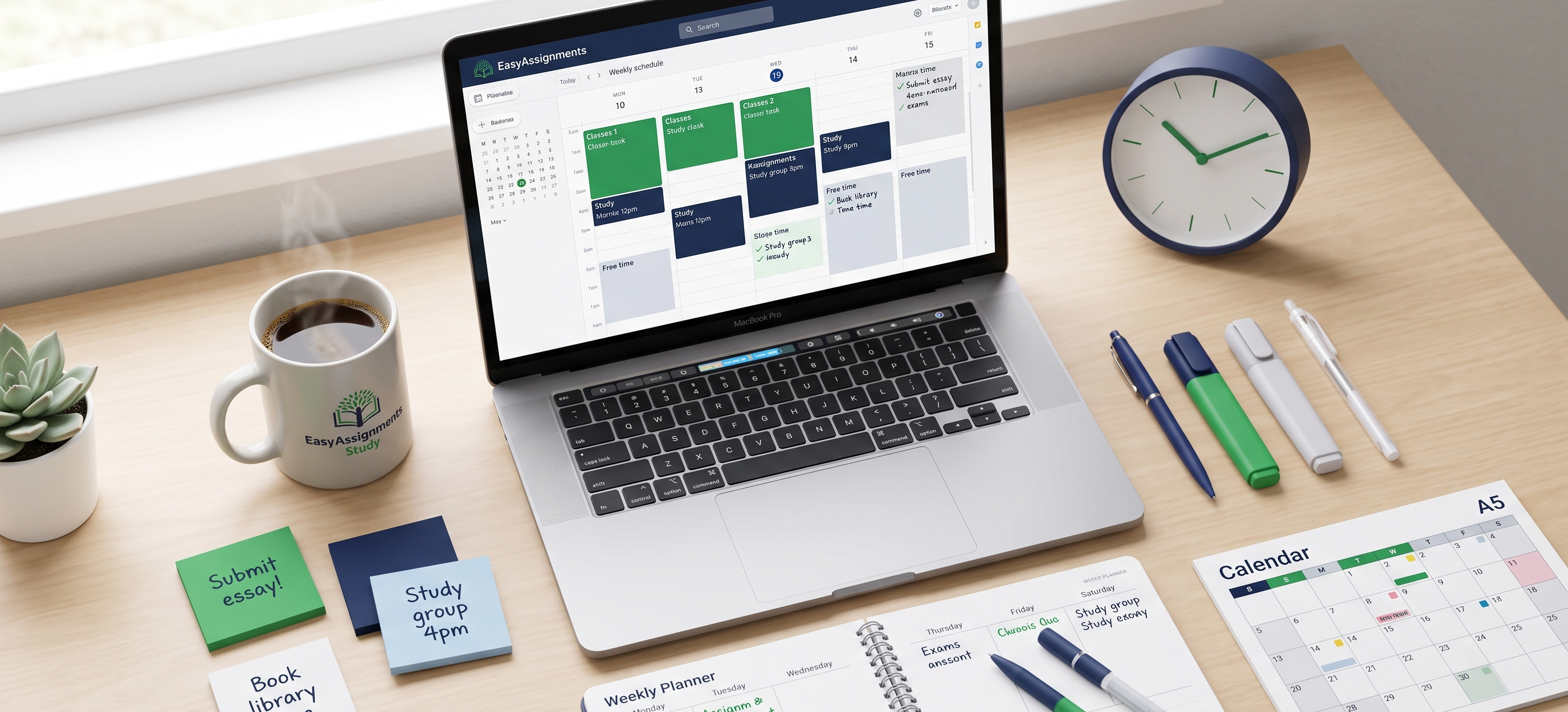
A weekly planner gives you a bird's-eye view of your commitments so nothing sneaks up on you. Here's a simple template structure you can recreate in a notebook, spreadsheet, or digital planner app.
| Day | Top Priority | Study Focus | Deadlines |
|---|---|---|---|
| Monday | Start essay outline | Literature reading | - |
| Tuesday | Math problem set | Calculus practice | Lab report due |
| Wednesday | Essay draft | Writing + editing | - |
| Thursday | Group project | Presentation prep | Essay draft due |
| Friday | Exam revision | Flashcards + practice tests | - |
| Weekend | Catch up + plan | Light review, rest | Plan next week |
Best Apps for Student Productivity
The right tools can make student time management much easier. While no app will study for you, these categories of tools can help you stay organized and focused:
- Calendar apps (Google Calendar, Apple Calendar) for scheduling classes and time-blocking.
- Task managers (Todoist, Microsoft To Do, Notion) for tracking assignments and deadlines.
- Focus timers (Forest, Pomofocus) for running Pomodoro sessions and blocking distractions.
- Note-taking apps (Notion, Evernote, OneNote) for organizing lecture notes and research.
- Website blockers (Freedom, Cold Turkey) for staying off distracting sites during study time.
Keep it simple: Don't fall into the trap of spending hours "setting up the perfect system." Pick one calendar and one task app, and start using them today. Tools only help if you actually use them consistently.
How to Beat Procrastination as a Student
Procrastination is the number one enemy of good time management. The trick is understanding that procrastination is usually driven by emotion a task feels boring, difficult, or overwhelming rather than laziness. Here's how to overcome it:
- Use the two-minute start. Commit to working for just two minutes. Starting is the hardest part, and momentum usually carries you forward.
- Shrink the task. Break intimidating work into the smallest possible first step.
- Remove friction. Have your materials ready and your phone out of reach before you sit down.
- Use accountability. Study with a friend or tell someone your goal to add gentle pressure.
- Forgive yourself. Research shows that self-compassion after procrastinating actually reduces future procrastination.
How to Balance Study, Work, and Personal Life
Many students juggle part-time jobs, family responsibilities, and social lives alongside their studies. Balancing everything is challenging, but achievable with intentional planning.
- Map fixed commitments first. Block out classes and work shifts, then schedule study around them.
- Protect non-negotiable study blocks. Treat key study times as seriously as a work shift.
- Use small pockets of time. Review flashcards on your commute or between shifts.
- Communicate with employers. Ask for lighter shifts during exam weeks when possible.
- Don't neglect rest. Overloading yourself leads to burnout, which costs you far more time in the long run.
If you're balancing work and study and find yourself overwhelmed by a heavy coursework load, professional homework help can take some pressure off during your busiest weeks.
Time Management for Exam Preparation
Exams demand a special kind of time management. Cramming rarely works because your brain needs time to consolidate information. Instead, use a countdown timeline that spreads revision over several weeks:
- 4 weeks out: Gather all materials, create a revision timetable, and identify weak areas.
- 3 weeks out: Begin active revision practice questions, flashcards, and summaries.
- 2 weeks out: Focus on your weakest topics and start timed practice papers.
- 1 week out: Review, do full mock exams, and consolidate notes.
- Day before: Light review only, then rest well and sleep properly.
Spacing your revision like this known as spaced repetition is scientifically proven to improve long-term memory far more than last-minute cramming. For more strategies, check out our exam help resources.
Your Weekly Time Management Checklist
Use this simple checklist every week to stay on top of your studies and keep your time management habits sharp:
- Review all upcoming deadlines and add them to your planner
- Set your top 3 priorities for the week
- Time-block study sessions into your calendar
- Break large assignments into smaller tasks
- Schedule breaks, exercise, and rest
- Identify your hardest subject and plan extra time for it
- Prepare materials the night before each study day
- Reflect on last week what worked, what didn't
- Adjust your plan based on that reflection
Remember: Time management is a skill, not a personality trait. If you struggle at first, that's completely normal. Keep refining your system, and it will get easier every week.
How Successful Students Manage Their Time
The most successful students aren't necessarily the smartest they're often just the most consistent. They plan ahead, protect their focus, start assignments early, and know when to ask for help. They treat their studies like a professional treats their job: with structure, discipline, and respect for deadlines.
They also understand their own limits. When workloads become unmanageable, they don't suffer in silence or sacrifice their health they reach out for support. That's not a weakness; it's smart resource management. Whether that means visiting your professor's office hours, forming a study group, or using an essay writing help service during a crunch, knowing when to get help is itself a time management skill.
Related Study Guides
Want to keep improving your academic skills? Explore these related resources:
- Academic Writing Guide sharpen your essay and report writing
- APA Referencing Guide cite sources correctly and save time
- Harvard Referencing Guide master Harvard-style citations
- How to Avoid Plagiarism keep your work original and safe
Frequently Asked Questions
What is time management for students?
Time management for students is the practice of planning, prioritizing, and organizing how you spend your time across studying, classes, assignments, work, and personal life. It helps you meet deadlines, reduce stress, and study more effectively.
Why is time management important for students?
Time management is important because it leads to better grades, lower stress, and more free time. It helps you prepare properly for exams, submit assignments on time, and build discipline that carries into your career.
How can students improve their time management?
Students can improve time management by using a single planner, setting SMART goals, prioritizing tasks with the Eisenhower Matrix, studying in focused Pomodoro blocks, eliminating distractions, and reviewing their plan weekly.
What are the best time management techniques for students?
Some of the best time management techniques include the Pomodoro Technique, the Eisenhower Matrix, time-blocking, SMART goal setting, and breaking large tasks into smaller steps. The best method is the one you'll actually stick to consistently.
How many hours should students study each day?
This varies by course and level, but a common guideline is 2–3 hours of focused study per hour of class time each week. Quality and consistency matter more than raw hours two focused hours often beat five distracted ones.
How can students avoid procrastination?
To avoid procrastination, use the two-minute rule to start, break tasks into small steps, remove distractions like your phone, study with an accountability partner, and practice self-compassion when you slip up.
Which time management method is best for students?
There's no single best method for everyone. The Pomodoro Technique works well for focus, the Eisenhower Matrix helps with prioritization, and time-blocking is great for planning. Experiment and combine methods to find what suits your study style.
How do I balance work and study as a student?
Balance work and study by scheduling fixed commitments first, protecting dedicated study blocks, using small pockets of time for review, communicating with your employer during busy periods, and getting professional help when your workload peaks.
Take Control of Your Studies Today
Great time management gives you better grades and more freedom but even the most organized students need backup sometimes. When deadlines pile up, EasyAssignments is here to help you deliver quality work on time, every time.