
Harvard Referencing Guide: Format, Examples, and Citation Rules
This complete Harvard referencing guide explains the format, in-text citations, and reference list rules you need to cite sources correctly and protect your academic integrity.
Whether you are writing your first essay or polishing a dissertation, referencing errors cost easy marks. Learn the Harvard citation format the right way, with clear examples for books, journals, websites, and more.
If you have ever lost marks on an assignment for a missing citation or a badly formatted reference, you already know how frustrating referencing can feel. This Harvard referencing guide breaks the whole system down into plain, practical steps so you can cite any source with confidence. We cover the Harvard referencing format, in-text citations, the reference list, and dozens of real examples for books, journal articles, websites, and reports.
Harvard referencing is one of the most widely used citation styles in universities across the USA, UK, Australia, and much of the world. Once you understand the underlying logic, the same rules apply to nearly every source type. Let's start with the basics and build up to the details.
Quick summary: Harvard referencing is an author–date system. You place a short in-text citation (author, year) next to borrowed ideas, and a full reference in an alphabetical reference list at the end of your work. That's the core of it everything else is formatting detail.
What Is Harvard Referencing?
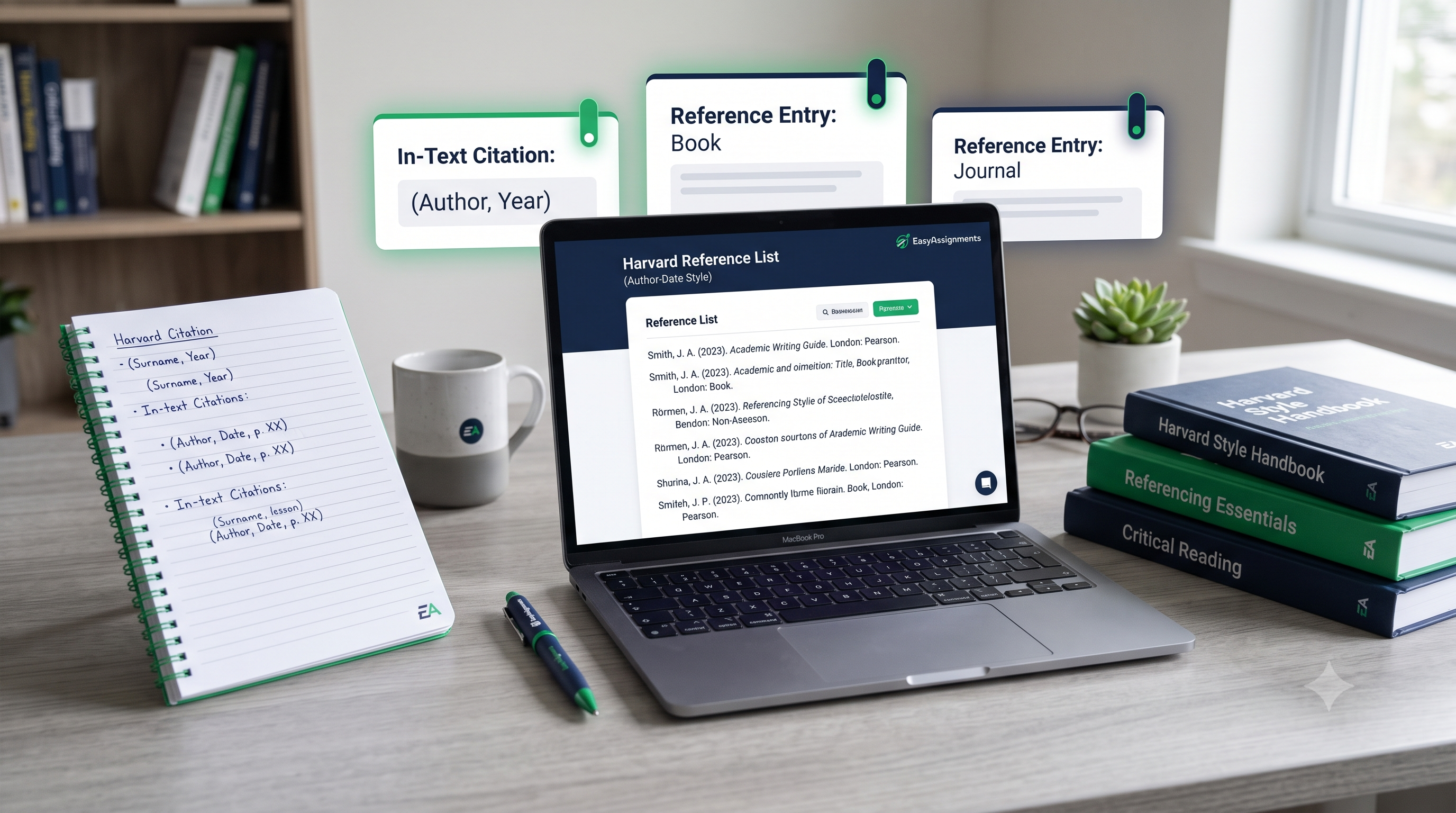
Harvard referencing is an author–date citation style used to credit the sources you use in academic writing. Every time you quote, paraphrase, or summarise someone else's work, you include a brief in-text citation showing the author's surname and the year of publication. You then list the full source details in a reference list at the end of the document.
The term "Harvard style" is slightly misleading. There is no single official Harvard manual owned by Harvard University. Instead, "Harvard" describes a family of author–date referencing styles. This is why you may notice small differences between universities but the fundamentals stay the same across every version.
The two building blocks of the Harvard referencing system are:
- In-text citations short pointers in the body of your text, usually formatted as (Author, Year) or (Author, Year, p. X).
- Reference list a complete, alphabetical list of every source you cited, placed at the end of your assignment.
Together, these let a reader trace any claim in your work back to its original source. That transparency is the whole point of referencing, and it is central to good academic writing.
Why Universities Use Harvard Style
Universities don't ask for referencing to make your life harder. Harvard referencing serves several genuine academic purposes, and understanding them makes the rules easier to remember.
It gives credit to original authors
Scholarship builds on scholarship. Referencing acknowledges the researchers, writers, and thinkers whose work you have used, which is a basic matter of academic honesty.
It prevents plagiarism
Accurate citations clearly separate your own ideas from those you borrowed. This is your strongest protection against accidental plagiarism. If you want a deeper walkthrough, see our guide on how to avoid plagiarism.
It lets readers verify your sources
A marker or fellow researcher should be able to follow your citations and find the exact sources you used. This supports transparency and academic integrity.
It strengthens your argument
Citing credible, scholarly sources shows that your claims are backed by evidence rather than opinion. Well-referenced work simply reads as more authoritative.

Harvard Referencing vs APA vs MLA
Students often mix up the major citation styles. Harvard, APA, and MLA all share the goal of crediting sources, but they differ in formatting and in which disciplines use them. The table below compares the three at a glance.
| Feature | Harvard | APA | MLA |
|---|---|---|---|
| System type | Author–date | Author–date | Author–page |
| In-text example | (Smith, 2021, p. 45) | (Smith, 2021, p. 45) | (Smith 45) |
| Common fields | Business, humanities, social sciences | Psychology, sciences, education | Literature, arts, humanities |
| End list name | Reference list | References | Works Cited |
| Title case in list | Sentence case (usually) | Sentence case | Title Case |
| Governing body | No single official manual | American Psychological Association | Modern Language Association |
The biggest practical difference is that MLA uses page numbers instead of dates in the text, while Harvard and APA both use the author–date approach. If your course requires a different style, our APA referencing guide covers that system in the same level of detail.
Important: Always check your university's specific referencing handbook. Small details such as punctuation, italics, and the use of "and" versus "&" can vary between institutions, even within Harvard style.
Harvard Paper Formatting Basics
Before diving into individual citations, set up your document correctly. While formatting requirements vary slightly by institution, most Harvard-style papers follow these conventions.
- Font: A clear, readable font such as Arial or Times New Roman, typically 11–12 point.
- Spacing: Double or 1.5 line spacing in the main body.
- Margins: Around 2.5 cm (1 inch) on all sides.
- Reference list heading: Titled "Reference List" or "References," placed on a new page at the end.
- Alphabetical order: References ordered by author surname.
- Hanging indent: Each reference after the first line is indented, which makes the list easier to scan.
Getting these basics right signals to your marker that you understand academic conventions before they even read your citations.
Harvard In-Text Citations Explained
In-text citations are short references placed within the body of your writing. They point the reader toward the full entry in your reference list. In Harvard style, the essential elements are the author's surname and the year of publication. When you quote directly, you also add a page number.
Basic in-text citation format
There are two common ways to include a Harvard in-text citation, and both are correct.
Parenthetical: Effective referencing supports academic integrity (Smith, 2021). Narrative: Smith (2021) argues that referencing supports academic integrity.
Use the parenthetical form when the citation sits at the end of a sentence, and the narrative form when you want the author's name to be part of your sentence.
Adding page numbers for quotations
When you quote word-for-word, include the page number so the reader can locate the exact passage.
Referencing is "the backbone of scholarly writing" (Smith, 2021, p. 12).
Citing two or three authors
List all authors, separated by commas and "and" (or "&" depending on your university's rules) before the final name.
(Smith and Jones, 2020) (Smith, Jones and Patel, 2019)
Citing four or more authors
Use the first author's surname followed by "et al." (Latin for "and others").
(Smith et al., 2022)
Citing sources with no author
If a source has no named author, use the organisation or the title in place of the author.
(World Health Organization, 2023) (Harvard Referencing Guide, 2024)
Citing multiple sources at once
When several sources support the same point, separate them with semicolons and list them alphabetically or chronologically.
(Jones, 2019; Patel, 2021; Smith, 2023)
Paraphrasing tip: You still need an in-text citation when you paraphrase. Changing the wording does not remove your obligation to credit the original author it only removes the quotation marks.
Struggling to reference your assignment correctly?
Our academic experts can format your citations, build your reference list, and check your work for consistency so you never lose marks on referencing again.
How to Create a Harvard Reference List
The reference list is the full record of every source you cited in your text. It appears on a separate page at the end of your assignment, under the heading "Reference List" or "References." A correctly built reference list follows a few consistent rules.
- Include only sources you actually cited in the text (a bibliography, by contrast, may include background reading).
- Arrange entries alphabetically by the author's surname.
- Use a hanging indent for each entry.
- If an author has multiple works, order them by year, oldest first.
- For same author and same year, add letters: 2021a, 2021b, and so on.
The general pattern for most reference list entries is: Author surname, Initial(s). (Year) Title. Publication details. The exact fields change depending on the source type, which we'll cover next with worked examples.
How to Cite a Book in Harvard Style
Books are one of the most common sources you'll cite. The reference list format for a book includes the author, year, title in italics, edition (if not the first), place of publication, and publisher.
Format: Author surname, Initial(s). (Year) Title of book. Edition. Place of publication: Publisher. Example: Smith, J. (2021) Academic writing made simple. 2nd edn. London: Scholarly Press.
Book with two or three authors
Smith, J. and Jones, R. (2020) Referencing for students. Oxford: Bright Books.
Chapter in an edited book
Patel, A. (2019) 'Citation basics', in Brown, T. (ed.) The academic handbook. Manchester: Uni Press, pp. 45–60.
How to Cite a Journal Article in Harvard Style
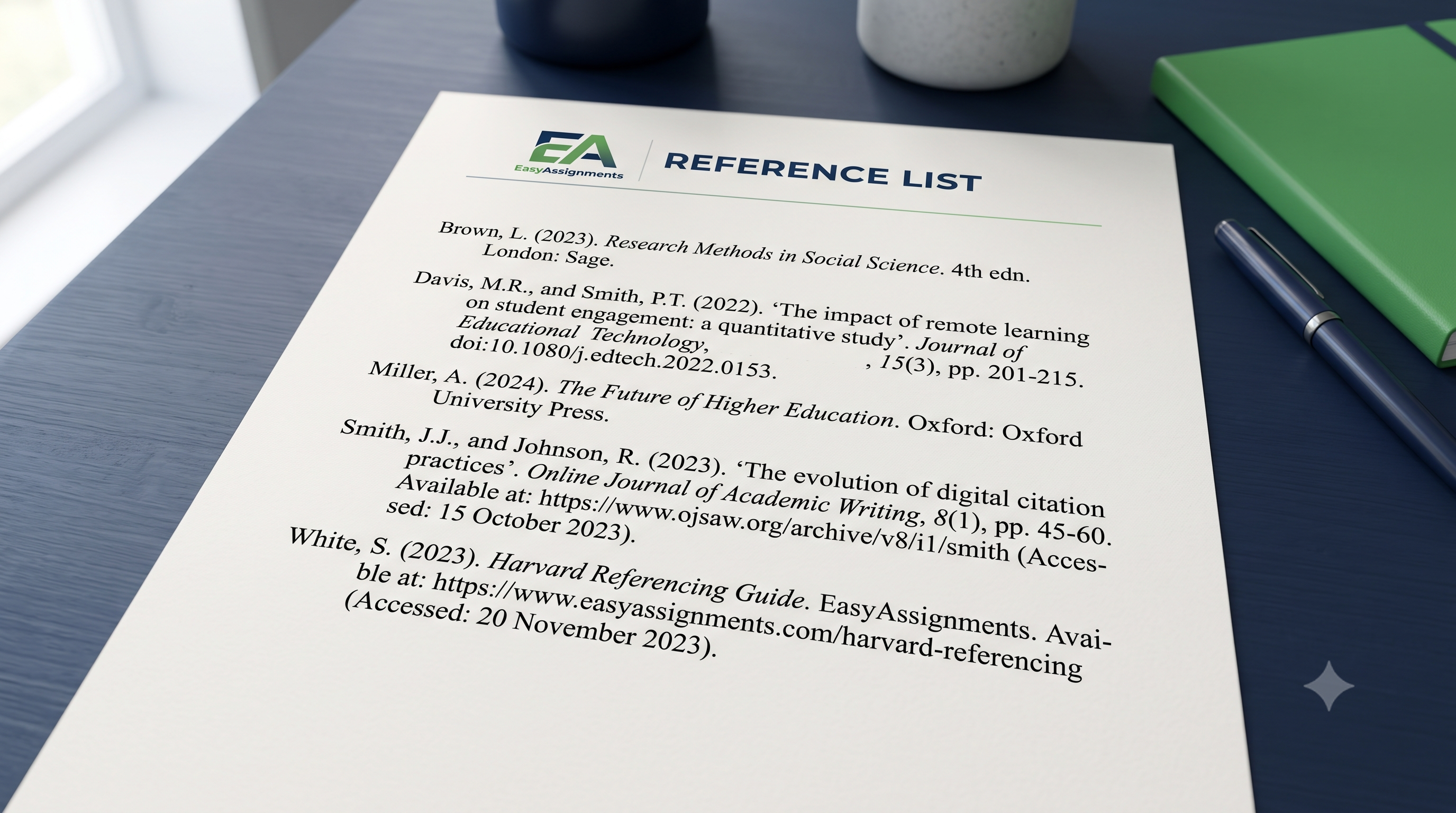
Journal articles are core sources in academic work. Note that the article title is in plain text with single quotation marks, while the journal name is italicised.
Format: Author surname, Initial(s). (Year) 'Title of article', Journal Name, Volume(Issue), page range. Example: Green, M. (2022) 'The value of referencing skills', Journal of Academic Practice, 14(3), pp. 210–225.
Online journal article with a DOI
For articles accessed online, add the DOI (Digital Object Identifier) where available, as it provides a stable link to the source.
Green, M. (2022) 'The value of referencing skills', Journal of Academic Practice, 14(3), pp. 210–225. doi: 10.1234/jap.2022.014.
How to Cite a Website in Harvard Style
Websites can be tricky because they often lack obvious authors or dates. Include as much information as you can find: author or organisation, year, page title, the site name, the URL, and the date you accessed it.
Format: Author/Organisation. (Year) Title of page. Available at: URL (Accessed: Day Month Year). Example: EasyAssignments. (2024) Harvard referencing guide. Available at: https://www.easyassignments.com/blog/harvard-referencing-guide (Accessed: 7 July 2026).
No date available? Use "(no date)" in place of the year, both in your in-text citation and reference list, for example: (EasyAssignments, no date).
How to Cite a Government Report in Harvard Style
Reports from governments and organisations are common in business, health, and social science assignments. Treat the issuing body as the author.
Format: Organisation. (Year) Title of report. Place of publication: Publisher. (Report series/number if available). Example: Department of Education. (2023) National literacy strategy report. Washington, DC: Government Printing Office.
How to Cite a YouTube Video in Harvard Style
Multimedia sources such as YouTube videos are increasingly cited in coursework. Use the name of the channel or uploader as the author.
Format: Uploader. (Year) Title of video. Available at: URL (Accessed: Day Month Year). Example: EasyAssignments. (2025) How Harvard referencing works. Available at: https://www.youtube.com/watch?v=example (Accessed: 7 July 2026).
Citing AI Tools Responsibly
As generative tools become common, some universities now expect students to acknowledge their use. Policies vary widely, so this area needs particular care.
- Always check whether your institution permits the use of AI tools for the assignment at all.
- If permitted, disclose how you used the tool, following your university's specific guidance.
- Never present tool-generated text as your own original work that can breach academic integrity rules.
Check first: Rules on citing AI tools differ significantly between universities and are changing quickly. When in doubt, ask your tutor or consult your course's academic integrity policy before submitting.
Common Harvard Referencing Mistakes
Even careful students lose marks to small, avoidable referencing errors. Watch out for these common Harvard referencing mistakes.
Missing in-text citations
Adding a source to the reference list but forgetting to cite it in the text or vice versa.
Inconsistent formatting
Mixing punctuation, italics, or author order between entries instead of applying one consistent pattern.
Wrong italics
Italicising an article title instead of the journal name, or the reverse.
No page numbers for quotes
Leaving out page numbers when quoting directly from a source.
Reference list not alphabetised
Listing sources in the order they appear rather than alphabetically by surname.
Missing access dates
Forgetting the accessed date on website and online sources.
Harvard Referencing Checklist
Before you submit, run through this quick Harvard referencing checklist to catch errors and protect easy marks.
- Every in-text citation has a matching reference list entry.
- Every reference list entry is cited at least once in the text.
- The reference list is in alphabetical order by surname.
- Book and journal titles are italicised correctly.
- Direct quotes include page numbers.
- Websites include access dates and URLs.
- Author names and dates are consistent between text and list.
- "et al." is used correctly for four or more authors.
- Formatting is consistent across every entry.
- You have checked your specific university's Harvard guidelines.
Pro tip: Reference as you write, not at the end. Adding citations while you draft is far faster and more accurate than trying to reconstruct every source afterward.
Frequently Asked Questions
What is Harvard referencing?
Harvard referencing is an author–date citation style used in academic writing. It uses short in-text citations showing the author's surname and publication year, along with a full alphabetical reference list at the end of your work.
How do you write Harvard in-text citations?
Include the author's surname and the year in brackets, for example (Smith, 2021). When quoting directly, add a page number: (Smith, 2021, p. 45). You can also weave the author's name into your sentence: Smith (2021) argues that...
How do you create a Harvard reference list?
List every source you cited, arranged alphabetically by author surname, on a separate page at the end of your assignment. Use a hanging indent and follow the correct format for each source type, such as books, journals, and websites.
How do you cite a website in Harvard style?
Include the author or organisation, year, page title, the URL, and the date you accessed it for example: EasyAssignments. (2024) Harvard referencing guide. Available at: URL (Accessed: 7 July 2026).
What is the difference between Harvard and APA referencing?
Both are author–date systems and look similar in the text. The main differences are in reference list formatting details, capitalisation, and the fact that APA is governed by the American Psychological Association, while Harvard has no single official manual.
Is Harvard referencing the same at every university?
No. "Harvard" refers to a family of author–date styles, and universities apply slightly different rules for punctuation, italics, and layout. Always check your institution's specific referencing handbook.
Why is Harvard referencing important?
It credits original authors, prevents plagiarism, lets readers verify your sources, and strengthens your argument by showing your claims are backed by credible evidence all central to academic integrity.
Need help getting your referencing perfect?
From a single essay to a full dissertation, our experts can format your citations, build your reference list, and check everything for consistency and accuracy.
Reference with Confidence, Every Time
Stop losing easy marks to referencing errors. Our academic experts are ready to help you cite, format, and polish your work to a professional standard.