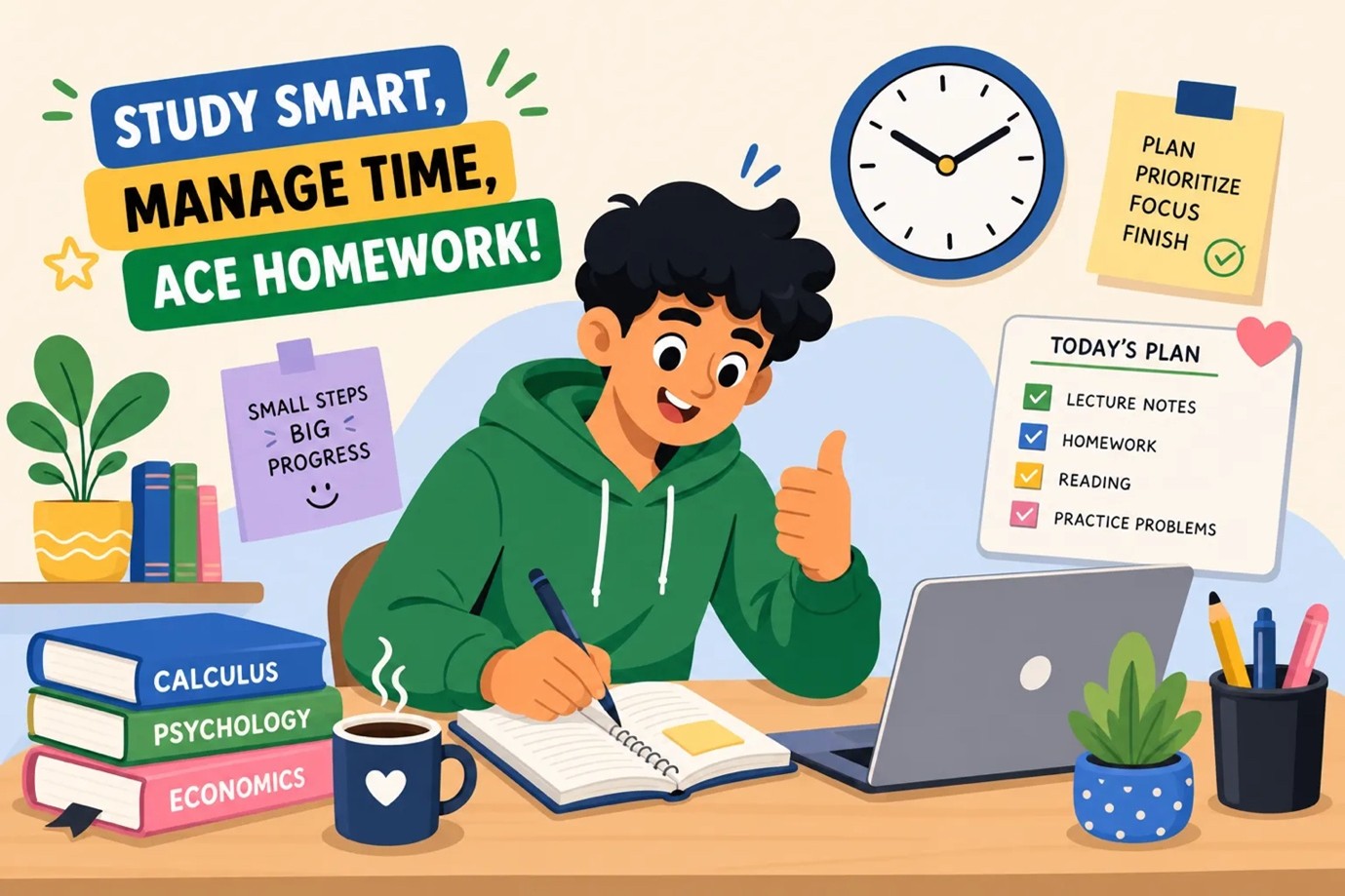
Homework Time Management Tips Every College Student Needs
It's Sunday night, your alarm is set for 8 AM, and three assignments are all due Monday. The week's hours somehow disappeared. This isn't a motivation problem, it's a homework time management problem, and it's far more common than you think.
Managing homework time well doesn't require more willpower or longer sessions. It needs a structure that tells you exactly what to work on, when, and how to break it down so the work actually gets done.
Why Most Time Management Advice Doesn't Work for College Students
The Motivation Myth
Most advice tells you to "just focus more" or "stop procrastinating." The problem is that focus and willpower are finite resources. Studies in behavioral psychology suggest that systems and structure are more reliable than willpower for most students. When you're balancing multiple courses, a part-time job, and constantly shifting deadlines, waiting to feel motivated is a losing strategy.
The more useful reframe is this: time management is really priority management. Instead of staring down a massive to-do list each morning, identify one main academic task per day. That single shift reduces overwhelm, builds momentum, and keeps you moving forward even on the hardest weeks.
What a Working Homework Management System Looks Like
A functional homework management system works across three connected layers: a weekly overview that shows every commitment and open window; daily time blocks assigned to specific subjects rather than vague "study time"; and a task-level breakdown that converts each assignment into specific, timed action steps.
Each layer supports the others. Without the weekly overview, daily blocks are guesswork. Without the task breakdown, those blocks get wasted on the wrong work. Build all three into your routine, and the system largely runs itself.
For additional tactics and examples tailored to students, see our in-depth time management for students guide.

Build a Weekly Homework Schedule That Holds Up
Starting With a Calendar Audit
Before you schedule a single study session, do a one-week calendar review. Write down every fixed commitment: class times, work shifts, commutes, recurring appointments, and anything else that takes a set block of your time. What's left is your actual available time, and seeing it clearly prevents the classic mistake of overcommitting and then wondering why nothing got done.
Students at online universities like WGU and Capella are especially vulnerable to this trap because their schedules feel wide open. Without fixed class times, it's easy to assume you have more time than you do. The calendar audit makes reality visible and gives your homework scheduling a foundation that reflects your actual week.
Blocking Time for Study and Recovery
Once you can see your open windows, assign focused blocks to specific subjects rather than general "study time." Many students find 50- to 90-minute focused blocks useful, though the right length depends on the subject and your own stamina. A block labeled "English paper draft" is far more actionable than one labeled "homework." This approach, known as time blocking, protects your study time the same way a meeting protects a work hour.
A widely used rule of thumb holds that students should plan roughly two hours of study per week for every credit hour they're taking. A 15-credit semester means about 30 hours of weekly study on top of class time. Schedule recovery time too. Burnout kills consistency faster than any distraction, and a homework planner that ignores rest is one you're far more likely to abandon.
The Pomodoro Technique for Homework Time Management
How a Pomodoro Session Works
The Pomodoro technique is straightforward: work for 25 minutes with full focus, take a 5-minute break, then repeat. After four rounds, take a longer break of 20 to 30 minutes. The structure works because it creates artificial urgency, the kind that makes it easier to start and harder to drift.
The psychology matters. Each 25-minute block is short enough to feel manageable, even when the assignment feels overwhelming. The breaks prevent the mental fatigue that steadily erodes productive time during longer, unbroken sessions. For students who battle constant distractions, the timer acts as a commitment device few other techniques can match. If you want a good timer app, check this curated list of the best Pomodoro apps.
Adapting Intervals to Different Assignment Types
The standard 25-minute structure isn't a rigid rule. Reading-heavy assignments, like working through a dense textbook chapter, often benefit from longer intervals, so test 35 to 45 minutes and adjust based on what works for you. Writing and problem sets tend to fit the standard 25-minute structure well, since both require sustained bursts of active thinking.
The Five-Minute Rule: On days when starting feels impossible, commit to working for just five minutes, then stop if you want to. You almost never stop after five minutes. Once you're in the work, momentum takes over. Pair it with Pomodoro intervals for a two-step anti-procrastination strategy that holds up even on the worst days.
Breaking a Large Assignment Into Timed Subtasks
The Project-to-Task Breakdown Method
A research paper is not a task. It's a project made up of many tasks, and treating it like one big thing is exactly why it feels paralyzing. The fix is a clear breakdown: write down the final deliverable, identify three to five major milestones (research, outline, first draft, revision, final submission), and list every specific action step under each milestone. This is the heart of solid assignment time estimation. For practical techniques on how to break large projects into bite-sized tasks, see this step-by-step guide.
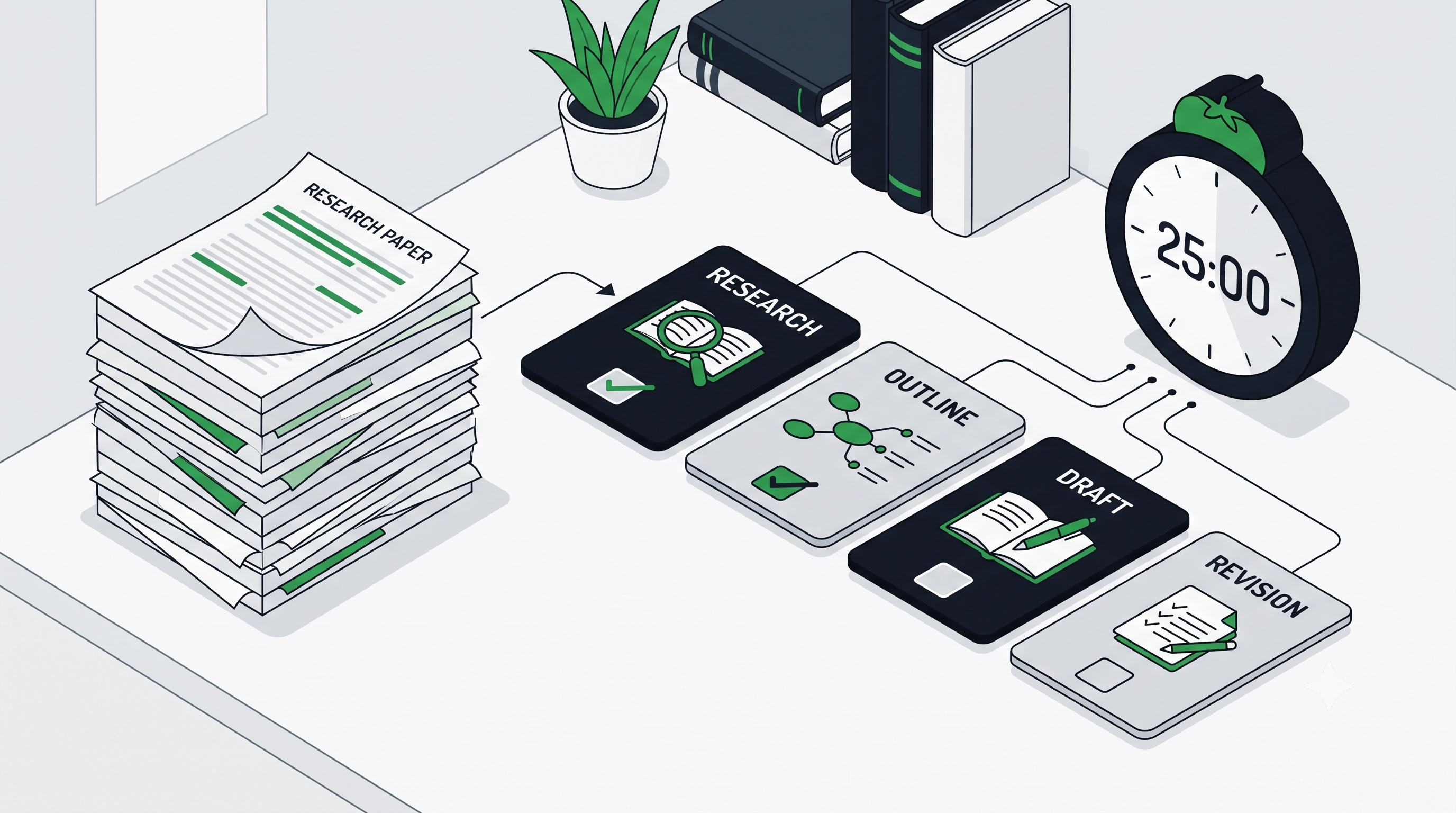
Write every step down. Don't rely on memory to fill in the gaps. The act of writing removes the anxiety of ambiguity, which is often what drives procrastination in the first place. When each step is specific and visible, the assignment stops feeling like a wall and starts feeling like a checklist. When you reach the citations stage, consult a clear referencing guide such as our APA referencing guide or the Harvard referencing guide.
Applying Time Boxing to Each Step
Once the steps are listed, assign a specific time limit to each one. This is called time boxing. Set a timer when you begin, work until it ends, and check off the task. If a step takes longer than one hour to estimate, break it down further, that's a signal the step is still too vague.
Set artificial deadlines five to seven days before the actual due date. This buffer protects you when life gets unpredictable and significantly reduces the Sunday-night panic that derails otherwise solid study routines, especially in accelerated online programs where courses finish in weeks.
The Best Apps for Keeping Your Homework Schedule on Track
Three tools stand out for college students managing real homework schedules in 2026. Don't use all three, pick one based on your biggest problem.
| App | What It Does Well | Best For |
|---|---|---|
| MyStudyLife | All-in-one with a built-in Pomodoro timer, rotating schedules, grade tracking, cross-device sync | Students who want scheduling and timing in one app |
| myHomework | Clean calendar interface with priority flagging and block-schedule support | Visual learners who want a clear view of what's due |
| Todoist | Project-based organizer with a separate project per class, recurring tasks, priority labels | Managing several large projects across courses |
Try MyStudyLife for cross-platform scheduling, or the myHomework student planner app on iOS. If you consistently miss deadlines, MyStudyLife's alert system addresses that directly. If your schedule feels visually chaotic, myHomework's calendar helps you see the week clearly. If you're buried in overlapping projects, Todoist's structure brings order to the mess. The best homework app is the one you'll actually open every day, so start simple, build the habit, and upgrade once the routine is solid.
When the Week Simply Doesn't Add Up
Some weeks no timer or planner fixes the math. EasyAssignments connects you with subject-matter writers, with plagiarism checks and round-the-clock support compatible with Canvas, Blackboard, and Moodle, when time is the one thing you don't have.
When Your Best Homework Plan Still Isn't Enough
The Weeks That Break Every System
Some college weeks are genuinely unmanageable. A family emergency, a health setback, a sudden pile-up of major deadlines across every course at once, these don't respond to better scheduling. No Pomodoro timer or homework planner fixes a week where the math simply doesn't work. Recognizing that reality early is not making excuses, it's managing the semester with clear eyes.
The goal in those moments is triage, not perfection. Identify which assignments carry the most weight, protect your GPA where it matters most, and accept that some weeks require outside help rather than a heroic solo effort.
Using EasyAssignments as a Reliable Academic Backup
This is exactly where EasyAssignments fits into a well-managed semester. It's not a shortcut for students who skipped their planning system. It's a strategic resource for students who built the system, followed it, and still hit a week that overwhelmed everything. Think of it the way you'd think about hiring a tutor when you hit a wall in organic chemistry: a smart decision, not a defeat.
EasyAssignments connects students with subject-matter writers, and submissions are accompanied by plagiarism checks to support academic integrity. The service offers a satisfaction guarantee and revision policy, so check the platform's current terms for specifics. Round-the-clock support and compatibility with major learning management systems, including Blackboard, Canvas, and Moodle, make the process straightforward when time is the one thing you don't have. The platform has built a track record with students who use it not to replace their academic effort, but to protect the GPA they worked hard to build during an unavoidable rough patch.
Build the System, Then Work the System
Homework time management is a skill, and like every skill, it improves with deliberate practice. The core framework here, weekly calendar audits, subject-specific time blocks, Pomodoro intervals, timed task breakdowns, and the right digital tools, gives you everything you need to stop reacting to deadlines and start staying ahead of them.
Audit Your Week
Map fixed commitments first, then find your real open time.
Block by Subject
Name each block for a specific task, not vague "study time."
Work in Pomodoros
25 on, 5 off, adjusting intervals to the assignment type.
Box Every Step
Break projects into timed subtasks with an early deadline.
Consistency matters far more than perfection. A schedule you follow most of the time beats a flawless plan that collapses by Tuesday every week. Start with one technique from this article, put it into practice before the week ends, and build from there. Treat homework time management as an ongoing habit rather than a one-time fix, and the results compound over an entire semester.
For the weeks when the system gets overwhelmed regardless, EasyAssignments is there as a trusted, confidential backup. One rough week doesn't have to derail an entire semester, not when you have both a solid plan and a reliable safety net working together.
Frequently Asked Questions
What is the best homework time management technique for college students?
There's no single best one, but the strongest framework combines a weekly calendar audit, subject-specific time blocks, Pomodoro intervals, and timed task breakdowns. Structure beats willpower, so start with one technique and build the habit before adding more.
How many hours should I study per week in college?
A common rule of thumb is about two hours of study per week for each credit hour. For a 15-credit semester, that's roughly 30 hours weekly on top of class time. Adjust to your courses, and always schedule recovery time to avoid burnout.
How does the Pomodoro technique help with homework?
You work for 25 focused minutes, break for 5, and take a longer break after four rounds. Short blocks feel manageable and the breaks prevent fatigue. For reading-heavy work, try 35 to 45-minute intervals instead of the standard 25.
What should I do when my whole week falls apart?
Triage, don't aim for perfection. Rank assignments by weight, protect your GPA where it matters most, and ask professors about extensions early. For genuinely overwhelming weeks, a vetted service like EasyAssignments can serve as a backup, provided your use fits your school's integrity policy.
Stop Reacting to Deadlines, Start Staying Ahead
Build the system now, and keep a confidential backup for the weeks that break every plan. EasyAssignments is here when you need reliable, on-time academic support.