Plagiarism Definition: What Every College Student Must Know
A student paraphrases a journal paragraph, puts it in their own words, and submits without a citation. A week later the professor flags it for academic dishonesty. The student is genuinely confused, they changed the words and thought that was enough. It wasn't.
Academic integrity violations happen more often than students expect, and many involve people who never intended to cheat. This guide covers every major form, how colleges enforce their policies, and the concrete steps that keep your record clean.
Plagiarism Definition: What It Really Means
The Core Idea Shared by Every Definition
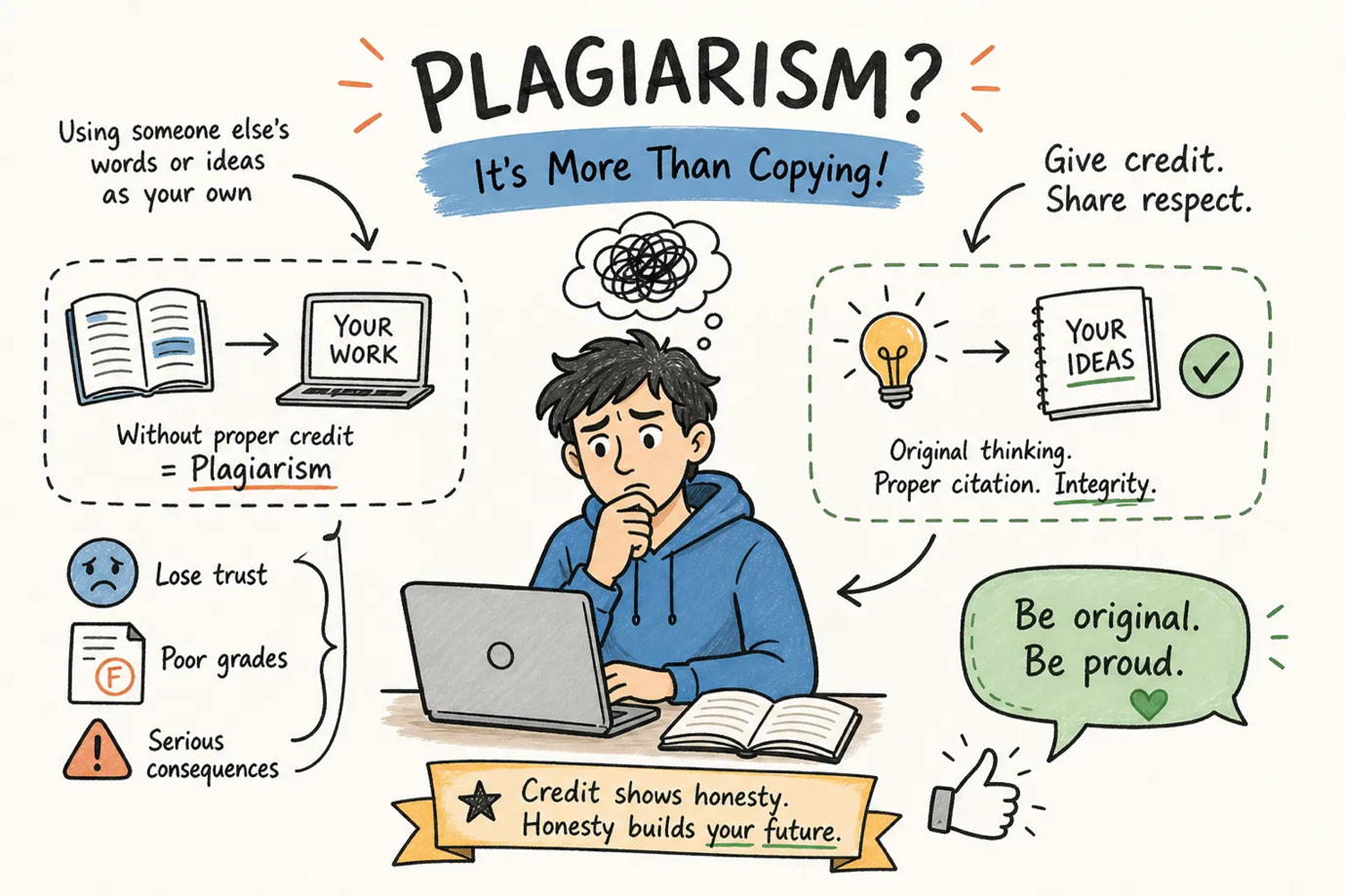
So what is plagiarism, exactly? Merriam-Webster defines it as stealing and passing off the ideas or words of another as one's own, or using another's production without crediting the source. That's the foundation, and every major dictionary agrees on it. Two conditions must be true simultaneously: the content originated somewhere other than the writer's own mind, and the reader is led to believe it didn't. No citation means no credit to the original author, and that single omission is where most violations begin.
The scope of this plagiarism definition is broader than most students realize. It covers words, ideas, data, images, and any other form of intellectual output, including code and software in fields where those are submitted as academic work. You don't have to copy a sentence verbatim to plagiarize. Using someone's original argument, research finding, or creative structure without attribution is enough to qualify under any institutional plagiarism policy.
Why "I Didn't Mean To" Is Not a Defense
Intent affects the penalty, not whether a violation occurred. Accidental plagiarism from poor note-taking, a forgotten citation, or genuine misunderstanding still counts under most institutional policies, because the harm to academic integrity is identical regardless of intent: the original author gets no credit, and the student gets credit for work that isn't fully theirs.
For an overview of how universities explain these expectations, see Oxford's guidance on plagiarism.
Forms of Plagiarism: Definition and Examples
Direct Copying and Mosaic Plagiarism
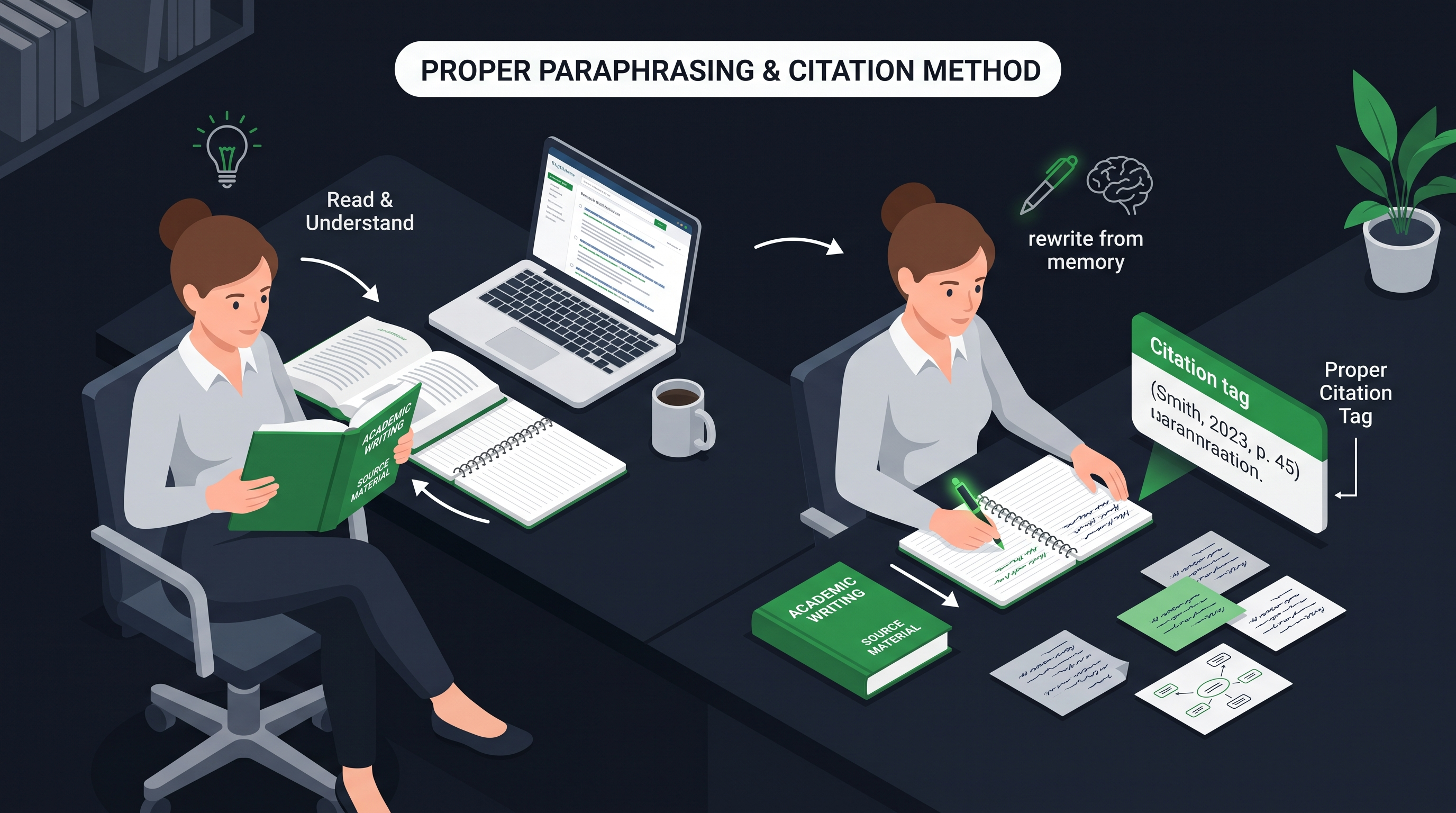
Direct plagiarism is the most straightforward form: copying text word-for-word from a source without quotation marks or a citation. It's what most students picture when they hear the term. More students get caught, however, by mosaic plagiarism, sometimes called patchwriting. This is where a student takes phrases from multiple sources and stitches them into their own sentences, changing a word here and there but keeping the original structure and borrowed phrasing intact.
Here's a concrete example. An original source reads: "Climate change accelerates the frequency of extreme weather events by increasing atmospheric energy." A mosaic version might read: "Climate change speeds up how often extreme weather occurs by raising energy levels in the atmosphere." The vocabulary shifted, but the sentence architecture and core phrasing are still borrowed without attribution. That's a violation, even though it looks like original writing at first glance. Professors who know their course material routinely recognize this pattern, even when a similarity score doesn't catch it.
Paraphrasing Without Credit: The Most Common Mistake
Restating someone else's idea in your own words still requires a citation. The words changed; the idea didn't. This is the form behind the majority of academic dishonesty cases because students genuinely believe that rewriting a sentence makes the idea theirs. It doesn't. The source of an idea must always be attributed, even when zero original wording survives in the final version. For a clear breakdown of common types and examples, review Grammarly's guide to types of plagiarism.
The logic is straightforward: if you read a study that found a specific result and write that finding into your paper in different words, the intellectual work behind that finding still belongs to the researchers who conducted the study. Your paraphrasing is a presentation choice, not an act of creation.
| Form | What It Looks Like | Why It Counts |
|---|---|---|
| Direct copying | Word-for-word, no quotes or citation | Passes another's exact words as your own |
| Mosaic / patchwriting | Stitched phrases, structure kept intact | Borrowed architecture without attribution |
| Paraphrase, no credit | Reworded idea with no citation | The idea still belongs to its originator |
| Self-plagiarism | Reusing your own graded work | Misrepresents current, original effort |
Self-Plagiarism: The Rule That Surprises Almost Everyone
What Actually Counts as Self-Plagiarism in College
Self-plagiarism means submitting your own previously graded work for a new assignment without the instructor's explicit permission. This includes reusing a paper written in high school for a college course, submitting the same essay to two different courses simultaneously, or recycling significant sections of an earlier assignment into a new submission. The rule applies to portions of work, not only entire papers. Dropping three paragraphs from a prior submission into a new paper without disclosure is a violation even though you wrote those paragraphs yourself.
Why Colleges Penalize It Just as Seriously
Every assignment is designed to demonstrate new learning and original effort for that specific course at that point in a student's academic development. Reusing old work misrepresents the student's current academic output and denies the instructor an accurate assessment of what the student knows now. Most US universities treat self-plagiarism as a formal violation under the same academic dishonesty policy that covers all other forms, and the penalties can be equally significant.
Clear the Highest Originality Bar
EasyAssignments delivers 100% human-written, original work from verified experts, backed by a Turnitin report with every submission, so you see your originality score before anything reaches an instructor.
Why Colleges Treat Academic Dishonesty So Seriously
Institutional Penalties: What Actually Happens
Penalty structures at US universities typically follow escalating tiers. A first offense often results in a grade of zero on the assignment, an academic warning, or mandatory completion of an integrity course. More serious or repeat violations move to course failure, suspension for one or more terms, or permanent expulsion. Harvard, for example, handles cases individually, with sanctions ranging from probation to forced withdrawal lasting two to four terms; in one recent academic year, 27 students were removed for that period. Research universities also reserve the right to revoke a degree years after graduation if plagiarism in submitted work is later discovered.
Formal cases go on your permanent academic record, a notation that follows you well beyond the course where the violation occurred and can surface during graduate school applications or employment background checks.
Long-Term Fallout Beyond the Grade
Academic records connect directly to graduate school applications, professional licensing processes, and employment background checks in fields like law, medicine, and finance. A plagiarism finding that results in suspension or expulsion doesn't stay on campus. Some graduate admissions committees and employers request conduct records as part of the evaluation process, and a serious academic integrity violation can close doors that years of legitimate work opened. The risk-reward calculation for cutting corners is overwhelmingly negative.
How Plagiarism Detection Tools Actually Work
What a Similarity Report Does and Doesn't Tell You
Turnitin compares submitted text against a database that includes billions of web pages, academic journals, and previously submitted student papers, then generates a similarity percentage. That percentage is not a plagiarism ruling. It's a starting point for human review. A paper with 30% similarity can be entirely clean if every flagged passage is correctly quoted and cited. A paper at 8% similarity can still contain plagiarism if an idea was taken without attribution. Context determines the outcome, and a professor reviews every flagged match before any decision is made. For details on how percentages are calculated, consult Turnitin's guide to the similarity score.
Many US universities flag papers for manual review when similarity scores exceed roughly 15 to 25 percent, though thresholds vary by institution and program. Graduate programs in some departments set the bar as low as 10 percent. A more meaningful factor is source concentration: an 18% score where a single source accounts for 12% of the matches raises more concern than a 35% score distributed across 25 sources at 1 to 2% each.
What the Tool Misses, and Why That's Not a Loophole
Turnitin cannot catch sources outside its database, cannot assess whether paraphrasing is genuinely original or just cleverly rearranged, and cannot evaluate the quality of ideas. Students who believe they've outsmarted the software by swapping synonyms are usually wrong: professors who taught the course material recognize mosaic patchwriting manually, often faster than any algorithm. That's why genuinely original work is the only reliable protection. EasyAssignments writes every assignment from scratch using credentialed subject-matter experts and includes a Turnitin report with each submission, so students see their originality score before anything reaches an instructor.
Practical Steps to Keep Every Submission Genuinely Original
Smart Note-Taking and Citation Habits That Prevent Problems
Mark every note with its source immediately, not at the end of a research session when memory has blurred which idea came from where. Put quotation marks around any text copied verbatim into notes, even rough notes, so the distinction between your words and the source's words is never lost. Record all citation details in the note file itself: author name, publication title, date, and page number. A missing page number discovered at midnight before a deadline is a preventable crisis.
Choose a citation format that matches your discipline and apply it consistently from the first draft:
- APA is the standard for social and behavioral sciences, including psychology, sociology, and education.
- MLA is used across the humanities, covering literature, philosophy, and cultural studies.
- Chicago is the convention in history, business, and some fine arts programs.
Switching formats mid-paper creates errors that look like academic sloppiness at best and intentional obfuscation at worst. For discipline-specific techniques and resources, see our research guide.
The Right Way to Paraphrase So It's Actually Paraphrasing
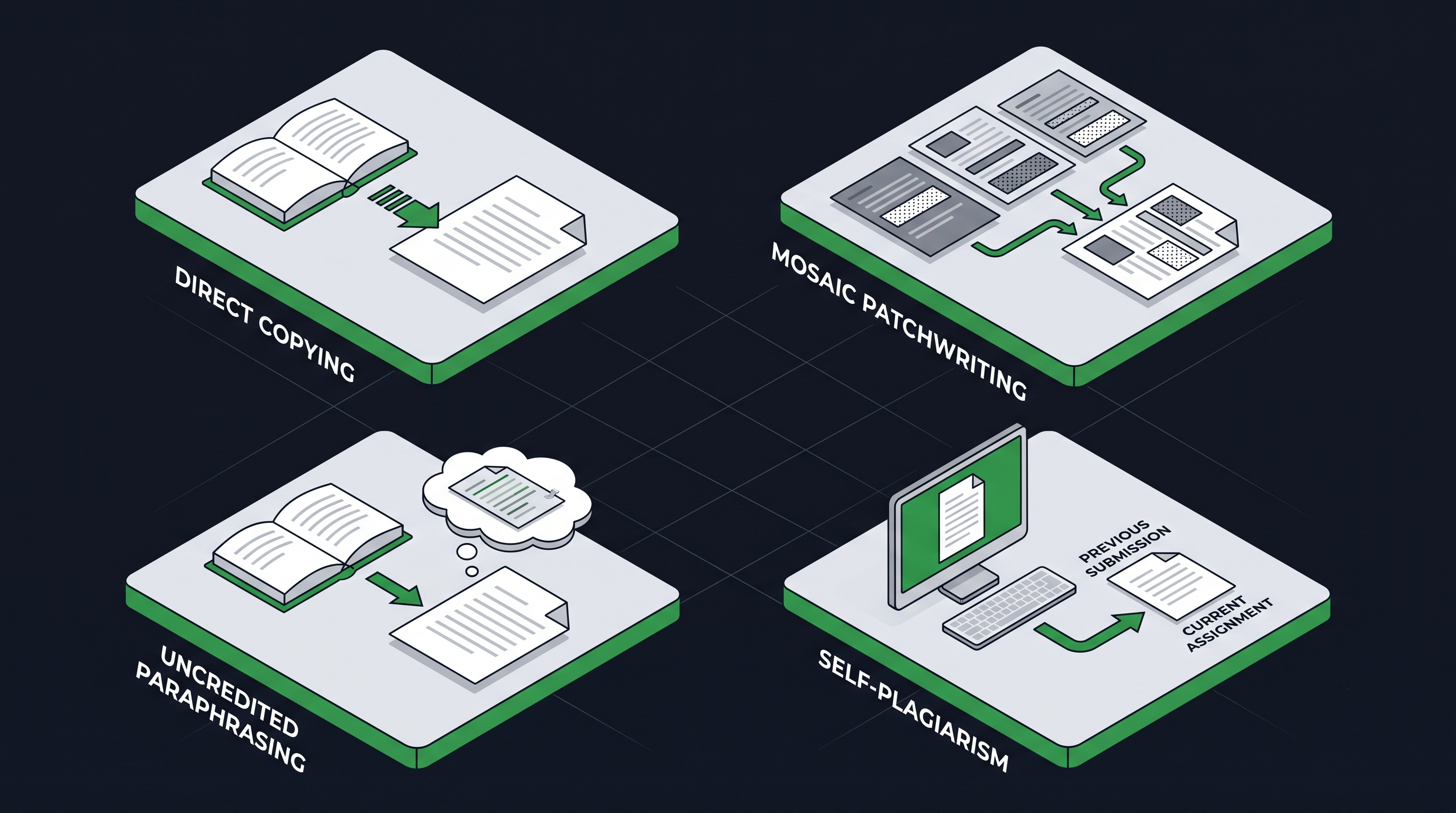
The read-understand-close-rewrite method is the most reliable approach. Read the passage fully, understand the idea it conveys, close or minimize the source so it's no longer in front of you, then write the concept from memory in your own words. After writing your version, compare it to the original. If the sentence structure still mirrors the source, or if more than a few words match, rewrite it again before adding the citation. This process produces phrasing that is genuinely yours while still giving the original author proper credit for the underlying idea, and that credit is required whether you're quoting directly or paraphrasing entirely. For step-by-step techniques, review our how to avoid plagiarism article.
Your Academic Record Is Worth Protecting
Understanding the plagiarism definition in full is the first line of defense for any student's academic future. It isn't limited to copying text: it includes mosaic patchwriting, paraphrasing without citation, and reusing your own previously submitted work. The consequences are real, documented on permanent records, and capable of affecting career and graduate school opportunities for years after graduation. For a concise external definition and examples, see what constitutes plagiarism.
Cite Every Source
Attribute every idea, quoted or paraphrased, without exception.
Rewrite From Memory
Close the source, then write the concept in your own words.
Mark Quotes Clearly
Direct quotes always need quotation marks plus a citation.
Never Reuse Graded Work
Old submissions need explicit instructor permission first.
The fix is direct: cite every source, use the read-understand-close-rewrite method for paraphrasing, and make sure direct quotations are clearly marked and every idea is properly attributed. For students who need expert support meeting that standard on a demanding assignment, EasyAssignments provides 100% original, human-written work from verified experts across 75+ subjects, with Turnitin reports included so there's no uncertainty about what you're submitting. Your academic record reflects years of work, make sure every submission protects it.
Frequently Asked Questions
What is the definition of plagiarism?
Plagiarism is presenting someone else's words, ideas, data, or other intellectual output as your own without crediting the source. Two things must be true at once: the content came from elsewhere, and the reader is led to believe it didn't. Missing attribution is where it begins.
Is it still plagiarism if I didn't mean to do it?
Yes. Intent affects the penalty, not whether a violation occurred. Accidental plagiarism from a forgotten citation or poor note-taking still counts under most policies, because the harm, an author going uncredited, is the same regardless of intent.
Can I reuse my own previous paper?
Not without explicit permission. Submitting your own graded work again, or recycling significant sections of it, is self-plagiarism at most US universities. It's treated as a formal violation because it misrepresents new learning and original effort for that course.
Does paraphrasing avoid plagiarism?
Only if you also cite the source. Rewording changes the words, not the ownership of the idea. Swapping synonyms while keeping the structure is mosaic patchwriting, still a violation. Use the read-understand-close-rewrite method, then add the citation.
Protect the Record You've Worked Years to Build
Understand the definition, apply the right habits, and never submit with uncertainty. EasyAssignments delivers 100% original, human-written work with a Turnitin report on every order.