How Turnitin Detection Works: What Every Student Must Know
Turnitin runs two separate checks, a plagiarism similarity scan and an AI Writing Indicator, and confusing the two is where most student panic begins. Knowing what each layer actually measures changes how you read your own report.
This guide breaks down exactly how Turnitin detection operates, what your scores really mean, and what independent research says about accuracy and false positives, so your next submission is something you understand rather than fear.
Unexpected Turnitin detection results can derail an entire semester, and the anxiety that comes with submitting assignments is real. Many students report confusion about how the system actually works, and that gap between fear and understanding causes a lot of unnecessary panic. Turnitin runs two separate checks: a plagiarism similarity scan and an AI Writing Indicator. Confusing the two, or misreading what either score actually means, leads students to the wrong conclusions and sometimes the wrong decisions.
Even carefully written, original work can get flagged under certain conditions. Understanding why that happens, and what the research actually says about the tool's accuracy, puts you in a much stronger position. This article walks through exactly how each layer of Turnitin's system operates, what your scores mean, and what the evidence says about when the tool gets it wrong. If you're concerned about how your next submission will be read by Turnitin's detection model, the information below gives you the clearest picture available.
What Turnitin detection actually scans (and what it skips)
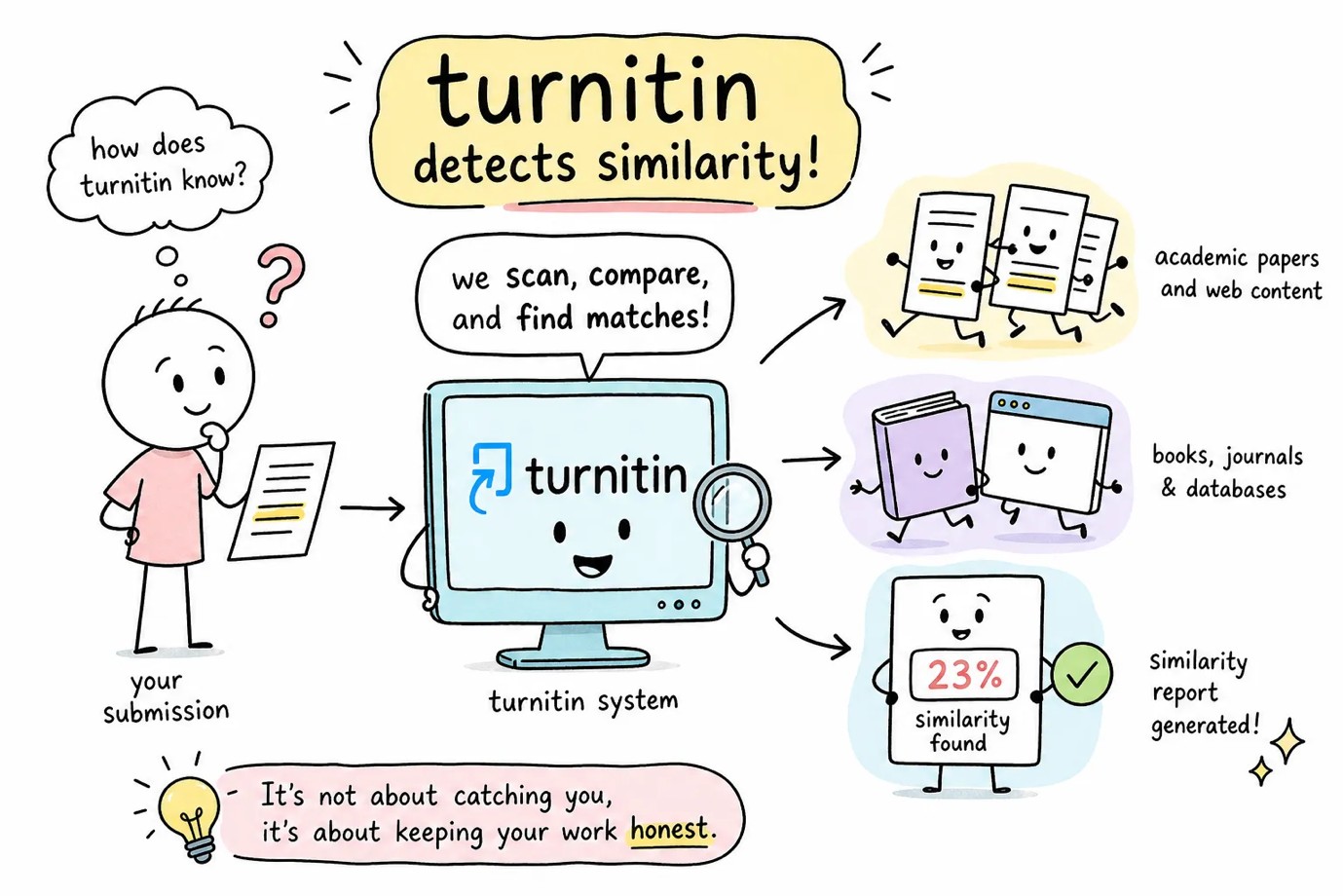
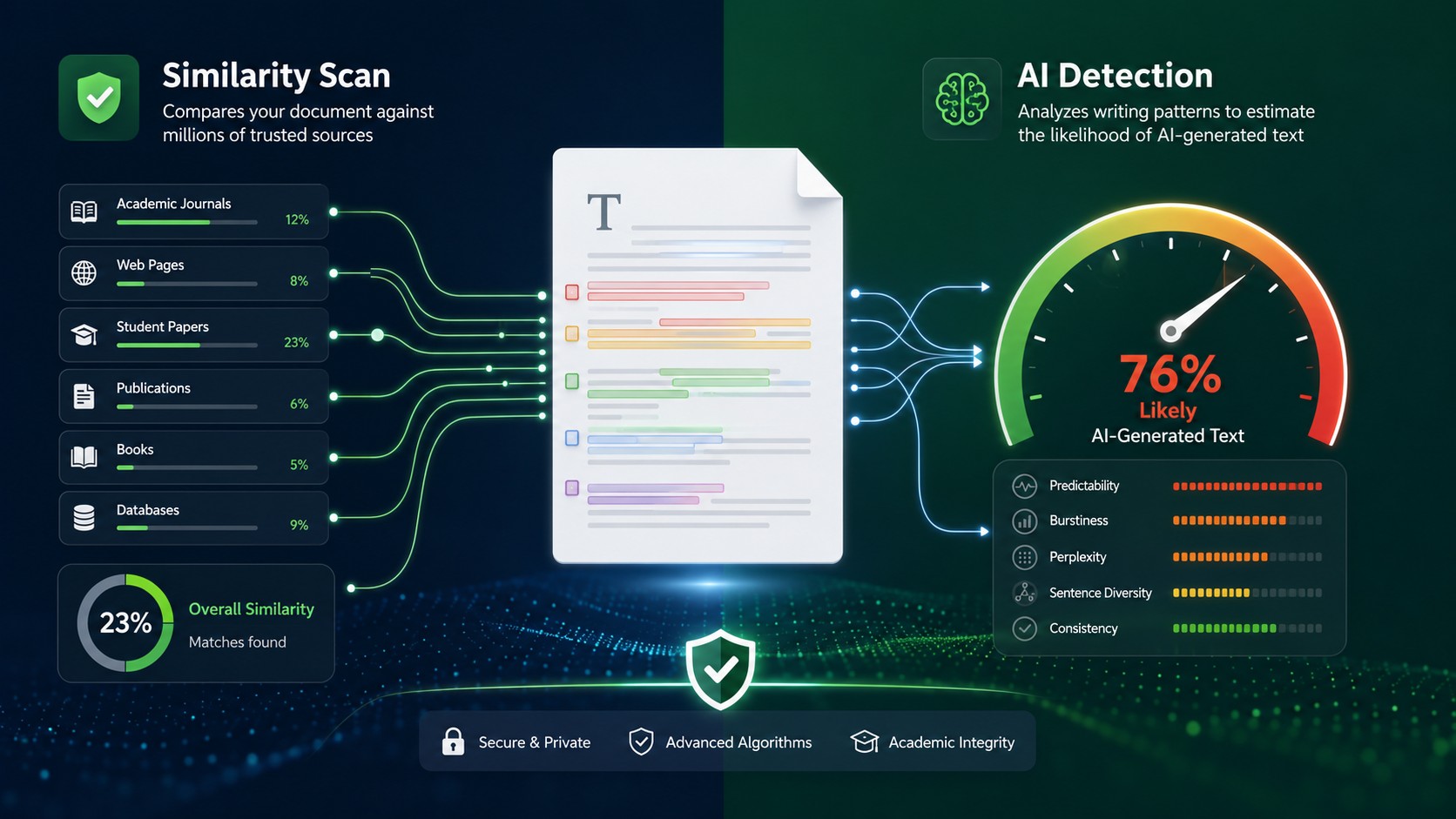
The similarity report and the AI Writing Indicator are two distinct tools that live inside the same platform. The similarity report compares your submitted text against Turnitin's database of web pages, academic journals, and previously submitted student work to identify potential plagiarism. The AI Writing Indicator runs a separate probabilistic model that estimates how much of your text was likely generated by a large language model. Students frequently conflate the two, which leads to misreading their own reports entirely.
What the similarity report checks
Turnitin's AI content detection is calibrated specifically for general English-language prose in long-form writing: essays, dissertations, research papers. It does not reliably detect AI content in code, poetry, scripts, bullet-point lists, or tables. If you're submitting a technical lab report with heavy formatting, a low AI score doesn't validate the tool's usefulness on that format; it simply means the tool wasn't designed to evaluate it. Knowing the scope of what Turnitin actually analyzes helps you interpret your results with far more clarity.
The signals the model uses to flag content
Turnitin's transformer deep-learning model examines vocabulary distribution, sentence structure, and information flow. AI-generated text tends to be statistically "flat" in its word choices, overly consistent in its grammatical patterns, and predictable in how ideas connect across paragraphs. These are the qualities the model is trained to detect, not specific words or phrases, but the underlying statistical uniformity that characterizes most LLM output.
The Turnitin AI checker only flags text as AI-generated when its model reaches 98% confidence. The output is a percentage from 0 to 100% representing the share of qualifying text determined to be AI-generated. Turnitin also distinguishes between text that was LLM-generated directly and text that was AI-generated and then run through a paraphrasing tool like QuillBot, assigning those two categories different visual markers in the report. That percentage is a probability estimate, not a determination of guilt. Turnitin's published guidance states this explicitly, and it matters for how you respond if a score comes back higher than expected.
How to read your Turnitin AI Writing Report
According to Turnitin's own documentation, score thresholds should be read as indicators rather than proof. A score of 20% means the model found AI-consistent patterns in a significant portion of the qualifying text. A score of 80% or higher means the majority of the text resembles AI output by the model's standards. Neither number automatically triggers disciplinary action. Context matters enormously: the score is one data point, and Turnitin's published guidance to instructors reinforces exactly that.
The AI Writing Indicator is instructor-facing only; students don't see it in the standard submission interface. Turnitin explicitly guides instructors to treat the score as a starting point for conversation, not evidence of misconduct. They're advised to compare flagged sections against a student's prior writing, request process artifacts like drafts and notes, and initiate open dialogue before drawing any conclusions. If you're ever questioned about a high score, the most effective response is verifiable evidence of your writing process, not an argument about the technology.
Turnitin detection accuracy: what the research shows
Turnitin internally claims 98% accuracy and a false positive rate below 1%. Independent findings tell a different story. A 2023 Stanford Human-Centered AI study found a 61% false positive rate for essays written by non-native English speakers, compared to near-zero for native English writers. A Washington Post test produced a 50% false positive rate on a small sample. Peer-reviewed studies from 2024 to 2025 suggest real-world detection accuracy on unedited GPT-4 output sits around 90 to 95%, with false positives on edited drafts and technical prose climbing to between 5% and 12%. For deeper technical analysis of Turnitin's model and testing protocol, see this evaluation of the model's effectiveness and testing methodology: Evaluating the Effectiveness of Turnitin's AI Writing Indicator Model.
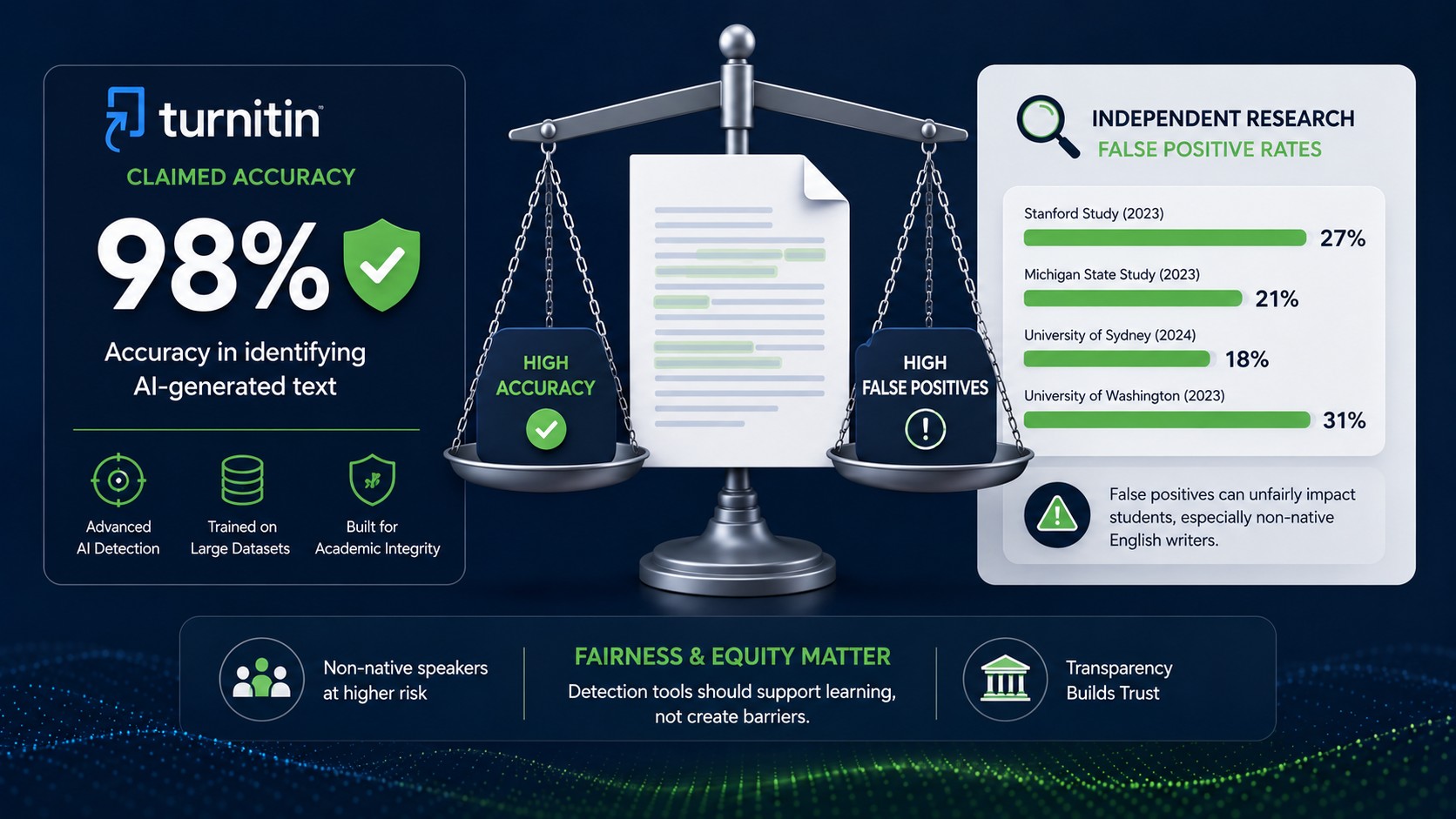
Multiple major institutions have publicly disabled or rejected Turnitin's AI detection as a result. Vanderbilt University disabled the tool in 2023, calculating that even a 1% false positive rate would wrongly flag roughly 750 papers annually. MIT issued a public statement asserting that AI detectors don't work reliably and recommended human-centered assessment instead. The University of California system, Curtin University, and the University of Pittsburgh have all followed similar paths, according to institutional communications and coverage in higher education press. The shared concerns across these institutions: unreliable accuracy, lack of transparency in Turnitin's methodology, and the real harm caused to specific student populations by false accusations.
For non-native English speakers, the risk is particularly pronounced. Writing that relies on standard grammatical structures, limited vocabulary variance, or repetitive phrasing, all common in second-language academic writing, is more likely to be flagged. Not because the work is AI-generated, but because those patterns overlap statistically with what the model is trained to detect. This isn't a minor technical footnote; it's a documented equity problem that led multiple institutions to act. Turnitin has published commentary responding to concerns about false positives and how they interpret flagged results: Turnitin's explanation of false positives.
Practical steps to protect yourself from a false positive
The patterns AI detectors flag most consistently are formulaic sentence construction, generic vocabulary, and predictable information flow. Writing in a personal, conversational voice, varying your sentence length, and grounding your argument in specific examples or anecdotes produces text with the kind of statistical irregularity that genuine human writing carries. This isn't about gaming a system. It's about writing the way your instructors actually want you to write, with a voice that reflects your own thinking and experience.
Your strongest defense against a false positive is a documented paper trail, not just a cleaner writing style. Use Google Docs version history or tools like Draftback to record your drafting progression from first word to final sentence. Write a brief process statement explaining how you approached the assignment. Keep your notes, outlines, and research bookmarks organized. If an instructor questions your work, verifiable evidence of how you wrote it carries far more weight with any academic integrity board than any detector score ever will. For institutional expectations and procedures, consult the Academic Integrity Policy | Easy Assignments.
- Vary sentence length deliberately; mix short punchy sentences with longer, developed ones
- Include specific examples, data points, or personal observations that only you would have
- Keep a running draft with timestamps, or use Google Docs so version history builds automatically
- Write a brief process statement before you submit any major assignment
- Save your research notes and annotated sources as a backup record of your thinking
Why human-written, expert-crafted work changes the equation entirely
Authentic human writing carries statistical fingerprints that AI cannot consistently replicate. Idiosyncratic phrasing, argument structures rooted in specific research decisions, a voice shaped by a writer's knowledge and lived experience, these qualities produce text that sits far outside the uniform statistical patterns Turnitin's model is trained to detect. Independent research characterizes these differences clearly: human-authored writing is substantially less likely to match common LLM output patterns, though no detector is perfect and false positives can still occur. What matters is that the origin of a piece carries more weight than any surface-level editing done after the fact. Running AI-generated content through a secondary paraphrasing tool doesn't eliminate the underlying statistical signature; it often just adds another detectable layer.
When assignments are completed by subject-matter experts writing from scratch based on your specific brief, the result is original in both the plagiarism and AI-detection sense. At EasyAssignments, every piece is written by a verified expert in the relevant subject, produced entirely from scratch, and delivered with a Turnitin originality report so you can review results before submission. Learn more about our approach on the Academic Blog | Easy Assignments.
What you actually need to take away from all of this
Turnitin detection is a probabilistic tool, not a lie detector. It has documented accuracy limitations, known bias against non-native English speakers and neurodivergent students, and a growing list of institutions that no longer rely on it as a primary enforcement mechanism. Understanding how the system works is the first step toward engaging with it calmly, interpreting your own results accurately, and responding effectively if questions ever arise.
For students who want to eliminate the uncertainty entirely, the most reliable path is starting with genuinely human-written work from credentialed experts, work that generates a clean Turnitin report by design, not by luck. Whether you're navigating a demanding deadline or a high-stakes course where your GPA can't afford a false accusation, knowing what Turnitin detection can and can't do gives you a real advantage. Use that knowledge, document your process, and don't let a probability estimate define your academic record. If you're juggling time-sensitive work, check out our tips on staying on track at the Academic Blog | Easy Assignments.
Stop guessing how Turnitin will read your work
Start with genuinely human-written work from credentialed experts, delivered with a Turnitin originality report so you can review results before you submit.