Academic Plagiarism: Definition, Types, and How to Avoid It
Academic plagiarism catches out more students than most people expect, and a surprising share of those violations happen entirely by accident. Understanding exactly where the line is drawn is the first step to protecting your grade and your record.
This guide breaks down how leading universities define plagiarism, the four most common forms, how detection tools actually work, and the practical habits that keep your writing genuinely original.
Academic plagiarism affects more students than most people expect: roughly one in four college students in the United States admits to plagiarizing at least once (based on research tracking a 26.9% rate in 2024, following a peak of 29.0% in 2020). What makes that number unsettling is not that some students cheat deliberately; it's that a significant portion of those violations happen by accident. A missing citation, a paragraph paraphrased too closely to the source, a section recycled from last semester's paper, these are the kinds of mistakes that trigger formal academic misconduct proceedings without the student ever intending to deceive anyone. Serious academic support, whether that means developing better writing habits or working with a credible service that delivers original work by design, starts with understanding exactly where the line is drawn.
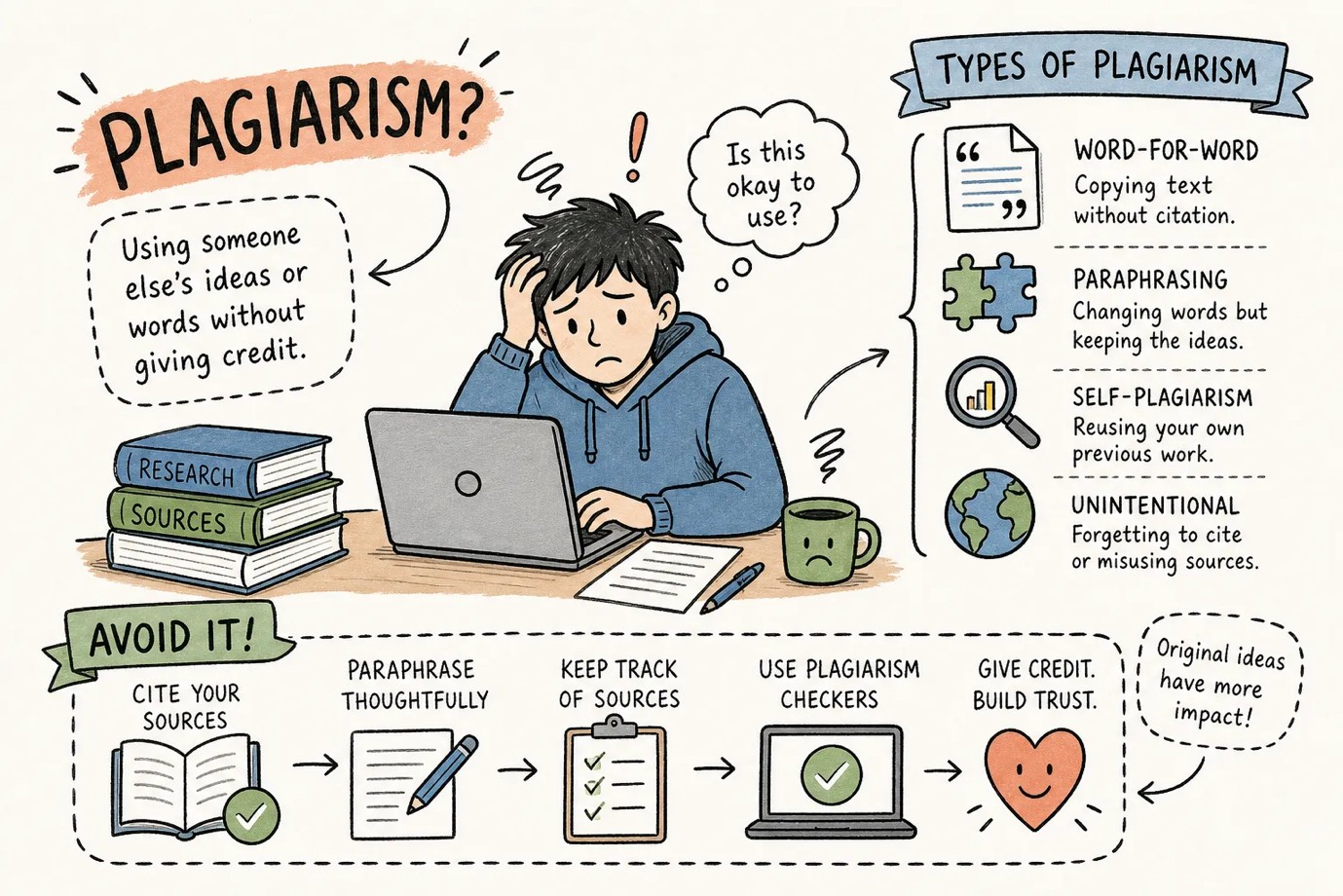
Academic plagiarism, as defined consistently across Oxford, Harvard, Rutgers, UC Berkeley, and the APA, is the act of using another person's words, ideas, or work without proper attribution and presenting that material as your own. The University of Oxford frames it as "the copying or paraphrasing of other people's work or ideas into your own work without full acknowledgment." APA calls it a form of academic fraud. Rutgers specifies that it applies whether the source is published or unpublished, digital or print. Three elements run through every definition: unauthorized use, missing attribution, and false presentation as original work. This article walks through what that means in practice, what happens when a violation is confirmed, how detection tools actually work, and what you can do to protect yourself.
What academic plagiarism actually means
How major universities and style guides define it
The consensus across institutions is more specific than most students realize. Harvard's policy emphasizes that plagiarism covers not just verbatim copying but also "paraphrasing poorly or failing to cite sources," making clear that the act extends far beyond cutting and pasting. UC Berkeley extends the definition explicitly to code, images, and AI-generated output. The APA reinforces that even paraphrased content requires citation because the underlying idea, not just the phrasing, originated with someone else. All of these definitions converge on the same principle: if the intellectual content came from a source and you didn't credit that source, it's plagiarism regardless of how much you rewrote it.

One distinction worth noting is that these definitions come from institutions with very different cultures and academic traditions, yet the language is remarkably consistent. That uniformity signals something important: this is not a matter of institutional preference. It is a settled standard of academic ethics shared across the field.
Why unintentional plagiarism is still plagiarism
Many students believe that intent is a defense. It isn't. Most U.S. university policies treat accidental omission of citation the same way they treat deliberate copying when determining whether a violation occurred. The reasoning is straightforward: institutions place the responsibility on students to learn citation and referencing conventions, and "I didn't know" does not erase the fact that uncredited material appeared in a submitted assignment. Some schools may consider intent when deciding how severe the sanction should be, but the finding of academic dishonesty itself typically stands regardless of what the student meant to do.
This matters practically because the most common plagiarism errors, forgetting a citation mid-draft, paraphrasing too closely, or not realizing that your own prior work needs attribution, are all unintentional. Understanding that intent provides no automatic protection is the first step toward building habits that actually keep you safe.
The four most common forms of academic plagiarism
Direct copying and mosaic plagiarism
Direct plagiarism is the clearest form: copying text word-for-word without quotation marks or a citation. A student who pastes a paragraph from a journal article into their essay and changes nothing has committed direct plagiarism. Mosaic plagiarism, also called patchwriting, is subtler and far more common among college writers. It involves weaving phrases and sentence structures from a source into your own prose while swapping out a few words, creating the appearance of original writing while the underlying architecture belongs to someone else.
Consider this example. The original source reads: "Climate change is accelerating the frequency of extreme weather events, placing disproportionate burdens on low-income communities." A patchwritten version might read: "Global warming is increasing how often severe weather occurs, putting unequal pressure on lower-income populations." The vocabulary changed; the structure, logic, and idea did not. Without a citation, that sentence constitutes plagiarism. A properly paraphrased version would reconstruct the idea from scratch with a different sentence architecture and still include a citation.
Self-plagiarism: the form no one expects
Submitting your own prior work without disclosure is academic dishonesty. Harvard's policy states explicitly that submitting the same or substantially similar work to more than one course without written permission from all instructors is a violation subject to disciplinary action up to withdrawal. The same logic applies to recycling a section from a high school paper or incorporating earlier coursework into a new assignment without acknowledgment. The reasoning behind this policy is that each assignment is meant to represent new intellectual effort; reusing prior work misrepresents the work done in the current course.
If you want to build on a previous paper, ask your instructor first and get that permission in writing. Many professors are willing to allow it when asked transparently; the problem arises when students make that decision unilaterally.
Poor paraphrasing: a hidden trap in academic writing
Genuine paraphrasing requires changing both vocabulary and sentence structure, not just swapping synonyms. A sentence that replaces "demonstrates" with "shows" and "significant" with "major" while keeping the same clause order is not a paraphrase. It is a near-copy. The distinction matters because paraphrased material still requires a citation. The idea came from a source; only the phrasing is yours. Omitting that citation, even when you genuinely rewrote the sentence, is one of the most common accidental citation errors in undergraduate writing.
Academic plagiarism: institutional responses and sanctions
The sanctions ladder: from grade penalties to expulsion
U.S. universities follow a general progression in academic integrity sanctions. Minor or first-time violations typically result in a zero on the assignment or failure in the course. Moderate or repeated offenses escalate to formal academic misconduct records, disciplinary probation, and in some cases a notation on the student's permanent transcript. Severe or intentional violations can result in suspension or expulsion. Most institutions require an administrative hearing where students can admit or deny the charge and, if they deny it, request a formal review. The process varies by school, but the escalating structure is consistent across most academic integrity codes.

The consequences that outlast the grade
A failed assignment affects one grade. A permanent transcript notation follows a student for decades. Law school, medical school, and graduate program applications commonly ask applicants to disclose prior academic misconduct findings, and an affirmative answer requires explanation that can affect admissions decisions. Students found responsible for violations may also be disqualified from receiving Latin Honors, institutional awards, or competitive scholarships. Beyond academia, professional licensing boards in fields like nursing, education, and accounting ask similar disclosure questions. The downstream risk of a confirmed plagiarism finding in academia extends far beyond the semester it happens in.
How plagiarism detection works (and where it stops short)
What the similarity score actually measures
Turnitin breaks submitted text into phrases and compares them against a database of roughly seven trillion matches, including internet sources, scholarly journals, and previously submitted student papers, according to Turnitin's published documentation on its matching methodology. The output is a similarity report with a color-coded percentage: blue for no matches, green for low similarity (1, 24%), yellow for moderate (25, 49%), orange for high (50, 74%), and red for very high (75, 100%). The critical detail is that Turnitin does not determine plagiarism; it flags similarity. Instructors review the highlighted matches and decide whether the similarity constitutes a violation. There is no universal acceptable percentage; a 20% score on a literature review means something entirely different than a 20% score on a personal reflection essay. (For more on the tool's matching and reporting approach, see Turnitin's similarity product.)
False positives and why low scores can still hide real problems
Two scenarios consistently confuse students. First, properly cited direct quotes still appear as matches in the Turnitin report, which can inflate a similarity score even when no misconduct occurred. An instructor reviewing the report will see that the matches are attributed and move on, but a student who sees a red score and panics may not understand why it's high. Second, a low score does not certify a clean paper. Well-reworded content that steals ideas without attribution, where the vocabulary is sufficiently changed to avoid a match, may return a green score while still constituting plagiarism in academia. Turnitin is a similarity detector, not an integrity certifier. Instructors know this, and they evaluate work accordingly.
Seven practical steps to keep your work original
Cite in real time, not after the fact
Inserting citations while you draft, rather than after you finish, is the most reliable way to prevent accidental omission. When you read a source and take notes, record the full citation details immediately: author, title, publication, date, URL. Use visual cues in your notes to distinguish quoted material from paraphrased material from your own ideas, such as different fonts, colors, or brackets. When you move from notes into a draft, carry those citations with you paragraph by paragraph. Waiting until the final polish to add citations creates gaps; sentences get rearranged, sources get forgotten, and the connection between a borrowed idea and its origin disappears.
Paraphrase properly and quote when in doubt
The most reliable technique for genuine paraphrasing is to read the passage, close the source, wait a few seconds, then write the idea from memory before reopening to check. This forces reconstruction rather than modification. For long passages, a common practical guideline holds that if you leave fifteen or more consecutive words unchanged from the original, those words need quotation marks, though exact thresholds can vary by instructor or institution, so confirm your course policy. When technical language, legal definitions, or precisely worded findings cannot be improved by paraphrase, quote directly and cite. Before submitting any major paper, run a self-check through a detection tool so you can review flagged matches while you still have time to address them. (Turnitin offers practical guidance on preventing accidental plagiarism in research and teaching contexts; see Turnitin's guidance on preventing accidental plagiarism.)
Additional steps for keeping your work original:
Label your notes clearly, distinguishing your ideas from source material from the first moment you take them.
Default to citing when you are unsure whether something counts as common knowledge. Over-citing is far safer than under-citing.
Match your in-text citations to your reference list exactly; a mismatch between the two is one of the most common structural citation errors that flags work as uncredited.
Ask your instructor before reusing any prior work, even work you wrote yourself.
Use a consistent citation style throughout the paper; mixing APA and MLA formatting within the same document creates confusion and can render individual citations unverifiable.
When working with a professional writer can help
Some students, those balancing full-time jobs, multiple courses, or hard deadlines, find themselves without the time to build strong citation and referencing habits from the ground up. In those situations, working with a professional academic writing service is one option worth understanding clearly. A qualified writer who knows a subject's source landscape deeply can produce original work that models correct citation practice throughout. It is worth noting, however, that submitting work written by another person may itself constitute a violation of your institution's academic integrity policy, depending on the assignment and the rules of your specific program. Before using any external writing service, review your institution's guidelines and, when appropriate, discuss the assignment with your instructor. (You can also review service-specific commitments, for example EasyAssignments' academic integrity policy.)
EasyAssignments is one service designed with originality as a structural priority. Writers hold verified subject-matter credentials across more than 75 academic disciplines and follow APA, MLA, and Chicago formatting standards throughout. Each completed assignment comes with a similarity report so students can review the originality score before submission (the company also explains its approach to grade guarantees on its blog). For working adult learners, students at online universities, or international students navigating unfamiliar academic formatting conventions, the value is in having a document built correctly from the start, with citations placed accurately, paraphrasing done properly, and formatting consistent throughout. If you are specifically interested in how service guarantees are framed, see EasyAssignments' discussion of its B-grade guarantee.
Conclusion
Academic plagiarism is broader than most students assume, and the consequences are more durable than a single failed assignment. The definitions used by Oxford, Harvard, Rutgers, and UC Berkeley all point to the same core standard: if the idea came from a source and you didn't credit it, it counts, regardless of how much you rewrote it or whether you intended to deceive anyone. The sanctions that follow a confirmed finding, from transcript notations to mandatory disclosure on graduate and professional school applications, can follow a student well past graduation.
Prevention requires consistency more than complexity. Citing as you draft, paraphrasing with genuine structural changes, disclosing prior work before reusing it, and verifying your own similarity score before submission are habits that protect both the grade and the long-term record. Students who build these practices into their workflow are in a meaningfully stronger position than those who rely on a low Turnitin score to tell them everything is fine. And when the workload becomes unmanageable, choosing a service built around originality and verified expertise, and doing so transparently within your institution's guidelines, is a practical decision grounded in the same commitment to academic integrity this article describes.
Protect your grade with original, well-cited work
Verified writers across 75+ disciplines, correct APA, MLA, and Chicago formatting, and a similarity report with every order.