
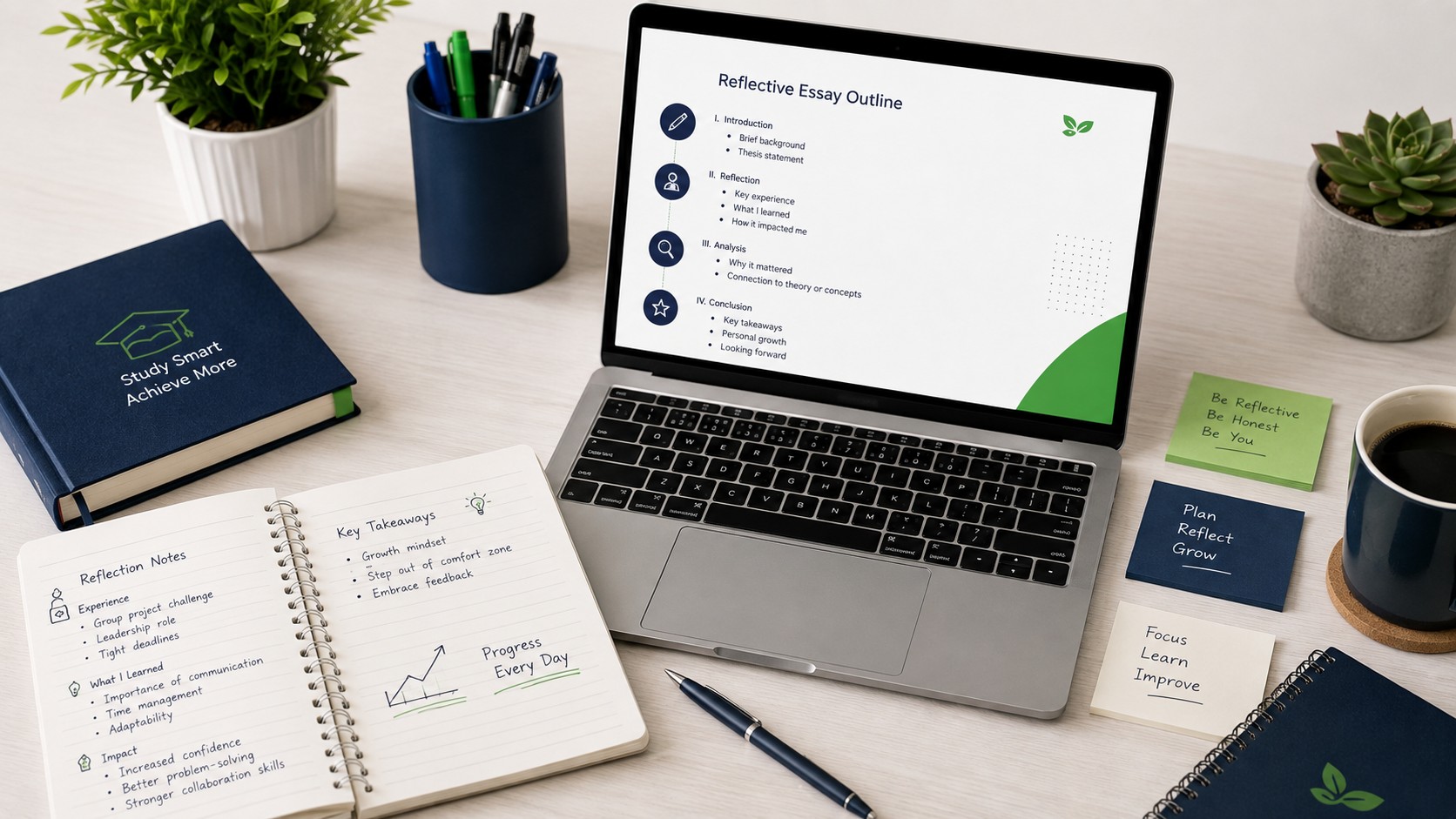
Academic Study Skills Reflective Essay Help With Example
A study skills reflective essay asks you to step back and examine how you actually learn: how you plan your time, take notes, revise, and handle deadlines. Instead of describing a topic, you describe yourself as a learner and explain what you will change.
This guide walks you through the structure, the reflective models tutors expect, the language that earns marks, and a full worked example you can adapt to your own module. By the end, you will know exactly how to turn a semester of study into a clear, honest, well-graded reflection.
What a Study Skills Reflective Essay Actually Is
A study skills reflective essay is a piece of academic writing where you analyse your own learning habits and how they developed over a period of time. Most modules set this task early in a degree, often in a first-year "academic skills," "learning to learn," or "study skills for higher education" course. The aim is not to test whether you know a subject. The aim is to test whether you can look at your own behaviour honestly, connect it to established ideas about learning, and plan realistic improvements.
This makes reflective writing different from almost everything else you produce at university. A standard essay hides the writer behind evidence and argument. A reflective essay puts you at the centre. You are allowed, and usually expected, to write in the first person, to describe emotions like frustration or relief, and to admit where things went wrong. What separates a strong reflection from a weak one is not how positive it sounds, but how thoughtfully you examine what happened and what it means for how you will study next.
Tutors care about this skill because self-aware learners tend to cope better with the independence of higher education. Someone who can recognise that cramming failed them, understand why, and design a better revision routine is far more likely to succeed across three or four years than someone who simply repeats the same habits and hopes for a different result. The essay is a controlled way of building and demonstrating that capacity for self-management.
Key point: Reflection is not the same as description. Describing what you did earns few marks. Analysing why it happened, what it reveals about you as a learner, and what you will do differently is where the grade lives.
Description Versus Reflection: The Distinction That Wins Marks
The single most common reason study skills reflections lose marks is that they stay at the level of description. A descriptive paragraph tells the reader what happened: "I had three deadlines in one week, so I stayed up late to finish them." A reflective paragraph goes further. It asks why the situation arose, how you felt, what you learned about your own planning, and what you would do to prevent it recurring.
A useful test is to read each paragraph and ask, "So what?" If the paragraph only reports events, it is description. If it explains significance and consequence, it is reflection. Aim for a rough balance where a short amount of description sets the scene and the majority of each section digs into meaning. Markers frequently note that students spend eighty percent of the essay narrating and only twenty percent reflecting, when the ratio should be closer to the reverse.
Consider how the same experience reads at each level:
- Description: I read the whole textbook the night before the exam.
- Reflection: Reading the whole textbook the night before left me exhausted and unable to recall detail, which showed me that passive re-reading does not move information into long-term memory. I now understand why my recall was so poor, and I plan to replace last-minute reading with spaced retrieval practice across several weeks.
The second version does everything the first does, then adds emotion, analysis, a link to a learning concept, and a forward-looking commitment. That is the shape every reflective paragraph should aim for.
Reflective Models You Can Use to Structure the Essay
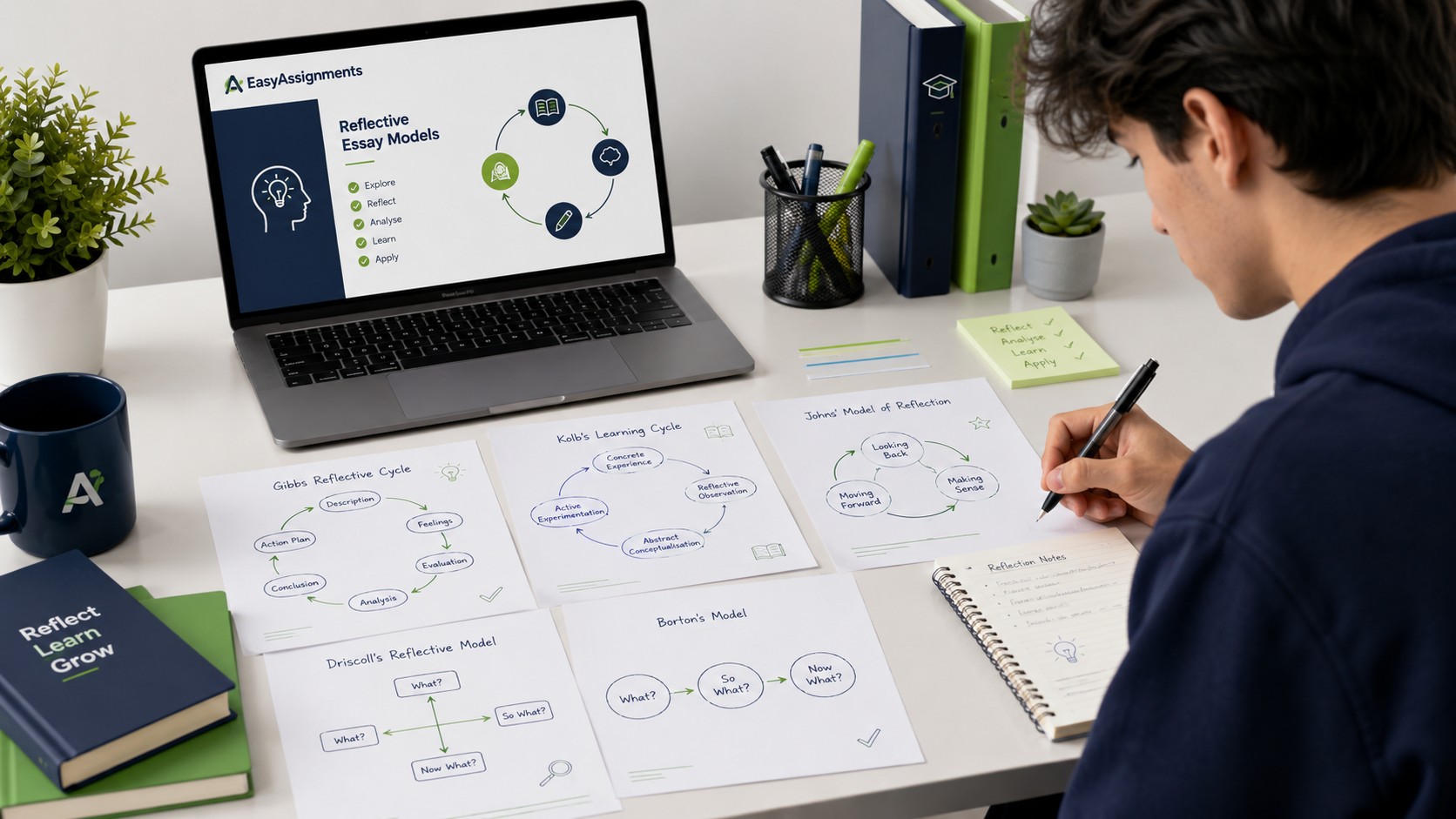
You do not have to reflect from scratch. Several well-established models give you a ready framework, and tutors often award marks specifically for applying one clearly. Choosing a model early gives your essay a spine and stops it drifting into a diary entry. The four below are the ones most commonly recommended in study skills modules.
| Model | Core stages | Best suited to |
|---|---|---|
| Gibbs Reflective Cycle | Description, feelings, evaluation, analysis, conclusion, action plan | A detailed, step-by-step reflection on one clear experience |
| Kolb Experiential Learning | Concrete experience, reflective observation, abstract conceptualisation, active experimentation | Showing how doing led to learning and new practice |
| Rolfe et al. Framework | What? So what? Now what? | Shorter reflections and students new to the format |
| Schon Reflection | Reflection-in-action and reflection-on-action | Distinguishing thinking during study from thinking afterwards |
For most first-year study skills essays, Gibbs is the safest choice because its six stages map neatly onto paragraphs and force you to include feelings, analysis, and an action plan. Rolfe's three questions are excellent if the word count is tight, since "What? So what? Now what?" can carry a whole essay while still moving from event to meaning to change. Whichever you pick, name it in your introduction and let its stages guide your paragraphing so the marker can see the framework working.
How to Structure a Study Skills Reflective Essay
Even with a model guiding your paragraphs, your essay still needs a recognisable academic shape: an introduction, a developed body, and a conclusion. The model shapes the middle. The introduction and conclusion frame it.
The introduction
Open by explaining what the essay will reflect on and why study skills matter to your development. State which reflective model you will use. Briefly signpost the study experiences you will examine, for example note-taking, time management, and exam revision. Keep it short: three or four sentences is usually enough. Avoid dropping straight into a story without telling the reader what the essay is doing.
The body
This is where the reflection happens. Rather than writing about every study skill you own, choose two or three that genuinely changed or challenged you over the term. Depth beats breadth. For each one, move through your chosen model's stages: set the scene briefly, describe how you felt, evaluate what went well and badly, analyse why, and link to a learning concept or piece of reading. Devote a clear section to each skill so the essay has visible structure.
The conclusion and action plan
Draw the threads together by summarising what you have learned about yourself as a learner. Then set out a concrete, realistic action plan. Vague promises like "I will work harder" earn nothing. Specific commitments do: "I will schedule two forty-minute retrieval sessions per module each week and review my planner every Sunday." The action plan is often the most heavily weighted part of the whole essay, so give it room.
Avoid this: Do not turn the essay into a list of everything you are bad at. A reflection that is nothing but self-criticism reads as unbalanced. Show what worked as well as what did not, and frame weaknesses as areas you are actively addressing.
Study Skills Worth Reflecting On
If you are unsure which experiences to write about, the following areas nearly always produce rich reflection because most students have a real story attached to each one. Pick the two or three where your own experience is most vivid.
- Time management and planning: how you handled competing deadlines, whether you used a planner, and how estimating task length affected your stress levels.
- Note-taking: whether you copied slides passively or built your own summaries, and how that affected recall and revision.
- Reading strategy: how you approached long reading lists, whether you read with a purpose, and how you decided what to skim and what to study closely.
- Revision and memory: how you prepared for assessments, and whether active methods like self-testing outperformed re-reading.
- Academic writing: how you planned essays, managed feedback, and improved structure or referencing across submissions.
- Group work and communication: how you contributed, handled disagreement, and coordinated shared deadlines.
The strongest essays often trace one or two of these across the whole term, showing a starting point, a moment of difficulty, and a genuine shift in approach. That arc of change is exactly what markers reward.
Stuck turning your experience into an essay?
Our academic writing specialists can help you plan, structure, and polish a reflective essay that sounds like you and hits the marking criteria. Get guidance built around your own module brief.
A Worked Example: Study Skills Reflective Essay Using Gibbs
Below is a short worked example built on the Gibbs Reflective Cycle. It is deliberately compact so you can see how each stage connects. Use it as a model of structure and reasoning, then write your own version from your genuine experience. Your tutor wants your reflection, not a template filled in with generic phrases.
Introduction
This essay reflects on my development as an independent learner during my first semester at university, focusing on time management and exam revision. I use the Gibbs Reflective Cycle to structure my reflection, moving from what happened to how I now plan to study differently. I have chosen these two skills because both caused me real difficulty and both taught me the most about how I learn.
Description
In my first semester I had three assessments due within a single week. I had known the dates since the start of term but had not planned backwards from them. As the week approached, I attempted to write two essays and revise for one exam at the same time, mostly by re-reading lecture slides late at night.
Feelings
I felt overwhelmed and anxious. During the week itself I was tired and irritable, and I doubted whether I belonged at university. After submitting the work, I felt relief rather than pride, which told me something was wrong with my approach rather than my ability.
Evaluation
Some things worked. I met every deadline and passed each assessment. However, the quality suffered. My essays lacked depth because I wrote them too quickly, and my exam recall was weak because re-reading did not help me remember. The cost in stress and sleep was far higher than it needed to be.
Analysis
Reflecting on why this happened, I can see that I relied on passive study methods and had no system for spreading work across the term. Re-reading feels productive but does little for long-term memory, whereas retrieval practice, actively recalling information without looking, strengthens it. My time problem was not a lack of hours but a lack of planning: I had never broken large tasks into smaller scheduled steps, so everything collapsed into one week.
Conclusion
This experience taught me that my main weakness is not intelligence or effort but planning and study method. I now understand that how I study matters more than how long I study, and that managing deadlines early prevents the stress that damaged my work.
Action plan
Next semester I will map every assessment deadline into a planner in week one and work backwards to set my own earlier milestones. I will replace re-reading with weekly retrieval practice, testing myself on each module without notes. I will also review my planner every Sunday evening to adjust for the week ahead. If I follow this system, I expect less stress and stronger work.
Notice the pattern: Each stage does one job, feelings are named honestly, analysis links to a real learning concept, and the action plan is specific enough to follow. That is what turns a diary entry into a graded reflective essay.

Language and Tone for Reflective Writing
Reflective writing has its own register, and getting it right signals to the marker that you understand the genre. First-person pronouns are not only allowed but expected, since the essay is about you. At the same time, the writing should stay academic in tone: thoughtful, structured, and free of slang.
Certain sentence stems help you sound analytical rather than merely descriptive. Phrases such as "On reflection, I now realise," "This experience showed me that," "In hindsight, I would," and "What I found difficult was" push you naturally toward meaning and change. Tentative language also has a place, because reflection is honest and provisional rather than absolute. Writing "this suggests that I tend to" is often truer than claiming a fixed conclusion about yourself.
Where your module allows or requires it, connect your experiences to reading. Referencing a study skills text or a learning theory when you analyse your habits shows you can link personal experience to established ideas, which lifts a reflection from anecdote to academic work. Always check your brief, since some study skills essays want light referencing and others want none.
Common Mistakes to Avoid
Knowing the traps in advance is one of the fastest ways to raise your grade. The following mistakes appear again and again in study skills reflections.
Pure narration
Telling the story of your term without analysing it. Every event needs a "so what" that explains its significance for you as a learner.
No action plan
Ending on what you learned but never saying what you will do. The forward-looking commitment is usually the highest-weighted part.
Ignoring the model
Naming a reflective model in the introduction, then never using its stages. Let the framework visibly shape your paragraphs.
Only listing weaknesses
Turning the essay into relentless self-criticism. Balanced reflection shows strengths too and frames weaknesses as work in progress.
Two smaller issues also cost marks: writing too vaguely, so the reader cannot picture any specific experience, and running over into unrelated topics instead of staying focused on study skills. Anchor every paragraph in a concrete moment from your own term, and keep the lens firmly on how you learn.
A Simple Process for Writing Yours
If you are staring at a blank page, this sequence turns the task into manageable steps. Work through them in order rather than trying to write the finished essay in one pass.
- List every study experience from the term that felt significant, whether positive or difficult.
- Choose the two or three that taught you the most and would make the richest reflection.
- Pick a reflective model and map each experience onto its stages in rough notes.
- Draft the body first, one section per skill, focusing on analysis over narration.
- Write a specific, realistic action plan for each skill you covered.
- Add the introduction and conclusion once the body exists, so they match what you actually wrote.
- Edit for the description-to-reflection ratio, cutting narration and expanding analysis wherever a paragraph only reports events.
Writing the middle before the ends is a small trick that saves a great deal of rewriting, because your introduction can only promise what the body delivers. When the reflection is done, the frame writes itself.
Frequently Asked Questions
Can I write a study skills reflective essay in the first person?
Yes. Reflective essays are about your own experience, so first-person pronouns like "I" and "my" are expected. Keep the tone academic and analytical even while writing personally, and always check any specific instructions in your assignment brief.
Which reflective model should I choose?
For most first-year study skills essays, the Gibbs Reflective Cycle works well because its six stages map neatly onto paragraphs and force you to include feelings and an action plan. If your word count is tight, the Rolfe "What? So what? Now what?" framework is simpler while still moving from event to meaning to change.
How long should a study skills reflective essay be?
Length depends entirely on your brief, but many first-year reflections fall between roughly 1000 and 2000 words. Rather than chasing a number, cover two or three study skills in real depth. Focused, analytical writing scores better than a longer essay that only describes events.
Do I need to reference sources in a reflective essay?
It depends on the module. Some study skills essays want light referencing to a learning theory or study skills text when you analyse your habits, while others focus purely on personal reflection. Check your brief, and where referencing is expected, link your experiences to established ideas about learning.
Turn Your Semester Into a Strong Reflective Essay
From choosing a model to writing an action plan that earns marks, EasyAssignments can help you produce an original, well-structured study skills reflective essay built around your own experience and brief.