
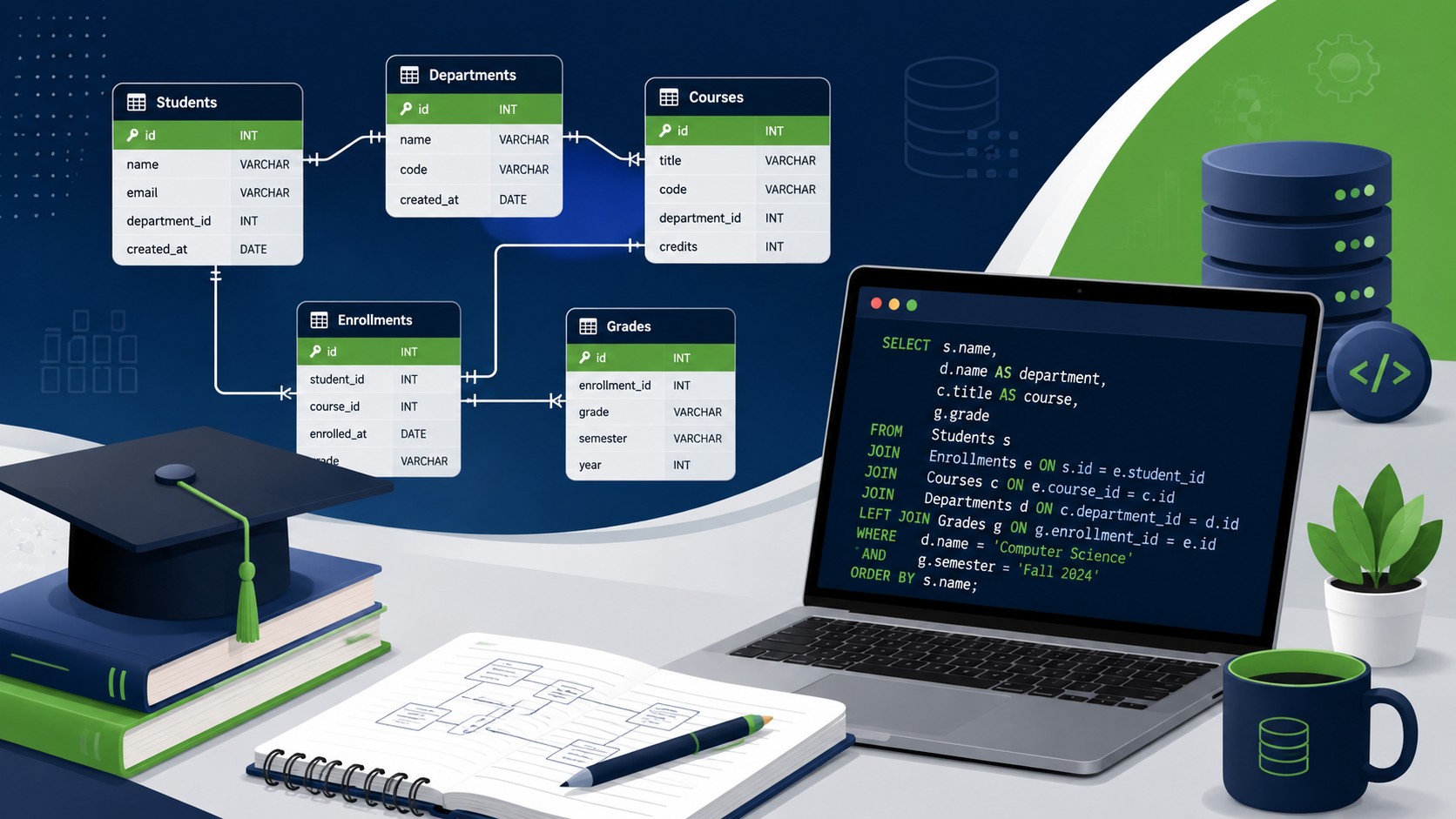
SQL Database Assignment Help for College Students
Databases sit at the core of almost every computer science and information systems program, yet SQL assignments trip up more students than nearly any other topic. If your queries keep returning the wrong rows or your schema diagrams never quite make sense, you are far from alone.
This guide walks through the SQL and database concepts college students find hardest, shows you how to approach each type of assignment, and explains where expert SQL database assignment help fits in when a deadline is closing fast.
Why SQL Database Assignment Help Is in Such High Demand
SQL looks deceptively simple at first. You learn a handful of keywords like SELECT, FROM, and WHERE, run a few queries against a sample table, and everything seems manageable. Then the coursework grows teeth. Suddenly you are joining five tables, writing correlated subqueries, normalizing a messy schema, and being graded on both the correctness of your output and the efficiency of your approach.
The gap between introductory examples and real assignment requirements is where most students get stuck. A database course blends abstract theory, such as relational algebra and normalization rules, with hands-on skills like writing precise queries and modeling data. Few other subjects demand that you switch between conceptual reasoning and exact syntax so quickly, and a single misplaced comma or forgotten join condition can break an entire result set.
SQL database assignment help exists to close that gap. Good help does not just hand you an answer. It shows you why a query is structured a certain way, how a schema should be organized, and what patterns you can reuse on the next problem. That combination of a working solution and a clear explanation is what turns a stressful assignment into a genuine learning moment.
Key point: The students who improve fastest treat every solved assignment as a template. Once you understand why a join or a normalization step works, you can apply the same reasoning to dozens of future problems.
The SQL Topics That Give Students the Most Trouble
Database courses cover a wide range of material, but a few topics reliably generate the most confusion and the most requests for help. Understanding where the difficulty comes from is the first step to overcoming it.
Joins and Relationships
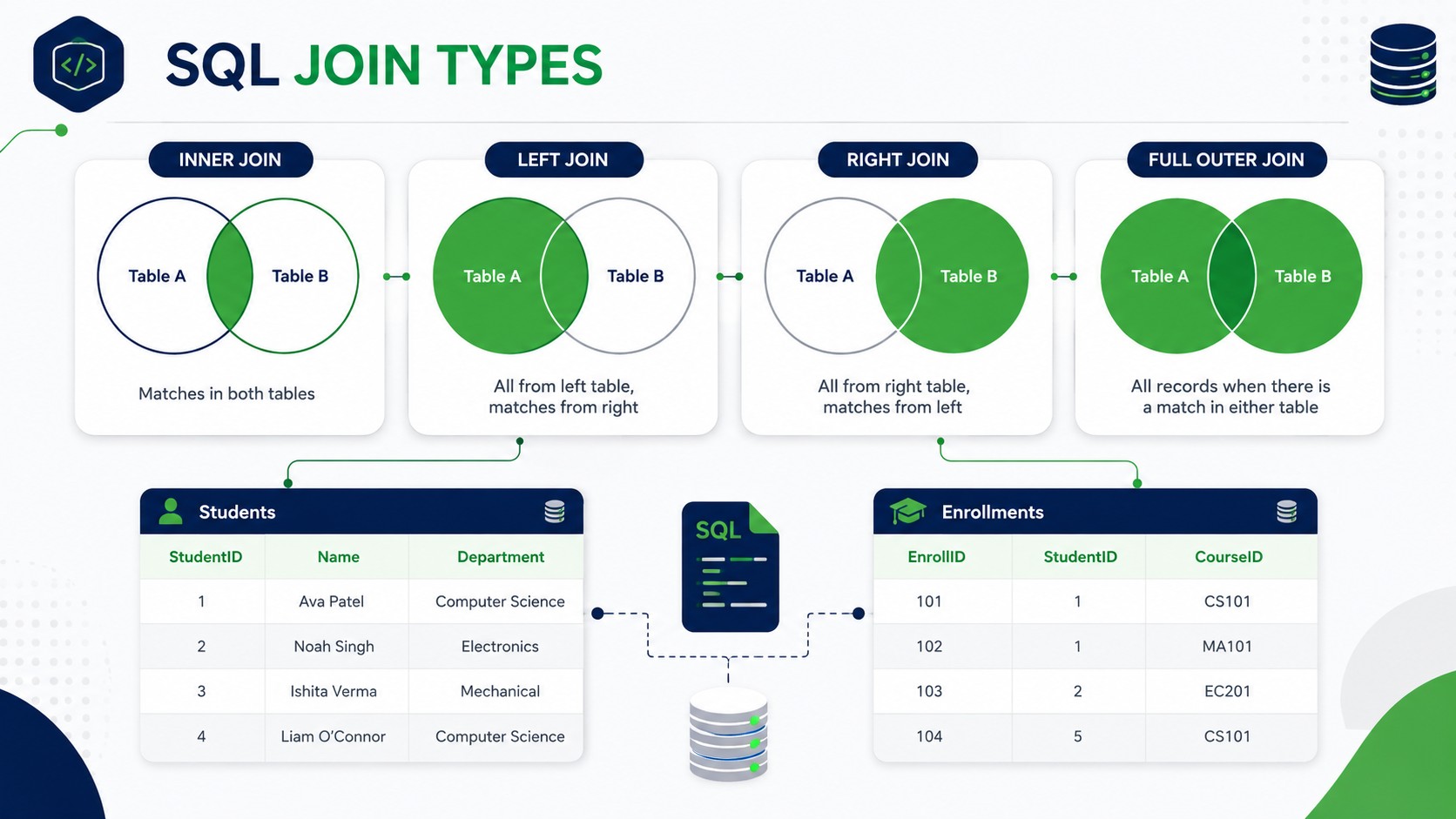
Joins are the single most common stumbling block. Students often understand an INNER JOIN but freeze when a question requires a LEFT JOIN, a RIGHT JOIN, a FULL OUTER JOIN, or a self join. The trouble usually is not the syntax itself but a shaky mental model of how rows from two tables are actually matched and combined. When you cannot picture the intermediate result set, choosing the right join type feels like guesswork.
The fix is to think in terms of what you want to keep. An inner join keeps only matching rows from both tables. A left join keeps every row from the left table and fills unmatched columns from the right with nulls. Once you frame every join question as "which rows must survive even when there is no match," the correct choice becomes far clearer.
Subqueries and Nested Logic
Subqueries confuse students because they invert the usual reading order. You have to evaluate the inner query first, then feed its result into the outer query. Correlated subqueries add another layer, since the inner query re-runs for each row of the outer query. Assignments that ask for "the customers who spent more than the average" or "products never ordered" almost always require this kind of nested thinking.
Aggregation and Grouping
The combination of GROUP BY, HAVING, and aggregate functions such as COUNT, SUM, and AVG causes a lot of errors. A frequent mistake is trying to filter aggregated results with WHERE instead of HAVING, or including a column in the SELECT list that is neither aggregated nor part of the GROUP BY clause. These rules feel arbitrary until you understand that grouping collapses many rows into one summary row.
Normalization and Schema Design
Normalization is where theory-heavy assignments live. You are asked to take a poorly structured table full of redundancy and break it into well-organized tables that satisfy first, second, and third normal form, sometimes going all the way to Boyce-Codd normal form. This requires spotting functional dependencies, which is a skill that takes real practice to develop. Design-focused assignments also ask you to draw entity relationship diagrams and translate them into correct table structures with proper keys.
Types of SQL Database Assignments You Might Face
Not every database assignment looks the same. Knowing which category you are dealing with helps you plan your time and know what a strong answer should contain. Most college SQL work falls into a handful of recognizable types.
| Assignment Type | What It Asks For | Common Challenge |
|---|---|---|
| Query writing | Write SQL to answer specific business questions | Choosing correct joins, filters, and grouping |
| Schema design | Design tables, keys, and relationships from requirements | Modeling entities and enforcing referential integrity |
| Normalization | Decompose tables to reduce redundancy | Identifying functional dependencies correctly |
| ER diagrams | Model data visually before implementation | Representing cardinality and weak entities |
| Stored procedures | Write reusable procedural database logic | Control flow, parameters, and error handling |
| Full projects | Build and populate a complete database | Combining design, queries, and documentation |
Query-Based Assignments
These are the bread and butter of any database course. You are given a schema, sometimes with sample data, and asked to answer a set of questions using SQL. The questions typically escalate in difficulty, starting with simple filters and building toward multi-table joins, nested subqueries, and window functions. The grading usually rewards not only correct output but also clean, readable queries.
Design and Modeling Assignments
Here you start from a written description of a business scenario, such as a library, a hospital, or an online store, and must produce a schema that captures every entity and relationship. These assignments test whether you can translate vague human requirements into precise tables, primary keys, foreign keys, and constraints. A good answer anticipates edge cases, such as a customer who has placed no orders or a product that belongs to multiple categories.
Theory and Analysis Assignments
Some assignments lean on written explanation rather than code. You might be asked to compare indexing strategies, explain the ACID properties of transactions, discuss the trade-offs between normalization and query performance, or analyze why a particular query is slow. These reward clear technical writing as much as database knowledge.
Stuck on a Database Assignment Right Now?
Whether it is a single tricky query or a full end-of-term database project, our team can help you understand it and finish it on time.
A Step-by-Step Approach to Any SQL Assignment
The students who consistently produce strong work tend to follow a repeatable process rather than diving straight into typing queries. Adopting a clear method reduces errors and makes even complex problems feel approachable.
Read the Schema Before You Write Anything
Before writing a single line of SQL, study the table structures. Identify the primary key of each table, note the foreign keys that connect them, and sketch the relationships on paper if it helps. Many mistakes come from misunderstanding how tables relate, not from bad syntax. Knowing that an orders table links to a customers table through a customer id column tells you exactly how the join must work.
Break the Question Into Pieces
Complex questions become manageable when you decompose them. A prompt like "list the top three customers by total spending in the last year" contains several distinct steps: filter by date, group by customer, sum the spending, sort the results, and limit to three. Tackle each piece in order and test as you go rather than trying to write the whole query at once.
Build Queries Incrementally
Start with a basic SELECT that returns the raw rows you need, confirm it works, then layer on joins, filters, grouping, and ordering one at a time. Running the query after each addition tells you immediately when something breaks, so you can fix it before the logic gets tangled. This habit alone prevents a huge share of the frustration students feel.
Test With Edge Cases
Once a query runs, do not assume it is correct just because it returned results. Check what happens with customers who have no orders, products with null prices, or dates on the boundary of a range. Assignments are often graded against hidden test data, so a query that works on the obvious cases but fails on the tricky ones will still lose marks.
Watch out: Copying a query that produces the right numbers without understanding it is a trap. Instructors frequently follow up with in-class questions or exam problems built on the same logic, so genuine comprehension always pays off more than a quick shortcut.
Common Mistakes That Cost Easy Marks
Many students lose points not because a concept was too hard but because of avoidable errors. Watching for these common pitfalls can noticeably improve your grades.
- Using WHERE to filter aggregated values instead of HAVING, which the database will reject or evaluate incorrectly.
- Forgetting the join condition and accidentally producing a Cartesian product with far too many rows.
- Selecting columns that are not in the GROUP BY clause and are not wrapped in an aggregate function.
- Ignoring null values, which behave differently from empty strings and can silently break comparisons.
- Leaving out foreign key constraints in design assignments, so the schema fails to enforce referential integrity.
- Writing everything as one giant unreadable query when subqueries or common table expressions would be cleaner and easier to grade.

How to Get the Most From SQL Database Assignment Help
Reaching out for help is a smart move when you are stuck, but the way you use that help determines how much you gain from it. The goal is always to finish the current assignment while building skills you keep for future courses and, eventually, your career.
Share the Full Context
When you request help, provide the complete assignment brief, the schema, any sample data, and the specific database engine you are required to use, since MySQL, PostgreSQL, Oracle, and SQL Server differ in syntax and available functions. The more context you share, the more precise and useful the solution will be. A query written for PostgreSQL may not run unchanged on Oracle, so those details matter.
Ask for Explanations, Not Just Answers
A finished query is far more valuable when it comes with commentary on why each part exists. When you receive worked solutions, read the reasoning behind each join, filter, and grouping choice. That is what allows you to reproduce the approach on your next assignment and in exams where no help is available.
Use It as a Study Tool
Treat solved assignments as a personal reference library. Keep a document of query patterns you have learned, common normalization steps, and design decisions that worked. Over a semester, this collection becomes a powerful revision resource that no textbook can match because it is written in the context of your own coursework.
Remember: Expert help is most effective when it is a supplement to your own effort, not a replacement for it. The combination of trying first, then reviewing an expert solution, produces the fastest learning.
What Good SQL Assignment Support Looks Like
Not all help is created equal. When you are choosing where to turn, look for support that genuinely serves your learning rather than just handing over a file. The best help shares a few consistent qualities.
Correct and Tested
Queries and schemas are actually run and verified against sample data, not just written to look right on paper.
Clearly Explained
Every solution comes with reasoning so you understand the logic and can defend your work if asked.
Engine-Aware
Solutions respect the exact database system your course requires, from MySQL to Oracle to PostgreSQL.
Delivered on Time
Work arrives with enough margin for you to review it, ask questions, and make it your own before the deadline.
At EasyAssignments, support is built around these principles. Whether you need a single query untangled or a full database project guided from design through documentation, the aim is always to leave you understanding the material better than before. You can get a free quote in minutes or talk to support if you want to discuss your assignment first.
Building SQL Skills That Last Beyond the Assignment
SQL is one of the most durable skills you can learn in college. Long after a specific assignment is graded and forgotten, the ability to query and design databases remains valuable across software development, data analysis, business intelligence, and countless other fields. Treating your coursework as skill-building rather than a chore pays off well past graduation.
To keep improving, practice regularly with small self-directed exercises, rewrite past assignment queries in different ways to see alternatives, and read other people's solutions to learn new patterns. Try recreating a database you use in daily life, such as a music library or a class schedule, and write queries against it. The more you connect SQL to real situations you understand, the more intuitive the syntax becomes.
When you do get stuck, and everyone does, remember that asking for well-explained help is not a failure. It is the same thing professionals do when they hit a hard problem. The difference between a student who struggles all semester and one who thrives is often just a willingness to seek clarity early rather than falling further behind.
Frequently Asked Questions
Can I get SQL database assignment help for any database system?
Yes. SQL database assignment help covers all the major engines, including MySQL, PostgreSQL, Oracle, and SQL Server. Because these systems differ in syntax and functions, sharing which one your course requires ensures the solution runs correctly in your environment.
Is it just queries, or can you help with design and normalization too?
Both. Support extends beyond query writing to schema design, entity relationship diagrams, normalization to third normal form and beyond, stored procedures, and complete end-to-end database projects with documentation.
Will I actually understand the solution I receive?
That is the whole point. Strong help pairs a working solution with clear explanations of why each join, filter, and design choice was made, so you can reproduce the approach in future assignments and exams.
How quickly can I get help with a tight deadline?
Turnaround depends on the complexity and scope of the assignment, but the goal is always to deliver with enough margin for you to review the work and ask follow-up questions. Reach out through support with your deadline and we will let you know what is possible.
Finish Your SQL Assignment With Confidence
From a single stubborn query to a full database project, get clear, tested, and well-explained SQL database assignment help built around your learning.