

Expert Help With SQL Homework From Fundamentals to Advanced Queries
Databases power almost everything you touch, from banking apps to social feeds, yet SQL homework has a reputation for humbling even confident programming students. A query that looks perfectly reasonable can return zero rows, duplicate every record three times, or crash with an error message that explains nothing.
This guide walks you through how to actually get help with SQL homework in a way that builds skill instead of dependency. You will learn the concepts your assignments are testing, a repeatable method for debugging broken queries, the traps that catch nearly everyone, and how to work with an expert without handing off your own understanding.
Why SQL Homework Feels Harder Than It Should
Most students meet SQL after they have already learned a procedural language like Python, Java, or C. That prior experience can work against you, because SQL does not think the way those languages do. In a procedural language you tell the computer how to do something step by step: loop over this list, check each item, add it to a running total. SQL is declarative. You describe what you want, and the database engine decides how to fetch it. This mental shift is the single biggest reason help with SQL homework is in such constant demand. The syntax is small and learnable in an afternoon, but the way of thinking takes real practice to internalize.
The second reason SQL homework trips people up is that a query can be syntactically perfect and still be completely wrong. Your code runs, it returns rows, and there is no error in sight, yet the answer does not match what the question actually asked. A missing filter, a join on the wrong column, or a forgotten grouping can quietly produce results that look plausible. In a normal programming assignment a bug usually announces itself with a crash. In SQL, the most dangerous bugs are silent.
Third, SQL assignments are almost always tied to a specific database schema that you did not design and may barely understand. Before you can write a single meaningful query, you have to reverse engineer how the tables relate, which columns are keys, and where the data you need actually lives. Students who skip this step and dive straight into writing SELECT statements almost always struggle, because they are guessing at relationships instead of reading them.
The core insight: SQL rewards people who slow down and understand the data model before writing code. The students who struggle most are usually the ones typing queries the fastest. Understanding the schema is not a warm up exercise, it is most of the actual work.
None of this means SQL is beyond you. It means the skill you are building is a genuinely new one, and that struggling with it is normal rather than a sign that you are bad at programming. The rest of this guide gives you the concepts, the method, and the habits that turn SQL from a source of frustration into one of the most reliably useful skills you will carry into any technical career.
The Core SQL Concepts Your Homework Is Testing
Almost every SQL assignment, no matter how it is dressed up, is testing a handful of core ideas. If you can recognize which idea a question is really about, you are halfway to the answer. Let us walk through the concepts that show up again and again, roughly in the order most courses introduce them.
Filtering and the WHERE clause
The simplest queries select columns from a table and filter rows with a WHERE clause. This sounds trivial, and the basic form is, but WHERE is where many silent errors begin. Comparisons involving NULL are the classic trap. In SQL, NULL means unknown, not zero and not empty string. A condition like salary > 50000 will quietly exclude every row where salary is NULL, because the database cannot say whether an unknown value is greater than fifty thousand. Students lose marks constantly because they forget that NULL rows disappear from filtered results unless they explicitly handle them with IS NULL or IS NOT NULL.
The other frequent WHERE mistake is confusing AND with OR when combining conditions. A request like find customers in Texas or California who spent over one hundred dollars needs careful parenthesization. Written without parentheses, the AND and OR precedence rules can bind the conditions in a way you did not intend, and the query returns the wrong customers while looking perfectly reasonable.
Joins: the heart of relational databases
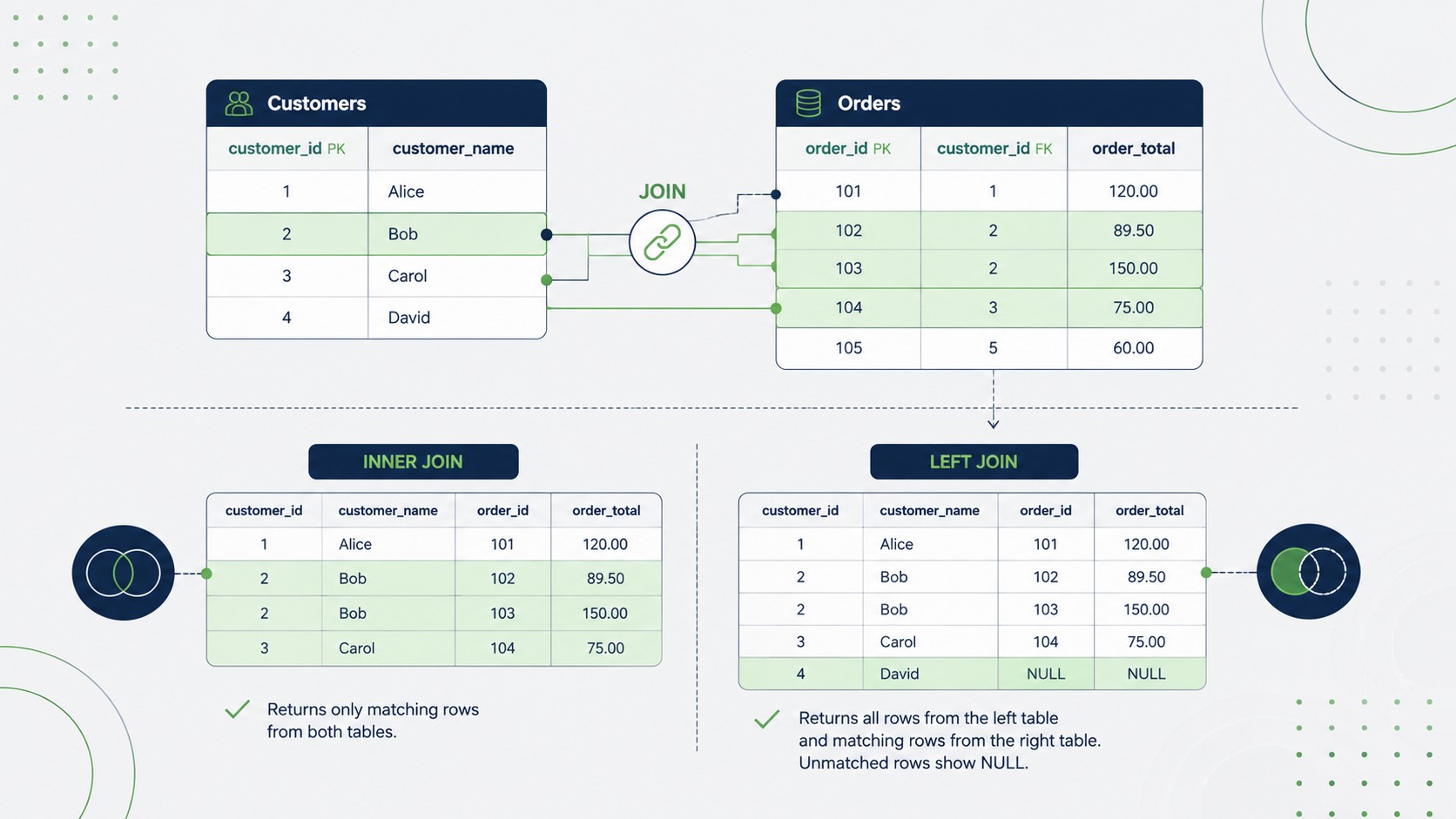
Joins are where SQL homework separates the students who understand relational databases from those who are pattern matching. A join combines rows from two or more tables based on a related column, usually a key. The concept is simple to state and endlessly easy to get wrong in practice.
The four join types you must know cold are the inner join, which returns only rows that match in both tables; the left join, which keeps every row from the left table and fills in NULLs where the right table has no match; the right join, which does the reverse; and the full outer join, which keeps unmatched rows from both sides. Choosing the wrong one is one of the most common reasons a query returns the wrong number of rows. If your assignment asks for all customers including those who have never placed an order, an inner join will silently drop the customers you were specifically asked to include, because they have no matching orders.
The subtler join problem is accidental row multiplication. When you join tables on a column that is not unique on one side, every matching row combines with every matching row on the other side. A customer with three orders joined to a table with two shipping records per order can suddenly appear six times. Your row counts balloon, your sums double, and nothing looks obviously broken. Whenever a join makes your result set larger than you expected, suspect a many to many relationship you did not account for.
Aggregation and GROUP BY
Aggregate functions like COUNT, SUM, AVG, MIN, and MAX collapse many rows into a single summary value. On their own they are easy. The complexity arrives with GROUP BY, which splits your rows into buckets and applies the aggregate to each bucket separately. The rule that catches everyone is that any column in your SELECT list that is not inside an aggregate function must appear in the GROUP BY clause. Forget this and you either get an error, in strict databases, or a misleading arbitrary value, in lenient ones.
Layered on top of GROUP BY is the distinction between WHERE and HAVING. WHERE filters individual rows before they are grouped. HAVING filters the groups after aggregation. If your assignment asks for departments with more than ten employees, you cannot use WHERE to check the count, because the count does not exist until after grouping. That condition belongs in HAVING. Mixing these two up is one of the most common conceptual errors in intermediate SQL homework.
Subqueries and nested logic
A subquery is a query inside another query. They let you answer questions in stages: find the average order value, then find every order above it. Subqueries can live in the WHERE clause, the FROM clause, or even the SELECT list, and each position behaves a little differently. Correlated subqueries, which reference the outer query and run once per outer row, are especially powerful and especially confusing. Many assignments that look impossible at first become straightforward once you break them into a subquery that answers one small question and an outer query that uses that answer.
Watch out: A query that runs without errors is not the same as a correct query. Always sanity check your row counts and spot check a few results by hand against the raw data. Silent logic errors are the number one reason SQL homework loses marks even when the code looks clean.
Window functions and advanced features
Higher level courses introduce window functions, which perform calculations across a set of rows related to the current row without collapsing them the way GROUP BY does. Functions like ROW_NUMBER, RANK, and running totals using SUM with an OVER clause are common assignment topics. They feel intimidating because the syntax is unfamiliar, but conceptually they answer a clear class of questions: rank these salespeople within each region, number the orders per customer in date order, calculate a running balance. If your homework mentions ranking, running totals, or comparisons to previous rows, window functions are almost certainly the intended tool.
A Repeatable Method for Debugging Broken Queries
The single most useful skill you can build is a calm, repeatable way to fix a query that is not doing what you want. Panic and random edits waste hours. A structured approach usually finds the problem in minutes. Here is a method that works for almost every stuck query.
Step one: read the schema again
Before touching your query, go back to the table definitions. Confirm the exact column names, their data types, and which columns are the primary and foreign keys. A shocking number of SQL bugs come from joining on the wrong column or comparing a text field to a number. Two minutes with the schema saves twenty minutes of guessing.
Step two: build the query in layers
Do not write a five table join with grouping and subqueries all at once and hope it works. Start with a single table and a basic SELECT. Run it. Add one join. Run it and check the row count. Add the WHERE clause. Run it. Add the grouping. Run it. By building incrementally you catch the exact moment the results go wrong, which tells you precisely which piece is at fault. When a complex query is broken, collapsing it back to a simpler version and rebuilding is faster than staring at the whole thing.
Step three: check your row counts obsessively
After every join, ask whether the number of rows makes sense. If joining orders to customers should give you one row per order but your count doubled, you have found a multiplication bug before it poisons your aggregates. Row counts are the single best early warning system in SQL debugging.
Step four: read the error message literally
SQL error messages are terse but usually honest. An unknown column error means exactly that: check spelling, check the table alias, check whether the column is actually in the table you think it is. An ambiguous column error means the same column name exists in two joined tables and you need to qualify it with a table name or alias. Resist the urge to change things randomly. Read the message, find the named object, and fix that specific thing.
Stuck on a Query That Will Not Cooperate?
Send us the assignment, the schema, and what you have tried so far. We will help you get a working, fully explained solution so you understand the logic, not just the output.
SQL Dialects: Why the Same Query Behaves Differently
One frustration that surprises students is that SQL is not truly one language. The core is standardized, but every database system adds its own quirks, functions, and syntax. Code that runs perfectly in one system throws an error in another. If your course uses PostgreSQL and you copy a solution written for SQL Server, you will hit mismatches. Knowing which dialect your assignment expects prevents a whole category of avoidable errors.
| Feature | MySQL | PostgreSQL | SQL Server |
|---|---|---|---|
| Limiting rows | LIMIT 10 | LIMIT 10 | TOP 10 or OFFSET FETCH |
| String concatenation | CONCAT() function | Double pipe operator | Plus sign or CONCAT() |
| Case sensitivity | Often case insensitive | Case sensitive by default | Depends on collation |
| Auto increment key | AUTO_INCREMENT | SERIAL or IDENTITY | IDENTITY |
| Current date and time | NOW() | NOW() or CURRENT_TIMESTAMP | GETDATE() |
The practical takeaway is simple: always confirm the database system your course uses before you start, and be careful about solutions you find online, since they may be written for a different dialect. When you ask for help with SQL homework, mentioning your exact database system up front saves everyone time and prevents solutions that will not run in your environment.
The Most Common SQL Homework Mistakes
After the concepts and the debugging method, it helps to know the specific mistakes that cost the most marks. These are the errors that appear on assignment after assignment, and simply being aware of them will lift your grade.
- Ignoring NULLs: Forgetting that NULL comparisons behave differently and quietly drop rows from your results.
- Wrong join type: Using an inner join when the question requires keeping unmatched rows, or vice versa.
- Accidental row multiplication: Joining on non unique columns and inflating counts and sums.
- WHERE versus HAVING: Trying to filter aggregated values with WHERE instead of HAVING.
- Missing GROUP BY columns: Selecting non aggregated columns that are not in the GROUP BY clause.
- Assuming order: Expecting rows in a particular order without an ORDER BY clause. Databases do not guarantee ordering otherwise.
- Copying the wrong dialect: Using functions or syntax that do not exist in your specific database system.
- Not reading the question fully: Answering a slightly different question than the one asked, which is the most avoidable mistake of all.
How to Get Help With SQL Homework the Right Way
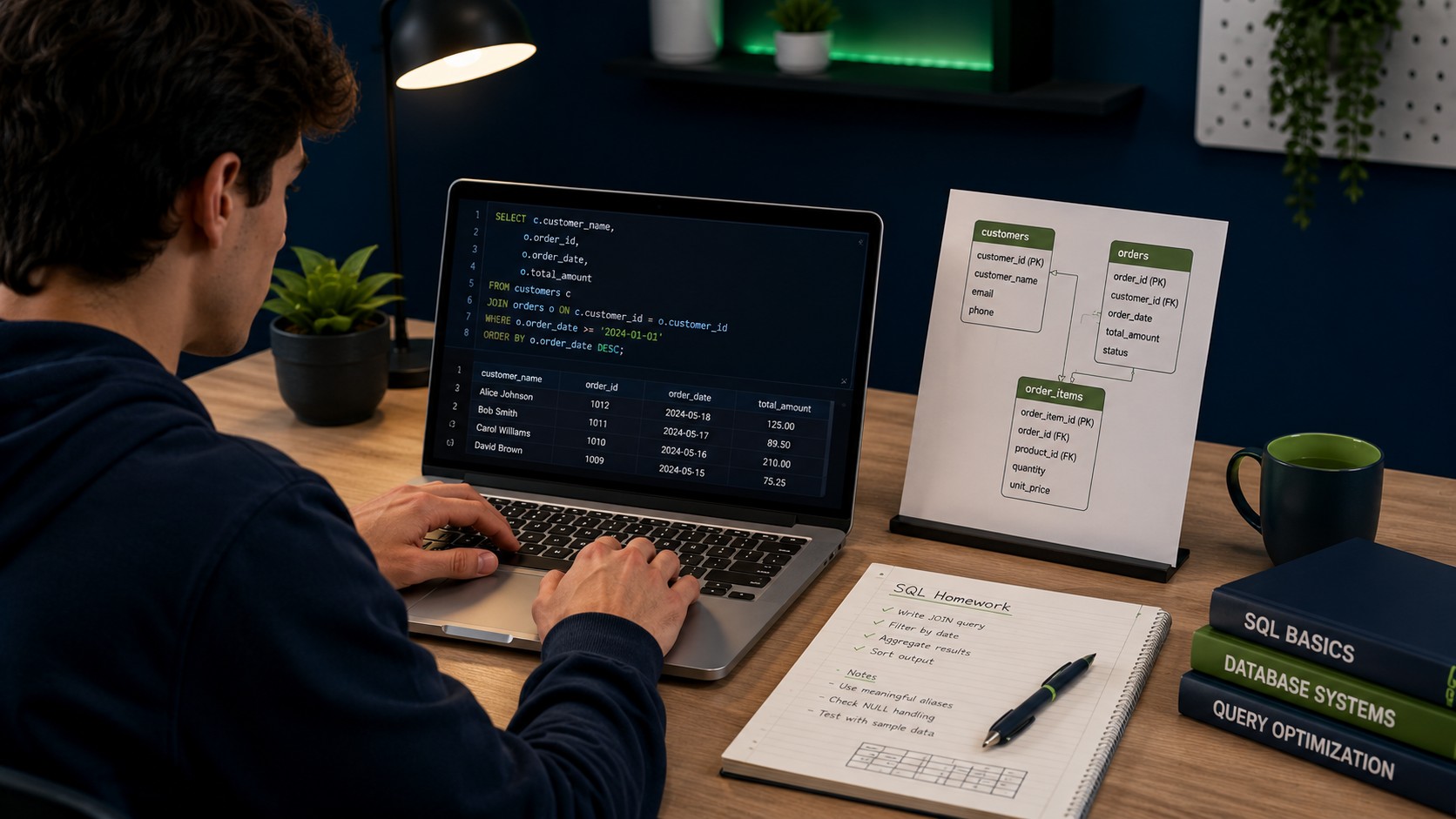
Getting help is not the same as skipping the learning. The goal is to come out of the assignment able to write similar queries yourself. There is a spectrum of help available, and the smart move is to use each type for what it does best.
Free resources and official documentation
The official documentation for your database system is the most reliable free resource that exists, and it is underused by students. Whether you are working in PostgreSQL, MySQL, or another system, the documentation is the definitive answer for how functions behave in your exact dialect. Interactive practice platforms and reference sites are excellent for drilling the fundamentals, and community question and answer sites can help when you are stuck on a specific error. The limitation of free resources is that they answer generic questions well but rarely help with the specific schema and requirements of your particular assignment.
Your instructor, office hours, and study groups
Your instructor and teaching assistants designed the assignment and know exactly what it is testing. Office hours are the highest value help available and the most underused. Come with a specific query and a specific problem, not a blank page, and you will get far more out of the session. Study groups help too, as long as everyone writes their own final solution. Explaining a join to a classmate is one of the best ways to confirm you actually understand it.
Professional SQL homework help
When a deadline is close, the schema is complex, or you have hit a wall that free resources cannot solve, working with an expert can be the difference between a missed deadline and a solid grade. The right kind of professional help does more than hand you a query. It gives you a working solution with the logic explained clearly, so you understand why each join, filter, and grouping is there. That understanding is what carries forward to your exam and your next assignment. If you want that kind of support, you can get a free quote or talk to our support team about exactly what your assignment needs.
Query Writing
From simple SELECT statements to complex multi table joins, subqueries, and window functions, with each part explained.
Debugging Support
Send us a query that will not work and we will find the fault, fix it, and show you exactly what went wrong.
Database Design
Help with schema design, normalization, entity relationship diagrams, and building tables from a set of requirements.
Concept Explanation
Clear walkthroughs of joins, aggregation, indexing, and any concept you need to solidify before an exam.
Building Long Term SQL Confidence
The students who stop struggling with SQL homework all share a few habits. First, they read the schema before writing anything, treating it as a map rather than an afterthought. Second, they build queries in small verified steps instead of writing everything at once. Third, they check their results against the raw data rather than trusting that a query that ran must be correct. Fourth, they practice regularly on real questions, because SQL is a skill that fades without use and strengthens quickly with it.
Perhaps the most important habit is treating every assignment as a chance to understand rather than a task to survive. When you get help, ask why, not just what. When you fix a bug, note what caused it so you recognize it next time. SQL is one of the most durable and portable technical skills you can own. It appears in software engineering, data analysis, product management, finance, and research. The effort you put into understanding it now pays back for years, which is exactly why it is worth getting help that teaches rather than help that merely delivers.
Frequently Asked Questions
Can you help with SQL homework in any database system?
Yes. We work across MySQL, PostgreSQL, SQL Server, Oracle, SQLite, and other common systems. Because dialects differ in their functions and syntax, it helps to tell us your exact database system when you send the assignment so the solution runs correctly in your environment.
Will I actually understand the solution or just get an answer?
Understanding is the point. Alongside a working query, you receive an explanation of the logic behind each join, filter, grouping, and subquery so you can reproduce similar work yourself and defend it in an exam or viva.
What should I send when I ask for help with SQL homework?
Send the full assignment question, the database schema or table definitions, your database system, and any attempt you have already made. The schema is especially important, because most of the work in a good query depends on knowing exactly how the tables relate.
Can you help me debug a query I already wrote?
Absolutely. Debugging is one of the most common requests. Send us the query, the schema, the error message or wrong output, and what you expected. We will identify the fault, correct it, and explain what caused it so you can catch it yourself next time.
Get Reliable Help With SQL Homework Today
Whether you need a single query debugged or a full assignment built and explained from scratch, EasyAssignments can help you hit your deadline and actually understand the work.