
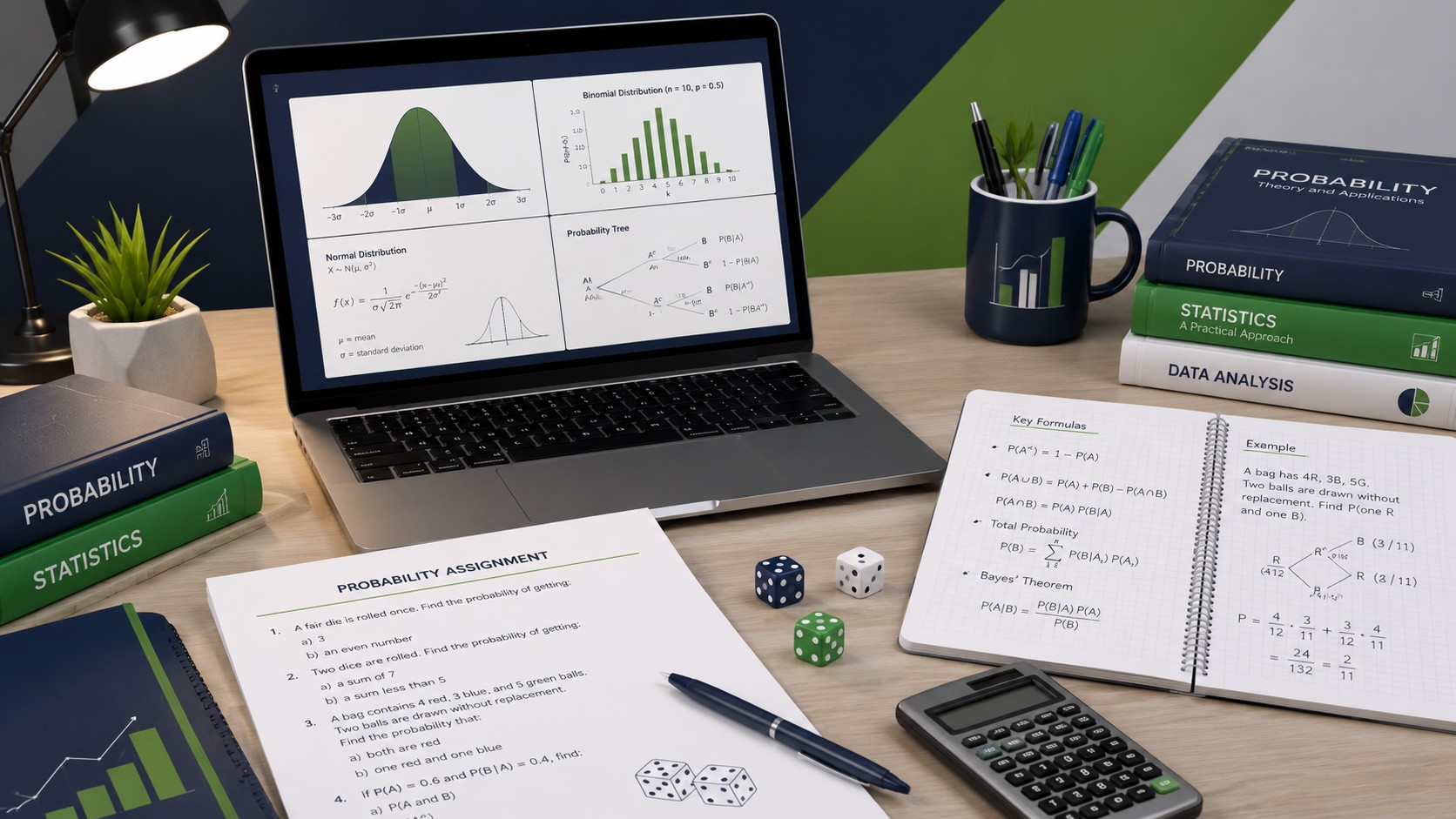
Probability Assignment Questions and Answers PDF: A Complete Student Guide
Searching for a solid probability assignment questions and answers PDF usually means one thing: a deadline is close and the formulas are not sticking. This guide gives you the structure, the worked examples, and the study method to actually understand the topic, not just copy an answer key.
Below you will find the core topics that show up in nearly every probability assignment, step-by-step solved examples, a quick-reference formula table, and a practical way to build your own solved PDF that beats any random download.
Why a Probability Assignment Questions and Answers PDF Is So Useful
Probability sits in a strange place for many students. The individual ideas feel simple, a coin flip, a dice roll, a deck of cards, yet the moment those ideas combine inside a real assignment, confidence tends to collapse. A well-built probability assignment questions and answers PDF solves this by putting the theory, the formula, and the full working side by side, so you can see exactly how an answer is reached rather than just what the answer is.
The value of a good answer key is not the answer at all. It is the reasoning. A number on its own tells you nothing about method, and probability exams reward method heavily. When you study from fully worked solutions, you train yourself to recognise which rule applies, how to set up the problem, and where the arithmetic tends to go wrong. That is the difference between memorising and understanding, and it is why students who study from solved sets consistently perform better under exam pressure.
There is a catch worth naming early. Many free PDFs floating around the internet are riddled with errors, use inconsistent notation, or skip the crucial middle steps where students actually get lost. A clean, reliable, well-explained set is worth far more than ten sloppy downloads. This guide shows you both how to evaluate any PDF you find and how to build your own trustworthy version.
Key idea: Study the working, not the answer. A probability assignment questions and answers PDF is only useful when every step of the solution is shown, because probability is graded on method as much as on the final number.
Core Probability Topics Every Assignment Covers
Before hunting for questions and answers, it helps to know the map. Nearly every probability assignment, from an introductory high school course to a first-year university statistics module, draws from the same set of foundational topics. If your solved PDF covers these, it covers the vast majority of what you will be tested on.
Basic probability and sample spaces
This is the foundation. The probability of an event equals the number of favourable outcomes divided by the total number of possible outcomes, assuming each outcome is equally likely. You define a sample space, which is the set of all possible results, and then count carefully. Most early questions test whether you can list outcomes correctly and avoid double counting.
The addition and multiplication rules
The addition rule handles the probability that event A or event B happens. The multiplication rule handles the probability that event A and event B both happen. The tricky part is knowing whether events are mutually exclusive (they cannot both occur) or independent (one does not affect the other), because that changes the formula you use. A large share of assignment errors come from applying the wrong rule here.
Conditional probability and Bayes' theorem
Conditional probability asks for the chance of one event given that another has already happened. It is written as P(A given B) and calculated as P(A and B) divided by P(B). Bayes' theorem extends this idea to reverse the condition, which is enormously useful in real problems like medical testing and spam filtering. Conditional questions are where many students lose marks, so a good PDF should give them plenty of space.
Random variables and distributions
Once basic probability is solid, assignments move to random variables, which assign numbers to outcomes, and probability distributions, which describe how likely each value is. Common distributions include the binomial distribution for counting successes in fixed trials, the Poisson distribution for rare events over an interval, and the normal distribution, the famous bell curve, for continuous data.
- Discrete distributions: binomial, Poisson, geometric
- Continuous distributions: normal, uniform, exponential
- Expected value and variance as summary measures
- Standard deviation as a measure of spread

Worked Probability Questions and Answers
Theory only sinks in when you see it applied. Here are several representative questions of the kind that appear across probability assignments, each solved in full so you can follow the logic from setup to answer. These mirror the format a strong questions and answers PDF should follow.
Question 1: Basic probability
A standard six-sided die is rolled once. What is the probability of rolling a number greater than 4?
Solution: The sample space is {1, 2, 3, 4, 5, 6}, so there are 6 equally likely outcomes. The favourable outcomes, numbers greater than 4, are {5, 6}, which gives 2 outcomes. The probability is therefore 2 divided by 6, which simplifies to 1/3, or approximately 0.333.
Question 2: Addition rule
A single card is drawn from a standard 52-card deck. What is the probability that it is either a king or a heart?
Solution: There are 4 kings and 13 hearts, but the king of hearts is counted in both groups. Using the addition rule for events that overlap, P(king or heart) equals P(king) plus P(heart) minus P(king and heart). That is 4/52 plus 13/52 minus 1/52, which equals 16/52, simplifying to 4/13, or roughly 0.308. Subtracting the overlap is the step students forget most often.
Question 3: Conditional probability
In a class, 60 percent of students study Spanish and 25 percent study both Spanish and French. If a student studies Spanish, what is the probability they also study French?
Solution: This asks for P(French given Spanish), which equals P(French and Spanish) divided by P(Spanish). That is 0.25 divided by 0.60, which equals approximately 0.417, or about 41.7 percent. Notice how the condition shrinks the sample space to only the Spanish students.
Question 4: Binomial distribution
A fair coin is flipped 5 times. What is the probability of getting exactly 3 heads?
Solution: This is a binomial problem with 5 trials and a success probability of 0.5. The number of ways to choose 3 heads from 5 flips is 10. Each specific arrangement has probability 0.5 raised to the power of 5, which is 1/32. Multiplying 10 by 1/32 gives 10/32, which simplifies to 5/16, or about 0.3125.
Watch out: Never treat "or" and "and" as interchangeable, and never forget to subtract the overlap in addition problems. These two mistakes account for a huge portion of lost marks in probability assignments.
Quick-Reference Probability Formula Table
Keep this table close while you work. Every formula below appears constantly across probability assignments, and having them collected in one place is one of the most useful things any answers PDF can offer.
| Concept | Formula | When to Use |
|---|---|---|
| Basic probability | P(A) = favourable / total | Equally likely outcomes |
| Complement | P(not A) = 1 - P(A) | Easier to count the opposite |
| Addition (overlap) | P(A or B) = P(A) + P(B) - P(A and B) | Events can both occur |
| Addition (exclusive) | P(A or B) = P(A) + P(B) | Events cannot both occur |
| Multiplication (independent) | P(A and B) = P(A) x P(B) | One event does not affect the other |
| Conditional probability | P(A given B) = P(A and B) / P(B) | One event already happened |
| Expected value | E(X) = sum of [x times P(x)] | Average outcome of a variable |
Stuck on a Tricky Probability Set?
If a specific assignment is fighting back, you do not have to grind through it alone. Our team can walk you through the method or provide fully worked, original solutions tailored to your exact questions.
How to Build Your Own Reliable Answers PDF
Rather than trusting a random file you found online, the smartest move is to assemble your own probability assignment questions and answers PDF. It takes a little effort, but the result is accurate, matched to your syllabus, and built around the exact topics you struggle with. Here is a practical approach.
Start from your own course materials
Your lecture notes, textbook chapters, and past assignments are the most relevant source you have. Pull the sample problems from each topic and group them by category: basic probability, conditional probability, distributions, and so on. This alignment matters because different courses use different notation and emphasis.
Solve each problem fully, then annotate
Work every problem completely, showing each step. Then add a short note beside the tricky steps explaining why you did what you did. Those annotations are what transform a plain answer key into a genuine study tool. Six months later, the note "subtract overlap here" will save you far more time than the bare number ever could.
Organise, label, and export
Structure the document with clear headings for each topic, number your questions, and keep answers directly beneath them. Export to PDF so it is easy to review on any device. A tidy, well-labelled file is genuinely pleasant to revise from, which makes you more likely to actually use it.
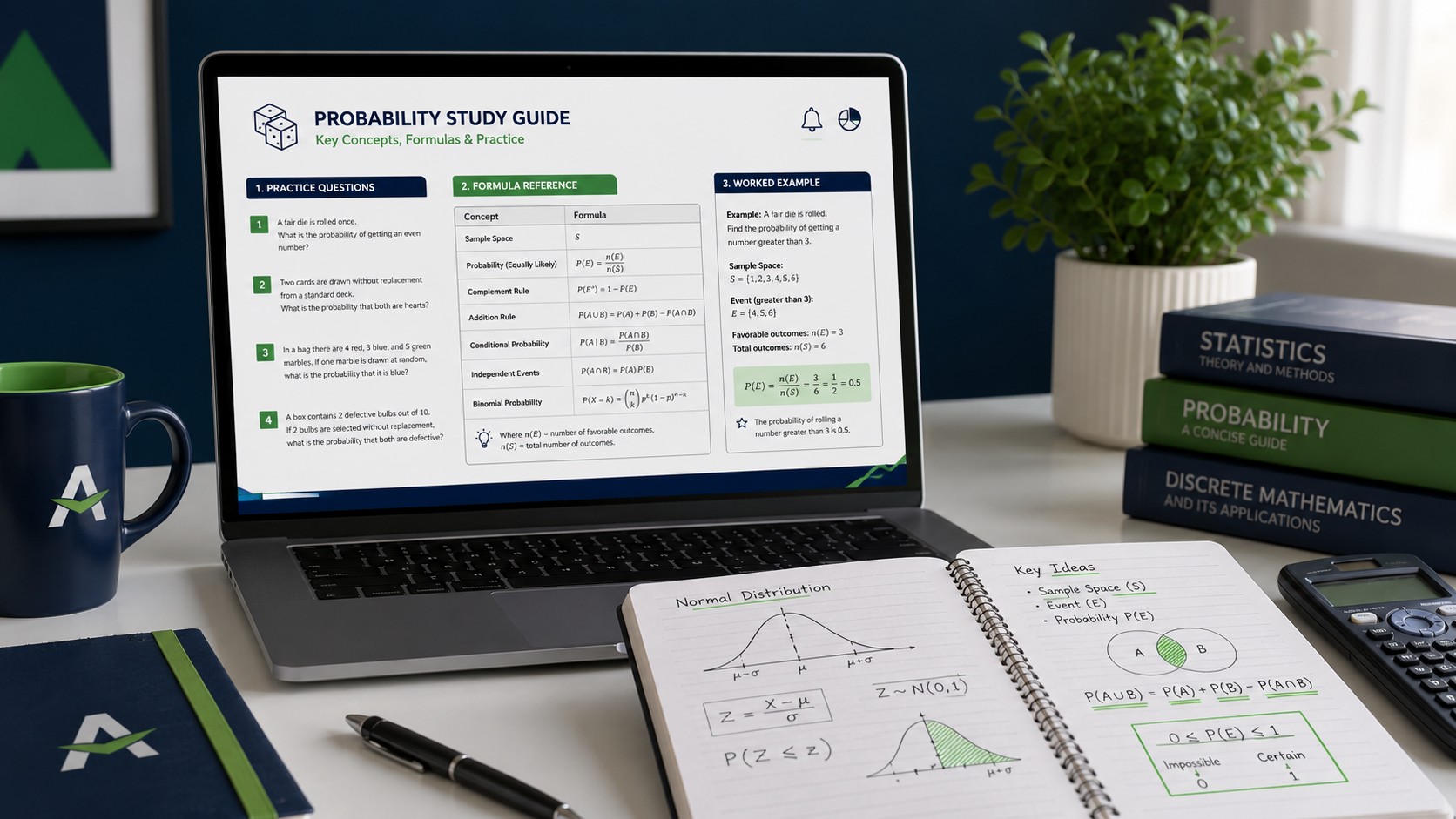
Common Mistakes That Cost Easy Marks
Even strong students lose points to a small handful of recurring errors. Knowing them in advance is half the battle, and a good answers PDF should flag them explicitly rather than hiding them inside a clean final answer.
Confusing "and" with "or"
The multiplication rule handles "and", the addition rule handles "or". Reading the question wording carefully prevents most of these slips.
Forgetting the overlap
In addition problems where events can both occur, failing to subtract P(A and B) inflates your answer above 1 or simply makes it wrong.
Assuming independence
Drawing cards without replacement changes later probabilities. Always check whether events truly are independent before multiplying.
Skipping the sample space
Rushing past a clear definition of all possible outcomes leads to miscounting. Write out or size the sample space first.
How to Actually Study From a Solved PDF
Owning a questions and answers PDF is not the same as learning from it. The way you use it decides whether it helps. Passive reading, where you glance at a solution and nod along, builds almost no lasting skill. Active practice does.
Use the cover-and-solve method. Read the question, cover the solution, and attempt it entirely on your own. Only after you have committed to an answer should you reveal the worked solution and compare. When you differ, do not just note the correct number, trace back to the exact step where your reasoning diverged. That single habit accelerates improvement more than any other.
Space your practice across several days rather than cramming it all at once. Probability rewards repeated exposure because the rules only become intuitive after you have applied them in varied contexts. A few problems daily across a week beats a marathon session the night before. For broader technique, our guides on effective study routines and structured revision pair well with this approach.
Pro tip: After finishing a worked set, close it and re-solve two or three problems from memory the next day. If you can reproduce the method cleanly, it has moved from your notes into your understanding.
Frequently Asked Questions
Where can I find a reliable probability assignment questions and answers PDF?
The most reliable source is one built from your own course materials, since it matches your syllabus and notation exactly. Reputable textbooks and university course pages also offer solved examples. If you need original worked solutions for a specific assignment, our team can prepare them for you through the Get Free Quote link.
What topics should a good probability answers PDF include?
A complete set should cover basic probability and sample spaces, the addition and multiplication rules, conditional probability and Bayes' theorem, and the main distributions including binomial, Poisson, and normal. It should also include expected value, variance, and a formula reference table.
How do I stop making the same probability mistakes?
Track your errors. Each time you get a problem wrong, write down the exact rule or step that tripped you up. Most students repeat a small number of specific mistakes, such as confusing "and" with "or" or forgetting to subtract overlap, and naming them makes them far easier to avoid.
Is it better to memorise formulas or understand the method?
Both matter, but understanding wins. Memorised formulas fail the moment a question is worded unusually, while understanding the method lets you adapt. Keep a formula sheet for quick reference, but focus your study time on why each formula applies to a given problem.
Turn Probability From Panic Into Points
Whether you need a full set of worked solutions or just a nudge on one stubborn question, EasyAssignments can help you understand the method and hit your deadline with confidence.