
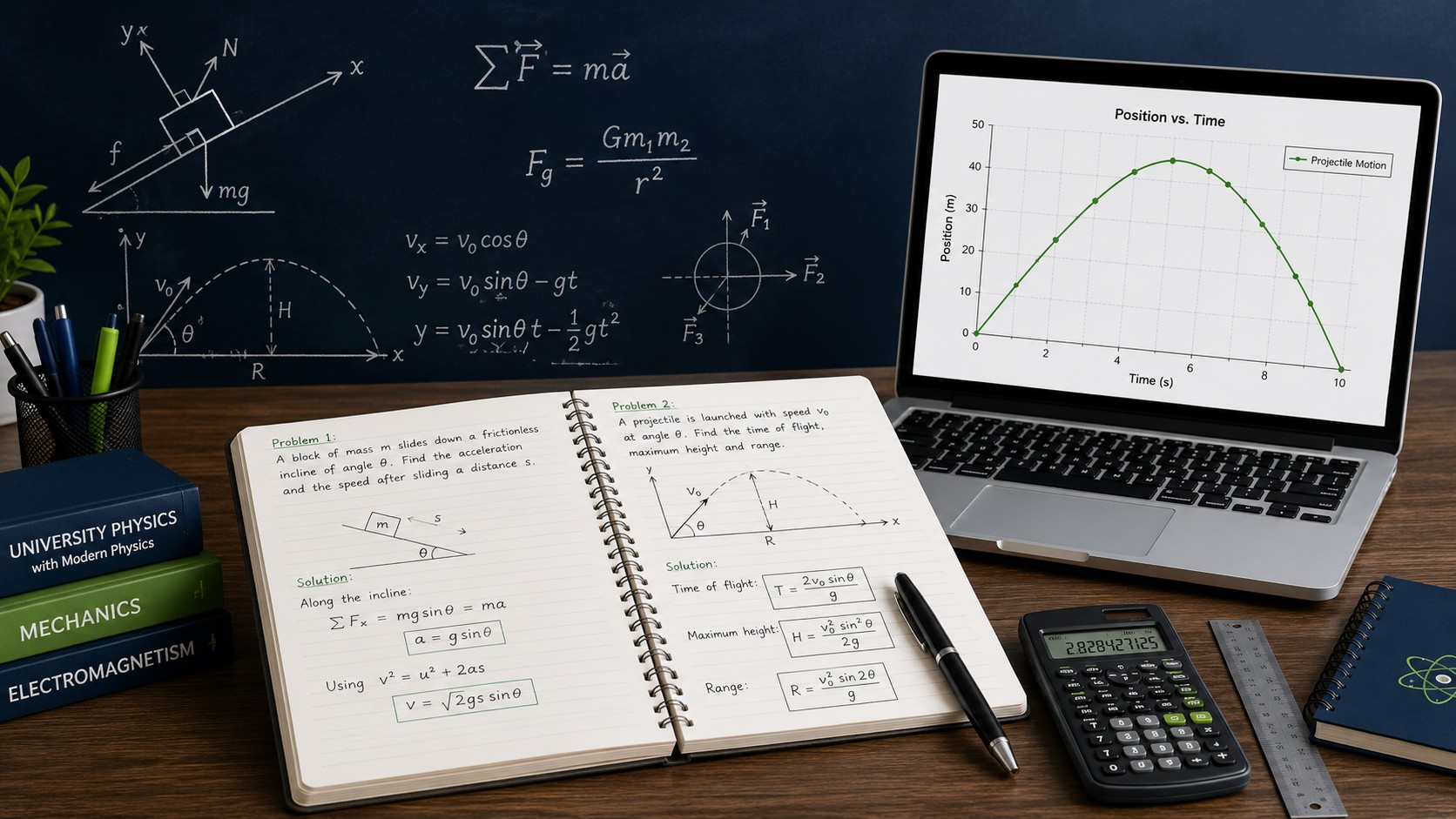
Physics Assignment Help With Solved Problems
Physics assignment help with solved problems is not about handing you an answer key. It is about seeing the full path from a confusing question to a clean, defensible solution, so the next problem feels less like a wall and more like a checklist you already know how to run.
This guide walks through the method serious students use, shows fully worked examples across mechanics, electricity, and thermodynamics, and explains how to turn a solved problem into lasting skill you can carry into your exams.
Why Physics Assignments Feel So Hard
Physics assignment help with solved problems tends to be the thing students search for at exactly the moment a homework set stops making sense. That moment is predictable. Physics is not a subject you can pass by memorising definitions, because most marks come from applying a small number of laws to situations you have never seen before. A problem may combine two or three concepts, hide a key assumption, or wrap the real question inside a paragraph of story. The equations you need are often simple. The hard part is deciding which equation applies and setting up the situation correctly.
There is also a language barrier that has nothing to do with the words. Physics speaks in diagrams, vectors, sign conventions, and units. A student who is comfortable with algebra can still lose most of the marks on a question because the free body diagram was wrong, a negative sign was dropped, or the coordinate system was never defined. These are not knowledge gaps in the usual sense. They are habits, and habits are exactly what worked solutions are good at teaching.
The final difficulty is confidence. When you are stuck, it is tempting to believe you simply do not understand the topic. More often you understand the concept but do not yet have a reliable process for turning that understanding into a finished answer. A good solved problem shows you that process in full, which is why studying worked examples is one of the most efficient ways to improve.
What Good Physics Assignment Help Actually Looks Like
The phrase can mean very different things depending on where you get it. At its weakest, help is just a final number copied off a screen, which teaches you nothing and collapses the moment the exam changes the values. At its best, help is a complete, readable solution that explains the reasoning behind every step, names the principle being used, and points out where students usually go wrong.
Quality physics support has a few consistent features. It always starts from the physics, not the algebra. It defines variables and directions before any numbers appear. It keeps units attached throughout so errors surface early. It shows intermediate steps rather than jumping to the answer. And it ends with a sanity check, asking whether the result is even physically reasonable.
The core idea: a solved problem is a teaching tool, not a shortcut. Read it once to follow the logic, then cover the solution and try to reproduce it from the question alone. The gap between what you can follow and what you can reproduce is exactly what you still need to learn.
This is the standard EasyAssignments works to when providing worked solutions. The goal is not only a correct final line but a solution you could hand to a classmate and have them understand it without your explanation. That readability is what separates genuine learning support from a disposable answer.
A Repeatable Method for Any Physics Problem
Most physics problems, from a first mechanics course to advanced electromagnetism, respond to the same underlying method. Learn it once and you have a scaffold you can apply even when the specific topic is unfamiliar. The steps below are the backbone of nearly every good solved problem you will read.
Read the problem twice and list what you know
Read once for the story and once for the physics. On the second pass, write down every given quantity with its unit, mark what is being asked, and note any words that carry hidden information. Phrases like "starts from rest," "smooth surface," "at constant velocity," or "just before it hits the ground" each translate into a specific mathematical condition. Missing one of these is the single most common way students lose marks before they even begin calculating.
Draw the diagram before touching an equation
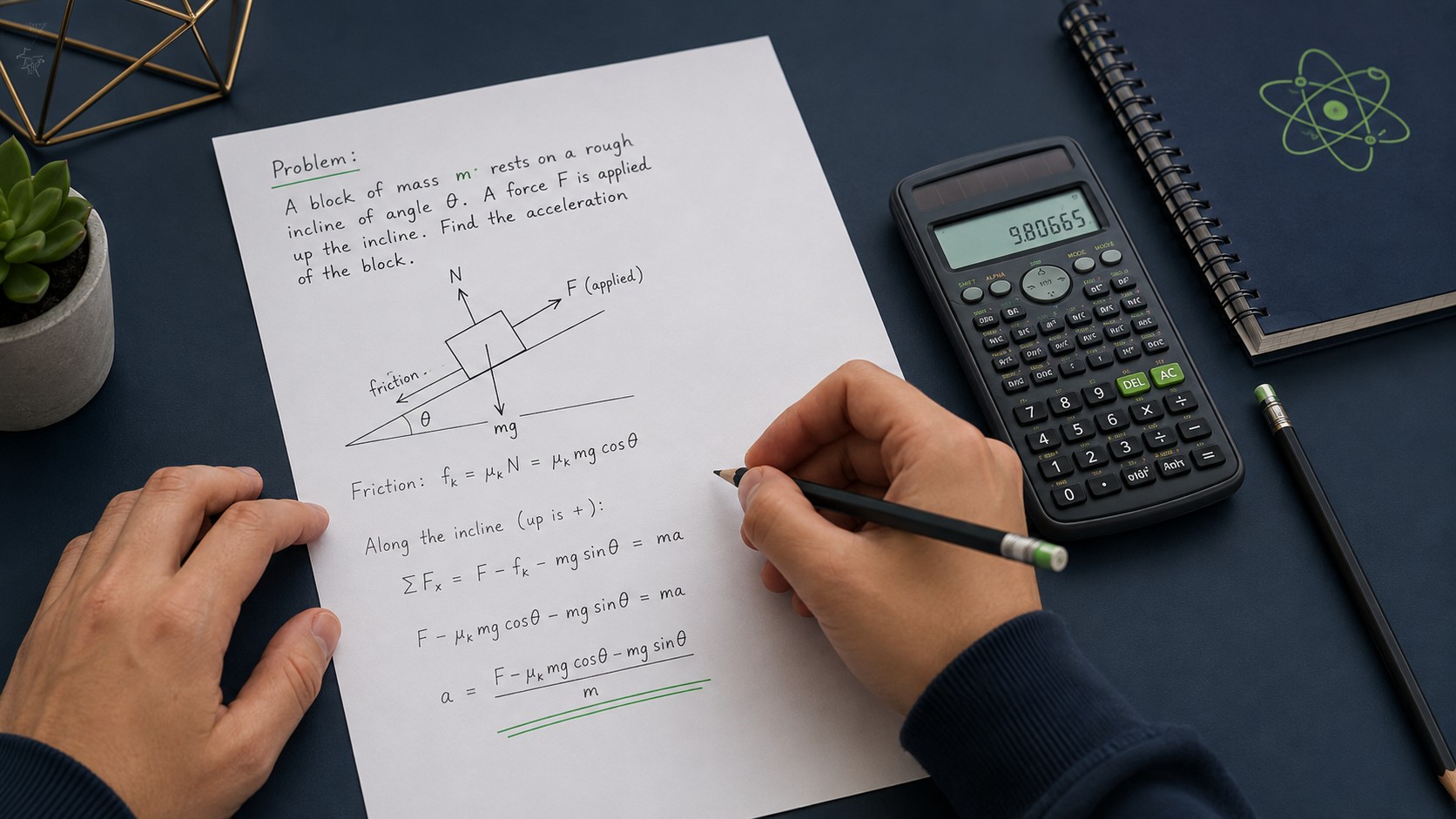
A sketch converts a wall of text into something you can reason about. For mechanics, draw a free body diagram with every force labelled and a clear set of axes. For circuits, redraw the network cleanly and mark current directions. For optics, trace the rays. The diagram forces you to commit to a sign convention and a coordinate system, and once those are fixed, the equations almost write themselves.
Choose the governing principle, then the equation
Ask what physical law governs the situation before reaching for a formula. Is this conservation of energy, conservation of momentum, Newton's second law, or a kinematic relationship? Naming the principle narrows hundreds of formulas down to a handful. Only after you have chosen the principle should you select the specific equation and rearrange it for the unknown.
Solve symbolically, then substitute numbers
Carry the algebra as far as you can using symbols before plugging in values. Working symbolically keeps the expression readable, makes errors easier to catch, and often reveals that some quantities cancel entirely. Substitute numbers only at the end, keep the units attached, and round sensibly at the final step rather than partway through.
Check units and physical sense
A finished answer is not finished until you check it. Do the units of your result match what was asked? Is the magnitude reasonable? A car does not accelerate at ten thousand metres per second squared, and a resistor does not dissipate negative power. This last step catches a surprising share of mistakes and costs only a few seconds.
Common trap: copying a final answer without following the method teaches you nothing transferable. The exam will change the numbers, add a step, or flip a sign convention, and a memorised result will fail you. Always study how a solution is built, not just where it lands.
Stuck on a Problem Set Tonight?
Send us the questions you are wrestling with and get clear, fully worked solutions you can actually learn from, delivered on your deadline.
Worked Example 1: Projectile Motion
A ball is thrown horizontally from the top of a cliff twenty metres high with an initial speed of fifteen metres per second. How long does it take to reach the ground, and how far from the base of the cliff does it land? Take the acceleration due to gravity as roughly ten metres per second squared.
Start by separating the motion into horizontal and vertical components, because they are independent. Horizontally the ball moves at a constant fifteen metres per second, since there is no horizontal force. Vertically it starts from rest in the vertical direction and accelerates downward under gravity.
To find the time in the air, use the vertical motion. The vertical drop equals one half times the acceleration times the time squared. Rearranging for time gives the square root of twice the height divided by the acceleration. That is the square root of two times twenty divided by ten, which is the square root of four, which equals two seconds.
Now find the horizontal distance. Horizontal distance equals horizontal speed multiplied by time, which is fifteen multiplied by two, giving thirty metres. So the ball is in the air for two seconds and lands thirty metres from the base of the cliff.
Notice what made this manageable. The moment we recognised that horizontal and vertical motion are independent, a two dimensional problem became two simple one dimensional problems. That recognition, not the arithmetic, is the real skill a solved example teaches.
Worked Example 2: Newton's Second Law on an Incline
A block of mass two kilograms rests on a frictionless ramp inclined at thirty degrees to the horizontal. What is its acceleration down the slope? Again take gravity as roughly ten metres per second squared.
Begin with the diagram. Draw the block on the incline and mark two forces: gravity acting straight down and the normal force acting perpendicular to the surface. Because the surface is frictionless there is no force along the slope except the component of gravity.
Choose axes aligned with the ramp, one along the slope and one perpendicular to it, rather than the usual horizontal and vertical. This is the key decision that simplifies everything. With these axes, the component of gravity along the slope is the weight multiplied by the sine of the angle, and the perpendicular component is the weight multiplied by the cosine.
Apply Newton's second law along the slope. The net force down the slope equals the mass times gravity times the sine of the angle. Since the sine of thirty degrees is one half, that force is two times ten times one half, which is ten newtons. Acceleration equals force divided by mass, so ten divided by two gives five metres per second squared down the slope.
The result is independent of mass in the frictionless case, since mass appears on both sides and cancels. A solved problem that carries the algebra symbolically would reveal this cancellation directly, which is a good argument for not rushing to plug in numbers.

Worked Example 3: A Simple Series Circuit
Two resistors, one of four ohms and one of six ohms, are connected in series across a twelve volt battery. Find the current in the circuit and the voltage across each resistor.
First identify the governing principles: for resistors in series the total resistance is the sum, and the current is the same through every component. Ohm's law relates voltage, current, and resistance.
The total resistance is four plus six, which is ten ohms. By Ohm's law the current equals the voltage divided by the total resistance, which is twelve divided by ten, giving one point two amperes. Because the resistors are in series, this same current flows through both.
Now find the voltage across each resistor using Ohm's law again. Across the four ohm resistor the voltage is one point two times four, which is four point eight volts. Across the six ohm resistor it is one point two times six, which is seven point two volts. As a check, these add to twelve volts, exactly the battery voltage, which confirms the answer through conservation of energy around the loop.
That final check is not decoration. If the two voltages had not summed to the source voltage, we would know immediately that an error had crept in. Building that verification into every circuit solution is a habit worth copying from any well written worked example.
Branches of Physics We Cover
Physics assignment help with solved problems is only useful if it reaches the topic actually giving you trouble. The method above is universal, but each branch has its own conventions, common pitfalls, and characteristic problem types. The table below maps the major areas to the kinds of questions students most often need help with.
| Branch | Typical Problems | Where Students Struggle |
|---|---|---|
| Mechanics | Kinematics, forces, energy, momentum, rotation | Free body diagrams and sign conventions |
| Electricity and Magnetism | Circuits, fields, Gauss's law, induction | Vector directions and choosing the right law |
| Thermodynamics | Heat transfer, gas laws, entropy, cycles | Tracking sign of work and heat |
| Waves and Optics | Interference, diffraction, lenses, mirrors | Phase relationships and ray diagrams |
| Modern Physics | Relativity, photoelectric effect, atomic models | Connecting formulas to physical meaning |
How to Learn From a Solved Problem
Reading a solution passively is close to useless. The value appears only when you engage with it actively, and there are a few reliable ways to do that.
- Read the full solution once slowly, making sure you can justify every line before moving on.
- Cover the solution and reproduce it from the question alone, writing out each step.
- Change one number in the problem and rework it to confirm you understood the method rather than the specific values.
- Explain the solution out loud as if teaching it, since gaps in your understanding surface the instant you try to speak them.
- Collect the mistakes you make into a personal list, because your recurring errors are the fastest thing to fix.
Treat every solved problem as a small lesson rather than a finished chore. A single example studied this way often teaches more than a dozen skimmed passively.
Why Students Choose EasyAssignments for Physics
When the deadline is close and the concepts have not clicked, structured help makes the difference between a rushed guess and a solution you can stand behind. Here is what our physics support is built to deliver.
Fully Worked Steps
Every solution shows the reasoning line by line, so you can follow and reproduce it rather than just read a final number.
All Levels Covered
From introductory high school mechanics to postgraduate electromagnetism, the depth is matched to your course.
Clear Diagrams
Free body diagrams, circuit sketches, and ray traces are included where they help, not left for you to guess.
Deadline Focused
Solutions arrive on time and formatted to your requirements, so you have room to review before submission.
Frequently Asked Questions
Does physics assignment help with solved problems actually help me learn?
Yes, when you use the solutions actively. A worked solution shows the full reasoning path, and if you cover it and reproduce the steps yourself, then rework the problem with different numbers, you build transferable skill rather than a one time answer.
Which branches of physics can you help with?
We cover the full range, including mechanics, electricity and magnetism, thermodynamics, waves and optics, and modern physics topics like relativity and atomic structure, across levels from high school to postgraduate.
Will the solutions show every step or just the final answer?
Every step. Our solutions define the variables, show the diagram where relevant, name the principle being used, carry the algebra clearly, and finish with a units and sanity check so you can understand and defend the result.
How do I get started with a physics assignment?
Send us the exact questions and any instructions from your course, along with your deadline. You can request a free quote through our order page or reach out on the contact page and our support team will guide you through the next steps.
Turn Confusing Problems Into Clear Solutions
Get physics assignment help with solved problems you can actually learn from, worked step by step and delivered on your deadline. Send us your toughest question and see the difference a clear solution makes.