

Nursing Assignment Help for Care Plans, Case Studies & Essays
Nursing assignment help is different from ordinary essay support because nursing coursework asks two things at once: sound clinical reasoning and clear academic writing. You are not only describing a patient, you are justifying decisions with evidence, frameworks, and correct referencing, usually against a tight deadline.
This page explains how support actually works for the main types of nursing assignments, what a strong submission needs, and how to get help that improves your own understanding rather than replacing it.
Why Nursing Assignments Are Harder Than They Look
Most students who struggle with nursing coursework are not weak writers and do not lack clinical knowledge. What trips them up is the join between the two. A nursing assignment rarely rewards description alone. It asks you to assess a scenario, identify priorities, apply a recognised framework, justify each decision with evidence, and present all of that in formal academic language with accurate referencing. Any one of those layers can pull a grade down even when the underlying understanding is sound.
This is why a generic essay approach falls short in nursing. A well-written paragraph that does not connect a symptom to a nursing priority, or an intervention to a rationale, misses the point of the task. The marker is looking for clinical logic on the page, not just clean prose. Recognising which layer you are actually stuck on, the clinical reasoning, the structure, or the referencing, is the first step to fixing it efficiently rather than rewriting blindly.
Diagnose the task first. Before you write or ask for help, name the specific gap: "I understand the patient but cannot structure a care plan," or "I have the structure but my evidence is thin." A precise problem is a solvable one, and it saves the first twenty minutes of any tutoring session.
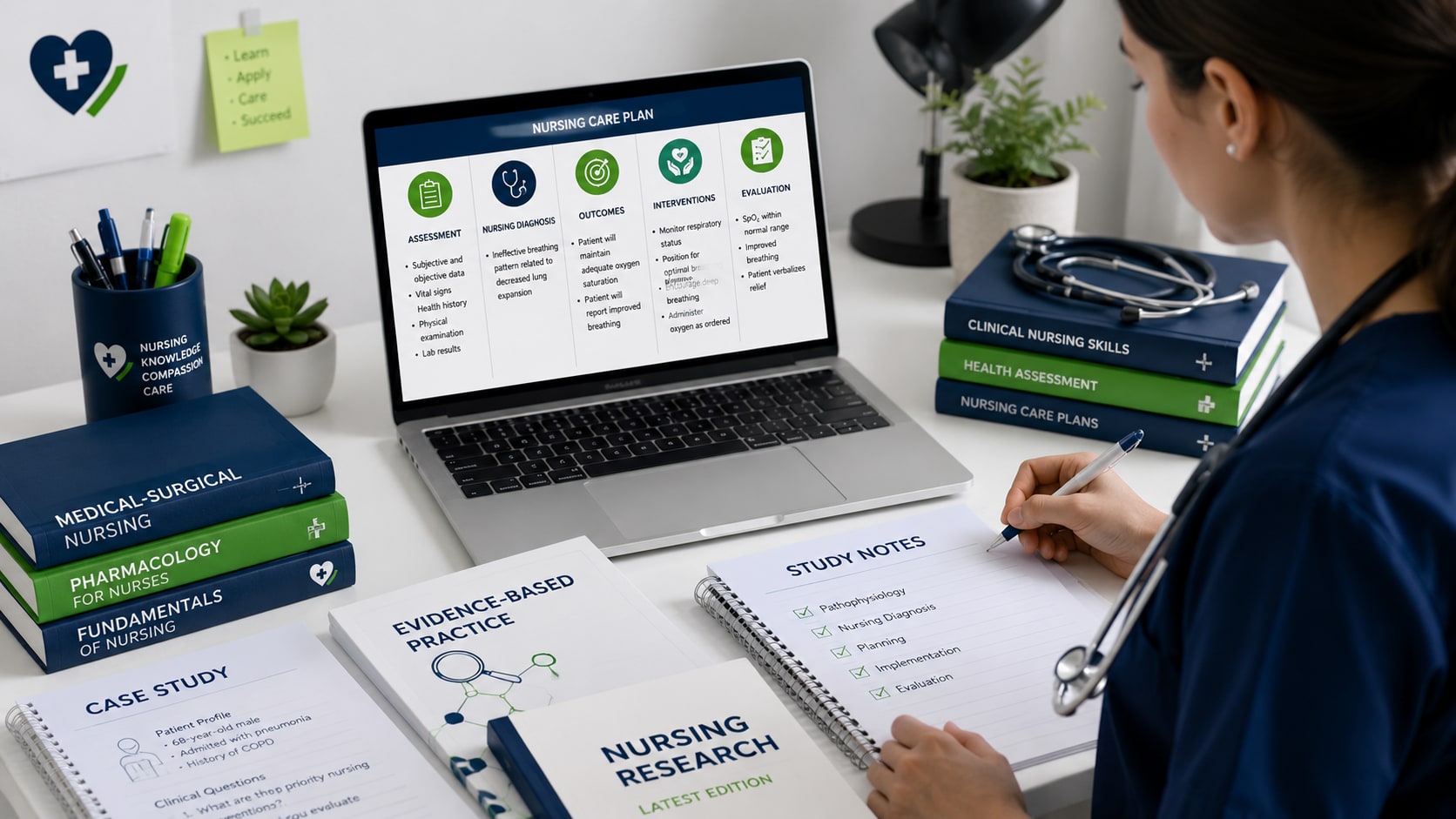
The Main Types of Nursing Assignments
Nursing programs set several distinct assignment types, and each rewards a different skill. Knowing which one you are working on tells you where your effort should go.
Care Plans
A care plan asks you to move from patient assessment to a structured plan of action: nursing diagnoses, measurable goals, evidence-based interventions, rationales, and evaluation criteria. Many programs expect NANDA-I diagnoses and SMART goals. The most common weakness is a plan where the interventions are not clearly tied to a rationale or to the patient's actual priorities.
Clinical Case Studies
Case studies test whether you can connect the dots: symptoms, assessment data, pathophysiology, nursing priorities, and patient-centred interventions. The trap is description without analysis. A strong case study explains what matters most in the scenario and why, rather than simply retelling it.
Reflective Writing
Reflective assignments ask you to examine your own learning and practice, often through a model such as Gibbs' Reflective Cycle. Strong programmers of clinical logic sometimes underperform here because reflection is a different discipline: it needs honesty, structure, and a clear link between experience and professional development.
Evidence-Based Practice and Research Assignments
These require you to locate credible evidence, appraise it, and apply it to practice. Marks are lost when sources are used to decorate an argument rather than to build one. The skill is integrating research into your reasoning, not listing it at the end.
What a Strong Nursing Submission Actually Needs
Across all of these assignment types, the same core elements separate a high mark from an average one. Support is most useful when it targets these directly.
| Assignment | What Students Usually Need | Where Marks Are Won |
|---|---|---|
| Nursing Essay | Clear argument, structure, references | Evidence woven into the discussion, not stacked at the end |
| Care Plan | Assessment, diagnosis, goals, interventions | Every intervention tied to a clear, evidence-based rationale |
| Case Study | Patient analysis and clinical reasoning | Prioritising the right concerns and explaining why |
| Reflective Writing | Personal insight using a model | Honest reflection linked to professional development |
| EBP / Research | Credible sources and appraisal | Research applied to practice, not just cited |
Stuck on a nursing assignment right now?
Share your brief, rubric, word count, and deadline. You will get a clear plan and support you can actually learn from, whether that is structuring a care plan, tightening your evidence, or working through a case study.
How to Get Nursing Assignment Help the Right Way
Nursing carries a professional responsibility that most subjects do not, so the way you use support matters. Always check your program's rules on outside help and collaboration first, since these vary and your student handbook is the authority. Within those rules, there is a large, legitimate space for tutoring, explanation, and guidance that strengthens your own work rather than replacing it.
The most useful support behaves like a good clinical mentor: it asks what you have tried, explains the reasoning behind a framework, shows a worked example on a similar scenario, and points you to the exact place your reasoning needs tightening. The goal is to leave you more capable on the next placement report or care plan, not just past this deadline.
Concept Clarification
Getting frameworks like NANDA-I, SMART goals, or Gibbs' cycle explained so they finally click for your specific assignment.
Structure and Planning
Turning a dense brief and rubric into a clear plan for a care plan, case study, or reflective piece before you write.
Evidence and Referencing
Guidance on finding credible sources, applying evidence-based practice, and formatting APA or your required style correctly.
Review of Your Own Work
Having your draft read for clinical logic and structure, with feedback on where it is strong and where it needs work.

Common Nursing Assignment Topics
Support commonly spans the topics that appear most often across undergraduate and postgraduate nursing programs, where students need to combine theory, assessment, and evidence-based practice.
- Patient safety and quality improvement
- Evidence-based practice and clinical decision-making
- Ethics and professional standards in nursing
- Health promotion and disease prevention
- Medication safety and patient education
- Chronic disease and long-term condition management
- Mental health nursing, including therapeutic communication and risk assessment
- Medical-surgical topics such as postoperative and wound care
A note on choosing support: be cautious of any service that sells only on "cheap" or "free." Nursing coursework connects to patient safety and professional standards, so accuracy, correct terminology, and careful handling matter far more than price. Ask how work is checked and who will handle your assignment before you commit.
Frequently Asked Questions About Nursing Assignment Help
Can I get nursing assignment help online?
Yes. Online support is available for nursing essays, care plans, case studies, reflective writing, and evidence-based practice assignments. Share your brief, rubric, word count, citation style, and deadline so the help fits exactly what your task requires.
Is using nursing assignment help allowed?
Tutoring, concept explanation, structural guidance, and review of your own work are widely accepted forms of academic support. Submitting someone else's work as your own is not. Policies vary by program, so check your student handbook and, where collaboration is permitted, acknowledge it as required.
Can I get help with a nursing care plan?
Yes. Support can cover the full structure of a care plan, from patient assessment and nursing diagnosis to measurable goals, evidence-based interventions, clear rationales, and evaluation criteria, so the plan reads as one coherent line of reasoning.
Do you support reflective and mental health nursing writing?
Yes. Reflective assignments can be supported using models such as Gibbs' Reflective Cycle, and mental health nursing topics such as therapeutic communication, risk assessment, and recovery-focused care are commonly covered, always tied back to patient safety and professional standards.
How early should I ask for help on a nursing assignment?
As early as possible, ideally once you have read the brief and made a first attempt. A few days of margin allows time for explanation, your own revision, and referencing checks, rather than a rushed patch the night before submission.
Get Nursing Assignment Help That Builds Real Understanding
Whether it is a care plan, a case study, reflective writing, or an evidence-based practice essay, EasyAssignments supports nursing students with clear, on-time help that strengthens your own work.