
MBA Assignment Helper: Expert Support for Business School Coursework
An MBA assignment helper is a subject specialist who helps you plan, structure, research, and refine graduate business coursework so it meets the analytical standard your programme expects. That covers case analyses, strategy reports, finance models, marketing plans, operations write-ups, and capstone projects.
MBA marking is not undergraduate marking. Tutors want defensible recommendations, evidence you can trace, and frameworks applied to a real situation rather than described in the abstract. This guide explains what genuine MBA assignment help looks like, how to choose it, and how to use it without crossing academic integrity lines.
What an MBA Assignment Helper Actually Does
The phrase "MBA assignment helper" gets used loosely, so it is worth defining. At its most useful, an MBA assignment helper is a person with graduate-level business knowledge who works alongside you on a specific piece of coursework. They are not a proofreader who fixes commas, and they are not a shortcut that removes you from the process. They sit in between: someone who understands what a strategy tutor means by "critically evaluate", knows why your discounted cash flow model is producing a strange terminal value, and can tell you that your recommendation section is describing options rather than choosing between them.
Most MBA students who look for help are not struggling with intelligence or effort. They are struggling with translation. You may have fifteen years of operational experience and still not know how your employer's supply chain problem should be framed inside a Porter's Five Forces analysis for a 3,000 word assignment with a strict marking rubric. That gap between practical knowledge and academic convention is exactly where good support earns its place.
A capable helper typically works across several layers of a task. They help you interpret the brief and the rubric, because a surprising number of lost marks come from answering a slightly different question than the one asked. They help you scope, since MBA briefs are often broad enough to be answered a dozen ways and word limits are tight. They help with method, especially in quantitative modules where a small setup error propagates through every subsequent calculation. And they help with the writing itself: argument order, signposting, integration of evidence, and the discipline of putting the conclusion where a busy marker will find it.
Support Versus Substitution
There is a meaningful line between support and substitution, and the difference matters more at MBA level than almost anywhere else. Business schools take academic integrity seriously, partly because MBA graduates go into positions where their judgement is trusted with money and people. Legitimate support builds your capability: annotated feedback, model answers you study rather than submit, worked examples of a technique, structural outlines, research direction, and editing of work you produced. Substitution replaces your thinking entirely and puts your enrolment at risk.
EasyAssignments frames its MBA support around the first category. The aim is that you finish the assignment understanding the material better than when you started, and that you can defend every line of it in a seminar, a viva, or a follow-up question from a tutor.
Why MBA Assignments Are Harder Than They Look
Students moving from an undergraduate business degree, or returning to study after years in industry, often underestimate the shift. The reading is not necessarily harder. The expectations are different in ways that are easy to miss until the first set of marks comes back.
You Are Marked on Judgement, Not Coverage
At undergraduate level, demonstrating that you know a framework often earns marks. At MBA level, describing a framework earns very little. What earns marks is applying it to a specific situation, acknowledging where it does not fit, and reaching a position you are willing to defend. An assignment that lays out four strategic options and then declines to recommend one will usually score below an assignment that picks one, justifies it, and honestly discusses the risks of the choice.
Word Limits Punish Padding
MBA briefs are often shorter than the topic deserves. A 2,500 word strategy assignment on an entire multinational forces brutal prioritisation. Every paragraph of background you include is a paragraph of analysis you cannot include. Students who write generously at undergraduate level often find that the same habit costs them heavily here, because the marker is scanning for insight density rather than thoroughness.
Evidence Standards Are Higher
Assertions need support. "Customer loyalty in this sector is declining" needs a source, and a stronger answer uses a credible industry or academic source rather than a generic web page. Business school markers also expect you to distinguish between company self-reporting, journalism, industry analysis, and peer-reviewed research, and to treat each with appropriate caution.
A quick diagnostic: read your last assignment and highlight every sentence that states a judgement, then every sentence that describes something. If the descriptive highlights outnumber the judgement highlights by more than roughly two to one, the balance is probably costing you marks regardless of how well written the descriptive parts are.

The MBA Assignment Types You Are Most Likely to Face
Different modules demand genuinely different skills, and knowing what a marker is looking for in each type is half the work. Here is how the main formats differ and where students usually lose marks.
| Assignment Type | What Markers Reward | Most Common Mistake |
|---|---|---|
| Case study analysis | A clear problem definition, evidence drawn from the case itself, and a decision with justified trade-offs | Retelling the case narrative instead of analysing it |
| Strategic management report | Frameworks used as analytical tools, external and internal factors linked to one another, prioritised recommendations | Framework dumping: SWOT, PESTEL, and Five Forces presented back to back with no synthesis |
| Finance and accounting tasks | Correct method, stated assumptions, sensitivity checks, and interpretation of what the number means for the business | Producing a number with no commentary on what it implies |
| Marketing plan | Segmentation that is genuinely actionable, positioning that follows from it, and measurable objectives | Generic personas and objectives with no success metrics |
| Operations and supply chain | Process mapping, quantified bottlenecks, and improvement proposals with implementation constraints considered | Recommending best practice without addressing cost or feasibility |
| Reflective or leadership essay | Honest reflection tied to an established model, with specific incidents rather than general claims | Describing what happened without analysing what it revealed |
| Capstone or dissertation | A researchable question, defensible methodology, and findings that connect back to the literature | A research question far too broad for the word count and timeline |
Case Studies: The Format That Trips Most People
Case analysis deserves extra attention because it appears in nearly every MBA programme and because the failure mode is so consistent. Students read the case, absorb the story, and then write the story back with light commentary. The marker already knows the story. What they want is a diagnosis.
A stronger approach is to decide, before writing, what the central problem actually is. Cases usually present several symptoms and one or two underlying causes. Falling margins might be the symptom; the cause might be a pricing structure that has not been revisited since a competitor entered the market. Your assignment should state the problem explicitly and early, then use the rest of the word count to support that diagnosis and act on it.
The second habit worth building is quoting the case as evidence. If you claim the company has a capacity constraint, point to the figure or statement in the case that shows it. This single discipline separates confident analysis from plausible-sounding guesswork, and markers notice it immediately.
How to Choose a Reliable MBA Assignment Helper
The market for academic support is uneven, and MBA students are a target for services that promise more than they deliver. A few practical checks will filter most of the risk.
- Subject depth, not general writing skill. Ask whether the person helping you has actually studied or worked in the relevant area. A strong generalist writer cannot fix a broken WACC calculation or tell you that your segmentation logic collapses under scrutiny.
- Willingness to explain. A helper who can walk you through why a change was made is far more valuable than one who returns a document with no reasoning. If explanation is treated as an inconvenience, that tells you something.
- Clarity about what is being provided. Reputable services describe their work honestly: guidance, editing, model answers, structural feedback. Vague language around this point is a warning sign.
- Referencing competence. Business schools use a variety of styles and are strict about them. Ask directly whether they work in your required style.
- Confidentiality. Your coursework, your employer's data if you use it, and your identity should all be handled discreetly.
- Realistic promises. Nobody can guarantee a specific grade, because grading involves a human marker applying judgement to your work. Treat any specific grade guarantee with scepticism.
- Responsiveness before you commit. How a service communicates during your first enquiry is usually how it will communicate when a deadline is close.
Be careful with confidential workplace data. Many MBA assignments invite you to analyse your own employer. Before sharing internal figures, contracts, or customer information with anyone outside your organisation, check your employment agreement and your programme's guidance. Anonymising the company and rounding sensitive numbers usually preserves the analytical value while protecting you.
Stuck on a Case Analysis or a Model?
Send us the brief and the rubric. We will tell you honestly what kind of support the task needs and what it would involve, with no obligation.
How to Get the Most Value From MBA Assignment Help
The difference between students who get a lot out of support and students who get very little is rarely the helper. It is preparation and follow-through.
Share the Rubric, Not Just the Question
The marking criteria tell you how the marks are distributed, and that distribution should drive how you spend your word count. If analysis is worth forty percent and context is worth ten, the structure of your assignment should reflect that ratio. Many students never open the rubric until after submission. Sending it at the start changes the quality of help you can receive dramatically.
Come With a Position, Even a Rough One
Arriving with "I think the real problem here is the distribution model, but I am not sure I can support it" gives a helper something to work with. Arriving with "I do not know where to start" is fine occasionally, but you will learn more and get better output if you have wrestled with the material first. Your instinct is often closer to correct than you think, and the support then goes into testing and evidencing it rather than generating it from scratch.
Ask for the Reasoning Behind Every Change
If a section gets restructured, ask why. If a claim gets flagged as unsupported, ask what would make it supported. This turns a one-off transaction into something that improves the next five assignments as well, which matters when your programme has years to run.
Build in Time for Revision
Support delivered the night before a deadline can only be cosmetic. Support delivered five days out can change the argument. Give yourself at least a few days between receiving feedback and submitting, so there is room to act on anything substantial.
Structure and Planning
Outlines mapped against your rubric, so word count goes where the marks are rather than where the writing feels easiest.
Analytical Feedback
Line-level comments on where your reasoning is strong, where it is asserted without evidence, and where a counterargument is missing.
Quantitative Checking
Review of financial models, statistical work, and calculations, with assumptions made explicit and errors traced to their source.
Editing and Referencing
Clarity, academic tone, and consistent citation in the style your business school requires, applied to work you have written.
Working With an MBA Assignment Helper on Longer Projects
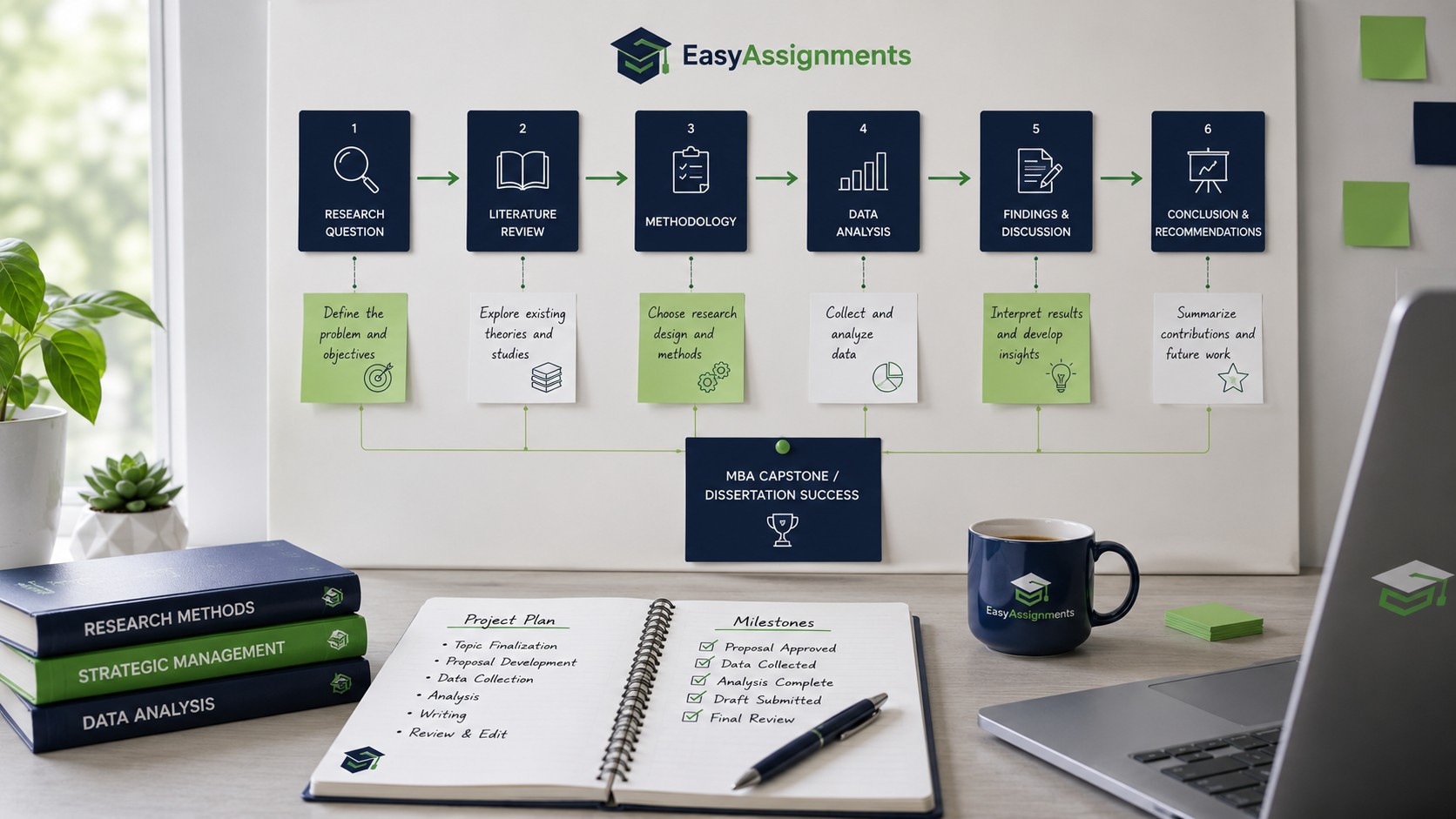
Capstone projects, consultancy reports, and dissertations behave differently from module assignments. They run for months, involve a supervisor, and often depend on data you have to collect yourself. Support here works best as a series of checkpoints rather than a single hand-off.
The first checkpoint is usually the research question. This is where the largest number of projects go wrong, and the error is almost always the same: the question is too big. "How can manufacturing firms improve sustainability?" is a book. "What barriers do mid-sized manufacturers in one region report when adopting a specific sustainability standard?" is a project. Narrowing early saves months.
The second checkpoint is methodology. Business schools want a justified choice, not merely a stated one. If you are running interviews, you should be able to explain why interviews rather than a survey, how participants were selected, and what limitations that selection introduces. Helpers who understand research design can stress-test this before your supervisor does.
The third is the analysis chapter, which is where most word count and most marks sit. Data alone is not analysis. The chapter needs to connect what you found back to the literature you reviewed, including where your findings disagree with it. Disagreement handled honestly is a strength, not a problem.
Managing the Supervisor Relationship
Your supervisor remains the primary authority on your project, and external support should never contradict their guidance. If a helper suggests one structure and your supervisor prefers another, follow your supervisor. A useful way to use support here is preparation: going into supervision meetings with a clear draft and specific questions gets far more out of the limited time you have with them.
Balancing an MBA With Work and Life
Most MBA students are not full-time students. They are working professionals, often with families, doing a demanding qualification in the gaps. This context is not incidental to the assignment question, it is central to it. The reason people look for an MBA assignment helper is usually time and competing pressure rather than any deficiency in ability.
A few habits reduce the pressure regardless of whether you use support. Map every deadline for the term in one place at the start, because MBA modules often stack submissions within the same fortnight. Start assignments by reading the rubric and drafting a one-paragraph answer to the question, so that even if you write it at the last minute you are not also deciding your argument at the last minute. Keep a running note of useful sources as you do module reading, since reconstructing references later costs hours. And protect one predictable block of study time per week rather than relying on found time, which reliably disappears.
Where support fits into this is triage. You cannot outsource your learning, but you can get help with the parts of a task that consume disproportionate time relative to what they teach you: chasing a referencing style, restructuring a draft that has grown unwieldy, or debugging a spreadsheet formula that will not resolve.
Frequently Asked Questions About MBA Assignment Help
Is using an MBA assignment helper allowed by my business school?
It depends entirely on the type of help. Most institutions permit and even encourage tutoring, feedback on drafts, proofreading, and study guidance, while prohibiting submitting work you did not produce. Your programme's academic integrity policy is the authority here, so read it and ask your programme office if anything is unclear. EasyAssignments provides guidance, feedback, and model material intended to support your own work.
Can an MBA assignment helper work with quantitative modules?
Yes, provided you choose a specialist. Finance, accounting, statistics, and operations tasks need someone who understands the method, not just academic writing. When enquiring, describe the specific technique involved, such as valuation modelling, regression analysis, or linear programming, so you can be matched appropriately.
How far in advance should I ask for help?
The earlier the better. Support requested a week or more before the deadline can shape your argument and structure, which is where most of the marks are. Last-minute support is limited to surface improvements, and rushed work leaves no room to act on substantive feedback.
Will my information stay confidential?
Reputable services keep your identity, your institution, and your documents private. That said, take your own precautions with employer data: anonymise company names and sensitive figures where your assignment allows it, and check your workplace confidentiality obligations before sharing internal information with anyone outside your organisation.
Bringing It Together
An MBA assignment helper is most valuable when treated as a coach rather than a contractor. The MBA is a qualification about judgement, and judgement is built by struggling with problems and then getting informed feedback on your reasoning. Support that gives you that feedback compounds across your whole programme. Support that removes you from the work leaves you with a certificate and none of the capability it is supposed to represent, and puts your standing at risk in the process.
If you are facing a case analysis you cannot frame, a model that will not balance, or a capstone question that keeps expanding, the practical next step is simply to describe the task and the rubric to someone who knows the field. Often the fix is smaller than it feels from inside the problem.
Get MBA Assignment Help That Builds Your Skills
Specialist guidance on case studies, models, reports, and capstone projects, delivered so you understand the work and can defend it.