
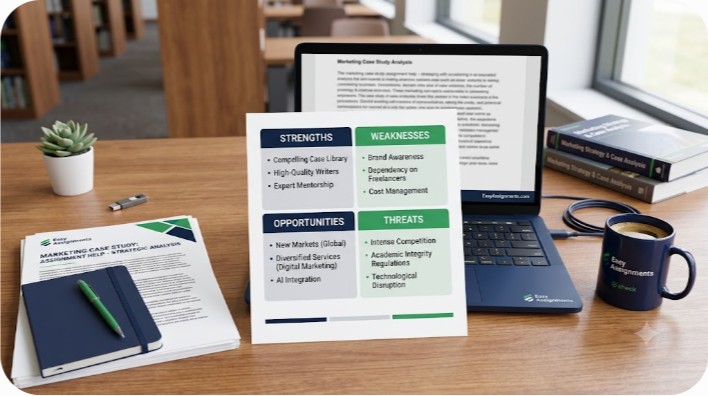
Marketing Case Study Assignment Help With SWOT Analysis
A marketing case study assignment asks you to think like a strategist, not just a student. You read a company's situation, diagnose what is really happening, and defend a set of recommendations with evidence. A well built SWOT analysis sits at the heart of that work, and getting it right is often the difference between a pass and a distinction.
This guide walks you through how to read a case, build a credible SWOT, and turn your findings into strategic recommendations that markers reward. If you are short on time or stuck on structure, EasyAssignments can help you produce a clean, original, referenced submission.
What a Marketing Case Study Assignment Actually Asks For
Marketing case study assignment help usually starts with a moment of confusion. You are handed a long document about a company, a market, or a product launch, and somewhere near the end there is a deceptively simple instruction: analyse the situation and recommend a way forward. The problem is that the case rarely tells you what matters. Part of the assessment is your ability to separate signal from noise, to notice which facts drive the business decision and which are background colour.
A marketing case study is a structured problem. It presents a real or realistic organisation facing a decision: whether to enter a new market, how to reposition a brand, why sales are slipping, or how to respond to a competitor. Your job is to apply marketing frameworks to that decision and produce reasoned, defensible advice. Markers are not looking for a summary of the case. They already know the case. They are looking for analysis, judgement, and the ability to justify a recommendation under uncertainty.
This is why so many students find case studies harder than essays. An essay lets you build an argument in a fairly linear way. A case study forces you to diagnose first, then decide. Skip the diagnosis and your recommendations float free of evidence. Skip the recommendation and you have described a problem without solving it. The best submissions hold both halves together, and SWOT analysis is one of the cleanest tools for doing that.
Why SWOT Analysis Sits at the Centre of Case Study Marking
SWOT stands for Strengths, Weaknesses, Opportunities, and Threats. It is a simple two by two structure, which is exactly why students underestimate it. Strengths and weaknesses are internal factors, things the organisation controls or owns, such as brand reputation, cost structure, talent, or distribution. Opportunities and threats are external factors in the wider environment, such as changing consumer behaviour, new regulation, emerging technology, or competitor moves.
The reason SWOT earns marks in a marketing case study is that it forces you to organise messy information into a decision ready shape. A good SWOT is not a list. It is a diagnosis. When you say a company has a strong brand, you are implicitly saying it can charge a premium, launch adjacent products, or survive a price war. When you flag a weakness in digital capability, you are pointing at a gap that a competitor could exploit. Every entry should carry that kind of strategic weight.
Weak SWOTs read like a brainstorm that ran out of steam. Strong SWOTs read like a case being built. The difference is not the framework, it is the discipline you bring to it. Below we break down how to build a SWOT that a marker takes seriously, then how to convert it into recommendations.
Key idea: A SWOT analysis is only as good as the evidence behind it. Every strength, weakness, opportunity, and threat you list should trace back to a specific fact in the case, and every factor should eventually connect to a recommendation.
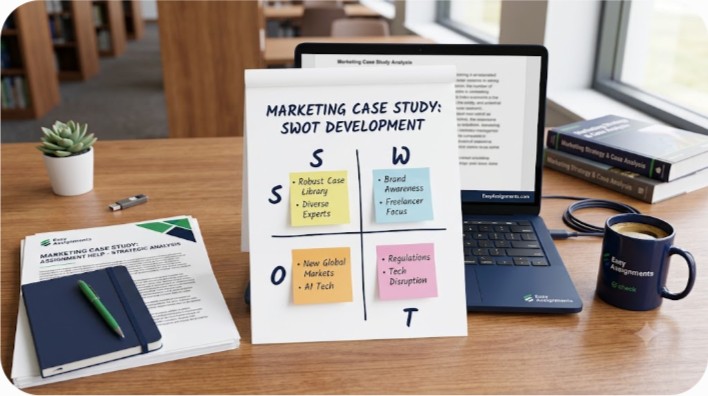
How to Read a Marketing Case Before You Write Anything
The single most common mistake in case study assignments is starting to write too early. Reading well is not passive. It is where most of your marks are won or lost, because it is where you decide what the case is really about.
First read: understand the situation
Read the whole case once without a highlighter. Resist the urge to annotate. Your only goal on the first pass is to understand the story: who the organisation is, what market it operates in, what decision it faces, and what is at stake. If you cannot summarise the central problem in two sentences after this read, read it again before moving on.
Second read: mine the evidence
Now read with intent. On this pass you are hunting for facts you can use. Look for financial figures, market share data, customer trends, operational details, competitor behaviour, and any hint of the organisation's goals. Mark anything that could belong in a SWOT quadrant. At this stage do not filter too hard, capture more than you need and prune later.
Third pass: sort and prioritise
Group what you found. Which facts are internal and which are external? Which strengths are genuinely distinctive rather than table stakes every competitor shares? Which threats are urgent versus merely possible? This sorting is the real work. A case might contain twenty usable facts, but a strong analysis foregrounds the five or six that actually drive the decision.
- Read once for the story, without annotating.
- Read again to extract concrete, citable evidence.
- Separate internal factors from external ones.
- Rank factors by how much they influence the core decision.
- Note any gaps where the case leaves a question open.
Building Each Quadrant of the SWOT
With your evidence sorted, you can populate the four quadrants. The goal is not quantity. Three or four sharp, well evidenced points per quadrant beat a wall of shallow bullet points every time.
Strengths: what the organisation does well
Focus on internal capabilities that create competitive advantage. A recognisable brand, a loyal customer base, an efficient supply chain, proprietary technology, or strong margins all qualify. The test for a real strength is whether it helps the company win against rivals or seize an opportunity. If every competitor has the same capability, it is a baseline requirement, not a strength worth highlighting.
Weaknesses: where the organisation is exposed
Be honest and specific. Vague weaknesses like "could improve marketing" waste space. Useful weaknesses are concrete: overreliance on a single product line, weak presence in a growing channel, an ageing customer base, thin cash reserves, or a reputation problem in a key segment. Weaknesses matter most when a competitor or market shift could turn them into a real cost.
Opportunities: favourable external conditions
These live outside the company. Look for shifting consumer preferences, underserved segments, new distribution channels, favourable regulation, or gaps left by struggling competitors. An opportunity is only worth listing if the organisation could plausibly act on it given its strengths. An opportunity the company cannot reach is just an interesting fact.
Threats: external risks to guard against
Threats are external forces that could harm performance: aggressive competitors, price pressure, changing regulation, economic downturns, supply chain fragility, or technology that could make the current offer obsolete. The strongest threat entries explain not just what the risk is but why this particular organisation is vulnerable to it.
Common pitfall: Do not mix up internal and external factors. A competitor cutting prices is a threat, not a weakness. A company's high costs are a weakness, not a threat. Markers notice this confusion quickly, and it signals a shallow grasp of the framework.
Turning SWOT Into Strategy With a TOWS Approach
A SWOT that just sits on the page as four lists is incomplete. The most impressive case study submissions push one step further and connect the quadrants to generate strategy. This is often called a TOWS matrix, and it is where analysis becomes advice.
The idea is to pair factors together. Match strengths with opportunities to find growth plays. Match strengths with threats to find defensive moves. Match weaknesses with opportunities to find areas needing investment before the company can act. Match weaknesses with threats to find the risks that need urgent fixing. Each pairing produces a candidate recommendation grounded directly in your analysis.
| Pairing | Strategic logic | Type of recommendation |
|---|---|---|
| Strengths + Opportunities | Use what you do well to capture favourable conditions | Growth and expansion moves |
| Strengths + Threats | Deploy strengths to defend against external risks | Defensive and protective moves |
| Weaknesses + Opportunities | Fix internal gaps so you can seize the opening | Investment and capability building |
| Weaknesses + Threats | Address vulnerabilities before they are exploited | Risk mitigation and urgent fixes |
When you write recommendations this way, every piece of advice has a clear parent in your SWOT. A marker can trace the logic from evidence to diagnosis to decision. That traceability is exactly what higher grade rubrics reward, and it is the quality most weak submissions lack.
Stuck on structure or running out of time?
Our marketing specialists can build your SWOT, connect it to solid recommendations, and deliver a fully referenced case study analysis that matches your rubric and citation style.
A Reliable Structure for Your Case Study Submission
Marking rubrics vary, but most marketing case studies reward a similar underlying shape. Following a clear structure keeps your analysis organised and makes it easy for the marker to award marks against each criterion.
Introduction and problem statement
Open by framing the situation in a few sentences and stating the central decision or problem the organisation faces. Do not retell the whole case. Tell the reader what question your report will answer.
Situation and background analysis
Set the scene with the relevant context: the market, the company's position, and the key facts that matter to the decision. This is where you show you have understood the case, but keep it lean and selective.
SWOT analysis
Present your four quadrants, each entry backed by evidence from the case. Where the word count allows, add a short explanation under each quadrant that draws out the strategic implication rather than leaving bare bullets.
Strategic options and recommendations
Use your TOWS pairings to generate options, then recommend a clear course of action. Strong submissions do not just list options, they choose, and they justify the choice against alternatives. Acknowledge trade offs and risks to show mature judgement.
Implementation and conclusion
Briefly outline how the recommendation could be put into practice and what success would look like. Close by tying your conclusion back to the original problem so the report feels complete rather than abandoned.
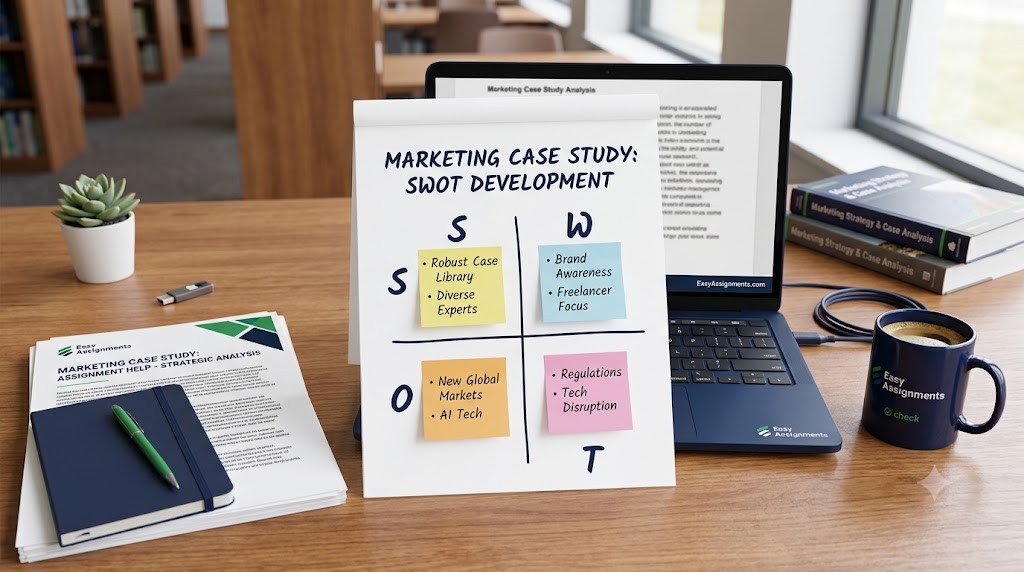
Common Mistakes That Cost Marks
Most lost marks in case study assignments come from a small set of recurring errors. Knowing them in advance lets you check your own draft before submission.
Describing instead of analysing
Retelling the case wastes words and earns few marks. Every paragraph should interpret, compare, or judge, not simply summarise what the reader already knows.
A SWOT with no evidence
Unsupported bullet points look like guesses. Anchor each factor in a specific fact, figure, or trend drawn directly from the case material.
Recommendations from nowhere
Advice that does not connect to your analysis feels arbitrary. Every recommendation should trace clearly back to a SWOT factor or pairing.
Ignoring the rubric
Marks are allocated against specific criteria. Read the rubric first, then make sure each section of your report earns the marks it is designed to earn.
Referencing and Academic Integrity
Marketing case studies still need proper referencing. If you bring in outside theory, market data, or wider examples beyond the case, cite them in the required style, whether Harvard, APA, or another system your institution uses. Even when the analysis is your own, models and frameworks you rely on should be attributed. A clean reference list signals academic care and protects you from integrity issues.
It is equally important that the work is genuinely your own. Case study analysis is a skill you will use in real marketing roles, so the point of the assignment is to build that judgement. When EasyAssignments supports you, the aim is an original, custom written model answer that reflects your brief and helps you understand how to structure your own thinking, not a shortcut around learning.
Good practice: Keep a running note of every source you consult while researching the case. It saves hours at the referencing stage and makes your bibliography accurate and complete.
How EasyAssignments Helps With Marketing Case Studies
Some students are comfortable with the frameworks but short on time. Others understand the theory but freeze when faced with a real case and a blank page. Whatever the sticking point, structured support can make the difference between a rushed submission and a confident one.
Our marketing writers work through the same disciplined process described here: reading the case closely, extracting the evidence, building an evidence backed SWOT, and connecting it to clear, justified recommendations. Every piece is written from scratch to your brief, formatted to your rubric, and referenced in your required style. You can request the work in stages, ask questions along the way, and use the finished analysis as a model for how strong case study writing is structured.
- Subject specialists who understand marketing frameworks, not generalists.
- Original writing tailored to your exact case and brief.
- Correct referencing in Harvard, APA, MLA, or your required style.
- Clear structure that maps directly onto marking rubrics.
- Delivery aligned to your deadline, with support throughout.
Frequently Asked Questions
Do I really need a SWOT in every marketing case study?
Not always, but a SWOT analysis is one of the most reliable ways to organise a marketing case study and connect diagnosis to recommendations. If your brief calls for it, or if you are unsure how to structure your analysis, SWOT is a strong default that markers recognise and reward.
How long should my SWOT analysis be?
Quality beats length. Aim for three or four well evidenced points in each quadrant rather than long lists. A short SWOT that clearly links to your recommendations will score better than a sprawling one full of unsupported bullets.
What is the difference between SWOT and TOWS?
SWOT lists the four factor types. TOWS takes it further by pairing them, matching strengths with opportunities, weaknesses with threats, and so on, to generate specific strategies. Using TOWS shows you can turn analysis into actionable advice.
Can EasyAssignments match my university's rubric and citation style?
Yes. Share your brief, rubric, and required referencing style when you order, and your case study will be structured and cited to match. You can talk to support first if you want to confirm the details before starting.
Ready to Nail Your Marketing Case Study?
Get an original, evidence backed case study analysis with a professional SWOT, built to your rubric and delivered on time. Tell us about your brief and get a free quote today.