
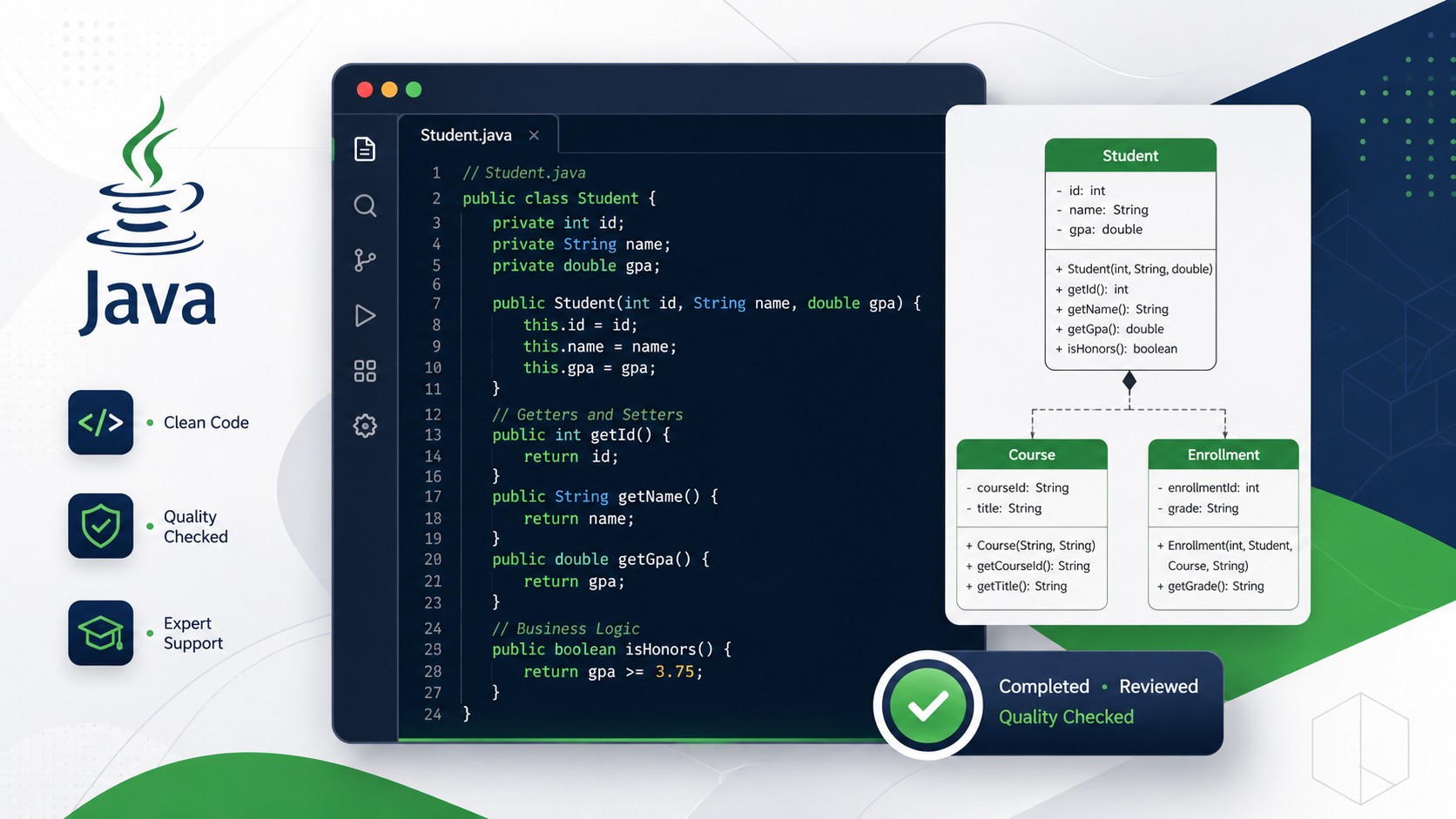
Java Programming Assignment Help With Source Code
Java assignments have a way of looking simple on the brief and then turning into hours of chasing a single misplaced bracket or a null pointer that appears out of nowhere. Getting Java programming assignment help with source code means you receive not just a working program, but code you can actually read, run, and learn from.
This guide explains what genuinely useful help looks like, how to study the source code you receive so it improves your own skills, and how to sidestep the mistakes that quietly cost students marks on every submission.
Why Java Assignments Trip Students Up
Java is one of the first languages most computer science and software engineering students meet, and for good reason. It is strongly typed, object oriented from the ground up, and used across enterprise systems, Android apps, and huge parts of the backend infrastructure that runs the modern web. That popularity is exactly why professors lean on it so heavily for coursework, and why the assignments can escalate in difficulty faster than a beginner expects.
The trouble is that Java asks you to hold several ideas in your head at once. You are not just writing logic that produces the right answer. You are also managing classes and objects, thinking about access modifiers, respecting the type system, handling exceptions gracefully, and organising files so the compiler can find everything. A single missing semicolon, an uninitialised variable, or a mismatched data type will stop the whole program from compiling, and the error messages are not always friendly to a newcomer.
When you seek Java programming assignment help with source code, the goal is not to skip that learning curve entirely. It is to see a correct, well structured example next to your own attempt so the abstract concepts finally click. A good solution acts like a worked example in a maths textbook: you follow the reasoning, understand why each step happens, and then you can reproduce the pattern yourself in the exam or the next assignment.
The most common sticking points
Across thousands of Java briefs, the same themes cause the most frustration. Recognising them early helps you ask for the right kind of help.
- Object oriented design: deciding which classes you need, what belongs in each one, and how they should relate through inheritance or composition.
- The exception system: knowing when to catch, when to throw, and how to keep a program stable when something goes wrong at runtime.
- Data structures: implementing or correctly using arrays, ArrayLists, HashMaps, stacks, queues, and linked lists without off by one errors.
- Generics and collections: writing type safe code that the compiler is happy with while staying readable.
- File input and output: reading from and writing to files, which is where many otherwise correct programs quietly fail.
- Concurrency: threads and synchronisation, usually reserved for advanced modules but notoriously hard to get right.
What Good Java Source Code Actually Looks Like
Not all working code is good code. A program can produce the right output and still earn a mediocre grade because it is messy, undocumented, or structured in a way that ignores object oriented principles. When you receive Java programming assignment help with source code, the quality of that code matters as much as its correctness, both for your marks and for what you take away from it.
High quality Java source code shares a set of recognisable traits. It compiles without warnings, uses clear and consistent naming, and separates responsibilities into sensible classes and methods. Variables are named for what they hold rather than cryptic single letters, methods do one job each, and comments explain the intent behind tricky sections rather than restating the obvious. Crucially, it follows the conventions your instructor expects, because a rubric almost always rewards style and structure alongside functionality.
Rule of thumb: if you cannot read a solution out loud and explain what each method does and why, the code is not helping you. Good source code should feel like a teacher talking you through the logic, not a black box that happens to work.
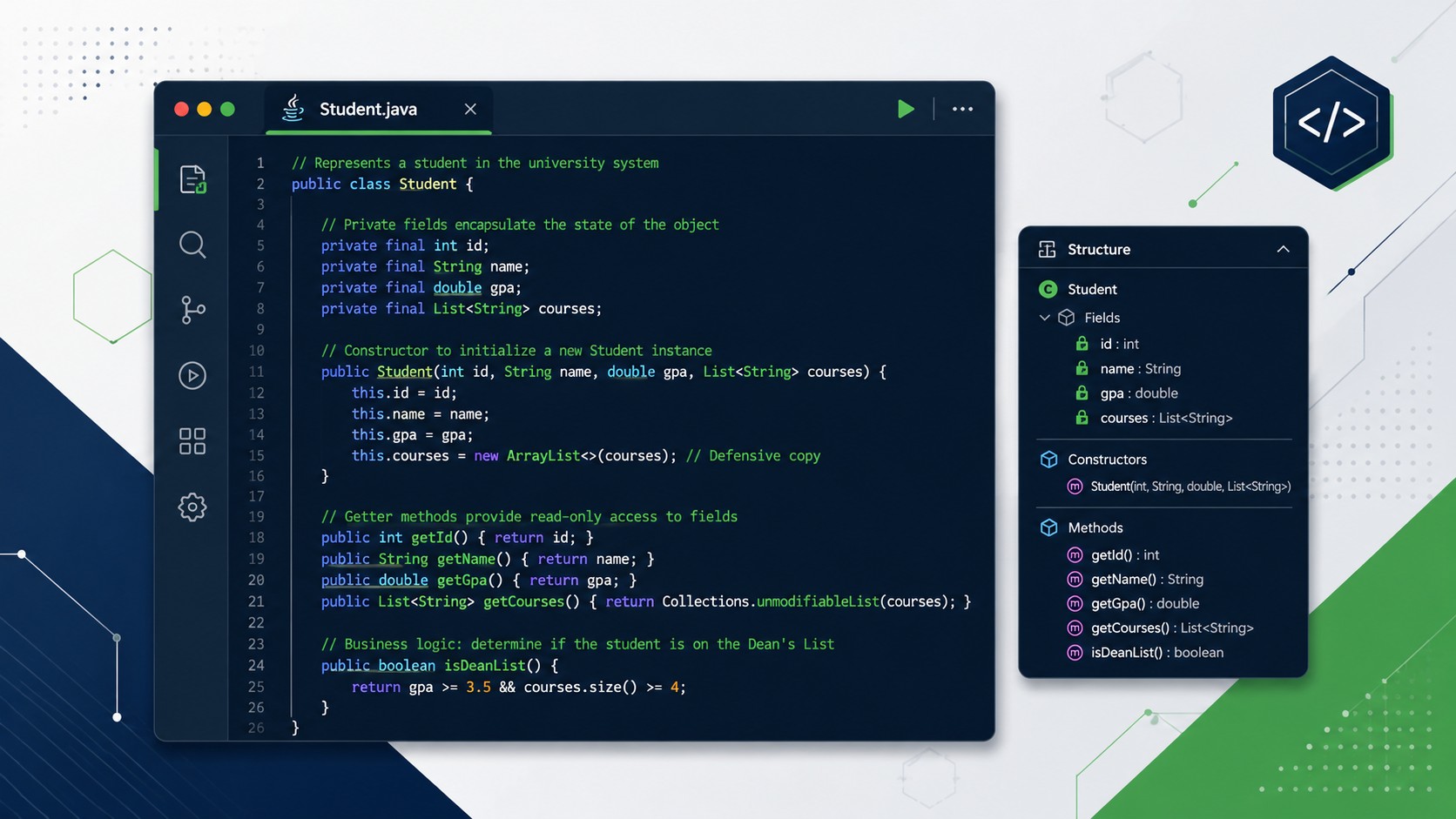
Readable naming and structure
The difference between a pass and a strong grade often comes down to how the code reads. Class names should be nouns written in PascalCase, such as Student or BankAccount. Method names should be verbs in camelCase, such as calculateTotal or withdrawFunds. Constants are typically written in uppercase with underscores. These are not arbitrary rules; they are shared conventions that let any Java developer, including your marker, understand your code instantly.
Structure matters just as much. A well organised solution keeps each class focused on a single responsibility. If one class is trying to manage user input, perform calculations, and print reports all at once, it is doing too much. Splitting those concerns into separate classes or methods makes the code easier to test, easier to mark, and far easier for you to explain if your tutor asks questions.
Comments that teach, not clutter
Comments are a balancing act. Too few and the reader is lost; too many and they drown the actual logic. The best comments explain why a decision was made, flag anything non obvious, and document what a method expects as input and returns as output. When source code comes with this kind of commenting, it doubles as a study aid, because you can trace the author's reasoning line by line and absorb the patterns for yourself.
Types of Java Assignments and How Help Differs
Java coursework spans a huge range, and the kind of help that suits a first week exercise is very different from what a final year project demands. Understanding where your task sits helps you set realistic expectations and ask for support that actually matches the difficulty.
| Assignment Type | Typical Focus | What Good Help Provides |
|---|---|---|
| Beginner exercises | Syntax, loops, conditionals, basic input and output | Simple, heavily commented code that reinforces fundamentals |
| Object oriented programming | Classes, objects, inheritance, polymorphism, encapsulation | Clear class diagrams and code that models the problem cleanly |
| Data structures and algorithms | Lists, trees, sorting, searching, complexity | Efficient implementations with reasoning about time and space |
| GUI applications | Swing or JavaFX, event handling, layouts | Working interfaces with separated logic and presentation |
| Database and file projects | JDBC, file I/O, persistence, CRUD operations | Robust code with error handling and clean data access |
| Capstone and enterprise projects | Multi class systems, design patterns, testing | Architecture guidance, documentation, and maintainable code |
Beginner and intermediate work
Early assignments are about building fluency. You are learning to declare variables, write loops, use conditionals, and structure simple methods. Help at this stage should never just hand over an answer, because the value is entirely in understanding the mechanics. A good solution here is deliberately simple and thoroughly commented so you can map each line back to the concept it demonstrates.
Advanced and project level work
By the time you reach data structures, design patterns, and full applications, the challenge shifts from syntax to architecture. Now the questions are about how to organise a system, which patterns fit the problem, and how to keep code maintainable as it grows. Help at this level is less about individual lines and more about the shape of the whole solution, along with the reasoning that justifies each design decision.
Stuck on a Java deadline?
Whether it is a stubborn compile error or a full multi class project, our team can help you get to clean, working, well explained code.
How to Learn From Source Code, Not Just Copy It
Receiving source code is only half the equation. The students who benefit most treat a solution as a study resource, not a shortcut to a submission they never understand. This distinction matters enormously, because your degree eventually tests you in closed conditions where no external help exists, and because integrity policies at every institution take copying seriously.
The most effective way to use a worked solution is to engage with it actively. Read it, run it, break it on purpose, and rebuild the logic in your own words. When you can reconstruct the approach from memory, you have actually learned it. Here is a practical process that turns any example into genuine understanding.
- Read the whole program once before running it, and try to predict what it will do.
- Compile and run it, then compare the output to your prediction to find gaps in your mental model.
- Add print statements or use a debugger to watch how values change as the program executes.
- Change one thing at a time, such as a loop condition or a method call, and observe the effect.
- Rewrite a section from scratch without looking, then check it against the original.
- Explain the whole solution aloud as if teaching it to a classmate.
A word of caution: submitting someone else's code as your own can breach your institution's academic integrity rules and put your standing at risk. Use source code to learn, adapt the ideas into your own work, and always follow your university's policy on outside help.
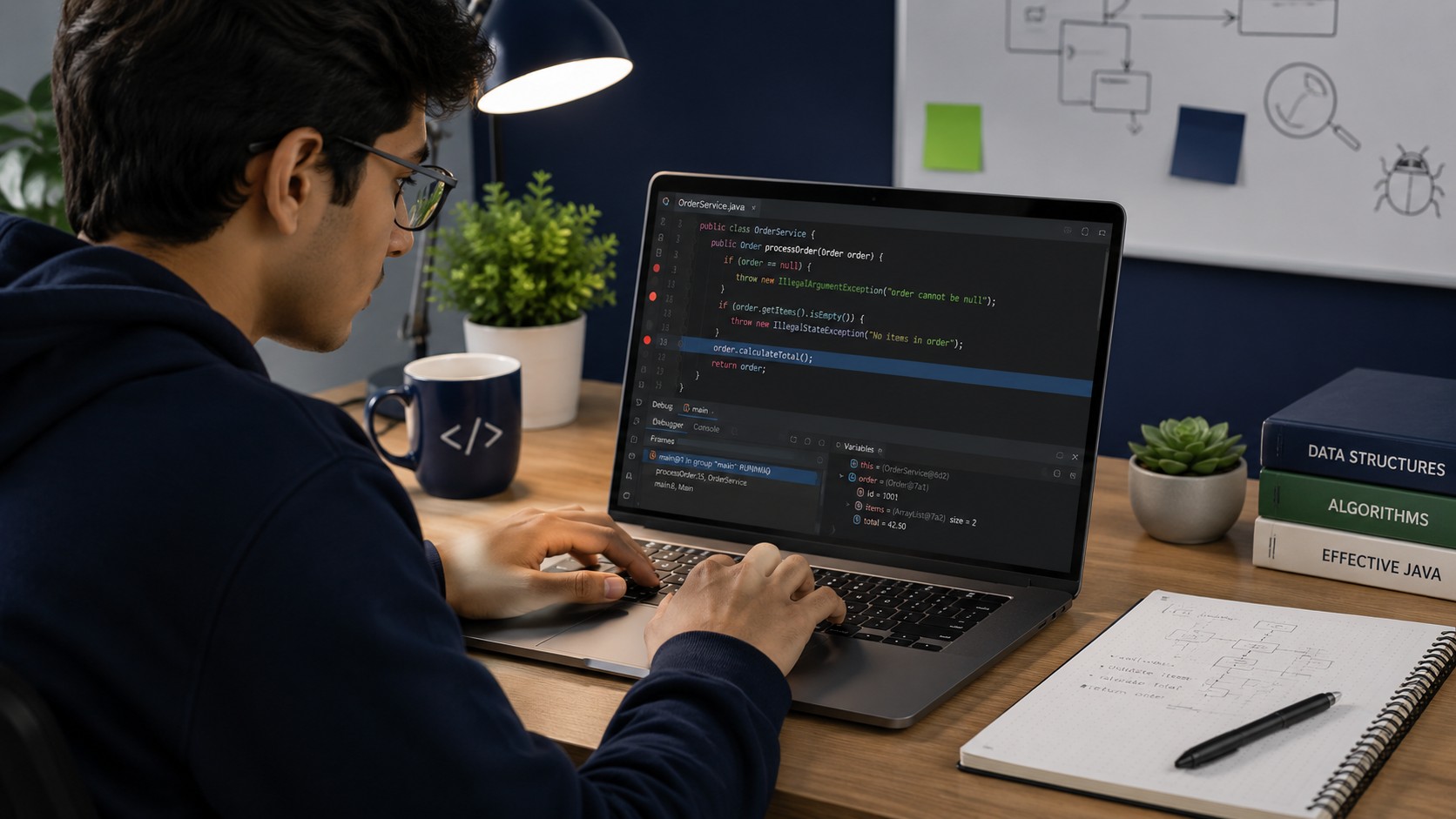
Debugging: the skill that separates good coders
Debugging is where real understanding is forged. When a program does not behave as expected, the temptation is to change things at random until it works, but that habit teaches you nothing and often introduces new bugs. A better approach is systematic. Read the error message carefully, because Java's stack traces point you to the exact line and type of problem. Reproduce the issue reliably, form a hypothesis about the cause, test that hypothesis with a small change, and confirm whether it fixed the problem before moving on.
Learning to use a proper debugger inside an environment such as IntelliJ IDEA, Eclipse, or Visual Studio Code transforms this process. Setting breakpoints and stepping through code line by line lets you watch exactly where reality diverges from your expectation. This single skill will serve you across every language you ever touch, not just Java.
Choosing the Right Java Help for Your Situation
Not all help is created equal, and choosing well protects both your grades and your learning. The right support depends on your deadline, the complexity of the task, and how much you already understand. A quick question about a single error is very different from needing a full project reviewed against a rubric.
When you evaluate any source of Java help, look for a few non negotiables. The code should be original and written for your specific brief, not lifted from a public repository. It should compile and run cleanly on a standard setup. It should come with enough explanation that you can defend every design choice. And the person or service helping you should be willing to walk you through the logic rather than simply drop a file and disappear.
Original code
Written fresh for your exact requirements, not copied from an online source or reused from another student.
Fully runnable
Compiles and executes on a standard Java setup so you can verify the output before you rely on it.
Clearly explained
Comes with commentary on the approach so you understand the why, not just the what.
Rubric aligned
Built around the marking criteria your instructor set, from style conventions to required features.
Questions worth asking before you commit
Before you accept help from anyone, get clear answers to a handful of simple questions. Will the code be written specifically for your assignment? Will it include comments and an explanation you can study? What happens if the marker asks for changes or the code does not match the brief? Can you get a walkthrough of the logic? Honest, confident answers to these are a strong signal that the help will actually serve you rather than land you in trouble.
Getting the Most From EasyAssignments
When you bring a Java task to EasyAssignments, the process works best when you share as much context as possible up front. The clearer your brief, the closer the source code will match what your marker expects, and the more useful the accompanying explanation will be for your own revision.
Send over the full assignment specification, any starter code or templates your instructor provided, the rubric or marking guide, and any constraints such as the Java version, permitted libraries, or forbidden approaches. If your course insists you only use concepts covered so far, say so, because a solution packed with advanced features you have not been taught can be a giveaway and will not help you learn. With that context in hand, you receive code that fits your situation and an explanation pitched at your level. You can start by requesting a free quote through our order page or reach the team directly through support.
Can I get Java programming assignment help with source code that actually compiles?
Yes. Working, runnable source code is the baseline, not a bonus. You should always be able to compile and run what you receive on a standard Java setup and see the expected output before you rely on it. If a solution does not compile, it is not finished.
Is using Java assignment help against academic rules?
It depends entirely on how you use it and what your institution allows. Using a worked solution to learn, then producing your own submission, is study support. Handing in someone else's code as your own can breach academic integrity policies. Always check and follow your university's rules on outside help.
What level of Java can you help with?
Support spans the full range, from first week syntax exercises and object oriented basics through to data structures, GUI applications, database projects, and multi class capstone systems. The explanation is pitched to match the level of your course.
How do I make sure the code matches my assignment?
Share the full specification, the rubric, any starter files, and any constraints such as the Java version or permitted libraries. The more context you provide, the more closely the source code and its explanation will fit your exact brief and your instructor's expectations.
Turn your Java assignment into clean, working code
Get source code you can run, read, and genuinely learn from, built around your rubric and delivered on time.