How to Paraphrase Properly Without Plagiarising
Learning how to paraphrase properly without plagiarising is one of the most valuable academic skills you can build. It lets you use other people's research to strengthen your own argument while keeping your voice firmly on the page.
This guide breaks down a repeatable method, walks through worked examples, and shows you how to cite paraphrased material correctly. If you would rather have expert support on a specific assignment, our team at EasyAssignments is ready to help.
How to Paraphrase Properly Without Plagiarising
Paraphrasing is the skill that separates confident academic writers from anxious ones. Done well, it lets you use other people's research to build your own argument while keeping your voice on the page. Done badly, it is one of the most common routes into an accidental plagiarism case. This guide explains what proper paraphrasing actually involves, gives you a repeatable method with worked examples, shows you how to cite paraphrased material, and covers the mistakes that trip students up most often.
What is paraphrasing?
Paraphrasing means restating someone else's idea completely in your own words and your own sentence structure, while keeping the original meaning intact. A good paraphrase is usually about the same length as the passage it replaces, because you are rewriting a specific point rather than compressing a whole chapter.
The important word in that definition is completely. Changing a few words while keeping the author's sentence shape is not paraphrasing. It is a well known form of plagiarism called patchwriting, and both markers and text matching software are good at spotting it. Proper paraphrasing requires you to understand the idea well enough to explain it from scratch, which is exactly why tutors ask you to do it.
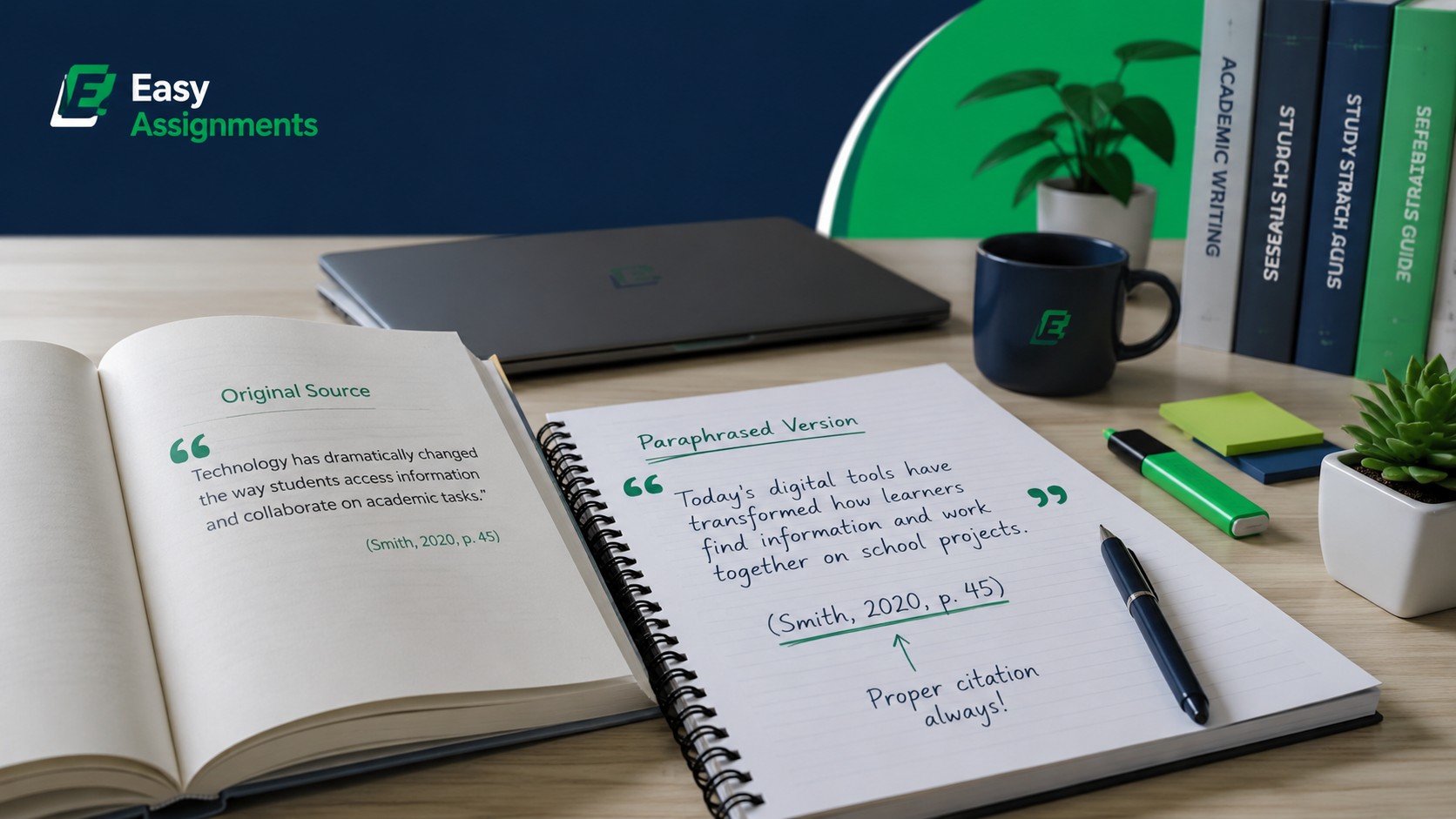
Paraphrasing also does not remove your obligation to cite. This surprises a lot of students. The words may be yours, but the idea still belongs to the original author, so the citation stays. More on that below, because it is the single most common misunderstanding in this whole topic.
Paraphrasing, quoting and summarising: what is the difference?
These three techniques are often confused, and choosing the wrong one weakens your writing. Here is how they compare.
Most academic writing should lean heavily on paraphrasing. A paper stitched together from long quotations shows that you have read the sources but not that you have understood them. Paraphrasing demonstrates comprehension, keeps your voice dominant, and reads far more fluently.
Why proper paraphrasing matters
It proves you understood the material. You cannot rewrite an idea properly unless you have grasped it. Markers know this, which is why paraphrasing is rewarded and copy and paste is not.
It keeps your voice in control. Your argument should be the thread running through your work. Sources support that thread. If the reader hears the sources more clearly than they hear you, the balance is wrong.
It protects you from an academic misconduct case. Most plagiarism cases at university are not deliberate cheating. They are the result of sloppy note taking and weak paraphrasing, where a student's draft ended up too close to the original and they no longer remembered which words were theirs.
It makes your writing better. Rewriting in your own words forces clarity. You end up with prose that fits your register and flows into the sentences around it, instead of lumps of borrowed text with different rhythms.
When does a paraphrase become plagiarism?
A paraphrase crosses into plagiarism in four main ways. Knowing them makes them much easier to avoid.
1. Patchwriting, or synonym swapping. You keep the original sentence structure and simply replace individual words with synonyms. The skeleton of the sentence still belongs to the author, so the passage is still their writing. This is the most common problem by far.
2. Missing citation. You genuinely rewrote the idea in your own words but did not credit the source. The words are yours, the idea is not, and presenting someone else's idea as your own is plagiarism regardless of the wording.
3. Keeping distinctive phrasing. You rewrote most of the passage but left an unusual phrase, coined term, or memorable formulation intact without quotation marks. If a phrase is distinctive enough that it belongs to the author, either quote it properly or rewrite it.
4. Misrepresenting the source. Your paraphrase changes what the author actually claimed, usually by dropping a qualifier or overstating a finding. This is a different kind of academic failure, but it is a serious one, and it often happens when students paraphrase from memory rather than from the text.
How to paraphrase properly: a six step method
This is the method to use whenever you need to bring a specific point from a source into your own writing.
Step 1: Read the passage until you can explain it out loud. Read it more than once. Then look away from the screen and say the idea in a sentence, as if explaining it to a friend on your course. If you cannot, you do not understand it well enough to paraphrase it yet, and any attempt will end up hugging the original wording.
Step 2: Close the source. This step does more work than any other. With the original text in front of you, your brain will reuse its structure automatically. Cover it, minimise the window, or turn the page over. Write from your understanding, not from the sentence on the screen.
Step 3: Write the idea in your own words, from scratch. Aim to convey the same meaning at roughly the same length. Do not worry about elegance on the first attempt. Get the idea down in your own natural phrasing.
Step 4: Compare your version with the original. Now reopen the source. Check two things. First, does your version say the same thing, including any hedges and qualifiers the author used? Second, is any string of words still shared with the original? A useful rule of thumb is that more than three or four consecutive words in common needs either rewriting or quotation marks.
Step 5: Revise for accuracy and fit. Fix anything you distorted. Then adjust the sentence so it flows into the paragraph around it, and add a signal phrase where useful, such as naming the author and what they did with the idea.
Step 6: Add the citation. Every paraphrase gets a citation, in the style your course requires. Do this immediately rather than promising yourself you will add references later, because that promise is where most accidental plagiarism begins.
Six techniques that make paraphrasing easier
If you find yourself stuck too close to the original, these specific moves help you break away from it. The best paraphrases usually combine several of them.
Change the sentence structure. Turn a long sentence into two short ones, or combine two short sentences into one. Move a subordinate clause from the end of a sentence to the beginning. Restructuring is more effective than any amount of word substitution.
Change the word class. Turn a noun into a verb, or an adjective into a noun. A source that discusses the rapid expansion of a sector can become a sentence about how quickly that sector expanded. This shifts the grammar of the sentence, not just its vocabulary.
Change the voice. Convert passive constructions to active ones, or the reverse. Academic sources use a lot of passive voice, so switching to active often produces a genuinely different sentence and clearer prose at the same time.
Reorder the information. Present the author's points in a different sequence, as long as the logic still holds and the meaning is unchanged. If the source gives a result and then the cause, you can give the cause and then the result.
Use a signal phrase. Opening with a phrase such as a named researcher found, argued, or observed does two useful things. It attributes the idea clearly, and it forces the rest of your sentence into your own grammar.
Reduce to a note first. Instead of paraphrasing the sentence directly, write a four or five word note capturing the point. Then expand that note into a full sentence later, working only from the note. Because you are building up from your own shorthand rather than editing down from the source, the wording comes out as yours.
Worked examples
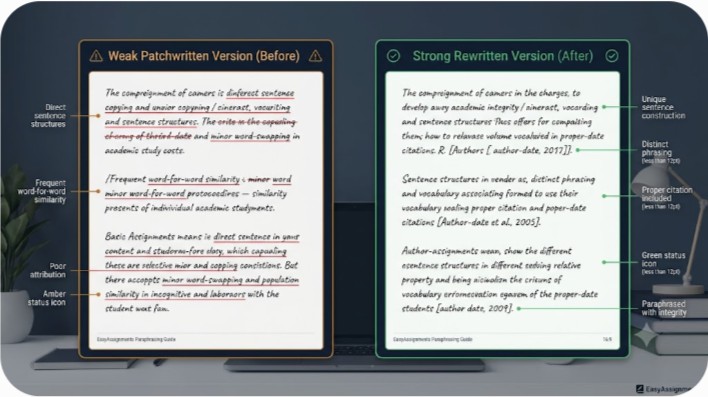
The examples below use invented source sentences so you can see the pattern clearly. In each case, look at what changes between the weak version and the strong one.
Example 1: a research finding
Original source: Students who reviewed material at spaced intervals retained significantly more information after four weeks than students who studied the same content in a single session.
Weak paraphrase (patchwriting): Pupils who revised content at spaced intervals remembered considerably more material after four weeks than pupils who studied the same content in one sitting.
This fails because only individual words changed. The sentence structure, the order of ideas and the comparison are all still the original author's. A marker or a similarity report would flag it immediately.
Strong paraphrase: Spacing revision out over time appears to be far more effective for long term recall than cramming. In one study, learners who returned to the same material across several sessions still remembered noticeably more of it a month later than those who covered it all at once (Author, 2024).
This works because the structure is rebuilt from scratch, the idea is expressed in the writer's own register, the finding is not overstated, and the source is cited.
Example 2: a definition
Original source: Academic integrity refers to the shared set of values, including honesty, trust and responsibility, that governs how members of a scholarly community produce and share knowledge.
Weak paraphrase: Academic integrity means the common set of values, such as honesty, trust and responsibility, that controls how members of a scholarly community create and share knowledge.
Again, this is a synonym exercise rather than a paraphrase. Note also that the phrase academic integrity is a standard term, not distinctive phrasing, so it can stay. The problem is everything around it.
Strong paraphrase: At its core, academic integrity is about the expectations a scholarly community places on its own members. Honesty, trust and a sense of responsibility shape how knowledge gets produced and passed on within that community (Author, 2023).
Example 3: a claim with a qualifier
Original source: Early evidence suggests that the intervention may reduce dropout rates, although the sample was small and the effect was not statistically significant across all groups.
Weak paraphrase (distorts meaning): Research shows that the intervention reduces dropout rates.
This one is short and uses different words, so it might pass a similarity check, but it is arguably a worse error. It has stripped out every qualifier and turned a tentative early finding into a confident fact. Paraphrasing must preserve the strength of the original claim, not just its topic.
Strong paraphrase: There are early signs that the intervention might help keep students enrolled, though the authors are cautious about this: the study involved few participants, and the effect did not hold consistently across every group (Author, 2025).
Do you still have to cite a paraphrase? Yes
This is worth stating as plainly as possible, because it causes more accidental plagiarism than anything else. Paraphrasing changes the words. It does not transfer ownership of the idea. Every paraphrase needs an in text citation and a matching entry in your reference list.
The one exception is common knowledge, meaning facts that are widely known and undisputed within your field and would not be traced to any particular source. Even then, if you are unsure whether something counts, cite it. Nobody has ever failed an assignment for including one citation too many.
The formatting differs by style, so check your course requirements. In author and date styles such as APA and Harvard, an in text paraphrase typically credits the author surname and year of publication, either in brackets after the sentence or woven into your signal phrase. In MLA, the in text citation gives the author surname and, where the source is paginated, the page number. In numeric styles such as Vancouver or IEEE, you insert the number assigned to that source. Whatever the style, the principle is identical: the reader must be able to get from your sentence to the exact source you used.
Page numbers deserve a note. Many styles do not strictly require them for a paraphrase, but including them when you are paraphrasing a specific passage from a long text is good practice and some tutors expect it. It helps your reader verify the point, and it helps you find it again during editing.
How text matching software sees a weak paraphrase
Students often assume that similarity software compares whole sentences, so changing a few words will defeat it. That is not how it works. These systems compare strings of consecutive words against very large databases of published work, student submissions and web pages. A patchwritten sentence keeps most of its word order intact, so the shared strings remain and the passage gets flagged.
It is also worth understanding that a similarity report is not a plagiarism verdict. It is a set of matches that a human being then interprets. A moderate similarity score made up of correctly quoted and cited material is normal and fine. A low score can still accompany serious plagiarism, for example when an idea has been rewritten well but not credited at all. The judgement is always human, which is why the underlying skill matters more than any score.
The practical implication is simple. Do not write in order to pass a checker. Write in order to explain ideas accurately in your own words and credit their sources. Do that, and the report takes care of itself.
A note on paraphrasing tools and AI
Automatic paraphrasing tools and spinners are widely available, and it is worth being clear eyed about them. There are three problems.
They often produce exactly the error you are trying to avoid. Most tools work by substituting synonyms within the existing sentence frame, which is the textbook definition of patchwriting. The output can look different while remaining structurally identical to the source.
They damage accuracy. Automatic substitution regularly replaces a technical term with a near synonym that means something different in your field. Statistically significant, for example, has a precise meaning that a generic synonym destroys.
Many institutions treat their use as misconduct. Policies vary and are changing quickly, so read your own institution's rules rather than assuming. Where use of such tools is permitted, it is usually on the condition that it is declared.
There is also a learning cost that is easy to overlook. Paraphrasing is a transferable skill that gets easier with practice. Every time you outsource it, you postpone acquiring it, and the exam or dissertation where you need it will arrive eventually.
Common mistakes to avoid
Writing with the source open in front of you, then wondering why your sentence looks similar.
Swapping synonyms while leaving the author's sentence structure untouched.
Assuming that because the words are yours, no citation is needed.
Dropping qualifiers such as may, suggests, or in some cases, and turning a tentative finding into a fact.
Leaving a distinctive coined phrase unquoted inside an otherwise original sentence.
Paraphrasing from memory days later, without checking your version against the original.
Keeping notes that do not distinguish between quotation, paraphrase and your own thinking.
Stringing several paraphrases together with no argument of your own connecting them.
The note taking habit that prevents most problems
Almost every accidental plagiarism case can be traced back to notes. If your notes do not record what is quoted, what is paraphrased and what is your own idea, then weeks later you cannot possibly reconstruct it, and something borrowed ends up in your draft unmarked.
Fix it with a simple convention and use it every time. Put anything copied word for word in quotation marks, always, even in rough notes. Mark your own thoughts with a distinct symbol or a different colour. Record the author, year and page number at the moment you take the note, not later. Write paraphrases in full sentences at the note taking stage rather than half copying phrases you intend to fix up afterwards.
This takes a few extra seconds per note and removes an entire category of risk from your work.
Checklist: is my paraphrase safe?
I understood the passage well enough to explain it without looking at it.
I wrote my version with the source closed.
The sentence structure is mine, not a rearrangement of the author's.
No more than three or four consecutive words are shared with the original.
Any distinctive phrase I kept is inside quotation marks.
The meaning is accurate, including every hedge and qualifier.
The paraphrase fits the grammar and tone of the paragraph around it.
There is an in text citation, and a matching reference list entry.
My paraphrase supports a point I am making, rather than sitting there on its own.
How to practise this skill
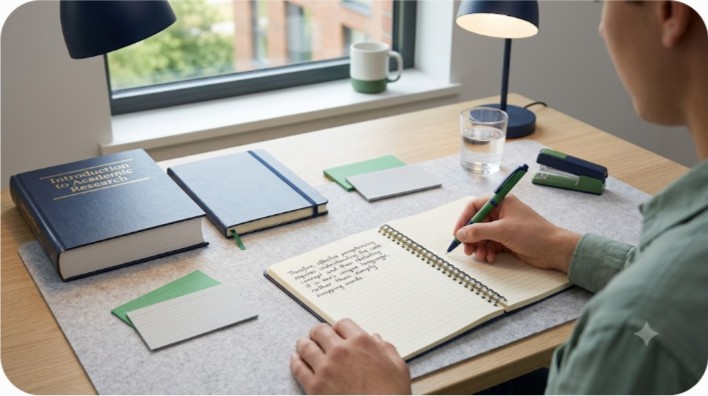
Paraphrasing improves quickly with deliberate practice, and it does not take long. Pick a short passage from a journal article in your subject, ideally three or four sentences. Read it twice, close it, and write your version. Then compare the two, highlighting any shared strings of words, and rewrite until none remain. Ten minutes of this a few times a week will change how you write within a month.
A useful variation is to paraphrase the same passage twice, on different days, without looking at your first attempt. Comparing the two versions shows you which parts of the original are gripping your memory, and those are usually the parts you need to work hardest to rebuild.
You can also practise in reverse. Take a paraphrase you wrote earlier in the term, find the original, and audit it honestly against the checklist above. Students are often surprised by what they find, and it is far better to discover it in your own review than in a misconduct meeting.
Frequently asked questions
How much do I need to change for it to count as a paraphrase? There is no magic percentage. The test is structural, not numerical: the sentence should be built by you, not edited from theirs. As a practical guide, if more than three or four consecutive words match the original, revise it or quote it.
Do I need to cite if I paraphrase? Yes, always, unless the point is genuine common knowledge in your field. Rewriting the words does not make the idea yours.
Is a paraphrase shorter than the original? Usually it is about the same length, because you are restating one passage. If you are compressing a long section into a couple of lines, that is a summary, which also needs a citation.
Can I paraphrase my own earlier work? Reusing your own submitted work without acknowledgement is self plagiarism at many institutions. If you want to draw on an earlier assignment, check your institution's policy and cite yourself where required.
Should I keep technical terms the same? Yes. Standard terminology in your discipline should not be replaced with synonyms, because the precise term carries the meaning. Rewrite the sentence around it instead.
Is it plagiarism if I did it by accident? Intent affects how an institution responds, but it does not change whether the work is plagiarised. This is why process habits, particularly good note taking, matter more than good intentions.
What if the original is already very simple? Short, plain sentences are the hardest to paraphrase, because there are few structural choices. In those cases, either quote the sentence properly or integrate the point into a larger sentence of your own that adds your framing.
Final thoughts
Paraphrasing well is not a trick for getting past a similarity checker. It is the mechanism by which you take part in an academic conversation: you read what others have found, you explain it accurately in your own words, you credit them, and then you add something of your own. Every step of that process is a skill worth having well beyond your degree.
If you remember one thing from this guide, make it this: close the source before you write, and cite it after. Those two habits, applied consistently, remove almost every risk discussed above.
This guide is written to help students develop their own paraphrasing and referencing skills, so that the work they submit is genuinely their own.
Turn your sources into confident, original writing
Whether you need feedback on a draft or help building an assignment from scratch, EasyAssignments has your back. Get a free quote today and keep your work genuinely your own.