
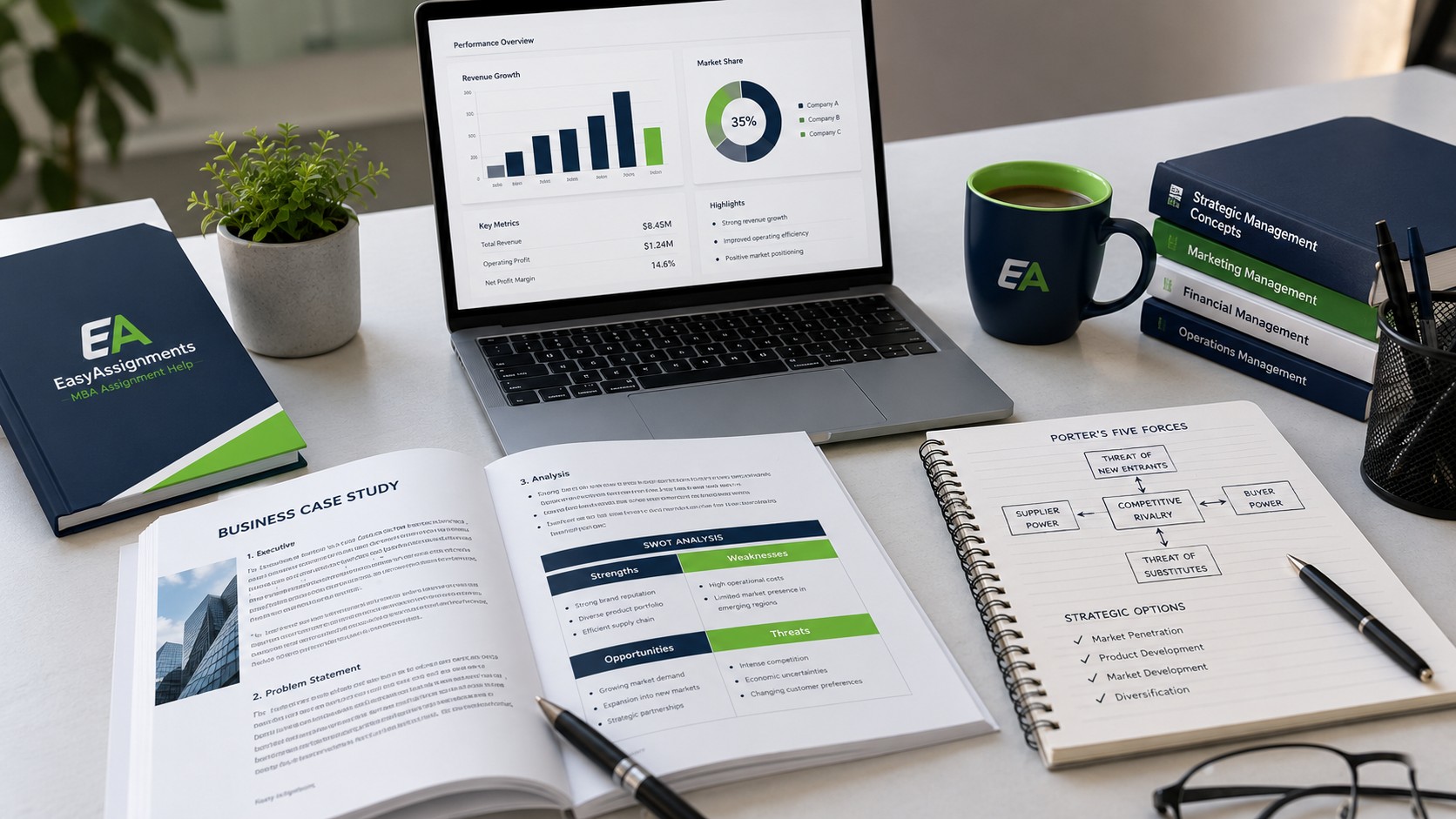
Help With MBA Assignments: Case Studies, Reports and Group Projects Made Manageable
An MBA assignment is not a longer undergraduate essay. It asks you to make a defensible business decision, support it with evidence, weigh the trade-offs honestly, and write it up the way a consultant would present to a board. That shift catches out even strong students in their first term.
This guide walks through every major assignment type you will meet in a business school programme, the structures that examiners actually reward, a realistic planning timeline for working professionals, and the small mistakes that quietly drain marks from otherwise good work.
Why MBA Assignments Feel Harder Than They Look
Students looking for help with MBA assignments usually arrive with the same complaint: they were good writers at undergraduate level, and now the same approach is producing average marks. The reason is a change in what is being assessed. Undergraduate coursework mostly tests whether you understand a body of knowledge. MBA coursework tests whether you can use that knowledge to decide something under uncertainty, and then defend the decision to people who might disagree.
That shift shows up in three places. First, the questions are open. There is rarely one correct answer to "Should this firm enter the Southeast Asian market?" so your mark depends on the quality of your reasoning rather than on landing on a predetermined conclusion. Second, evidence is expected to be quantitative wherever quantitative evidence exists. A strategy argument that never touches margins, market size, or payback period reads as opinion. Third, the writing style is different. Business school markers want front-loaded conclusions, tight paragraphs, and clean exhibits. A slow build to a conclusion in the final paragraph, which works beautifully in a humanities essay, actively costs marks here.
There is also a practical dimension that nobody advertises in the prospectus. Most MBA students are working, many are managing families, and a fair number are studying in a second language while adjusting to an unfamiliar academic culture. The workload is designed to be heavy, and the assignments cluster. When three modules all have deliverables in the same fortnight, the constraint is rarely intelligence. It is hours.
The Main Types of MBA Assignments
Different assignment types reward different things, and treating them all as "an essay with business content" is the single most common source of lost marks. Here is what each one is actually asking for.
Case study analysis
The case study is the signature MBA assessment. You are handed a company situation, usually with exhibits containing financial statements or market data, and asked to diagnose the problem and recommend a course of action. The trap is description. Weak submissions retell the case back to the marker, who wrote or selected the case and does not need a summary. Strong submissions spend a paragraph on situation, most of the word count on analysis, and finish with a recommendation specific enough to be implemented on Monday morning.
A structure that works reliably: state the core decision, diagnose the situation with evidence from the exhibits, generate two or three genuine alternatives, evaluate them against explicit criteria, recommend one, and close with implementation risks and how you would mitigate them. The alternatives matter more than students expect. If you present only your favoured option, the marker cannot see your judgement at work, only your conclusion.
Business reports and consulting-style deliverables
Reports are structured documents with an executive summary, numbered sections, headings, exhibits and appendices. The executive summary is where marks are won or lost, because it should stand alone: a reader who sees only that page should know your recommendation, your reasoning, and what it costs. Write it last, and write it as a summary of conclusions rather than a summary of contents. "This report examines three market entry options" tells the reader nothing. "We recommend a joint venture entry, which reaches breakeven roughly two years earlier than a wholly owned subsidiary at meaningfully lower capital risk" tells them everything.
Financial analysis and modelling
Finance, accounting and corporate valuation modules ask for ratio analysis, discounted cash flow models, capital budgeting decisions, or variance analysis. The technical work needs to be correct, but correctness alone earns a middling grade. What separates good from excellent is interpretation and assumption discipline. State your assumptions explicitly, show sensitivity around the ones that matter most, and translate the output into a business statement. A net present value figure sitting alone in a table is data. The same figure explained as "positive under every discount rate we tested up to 14 percent, and negative only if revenue growth falls below 3 percent" is analysis.
Strategy and marketing plans
These assignments invite frameworks: SWOT, PESTLE, Porter's Five Forces, the marketing mix, Ansoff, the BCG matrix. Frameworks are tools for organising thought, not content in themselves. Filling a SWOT grid with fifteen bullet points and moving on is framework use at the lowest level. Framework use at the highest level identifies which two or three factors genuinely drive the decision, explains why, and discards the rest. Markers notice the difference immediately.
Reflective assignments and leadership journals
Leadership, organisational behaviour and personal development modules often require reflective writing, where you analyse your own experience against theory. Students who are comfortable with analytical work often find these the hardest, because the instinct is to stay abstract and safe. Reflection needs a specific incident, an honest account of what happened including what you did poorly, a theoretical lens applied to explain it, and a concrete change in future behaviour. Models such as Gibbs' reflective cycle or Kolb's learning cycle give you a scaffold, but the substance has to be genuinely yours.
Dissertations and capstone projects
The final project is a sustained piece of research, often involving primary data from your own organisation. It brings its own machinery: a research question narrow enough to answer, a literature review that builds an argument rather than listing sources, a justified methodology, ethical approval where human participants are involved, and findings connected back to the literature. The most common failure is scope. A question like "How does culture affect performance?" cannot be answered in a capstone. "How did the shift to hybrid working affect team cohesion within one department of one mid-sized firm between 2023 and 2025?" can.
The one-sentence test: before you write anything, try to state your answer in a single sentence with a because clause. "We should acquire rather than build, because the eighteen-month time-to-market gap outweighs the acquisition premium." If you cannot fill that sentence in, you are not ready to write. You are still researching.

How Different Assignment Types Are Marked
Rubrics vary between institutions, but the underlying weighting is remarkably consistent. Knowing where the marks sit tells you where to spend your final hours.
| Assignment type | What carries the most weight | Most common failure | Highest-return fix |
|---|---|---|---|
| Case study | Quality of analysis and justified recommendation | Summarising the case instead of analysing it | Cut description to one short section, add explicit alternatives |
| Business report | Executive summary, structure, actionable output | Executive summary that describes rather than concludes | Rewrite the summary last so it states the decision |
| Financial analysis | Technical accuracy plus interpretation | Correct numbers with no business meaning attached | Add a sensitivity table and a plain-English verdict |
| Strategy plan | Depth of framework application | Frameworks filled in mechanically and left unused | Name the two factors that decide the outcome and defend them |
| Reflective essay | Honesty, specificity, theory linkage | Vague generalities with no real incident | Anchor to one concrete event and include what went wrong |
| Capstone project | Research design coherence and depth | Research question far too broad | Narrow by sector, timeframe and single organisation |
A Working Method for Any MBA Assignment
The students who cope best with MBA workload are rarely the fastest writers. They are the ones with a repeatable process, so that each new brief becomes a known sequence rather than a blank page. This is a method that adapts to most assignment types.
Step 1: Read the brief like a contract
Extract every deliverable, every constraint and every marking criterion into a checklist before you begin. Note the command verbs precisely, because "evaluate" is a different task from "describe" and "critically appraise" is different again. Note whether appendices count toward the word limit, which referencing style is required, and whether there is a mandated structure. A surprising share of lost marks come from a requirement that was stated plainly and simply not noticed.
Step 2: Build the argument before the paragraphs
Write your one-sentence answer, then list the three to five claims that must be true for that answer to hold, then note what evidence supports each. This skeleton is your outline. It also exposes weak spots early, while there is still time to research, rather than at 2am the night before when you discover claim three has nothing behind it.
Step 3: Gather evidence with a bias toward primary sources
Use your university's databases rather than general web search. Industry reports, company filings, peer-reviewed journals and reputable financial press carry weight; blog posts and content marketing pages do not. Record the full citation the moment you use a source. Reconstructing references at the end is slow, error-prone, and a frequent cause of accidental referencing failures.
Step 4: Draft fast, edit slow
Write a complete rough draft without stopping to perfect sentences. A finished bad draft is far more useful than a polished half. Editing is where the quality actually arrives: tightening claims, cutting description, adding the sensitivity analysis you skipped, and making sure every exhibit is referenced in the text and earns its place.
Step 5: Run a structured final check
Read only your topic sentences in sequence. If they tell a coherent story on their own, your structure is sound. If they read as a disconnected list, your argument is not doing the work you think it is. Then check formatting, word count, referencing consistency and file naming against the brief.
- Does the executive summary state a decision, not a description?
- Is every framework you used actually driving a conclusion?
- Are assumptions stated where numbers depend on them?
- Does each exhibit get referred to in the body text?
- Have you addressed limitations rather than pretending there are none?
- Is the referencing style consistent throughout, including in-text citations?
Stuck on a deadline this week?
Whether you need structural feedback on a case analysis, a second look at a valuation model, or support planning a capstone, EasyAssignments can help you get moving again.
Surviving MBA Group Assignments
Group work is a defining feature of business school and a persistent source of stress. Teams are often assigned rather than chosen, spread across time zones, and made up of people with very different professional backgrounds and standards. The academic justification is sound, since managing exactly that situation is what most MBA graduates go on to do, but it makes for painful evenings.
The single highest-value action is front-loading. In your first meeting, agree three things in writing: who owns which deliverable, what the internal deadlines are, and what happens if someone misses one. Internal deadlines should sit at least four days before the real one, so integration and editing have room. Without that buffer, the person doing the final assembly inherits an impossible night.
Appoint an integrator rather than assuming the document will merge itself. Group submissions frequently read as five separate essays stapled together, with inconsistent terminology, clashing formatting and contradictory conclusions between sections. One person owning voice and consistency across the whole document is worth more than an extra section of content.
On free riding: most programmes have a formal process for uneven contribution, often peer assessment or an escalation route to the module leader. Use it early and use it factually, with dates and what was agreed. Waiting until the submission deadline to raise a problem gives your tutor almost no options, and silently absorbing someone else's work teaches the group nothing.
Making distributed teams work
Keep a single shared document as the source of truth rather than emailing versions around. Agree on the referencing style and the section template at the start, so nobody rewrites formatting later. Record decisions in a running notes file, because in a team spread across four time zones, the conversation you had at 11pm will not be remembered accurately by the person who missed it.

Common Mistakes That Quietly Cost Marks
The errors that pull a good MBA assignment down to an average grade are rarely dramatic. They are small, systematic, and easy to correct once you know to look for them.
Describing instead of deciding
Pages spent explaining what the company does, what the framework is, or what the theory says. Markers know all of it. Cut the exposition and spend the space on judgement.
Numbers without meaning
Ratios calculated and left in a table. Every figure needs a sentence saying what it implies for the decision, and ideally a comparison to a benchmark or prior period.
Ignoring the rubric
Writing brilliantly about something that carries ten percent of the marks while under-serving the criterion worth forty. Map your word count to the weighting.
Sloppy referencing
Mixed styles, missing in-text citations, sources listed but never cited. It looks careless, it costs presentation marks, and at worst it raises academic integrity questions.
Two more worth naming
Overconfidence is a subtle one. Recommendations that admit no risk read as naive rather than decisive. A short, specific limitations paragraph strengthens your argument by showing you understand where it might break. Conversely, hedging everything is equally damaging: if your conclusion is that the firm might possibly consider several options depending on circumstances, you have not answered the question.
The other is length mismanagement. Word limits in MBA programmes are usually tight relative to the material, and going over is often penalised directly. If you are three hundred words over, the fix is almost never trimming adjectives. It is deleting a section that was describing rather than deciding.
Where Getting Help With MBA Assignments Genuinely Helps
Support works best when it targets the specific point where you are stuck rather than replacing the learning. Most students who ask for help with MBA assignments need one of a handful of things.
Structural feedback is the most common and the most valuable. You have the analysis and the evidence, but the argument is not landing, and a second reader can tell you within ten minutes that your recommendation is buried on page six and your alternatives section is missing. Technical checking is next: someone reviewing a valuation model, checking whether your assumptions are defensible, or spotting that your discount rate does not match your cash flow basis. Then there is planning support for long projects, where the challenge is scoping a capstone question that can actually be answered with the data and time available.
Language and clarity support matters enormously for students studying in a second language, whose analytical thinking is often strong while the written expression obscures it. And research guidance saves time when you cannot find the right sources: knowing which databases, which industry report series, and which search terms turn a fruitless afternoon into a productive hour.
Use support as scaffolding, not substitution. Every institution has its own academic integrity policy, and it is your responsibility to know what your programme permits. Guidance, feedback, worked examples and structural review help you produce better work of your own. Submitting work you did not do is a different thing entirely, and it carries real consequences.
Building a Sustainable Term Plan
Most MBA stress is scheduling stress rather than difficulty stress. Assignments do not arrive evenly; they cluster around the same weeks in every module. The fix is boring and effective: at the start of term, put every deadline from every module onto a single calendar, then look at the collisions.
Work backward from each deadline with rough stage dates. For a substantial assignment, something like: brief analysed and question defined at the start, research complete by roughly the halfway point, full draft finished with several days to spare, and the final days reserved for editing, formatting and referencing. Protect the editing window ruthlessly, because it is the stage that gets sacrificed first and the one that most affects your grade.
Then be honest about capacity. If two capstone-scale deliverables land in the same week and you are working full time, that is a problem to solve in week one, not week eleven. Many programmes allow extensions for genuine circumstances if requested in advance through the proper channel. Requesting one early is a legitimate planning decision. Requesting one the night before, when the real cause was scheduling, usually is not.
Finally, treat your first assignment of the programme as calibration. Read the feedback closely, especially the comments about analysis depth and structure, and adjust your approach before the second one. Students who do this typically see their marks move within a term. Students who write the next assignment exactly the same way tend to receive exactly the same feedback again.
Frequently Asked Questions About Help With MBA Assignments
What makes MBA assignments different from undergraduate work?
The core difference is that MBA assignments assess decision-making rather than knowledge recall. You are expected to reach a defensible conclusion under uncertainty, support it with quantitative evidence where available, weigh realistic alternatives, and present it in a front-loaded professional format. Depth of analysis matters far more than breadth of description.
How long should I spend on a typical MBA case study?
It varies with case complexity and word limit, but a useful split is roughly a third on reading and analysis including the exhibits, a third on drafting, and a third on editing and refining the recommendation. The final third is the one most often skipped and the one that most affects the grade.
Is it acceptable to get help with MBA assignments?
Getting guidance, structural feedback, tutoring and research support is normal and widely encouraged, and most business schools run writing centres for exactly this reason. What is not acceptable is submitting work as your own that you did not produce. Check your institution's academic integrity policy, since the specific boundaries differ between programmes.
How do I handle a group member who is not contributing?
Raise it directly with the person first, referring to the written deadlines and ownership you agreed at the start. If nothing changes, escalate to your module leader early with factual documentation of what was agreed and what was delivered. Most programmes have a formal peer assessment or contribution process, and using it well before the deadline gives your tutor room to act.
Final Thoughts
MBA assignments reward a specific habit of mind: decide, justify, quantify, and be honest about what you do not know. Once you internalise that, the individual assignment types stop feeling like separate challenges and start looking like variations on the same task. The frameworks change, the word limits change, the module changes, but the underlying question is always some version of "what would you do, and why should we believe you?"
The rest is logistics, and logistics can be solved. Map the term, protect your editing time, front-load your group agreements, and get targeted help at the point where you are genuinely stuck rather than grinding through it at 3am. That combination is what separates students who finish an MBA well from students who merely finish one.
Get Help With Your MBA Assignments Today
From a single case analysis to a full capstone project, EasyAssignments supports business school students at every stage. Share your brief and get a clear, no-pressure quote.