Free Plagiarism Checker for Assignments Before Submission
Using a free plagiarism checker for assignments before submission is one of the smartest last steps in your writing process. It gives you a clear view of how original your work is, flags anything that looks too close to a source, and lets you fix problems while you still control the outcome.
This guide walks you through how these tools work, how to read a similarity report without panicking, and the writing habits that keep your work genuinely your own. The goal is not to game a percentage, but to submit with real confidence.
Why You Should Use a Free Plagiarism Checker for Assignments Before Submission
Every academic year, capable students lose marks or face integrity hearings not because they set out to cheat, but because of small, avoidable mistakes. A missing citation, a paraphrase that stayed too close to the original, a quotation that lost its quotation marks during editing: any of these can push a similarity score higher than expected. A free plagiarism checker for assignments before submission acts as a safety net that catches these issues while you still have time to correct them.
Think of it the way a programmer thinks of a linter or a writer thinks of a proofreader. It is not there to judge you. It is there to surface patterns you cannot easily see on your own, especially after you have read your own draft so many times that the words blur together. When you check your work before it reaches your instructor, you convert a potential problem into a routine edit.
There is also a confidence benefit that is easy to overlook. Submitting an assignment you have not verified means carrying a low hum of anxiety until the grade comes back. Running a scan and seeing a clean, well-cited report replaces that anxiety with certainty. You know exactly what your instructor will see, and you have already addressed anything that might have raised a flag.
The core idea: a plagiarism checker does not decide whether you plagiarized. It shows you where your text overlaps with existing sources so that you can decide whether each match is properly cited, correctly quoted, or in need of rewriting.
How Plagiarism Checkers Actually Work
Understanding the mechanism behind these tools helps you read their results intelligently instead of reacting to a single number. Most checkers follow the same broad process, even though their databases and interfaces differ.
Text fingerprinting and matching
When you upload a document, the tool breaks your text into smaller chunks, often overlapping strings of words. It then compares these chunks against a large index of existing material: web pages, academic papers, journal articles, books, and in many cases a repository of previously submitted student work. Where your chunks match indexed content, the tool records the overlap and links back to the source.
The similarity score
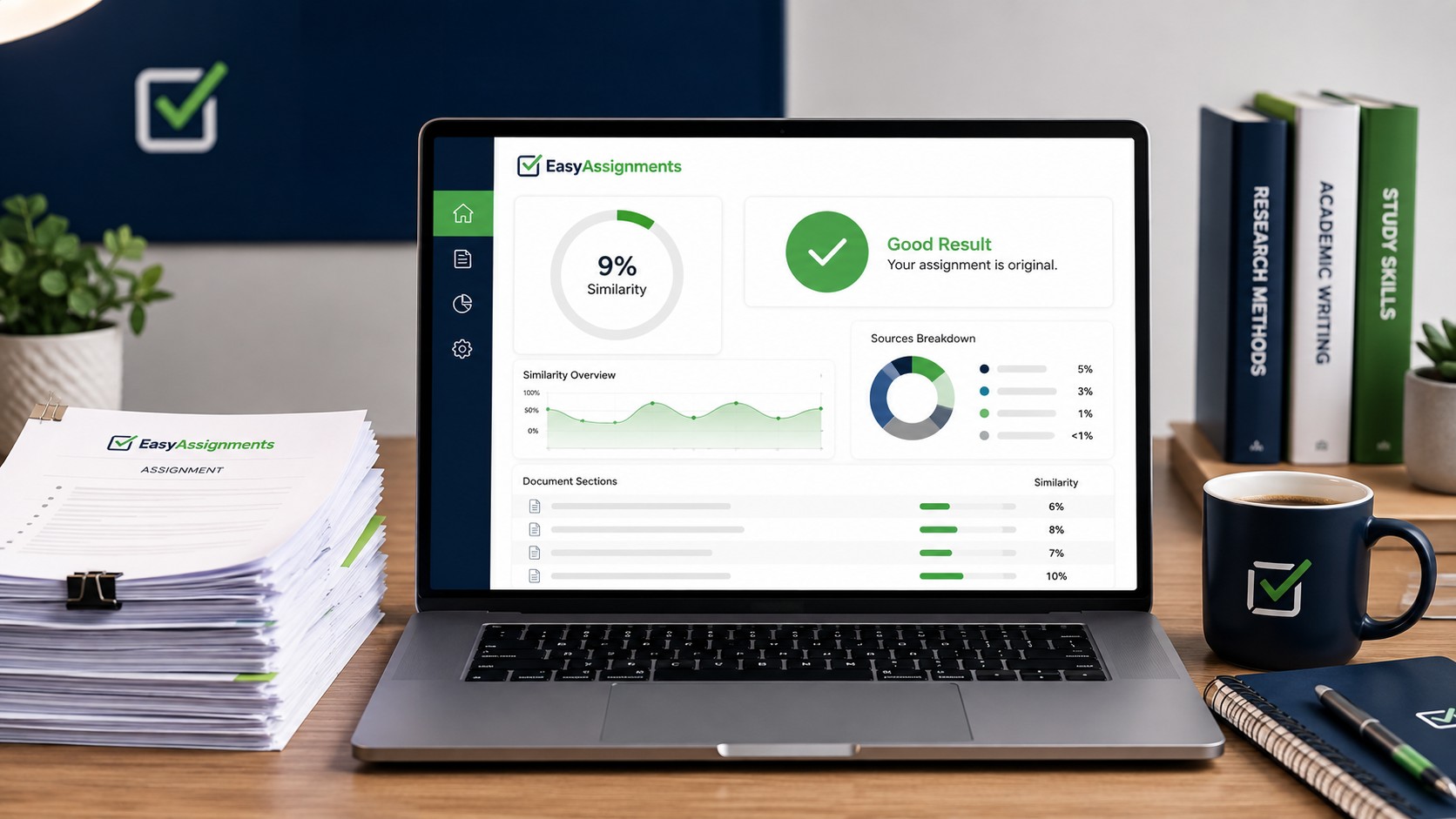
The headline output is usually a similarity percentage. This figure represents the proportion of your text that matches other sources. It is important to understand that this number is descriptive, not a verdict. A report can show a moderate percentage and still be perfectly acceptable, because properly quoted and cited material, common phrases, and your reference list all contribute to the total.
The source breakdown
Beyond the single number, good tools show you a breakdown of where matches came from and highlight the matching passages directly in your text. This is the part that actually matters. A cluster of matches against one uncited website is a genuine concern. The same percentage spread thinly across dozens of common phrases usually is not.
A common misconception: chasing a zero percent score is neither realistic nor necessary. Shared terminology, standard phrases, and correctly quoted sources will always register some overlap. Focus on whether each specific match is justified, not on driving the total to zero.
How to Read a Similarity Report Without Panicking
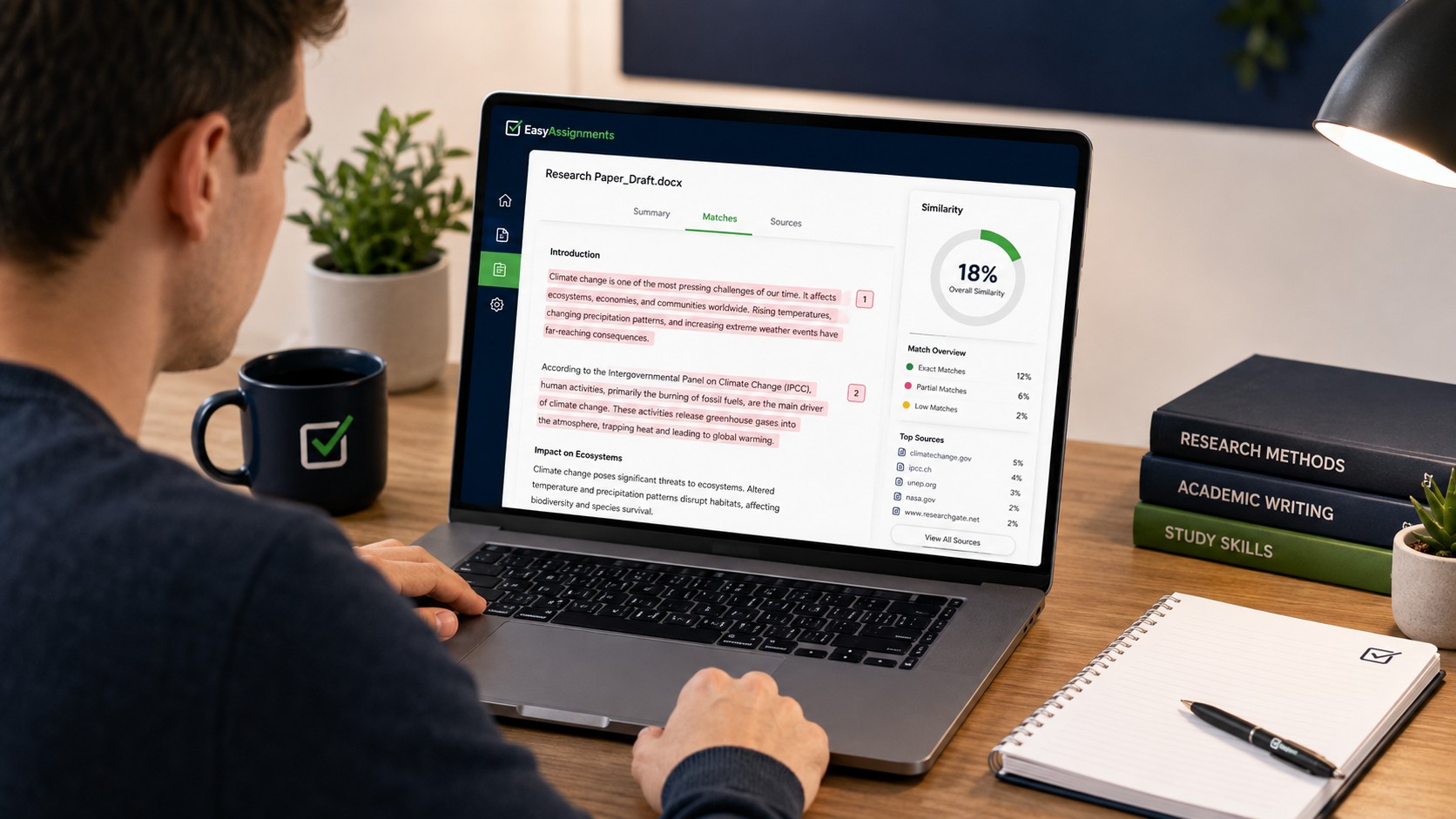
Opening a report for the first time can be alarming if you see coloured highlights scattered across your document. The trick is to work through it methodically. Every highlighted passage falls into one of a small number of categories, and each category has a clear response.
Step one: check your reference list and quotations
A large share of highlighted text in many reports comes from your bibliography and from correctly quoted material. Reference entries naturally match the original sources, and direct quotes are supposed to match. Many tools let you exclude the reference list or quoted material from the calculation. Once you account for these, the meaningful number is often much smaller than the raw figure suggested.
Step two: examine paraphrased passages
Next, look at highlighted sections that are meant to be your own paraphrasing. If a passage is flagged and it restates a source, ask whether you have genuinely rewritten the idea or merely swapped a few words. Close paraphrasing that follows the original sentence structure is a frequent cause of unexpected matches. These passages need to be rewritten in your own voice and, crucially, still cited.
Step three: investigate anything unexpected
Occasionally a report flags a passage you believed was entirely original. This can happen when you have unconsciously echoed phrasing from something you read, or when a common expression coincides with a source. Read the matched source, decide whether the overlap is meaningful, and rewrite if there is any doubt. When the match is trivial and unavoidable, you can note it and move on.
A practical rule: do not edit for the percentage. Edit each flagged passage on its own merits. If every highlighted section is either correctly cited, properly quoted, or rewritten in your own words, your report is in good shape regardless of the final number.
Free Checkers vs Paid and Institutional Tools
Students often ask whether a free plagiarism checker is good enough or whether they need a paid service. The honest answer is that each type has a role, and understanding the trade-offs helps you choose wisely for a given assignment.
| Feature | Free Checkers | Paid Tools | Institutional Systems |
|---|---|---|---|
| Cost | No cost, sometimes with word or scan limits | Subscription or per-document fee | Provided through your university |
| Database size | Often smaller, mainly web sources | Larger, may include journals | Extensive, including student submissions |
| Report detail | Basic highlights and score | Detailed source breakdown | Full report tied to your submission |
| Best used for | Early self-checks and quick drafts | Serious pre-submission review | The official mark your instructor sees |
| Privacy consideration | Read the terms before uploading | Usually clearer data policies | Governed by institutional rules |
For everyday assignments, a reputable free tool is genuinely useful as an early-warning system. It catches obvious problems long before the deadline. For a major essay, dissertation chapter, or anything carrying serious weight, a more thorough check gives you a fuller picture. Whatever you use, remember that the version your instructor runs through an institutional system is the one that counts, so your own check is a preview rather than the final word.
Watch the fine print: some free checkers store or reuse uploaded documents. Before you submit your work to any tool, read its privacy policy so your original writing is not added to a database or resold. If a service is vague about what it does with your file, treat that as a reason to look elsewhere.
Not sure your assignment is submission ready?
Our team can review your structure, referencing, and originality so you submit with confidence. Get a clear, honest assessment before your deadline.
The Real Causes of Accidental Plagiarism
Most similarity problems are not the result of dishonesty. They come from a handful of predictable research and writing habits. If you understand these causes, you can prevent the matches before they ever appear in a report.
Poor note-taking during research
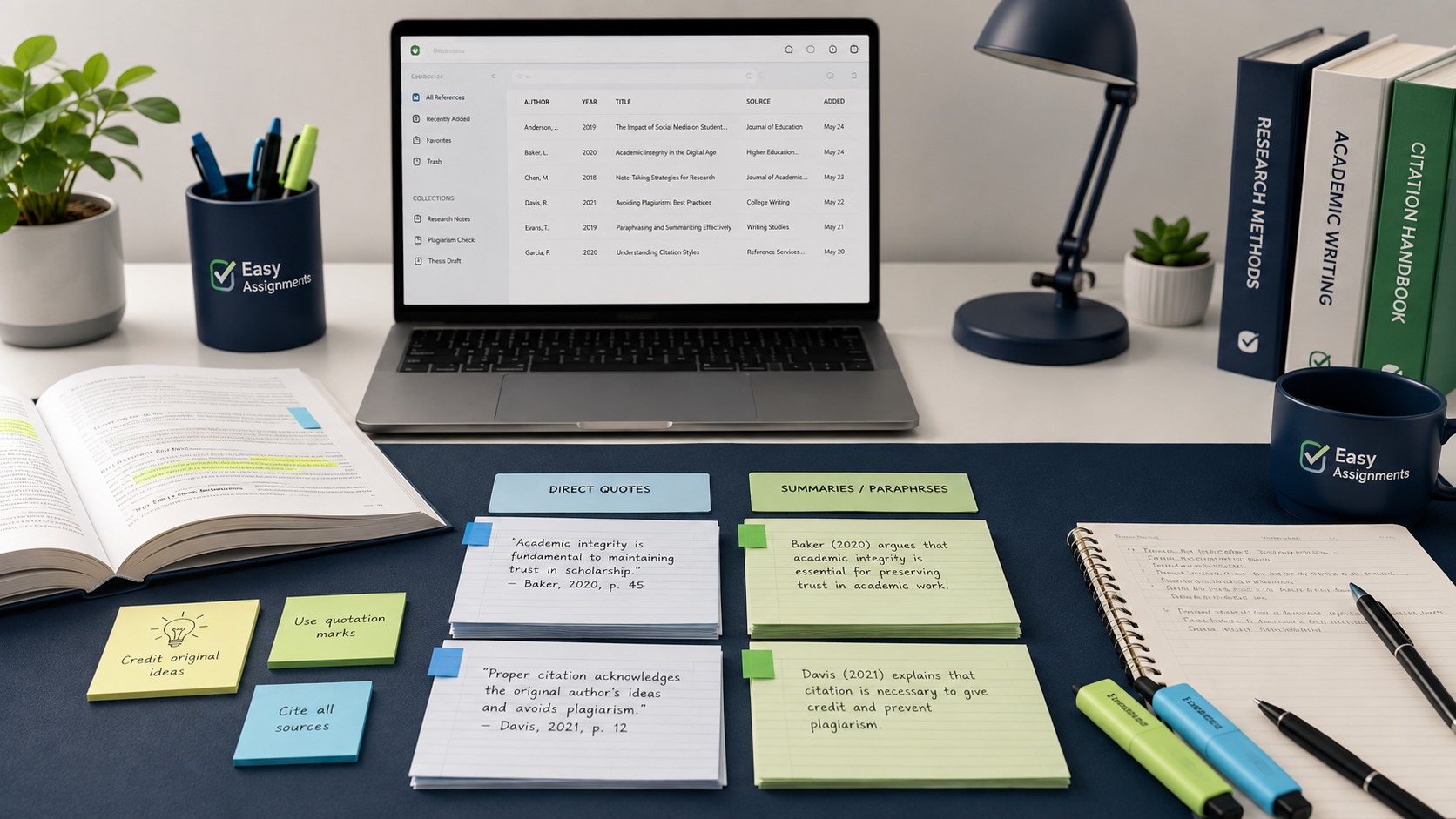
The single most common root cause is sloppy note-taking. When you copy a sentence from a source into your notes and forget to mark it as a direct quote, it can reappear in your draft weeks later as though it were your own writing. The fix is disciplined notes: always record the source, and clearly separate direct quotes from your own summaries and thoughts.
Patchwriting and shallow paraphrasing
Patchwriting is the habit of taking a source sentence and changing only a few words or reordering a clause while keeping the original structure. It feels like paraphrasing, but a checker recognizes the underlying pattern immediately. Real paraphrasing means understanding the idea, closing the source, and expressing it in your own sentence structure and vocabulary.
Forgetting to cite paraphrased ideas
Many students believe that citation is only for direct quotes. In fact, you must cite any idea, argument, statistic, or specific piece of information that you learned from a source, even when you express it entirely in your own words. Paraphrasing without citation is still plagiarism, because you are presenting someone else's idea as your own.
Reusing your own past work
Self-plagiarism catches many students by surprise. Submitting the same work, or large chunks of it, for two different assignments can breach academic policy even though the words are yours. When in doubt, treat your earlier submissions as sources and check your institution's rules on reusing your own material.
How to Genuinely Reduce Similarity in Your Writing
Once you know the causes, the solutions become straightforward. These are not tricks to lower a number. They are habits that make your writing stronger and more clearly your own.
- Read your source, close it, and write the idea from memory in your own words. Then reopen the source only to check accuracy and add the citation.
- Reserve direct quotations for moments where the exact wording matters, such as a definition or a striking phrase. Wrap every quote in quotation marks and cite it.
- Synthesize multiple sources into a single point rather than summarizing each one in turn. Blending ideas naturally reduces overlap and shows deeper understanding.
- Lead with your own analysis. When your voice drives each paragraph and sources support your argument, originality follows naturally.
- Keep a running reference list as you write, not at the end. This prevents missing citations and the last-minute scramble that causes errors.
Master your referencing style
A surprising number of similarity issues trace back to inconsistent or incorrect referencing. Whether your course uses APA, MLA, Harvard, Chicago, or another system, learn its rules for in-text citations and reference entries. Correct, consistent referencing is what allows a checker and an instructor to see clearly that matched material is properly attributed rather than lifted.
When to Check and How Often
Timing matters. Running a check the moment you finish writing, minutes before the deadline, leaves no room to fix anything. Build checking into your workflow instead.
A strong approach is to scan an early complete draft, well before the deadline, so you have days rather than minutes to address any issues. Make your edits, tighten your paraphrasing, and confirm your citations. Then run a final check after your last round of edits, because editing can accidentally reintroduce problems: a quotation mark deleted here, a citation lost during a paragraph rearrangement there. The final scan confirms your submission is exactly as clean as you believe it to be.
Building Long-Term Academic Integrity Habits
The best students eventually rely on checkers less, not because they stop using them, but because their writing habits make problems rare. A plagiarism checker becomes a confirmation of good practice rather than a rescue tool.
Research with intent
Gather sources to build understanding, not to harvest sentences. When you understand a topic, writing about it in your own words becomes natural.
Track every source
Log each source and page number as you use it. A complete trail makes citation effortless and eliminates guesswork later.
Write, then verify
Draft freely in your own voice first, then check the result. Leading with your own thinking keeps similarity low from the start.
Ask when unsure
If you are uncertain whether something needs a citation, cite it or ask. Over-citing is a minor issue; missing a citation is not.
These habits compound over a degree. By the time you reach your most demanding assignments, careful sourcing and confident paraphrasing will feel automatic, and a pre-submission check will simply confirm what you already know.
Frequently Asked Questions
Is a free plagiarism checker for assignments before submission accurate enough?
A reputable free plagiarism checker is accurate enough for early self-checks and everyday assignments, catching obvious overlaps and missing citations. For high-stakes work, a more thorough tool gives a fuller picture, but remember that the official result is whatever system your institution runs.
What similarity percentage is acceptable?
There is no universal cutoff, and chasing zero is unrealistic. Instructors and departments set their own expectations, and a moderate score can be perfectly fine when the matches are properly quoted and cited. Focus on whether each highlighted passage is justified rather than on the number alone.
Can paraphrasing still be flagged as plagiarism?
Yes. Shallow paraphrasing that keeps the original sentence structure will often be flagged, and paraphrasing without a citation is still plagiarism because the idea belongs to someone else. Genuine paraphrasing rewrites the idea in your own structure and words and includes a citation.
Is it safe to upload my assignment to a free checker?
It depends on the tool. Some free services store or reuse uploaded documents, which can cause problems later. Always read the privacy policy before uploading, and if a service is unclear about how it handles your file, choose a more transparent option.
Submit With Confidence, Every Time
Check your originality, tidy your referencing, and hand in work you are proud of. EasyAssignments is here whenever you want a second opinion before the deadline.