
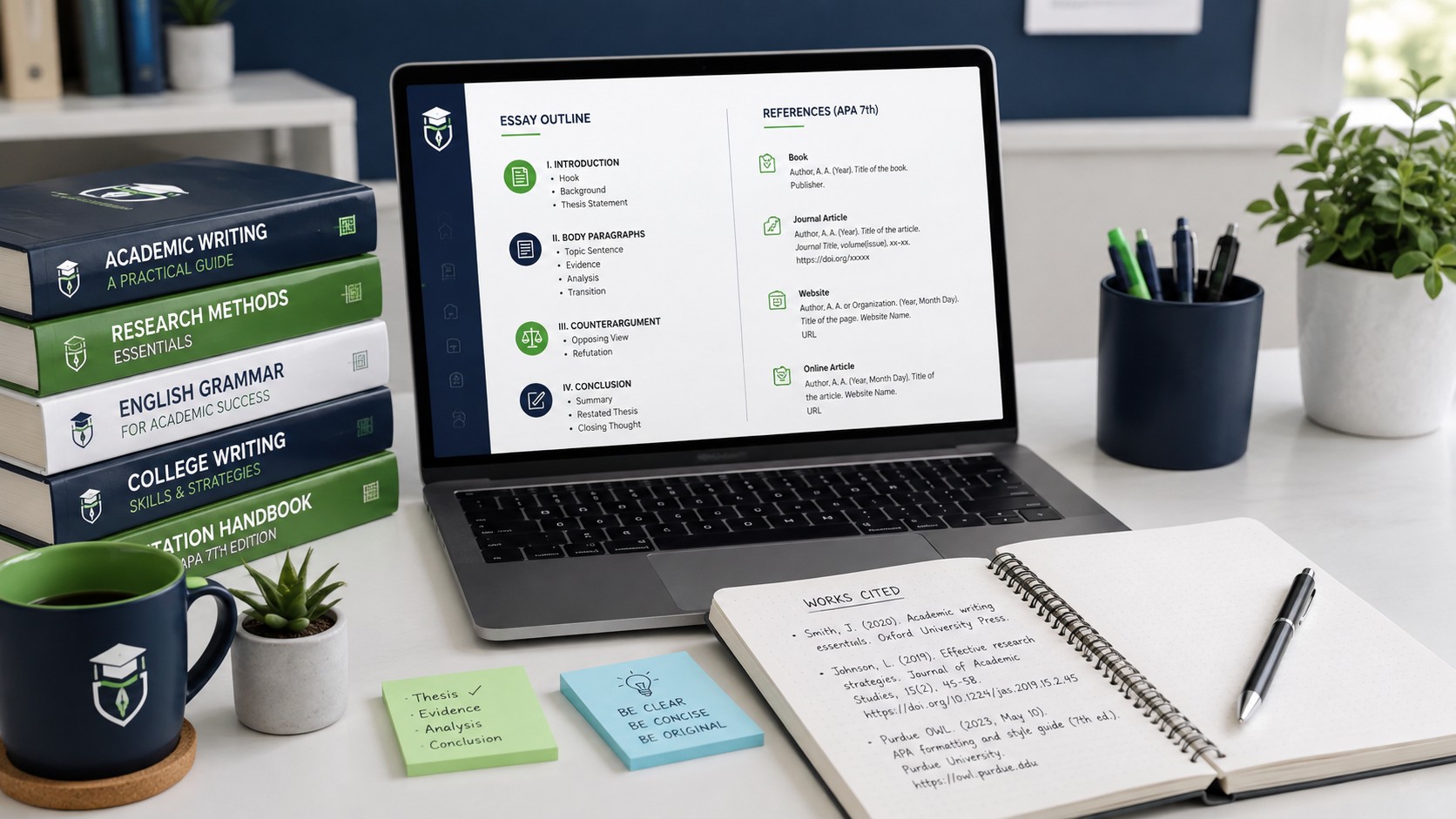
Essay Writing Help With References for College Students
A great essay is only as strong as the sources behind it. If you have ever lost marks on a paper you were proud of, there is a good chance the problem was not your argument but your referencing.
This guide walks you through everything you need to write well-referenced college essays: finding credible sources, integrating them into your writing, and citing them correctly in APA, MLA, Chicago, and Harvard so your work reads as trustworthy and original.
Why Essay Writing Help With References Matters So Much
When professors grade essays, they are not only judging whether your ideas are interesting. They are checking whether your claims are supported by evidence, whether that evidence comes from credible places, and whether you have given proper credit to the people whose work you used. That is where references come in, and it is exactly why essay writing help with references is one of the most requested forms of academic support among college students.
References do three jobs at once. They prove that your argument rests on more than personal opinion, they let a reader trace your sources and verify your claims, and they protect you from accusations of plagiarism. Weak or missing references undermine all three, no matter how polished your prose is. A brilliant paragraph with no citation can read as an unsupported assertion, while a modest point backed by a strong peer-reviewed source reads as scholarship.
Referencing also signals that you understand the conversation around your topic. Academic writing is a dialogue. When you cite authors, you are showing where your ideas sit in relation to existing research: agreeing, disagreeing, extending, or complicating what others have said. Done well, references turn an essay from a summary into a genuine contribution to a discussion.
Key idea: A reference is not decoration you add at the end. It is the backbone of an academic argument. Build your sources in as you write, not after you finish, and referencing stops feeling like a chore and starts doing real work for your grade.
Understanding the Building Blocks: In-Text Citations and Reference Lists
Before diving into specific styles, it helps to understand the two halves of any referencing system. Almost every academic citation style splits the job into two connected parts, and confusion between them is one of the most common sources of lost marks.
In-text citations
An in-text citation is the short marker you place inside your writing, right at the point where you use a source. Depending on the style, it might look like (Smith, 2020), a superscript number, or the author's name woven into your sentence. Its job is to point the reader toward the full details without interrupting the flow of your argument. Every time you quote, paraphrase, summarize, or borrow an idea, you need one of these markers.
The reference list or bibliography
At the end of your essay, the reference list gives the complete details for every source you cited: author, year, title, publisher, page numbers, and often a link or identifier. The golden rule is that these two parts must match perfectly. Every in-text citation should have a matching entry in the list, and every entry in the list should correspond to at least one in-text citation. Orphaned entries and unmatched citations are among the fastest ways to lose easy marks.
Quoting versus paraphrasing
Both need citations, but they are handled differently. A direct quote reproduces the exact words of a source and belongs inside quotation marks, usually with a page number. A paraphrase restates an idea in your own words and sentence structure, and it still needs a citation even though the wording is yours. A common mistake is assuming that changing a few words removes the need to cite. It does not. If the idea came from somewhere, it needs attribution.
Watch out: Swapping synonyms while keeping the original sentence structure is not real paraphrasing. It is a form of plagiarism that most similarity checkers will flag. To paraphrase properly, read the idea, look away from the source, and rewrite it in your own natural voice, then cite it.

The Four Major Citation Styles Explained
Most college courses ask for one of four referencing styles, and which one you use usually depends on your discipline. Understanding the logic behind each style makes it far easier to apply, because you stop memorizing formats and start recognizing patterns. Here is a practical comparison of where each style is used and what makes it distinctive.
| Style | Common fields | In-text format | Distinctive feature |
|---|---|---|---|
| APA (7th ed.) | Psychology, education, social sciences, nursing, business | (Author, Year, p. X) | Emphasizes date; reference list is title-cased sparingly |
| MLA (9th ed.) | Literature, humanities, languages, cultural studies | (Author Page) | Page-focused, no year in-text; uses a Works Cited page |
| Chicago | History, some humanities, publishing | Footnote number or (Author Year) | Offers notes-bibliography and author-date systems |
| Harvard | Widely used across UK and Australian universities | (Author, Year) | A family of author-date styles with local variations |
APA style
APA is built around the author-date system, which reflects how quickly knowledge changes in the sciences. Readers want to know how recent a source is, so the year sits right next to the author in every citation. Reference list entries are alphabetized by author surname, and titles of articles use sentence case while journal names use title case. If you study psychology, education, health sciences, or business, APA is likely your default.
MLA style
MLA is favored in the humanities, where close reading of specific passages matters more than publication dates. That is why MLA in-text citations lead with the author and a page number rather than a year. The full list at the end is called Works Cited, and MLA's container system is designed to handle complex sources like anthologies, films, and web content in a consistent way.
Chicago style
Chicago is flexible and comes in two flavors. The notes-and-bibliography system uses footnotes or endnotes and is popular in history and the arts. The author-date system looks more like APA and is common in the sciences. Because Chicago handles archival and primary sources gracefully, it is a favorite among historians who cite letters, manuscripts, and government records.
Harvard style
Harvard is less a single fixed standard and more a family of author-date styles. Different universities publish their own slightly different versions, so the safest move is to check your institution's specific Harvard guide. The core idea is consistent: author and year in the text, an alphabetized reference list at the end.
The most important rule: Consistency beats perfection. Whichever style you are assigned, apply it the same way from the first citation to the last. A paper that follows one style flawlessly reads better than one that mixes formats, even if each individual entry is technically defensible.
How to Find Credible Sources Worth Citing
References only strengthen your essay if the sources behind them are trustworthy. A citation to a random blog or an anonymous website can actually hurt your credibility. Learning to distinguish strong sources from weak ones is a skill that pays off in every paper you write.
Prioritize peer-reviewed and scholarly sources
Peer-reviewed journal articles have been evaluated by other experts before publication, which makes them among the most reliable sources you can use. Academic books from university presses, government reports, and reputable institutional publications also carry weight. When you build an essay on this kind of foundation, your argument inherits their credibility.
Use your library databases first
Your college library subscribes to databases that most students underuse. Tools like JSTOR, ProQuest, Scopus, and discipline-specific databases give you access to material that a general web search will not surface, and much of it is already vetted for academic quality. Learning to search these efficiently, with keywords, filters, and date ranges, is one of the highest-return study skills in college.
Evaluate sources with a simple test
When you are unsure whether a source belongs in your essay, run it through a few quick questions:
- Who is the author, and what are their credentials or affiliation?
- Where was it published, and does that venue have editorial standards?
- When was it published, and is it current enough for your topic?
- Why was it written, to inform, to persuade, or to sell something?
- Is the argument supported by its own evidence and references?
If a source struggles to answer these questions, it probably does not belong in an academic essay. That does not mean it is useless: it might point you toward better sources in its own reference list, a technique sometimes called citation chaining.
Handle web sources carefully
Not all online sources are equal. A government statistics page or a peer-reviewed article hosted online can be excellent. A crowdsourced encyclopedia is a fine starting point for orientation but rarely appropriate to cite directly. Always trace claims back to their original source rather than citing a summary of a summary.
Struggling to Reference Your Essay Correctly?
Whether you need help sourcing credible material, formatting citations, or building a flawless reference list, our team can support you at any stage. Get clear, original, properly referenced writing help.
A Step-by-Step Workflow for Well-Referenced Essays
Referencing feels overwhelming when it is left until the end. The solution is a repeatable workflow that builds your citations into the process from the very first day. Follow these steps and your reference list will practically write itself.
Step 1: Read the prompt and note the required style
Before you research anything, confirm which citation style your instructor wants and how many sources are expected. This one detail shapes everything that follows. Note it at the top of your working document so you never forget it mid-project.
Step 2: Research and capture sources immediately
As you find each useful source, record its full details right away: author, title, publication, year, page numbers, and link. The moment you decide a source is worth using, capture what you would need to cite it. Chasing down bibliographic details days later, after you have closed dozens of browser tabs, is a needless source of stress.
Step 3: Take notes in your own words
When you take notes, paraphrase as you go and mark clearly which idea came from which source. Put any exact wording in quotation marks immediately, so you never mistake a copied phrase for your own. This single habit prevents most accidental plagiarism.
Step 4: Draft with placeholder citations
Write your first draft with quick citation placeholders, such as (Author, year) or a shorthand tag, wherever you use a source. Do not stop your writing flow to format each citation perfectly. The goal at this stage is a complete argument with every borrowed idea tagged.
Step 5: Format citations and build the list
Once your draft is stable, convert your placeholders into properly formatted in-text citations and build the matching reference list. Work through the essay in order so nothing gets skipped. This is also the moment to alphabetize your list and apply the correct indentation and punctuation for your style.
Step 6: Cross-check everything
Finally, verify that every in-text citation has a list entry and every list entry appears in the text. Read your reference list aloud against the essay if you have to. This last pass catches the small mismatches that quietly cost marks.
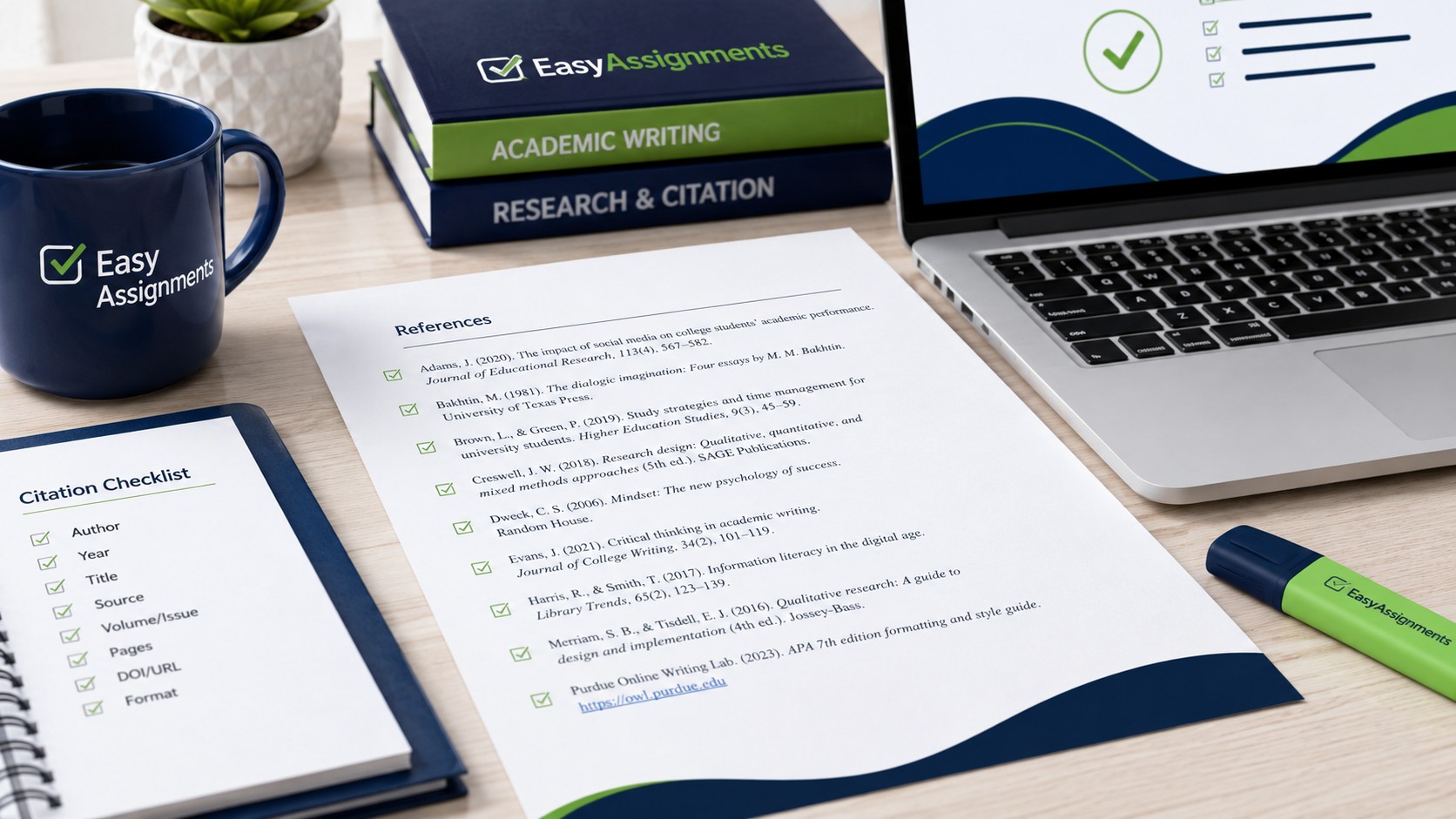
Common Referencing Mistakes That Cost Marks
Most referencing errors are small, predictable, and completely avoidable once you know to look for them. Here are the ones that appear again and again in student essays, along with how to fix each.
Mismatched citations
An in-text citation with no entry in the reference list, or an entry with no matching citation. Always cross-check both directions before submitting.
Missing page numbers
Direct quotes usually need a specific page or paragraph number. Leaving them out weakens your citation and can look like carelessness.
Mixing styles
Combining APA in-text format with an MLA reference list, or switching mid-essay. Choose one style and apply it uniformly throughout.
Uncited paraphrasing
Assuming that rewording removes the need for a citation. If the idea is not yours, it needs attribution regardless of the wording.
Beyond these, watch for inconsistent formatting of author names, incorrect capitalization of titles, and broken or missing links for online sources. None of these errors is difficult to fix, but together they create an impression of sloppiness that can pull down an otherwise strong essay. A careful final pass focused only on referencing is one of the highest-value ten minutes you can spend on any paper.
Tools and Habits That Make Referencing Easier
You do not have to manage every citation by hand. A range of tools can lighten the load, though none replaces understanding the fundamentals. Reference managers can store your sources, organize them into folders, and generate formatted citations in the style you choose. Building a personal library of sources across your degree also means you rarely start a new essay from scratch.
Style guides are the other essential resource. Official manuals and your university's own referencing guide are the definitive authority when a tool and your memory disagree. When formatting an unusual source, such as a podcast, a dataset, or a social media post, going straight to the official guide saves time and prevents guesswork. Keep a bookmark to your required style's guide and treat it as your reference of last resort.
Beyond tools, a few habits make the biggest difference. Cite as you write rather than at the end. Keep one working document with all your sources listed. Save the full details the moment you decide to use a source. And leave time for a dedicated referencing check before submission. These habits cost almost nothing and quietly protect your grade on every assignment.
Remember: Tools are helpers, not authorities. Automatic citation generators frequently produce small formatting errors, so always review what they give you against your official style guide before you submit.
When to Ask for Essay Writing Help With References
There is no shame in seeking support, and knowing when to ask for it is itself a mark of a mature student. Referencing rules can be genuinely confusing, especially when you are juggling multiple courses with different required styles, working with unusual source types, or writing in a second language. If you find yourself spending more time wrestling with citation format than developing your argument, that is a signal that targeted help could free you to focus on what matters.
Good essay writing help does more than fix your citations. It shows you the underlying logic so you improve for the next paper, catches the structural and evidence gaps a rushed self-review misses, and ensures your final reference list is clean, consistent, and complete. Whether you need a full essay written to your requirements, a referencing check on a draft you have already written, or coaching on how to cite a tricky source, support is available at every stage.
If you would like a hand, you can request a free quote or talk to our support team about exactly what you need. Every piece of work is original and written to your instructions, with references done properly the first time.
Frequently Asked Questions
Do I need essay writing help with references if I already know my topic well?
Knowing your topic and referencing it correctly are two different skills. You can understand your subject deeply and still lose marks on citation format, source credibility, or matching your in-text markers to your reference list. Help with references specifically targets that gap, so your strong ideas are presented with the academic rigor graders expect.
Which citation style should I use for my college essay?
Always follow the style your instructor or course specifies, since that overrides any general preference. As a rough guide, APA is common in the social sciences and health fields, MLA in the humanities, Chicago in history, and Harvard across many UK and Australian universities. When in doubt, check your assignment brief or ask your professor directly.
How many references does a college essay need?
There is no universal number, because it depends on the length, level, and requirements of the assignment. Some briefs specify a minimum, while others leave it to your judgment. A reliable principle is to support every significant claim with credible evidence and to use enough quality sources to show you have engaged with the relevant research, rather than aiming for a specific count.
Can I be penalized for citing too many sources?
You are rarely penalized for the number itself, but you can lose credit if your essay becomes a string of quotations with little of your own analysis. References should support your argument, not replace it. Aim for a balance where sources back up your points while your own critical thinking drives the essay forward.
Get Essay Writing Help With References Today
Stop losing marks to avoidable citation errors. Get original, well-argued essays with references done right, in the style your course requires.