
"Do My Test for Me": The Honest Answer Students Deserve
If you have typed "do my test for me" into a search bar at two in the morning, you are not a bad student. You are a stressed one. Almost every student who searches that phrase is dealing with a deadline collision, a health problem, a job shift that will not move, or a subject that stopped making sense three weeks ago.
This guide gives you the answer nobody selling logins will give you: what actually happens when someone else sits your exam, how modern proctoring detects it, what legitimate exam support looks like, and a revision framework that works even when you only have days left.
Why Students Search "Do My Test for Me" in the First Place
Nobody starts a degree planning to outsource an exam. The search phrase "do my test for me" is almost always the end of a chain of smaller problems that nobody intervened in early enough. Understanding that chain matters, because the real fix is usually further back than the exam itself.
The most common trigger is a scheduling collision. Universities cluster assessments, and a student can face two midterms, a lab report, and a group presentation inside eight days. Each individual task is manageable. Together they exceed the hours available. When something has to give, the exam that feels most impersonal, usually a multiple-choice online quiz, is the one students consider handing off.
The second trigger is a knowledge gap that quietly widened. A student misses two weeks of statistics because of illness, comes back, and finds every subsequent lecture assumes the material they missed. They keep attending, keep taking notes, and understand less each week. By exam season the gap is no longer two weeks wide. It feels unbridgeable, and paying someone feels like the only way out.
The third trigger is life pressure that has nothing to do with academics. Night shifts, caring for a family member, visa conditions tied to academic standing, a mental health episode, a bereavement. These are the situations where students feel the least agency and take the biggest risks.
The fourth is a subject that was never a genuine choice. Required statistics for a nursing degree, mandatory accounting for a marketing major, a language requirement for an engineering student. Motivation is low, the material is unfamiliar, and the assessment feels like a toll gate rather than learning.
Recognising which of these applies to you changes the response. A scheduling collision needs a triage plan and possibly a deadline extension. A knowledge gap needs targeted teaching, not more hours of unfocused rereading. A life crisis needs your university's support services, which exist precisely for this and are used far less than administrators expect. None of these are solved by someone else logging into your account.
What Actually Happens When Someone Takes Your Test
Let us be direct about the mechanics, because the marketing around exam-taking services is deliberately vague. When a service offers to sit your test, you hand over your institutional username and password. That single act creates several problems that compound.
You lose control of your entire student account
University credentials are rarely limited to the learning management system. The same login often opens your email, your enrolment record, your financial aid portal, your transcript, your library account, and sometimes payment details on file. Anyone with those credentials can see all of it, and you have no way to audit what they viewed or changed once the transaction is over.
Students frequently assume the arrangement ends when the test ends. It often does not. Some services retain credentials and return later, either to sell them onward or to contact the student with demands. Because the student cannot report the situation without disclosing the original misconduct, they have very little leverage.
The digital trail is far richer than most students realise
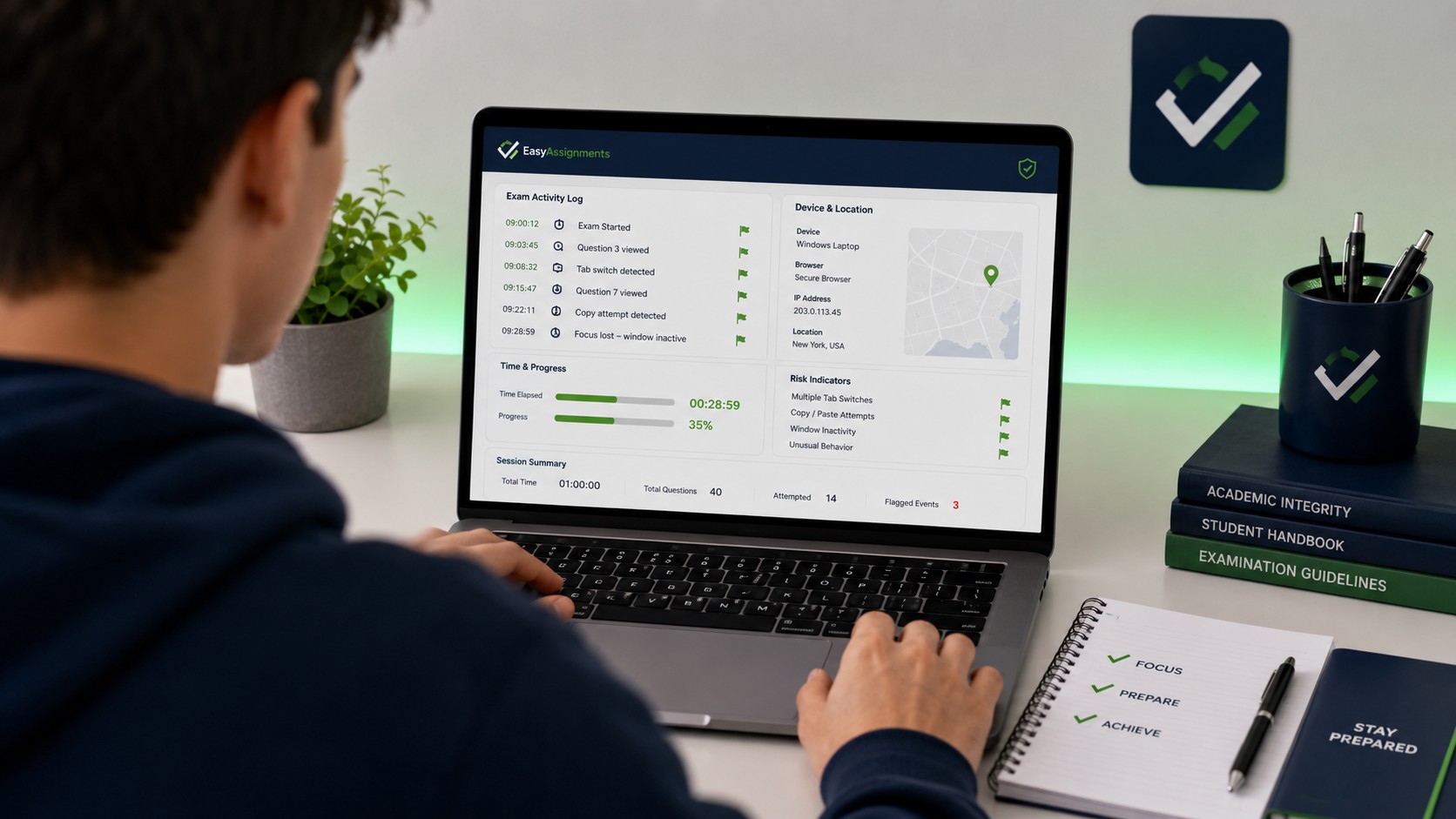
Learning platforms log a great deal by default. Login IP address, device fingerprint, browser and operating system version, session duration, the order in which questions were answered, how long each question took, when the tab lost focus, and how the click pattern compares to your previous activity in the course. None of this requires sophisticated surveillance software. It is standard platform logging that already exists in the systems your university runs.
An account that has logged in from one city on a familiar laptop for four months, and then completes a high-stakes exam from a different country on an unfamiliar device in half the expected time, produces an obvious anomaly. Institutions do not need to catch someone in the act. They only need a pattern that does not match, and then a conversation.
Proctoring adds identity and behaviour layers
Where remote proctoring is used, students typically complete an identity check, a room scan, and a session recorded through webcam and screen capture. Systems flag things like a second face appearing, a voice in the room, prolonged eye movement away from the screen, a second monitor, or virtual machine and remote-desktop signatures. Flags are not verdicts, a flagged session is reviewed by a human, but flags are what start investigations.
Impersonation is one of the easier things to detect because it fails at the identity layer rather than the behaviour layer. If a photo ID check happens at the start of the session and the face on camera is not the face on the record, no amount of technical workaround helps.
The consequences are structural, not just a bad grade
Academic misconduct involving impersonation or account sharing is treated as one of the most serious categories in almost every institutional policy, well above accidental citation errors. Typical outcomes range from a zero on the assessment through course failure, transcript notation, suspension, and expulsion. For international students, an academic standing problem can create visa complications. For students on licensure tracks such as nursing, teaching, law, or accounting, a misconduct finding can surface years later during professional registration.
Worth knowing: Institutions can and do investigate assessments retroactively. A test completed in one term can be reviewed in a later term if a pattern emerges, if a service's records are disclosed, or if another student's case surfaces shared infrastructure. Passing the exam is not the end of the risk window.
The Difference Between Exam Help and Exam Impersonation
This distinction is the single most useful thing in this article, and it is genuinely simple. The line is not about how much help you receive. It is about who performs the assessed act.
Everything that happens before you sit down to be assessed is preparation, and preparation is what education is built on. Lectures, tutorials, textbooks, study groups, tutors, worked examples, past papers, office hours, and coaching are all forms of someone else helping you learn. None of them are misconduct. Universities fund most of them directly.
The moment the assessment begins, the work must be yours. That is the whole rule. A tutor who teaches you to solve integration by parts for six hours has helped you legitimately. A person who logs in and answers the integration questions has committed misconduct, even if they only answered three.
| Scenario | What it involves | Status | What you actually get |
|---|---|---|---|
| Concept coaching before the exam | A tutor explains topics you failed to grasp in lectures | Legitimate | Understanding you keep for later courses |
| Practice questions with worked solutions | Custom problem sets matched to your syllabus, fully explained | Legitimate | Pattern recognition and speed under pressure |
| Timed mock exam and feedback | You sit a simulated paper, someone marks it and diagnoses gaps | Legitimate | A ranked list of what to fix first |
| Someone sits the exam on your login | Credential sharing and impersonation | Misconduct | A grade you cannot defend and lasting exposure |
| Live answers fed during a proctored test | Real-time assistance during the assessed session | Misconduct | Flagged sessions and an investigation trail |
Note what the right-hand column shows. The legitimate options produce a capability that stays with you. The misconduct options produce a number on a screen and a liability. In a degree where later courses build on earlier ones, a grade you did not earn is a debt that comes due in the next semester, usually at a worse moment.
The practical test: Ask yourself whether you could explain your answers to your instructor in a five-minute conversation without notes. If yes, the help you received was preparation. If no, something has gone wrong, regardless of how the service described itself.
What Legitimate Exam Support Looks Like in Practice
When students ask EasyAssignments for exam help, the useful version of that request is almost never "take the test." It is usually one of four things, and each has a concrete, permitted form of support.
Concept Coaching
A subject specialist works through the topics you never grasped, using your own course materials, until you can reproduce the reasoning without prompting.
Custom Practice Sets
Problem sets built to mirror your syllabus and question format, with fully worked solutions so you learn the method rather than memorising an answer.
Timed Mock Exams
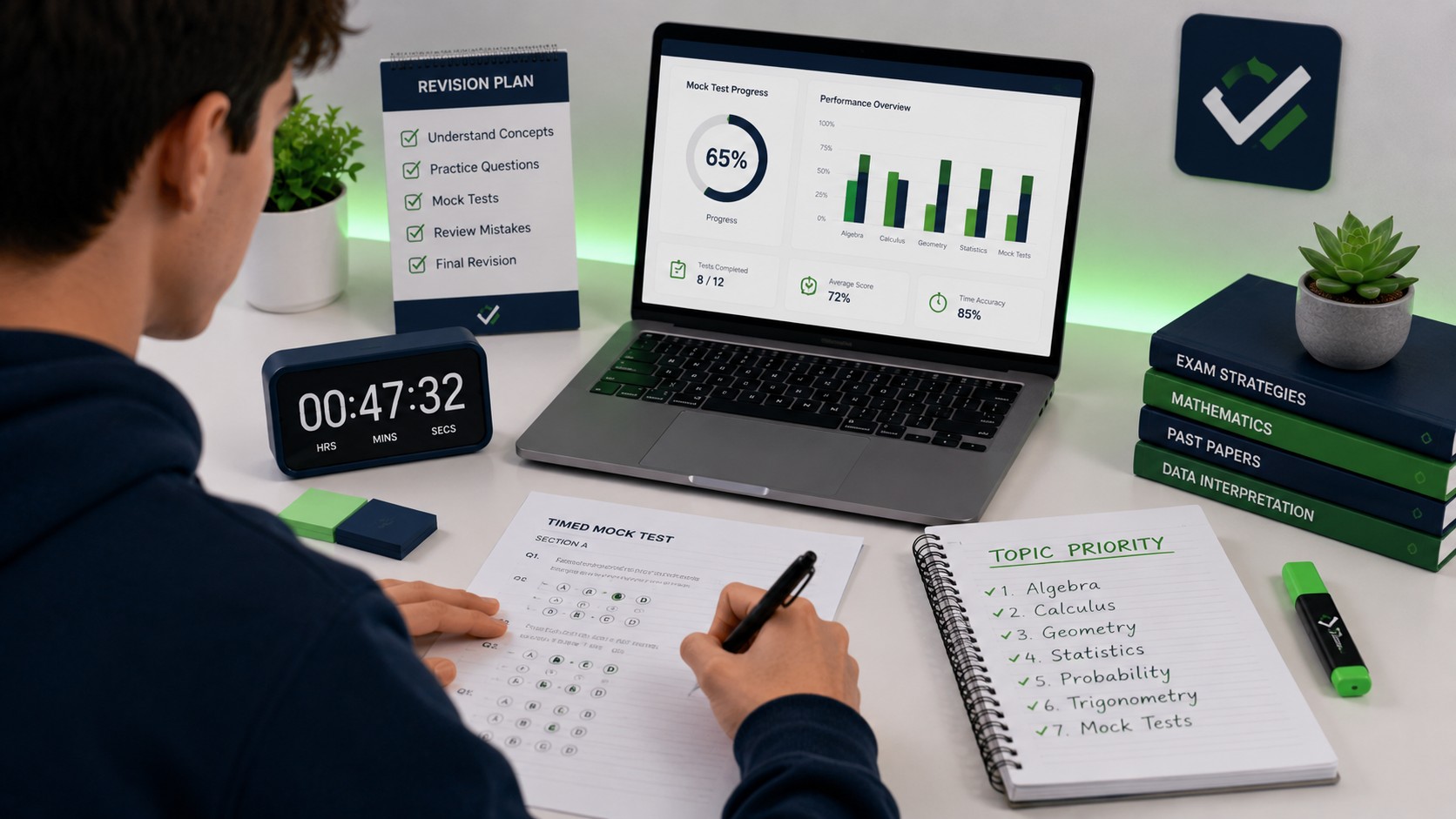
A simulated paper under real time pressure, marked with feedback that tells you exactly which topics to spend your remaining hours on.
Revision Planning
A realistic schedule built around your actual availability, weighted by topic difficulty and how heavily each area appears in the assessment.
Consider a student two weeks from a managerial accounting midterm who understands journal entries but cannot handle variance analysis. The unproductive version of help is a stranger sitting the exam. The productive version is a tutor spending three sessions on variance analysis, then supplying fifteen practice problems with worked solutions, then a timed mini-paper. That student walks into the exam able to defend every answer, and walks into the next accounting course with the foundation intact.
The same logic applies to written exams. If you struggle with timed essay questions, the support that helps is practice under time pressure with feedback on structure, argument, and evidence use. Learning to plan a four-paragraph answer in six minutes is a trainable skill. It is also useless to you if someone else does the training.
Stuck on a Subject Before Test Day?
Tell us the topic, the exam format, and how many days you have. We will tell you honestly whether coaching, practice sets, or a timed mock is the fastest route to a defendable grade.
A Realistic Revision Framework When Time Is Short
Most students who consider outsourcing an exam have between three days and three weeks. That is genuinely enough time to change an outcome, but only if the hours are spent differently from how most students spend them. Rereading notes feels productive and is close to worthless. Here is a framework that is not.
Step one: audit the assessment, not the syllabus
Spend the first hour finding out exactly what the exam is. Format, duration, number of questions, question types, weighting across topics, whether it is open book, whether calculators or formula sheets are permitted, and whether it is proctored. Check the syllabus, the assessment brief, the course announcements, and the platform itself. Ask the instructor directly if anything is unclear, since instructors answer this kind of question readily.
This hour changes everything downstream. Preparing for a two-hour essay exam and preparing for a forty-question timed multiple-choice test require almost opposite techniques, and students routinely prepare for the wrong one.
Step two: rank topics by weight multiplied by weakness
List every topic. Give each a weight from one to five based on how heavily it features in the assessment, and a weakness score from one to five based on how shaky you feel. Multiply them. Study in descending order of that product.
This deliberately deprioritises topics you already know, which is where anxious students waste most of their time because revising familiar material feels reassuring. It also deprioritises obscure topics you find hard but that carry almost no marks. The top of your list is where the marks actually are.
Step three: retrieve, do not review
Close the notes and try to reproduce the material from memory: write the process, solve the problem, sketch the diagram, state the definition. Then check. The gap between what you produced and what was correct is your real revision list. This feels harder and less pleasant than rereading, which is precisely why it works. Difficulty during practice is what makes recall available under exam conditions.
Step four: practise in the exam's format
If the exam is multiple choice under time pressure, practise multiple choice under time pressure. If it is worked calculations without a formula sheet, practise without the formula sheet. If it is essays in ninety minutes, write essays in ninety minutes. Format familiarity removes a surprising amount of exam-day friction, and friction costs marks that have nothing to do with your knowledge.
Step five: run one full timed rehearsal
At least seventy-two hours before the exam, sit a complete paper under real conditions. Same duration, same permitted materials, no phone, no pausing. Two things emerge: your pacing, and the topics that collapse under pressure even though they felt fine during study. Those seventy-two hours then have a specific job.
Step six: build a question-triage rule
Decide in advance what you do when a question stumps you. A workable default is a fixed time cap per question, then flag it and move on, returning at the end with whatever time remains. Students lose more marks to spending eleven minutes on one hard question than to not knowing the answer. Deciding this before the exam means you are not making the decision while your pulse is elevated.
What to Do If You Have Genuinely Run Out of Time
Sometimes the honest answer is that no revision plan fits the hours available, usually because something outside academics has gone wrong. In that situation the correct move is administrative, not academic, and students consistently underuse it.
- Email the instructor before the exam, not after. A short, factual message about your situation, sent in advance, is treated very differently from an explanation offered once a grade is recorded.
- Ask about deferred assessment. Most institutions have a formal route to sit an exam at a later date for medical, bereavement, or serious personal reasons, and it is usually a form plus documentation.
- Contact student services or the wellbeing team. They can often coordinate accommodations across all your courses at once rather than one instructor at a time.
- Check your academic advisor's options. Late withdrawal, a reduced load, or an incomplete grade may protect your standing better than a failed exam.
- Register documented conditions with disability services. Extra time, a separate room, or assistive technology are entitlements, not favours, and they apply to future assessments too.
Universities build these processes because they expect students to have crises. Using them is not an admission of failure. The students who get through difficult terms intact are usually the ones who asked early, not the ones who coped alone.
How to Spot a Service That Will Put You at Risk
If you are evaluating any exam-related service, a few signals reliably separate legitimate academic support from something that will expose you.
- It asks for your university login credentials. Legitimate tutoring never needs your institutional password, only the materials you choose to share.
- It promises a specific grade in advance. Nobody can guarantee a mark on an exam they have not seen, marked by a grader they do not control.
- It offers to be present during a proctored session. This is impersonation regardless of the wording used.
- It insists on untraceable payment or off-platform messaging. That is a design choice made for the service's protection, not yours.
- It will not explain how the help works. Any support you cannot describe to your instructor in plain language is support you should not accept.
Legitimate support has the opposite profile. It is specific about what it delivers, it teaches rather than substitutes, it produces materials you keep, and it survives the plain-language test: you can tell your instructor exactly what happened without discomfort.
Frequently Asked Questions About "Do My Test for Me"
Can EasyAssignments do my test for me?
No. We do not sit exams, log into student accounts, or provide answers during an assessment. What we do provide is everything before the exam: concept coaching, custom practice questions with worked solutions, timed mock papers with feedback, and a revision plan built around your syllabus and your available hours. That support is permitted, and it leaves you able to defend every answer you give.
Can universities really detect if someone else took my online test?
Frequently, yes. Learning platforms log IP address, device details, session timing, answer sequences, and tab activity as standard, so an unfamiliar device in an unusual location completing a test unusually fast is a visible anomaly. Where proctoring is used, identity checks and session recordings add another layer. Detection is also not limited to exam day, since institutions can review assessments retroactively when a pattern emerges.
Where exactly is the line between exam help and cheating?
The line falls at the start of the assessed session. Anything that helps you learn beforehand, tutoring, practice sets, mock exams, study groups, worked examples, is preparation and is entirely legitimate. Once the exam begins, the work must be yours alone. A useful self-check is whether you could explain your answers to your instructor without notes.
What should I do if my exam is in three days and I understand almost nothing?
Start by confirming the exact format and topic weighting, then rank topics by exam weight multiplied by your weakness and work down that list using active recall rather than rereading. Book targeted coaching on the highest-value topic you cannot self-teach. In parallel, email your instructor and check whether deferred assessment applies to your situation, because that route is often available and takes very little time to ask about.
Walk Into Your Next Exam Prepared, Not Exposed
You do not need someone to take your test. You need the gap closed before test day, and there is usually more time to do that than panic suggests. Tell us the subject and the deadline, and we will build the shortest honest path to a grade you can defend.