

Data Structures and Algorithms Assignment Help That Actually Builds Understanding
Data structures and algorithms assignment help is what most computer science students search for the moment recursion, linked lists, or Big O analysis stops making sense. These assignments are demanding because they test how you think, not just whether your code runs.
This guide walks through what DSA coursework really asks of you, the mistakes that quietly cost marks, and a repeatable method for solving problems. When you need a second set of eyes, EasyAssignments is ready to help you understand the solution, not just hand one over.
Why Data Structures and Algorithms Assignments Are So Hard
Almost every computer science degree has a course that separates students who are comfortable with programming from students who truly understand computing. That course is usually data structures and algorithms. It is where you stop asking only whether your program works and start asking whether it works efficiently, whether it scales, and whether it will still behave correctly when the input grows to a million elements.
The difficulty is rarely about syntax. Most students who reach a DSA course can already write a loop, define a function, and compile a program. The challenge is conceptual. You have to hold an abstract structure in your head, reason about how operations change its state, and predict how the cost of those operations grows. A single assignment might ask you to implement a balanced tree, analyze its worst-case behavior, and then justify why you chose it over a simpler alternative. That blend of implementation, analysis, and justification is what makes these assignments genuinely demanding.
There is also a compounding effect. Data structures build on one another. If linked lists never fully clicked, stacks and queues feel shaky, which makes trees confusing, which makes graphs overwhelming. Many students who struggle late in a course are actually missing a foundation from three weeks earlier. Good data structures and algorithms assignment help does more than deliver a finished file. It finds the gap in the foundation and closes it so the rest of the course stops feeling like guesswork.
The Core Topics Your Assignments Will Cover
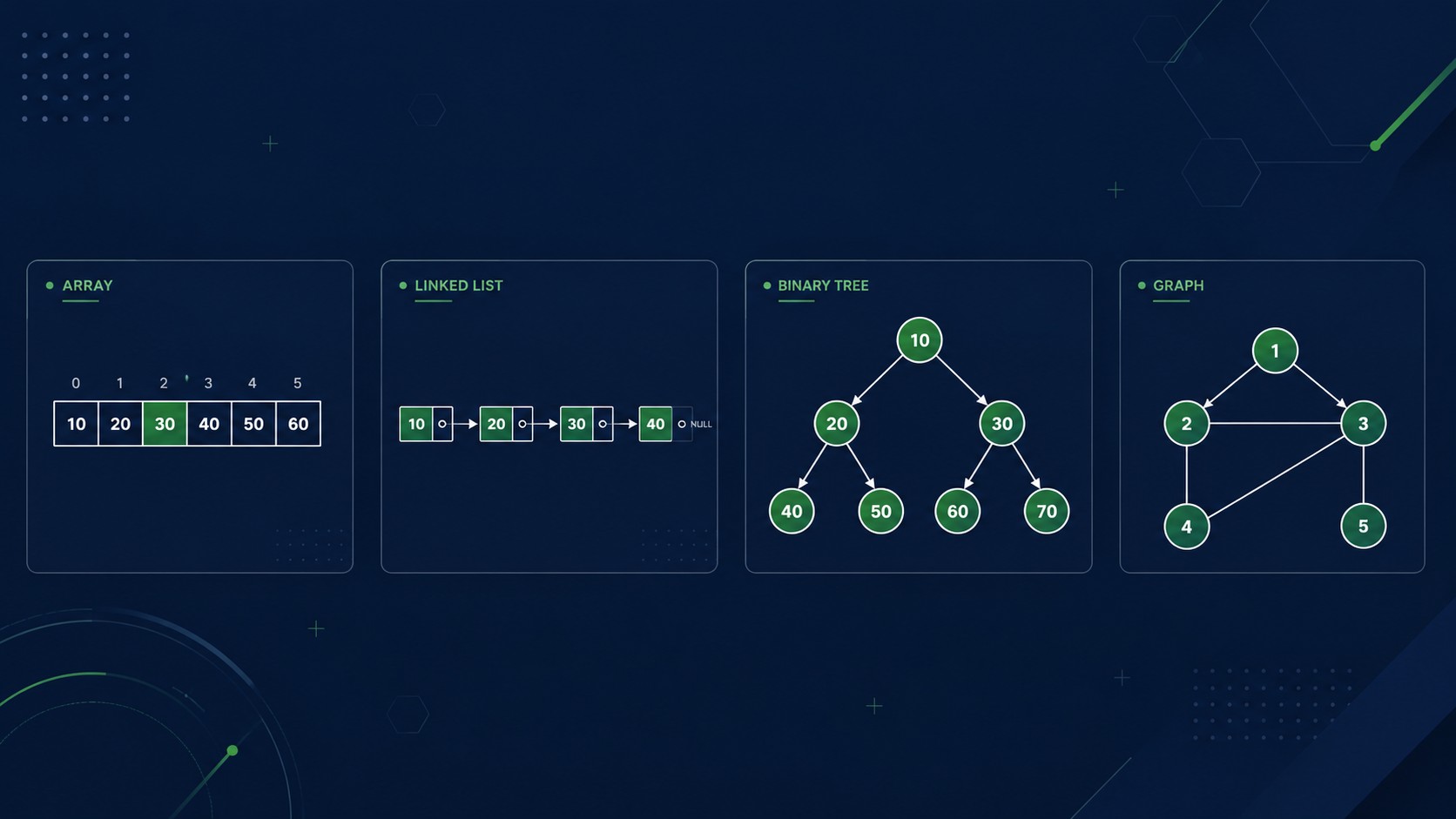
DSA courses vary between universities, but the backbone is remarkably consistent. Understanding how the topics connect helps you see why each assignment matters rather than treating them as unrelated hurdles.
Arrays, Strings, and Linked Structures
Everything starts with linear structures. Arrays give you fast indexed access but fixed or costly resizing. Linked lists trade indexed access for cheap insertion and deletion in the middle. Assignments here often ask you to reverse a list, detect a cycle, merge two sorted lists, or implement a dynamic array from scratch. These problems teach pointer manipulation and edge-case discipline, which matter for everything that follows.
Stacks, Queues, and Their Variants
Stacks and queues are deceptively simple: last in first out, and first in first out. The value lies in recognizing when a problem is secretly a stack or queue problem. Balanced-bracket checking, expression evaluation, undo functionality, and breadth-first traversal all lean on them. Deques, priority queues, and circular buffers extend the idea and show up in more advanced tasks.
Trees and Heaps
Trees introduce hierarchy and recursion at the same time, which is why they trip up so many students. Binary search trees, balanced trees such as AVL and red-black trees, tries, and heaps each solve a specific problem. Assignments frequently ask you to implement traversals, insertions, deletions, and rebalancing, then explain the resulting time complexity. Heaps in particular power priority queues and efficient sorting.
Graphs
Graphs model relationships: networks, maps, dependencies, and social connections. Representations such as adjacency lists and adjacency matrices come first, followed by traversals like depth-first and breadth-first search, then shortest-path and minimum-spanning-tree algorithms. Graph assignments are usually the most involved because they combine a data structure with a non-trivial algorithm on top.
Hashing
Hash tables deliver near-constant-time lookup when designed well, and they appear everywhere from dictionaries to caches. Assignments often ask you to implement a hash map, handle collisions through chaining or open addressing, and reason about load factor and resizing. Understanding hashing is what makes many later problems feel easy instead of impossible.
Understanding Algorithms and Complexity Analysis
If data structures are the nouns of the course, algorithms are the verbs, and complexity analysis is the grammar that judges them. This is the area where students most often lose marks, because it is the least intuitive and the hardest to fake.
Complexity analysis asks a single practical question: as the input grows, how does the work grow with it? Big O notation describes the upper bound on that growth. An algorithm that is O(n) does roughly proportional work as input increases, while an O(n squared) algorithm does work that grows with the square of the input, and an O(log n) algorithm barely grows at all. The reason instructors care so much is that these differences are enormous at scale. An approach that feels fast on ten items can become unusable on ten million.
Students often make two mistakes here. The first is analyzing the code they wish they had written rather than the code on the page, missing a hidden nested loop or an expensive operation inside a loop. The second is confusing best, average, and worst case. A quick sort is fast on average but can degrade to quadratic time on already-sorted input if the pivot is chosen poorly, and an assignment will often ask you to identify exactly that scenario.
Key idea: When you analyze an algorithm, trace it line by line and count the operations that scale with input size. If a loop runs n times and does constant work inside, that is O(n). If a loop runs n times and each pass triggers another loop over n items, that is O(n squared). Naming the dominant term is usually all the marker wants.
Common Algorithm Families
Beyond raw analysis, most courses cover a handful of algorithm families you will use again and again. Divide and conquer breaks a problem into smaller copies of itself, as in merge sort and binary search. Greedy algorithms make the locally best choice at each step and work well for certain problems like Huffman coding and some shortest-path variants. Dynamic programming stores the results of overlapping subproblems to avoid recomputing them, which is the key to problems like the knapsack, longest common subsequence, and edit distance. Recognizing which family a problem belongs to is often the entire battle.
A Comparison of Common Data Structures
One of the most common assignment tasks is choosing the right structure for a scenario and defending that choice with complexity figures. The table below summarizes typical average-case behavior. Real performance depends on implementation details, but this gives you the mental model markers expect you to demonstrate.
| Structure | Access | Search | Insertion | Best Used For |
|---|---|---|---|---|
| Array | O(1) | O(n) | O(n) | Fast indexed reads, fixed-size data |
| Linked List | O(n) | O(n) | O(1) | Frequent insertion and deletion |
| Hash Table | N/A | O(1) | O(1) | Fast lookup by key |
| Binary Search Tree | O(log n) | O(log n) | O(log n) | Sorted data with fast search |
| Heap | N/A | O(n) | O(log n) | Priority queues, finding min or max |
Watch out: The tree and hash figures above assume a well-behaved, balanced, or well-distributed structure. An unbalanced binary search tree can degrade to O(n), and a hash table with poor hashing can too. Assignments love to test whether you understand the worst case behind the tidy average.
Stuck on a Tricky DSA Problem?
Whether it is a failing test case, a complexity proof, or a graph algorithm that will not behave, our team can walk you through the solution so you understand every step. Share your assignment brief and we will show you the way forward.
A Reliable Method for Solving DSA Assignments
Strong students are not necessarily faster than everyone else. They are more systematic. When you approach every problem with the same disciplined method, difficult assignments become manageable and your solutions become easier to explain and defend.
Read the Problem Slowly and Restate It
Before writing a single line, put the problem in your own words. What are the inputs, what is the expected output, and what are the constraints? Constraints matter more than students realize. If the input can be up to a million elements, an O(n squared) approach is a warning sign. If the input is tiny, a simple brute-force solution may be perfectly acceptable and much easier to get right.
Work a Small Example by Hand
Trace a concrete, small input on paper before coding. This exposes edge cases and clarifies the exact behavior you need. Empty inputs, single elements, duplicates, and already-sorted data are the classic cases that break naive solutions and cost marks in automated test suites.
Choose the Structure, Then the Algorithm
Decide which data structure fits the operations you need most often. If you constantly look things up by key, reach for a hash table. If you need the smallest item repeatedly, a heap is natural. Once the structure is chosen, the algorithm often becomes obvious, and you can justify your choice with the complexity figures your marker wants to see.
Write, Test, Then Analyze
Implement the solution in small pieces and test each piece as you go rather than writing everything and hoping. Once it works, write down the time and space complexity and a short justification. Many assignments award marks specifically for that analysis, and it is the part most students rush or skip entirely.
Pro tip: Comment your reasoning, not just your code. A short note explaining why you chose a particular structure or how a loop achieves its complexity often earns marks on its own and makes your work far easier to grade and to defend in a viva.

Common Mistakes That Cost Students Marks
Most lost marks in DSA assignments come from a small set of recurring errors. Knowing them in advance is one of the fastest ways to raise your grade.
- Ignoring edge cases such as empty inputs, single elements, or duplicate values that automated tests almost always check.
- Providing correct code but no complexity analysis, when the analysis is often worth a significant share of the marks.
- Choosing a data structure out of habit rather than fit, then being unable to justify it.
- Confusing average and worst case, especially with hashing and unbalanced trees.
- Writing dense, uncommented code that works but is impossible for a marker to follow.
- Off-by-one errors in loops and recursion base cases that silently corrupt results.
- Submitting code that passes given tests but was never tested against inputs the student created themselves.
How EasyAssignments Approaches DSA Help
The goal of good assignment help is not to make you dependent on it. It is to get you unstuck and leave you more capable than before. That principle shapes how we work on data structures and algorithms tasks.
Concept First
We start by making sure the underlying structure or algorithm actually makes sense to you, because a fix you do not understand will not help on the exam.
Clean, Explained Code
Solutions are written clearly, commented, and structured so you can trace the logic and reproduce the approach on your own.
Complexity Included
We include the time and space analysis your brief asks for, with the reasoning spelled out rather than just a final Big O label.
Your Language and Level
From introductory Python to advanced C++ and Java, we match the language, style, and depth your course expects.
Whether you are debugging a segmentation fault in a C++ linked list, proving the complexity of a recursive algorithm, or building a graph traversal from scratch, the aim is the same: hand back work you can stand behind and understand. If you want a second set of expert eyes on your assignment, you can get a free quote or talk to our support team any time.
Frequently Asked Questions
Can you help with data structures and algorithms assignment help in any programming language?
Yes. We regularly work across Python, Java, C++, C, and other common languages. The concepts behind data structures and algorithms are the same everywhere, so we match the language and style your course requires while keeping the underlying logic clear.
Will you explain the solution or just send code?
We explain it. Our focus is helping you understand the structure, the algorithm, and the complexity so you can reproduce the approach and defend it. Finished code without understanding does not help you on exams or in vivas.
Do you include Big O complexity analysis?
Yes. When your assignment asks for time and space complexity, we provide it with the reasoning shown, not just a final label. That analysis is often worth a large share of the marks, so we treat it as a core part of the work.
How do I get started?
Share your assignment brief, any starter code, and your deadline. You can get a free quote or reach us through the contact page, and we will confirm scope and timing before any work begins.
Turn a Confusing DSA Assignment Into a Clear One
Get accurate, well-explained data structures and algorithms assignment help that leaves you understanding the solution, not just submitting it. Share your brief today and move forward with confidence.