
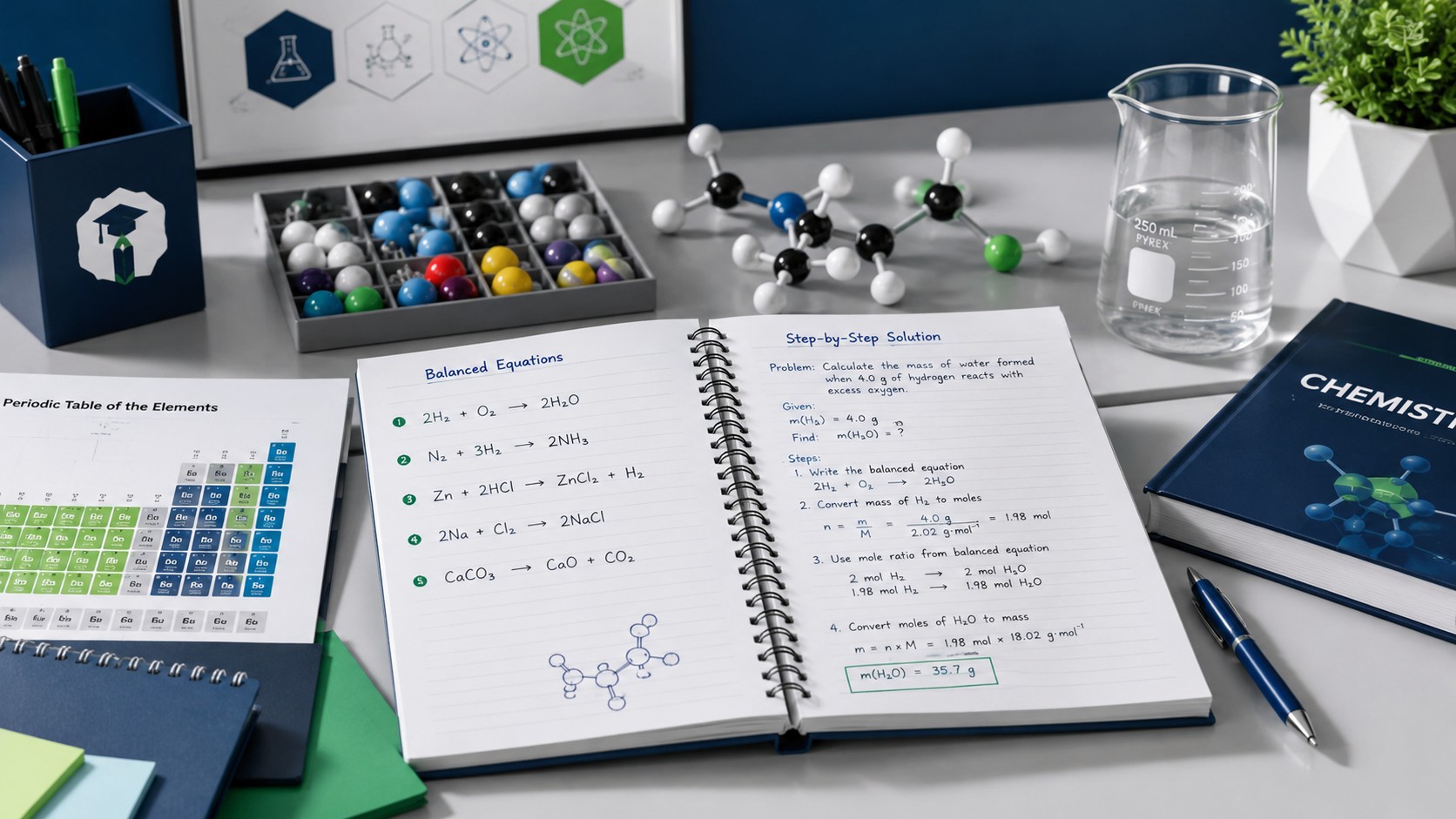
Chemistry Homework Help With Step by Step Answers
Getting chemistry homework help with step by step answers is the difference between copying a solution you forget by morning and finally understanding why a reaction behaves the way it does. This guide breaks down how a good step by step method turns moles, equations, and mechanisms into a process you can repeat on your own.
Whether you are stuck on stoichiometry, balancing redox reactions, or drawing an organic mechanism, the goal is the same: see every stage of the solution clearly so the next problem gets easier, not harder.
Why Chemistry Homework Help With Step by Step Answers Actually Works
Chemistry is a subject built on layers. You cannot balance an equation without understanding formulas, and you cannot tackle stoichiometry without first balancing that equation. When one layer is shaky, everything above it wobbles. That is why a final answer alone, even a correct one, rarely helps you improve. What you need is chemistry homework help with step by step answers, where each stage of the reasoning is visible, labeled, and explained.
Think about the difference between being handed the number 44 grams and being shown exactly how that number came from moles, molar mass, and a balanced ratio. The first teaches you nothing. The second gives you a template you can apply to the next twenty problems. Step by step help is not about doing less thinking. It is about seeing the thinking laid out so clearly that you can eventually do it yourself.
Good step by step solutions also expose the small habits that separate strong chemistry students from struggling ones: writing units at every stage, keeping significant figures consistent, checking that a balanced equation truly balances, and pausing to ask whether an answer is physically reasonable. These habits are invisible in a bare final answer but obvious in a worked solution.
The core idea: A correct answer tells you what happened once. A step by step solution teaches you the method so you can solve every similar problem after it. Understanding the process is the real goal of chemistry homework help.
The Chemistry Topics Students Struggle With Most
Chemistry covers an enormous range, and different topics trip students up for different reasons. Some are conceptually abstract, some are calculation heavy, and some require a spatial imagination that takes time to build. Knowing where your difficulty sits helps you ask for the right kind of help.
Stoichiometry and the mole concept
Stoichiometry is often the first real wall students hit. It ties together balanced equations, molar masses, mole ratios, and unit conversions all at once. A single problem can ask you to convert grams to moles, apply a ratio from the balanced equation, then convert back to grams or liters. Each conversion is simple on its own, but chained together they overwhelm students who have not seen the full path written out. Step by step help here means showing every conversion factor, complete with units that cancel visibly.
Balancing chemical and redox equations
Balancing simple equations by inspection feels manageable, but redox reactions in acidic or basic solution introduce half reactions, electron counting, and charge balancing. Students frequently lose track of which species is oxidized, how many electrons transfer, and how to balance oxygen and hydrogen using water and protons. A worked solution that separates the half reactions and balances them one property at a time removes most of the confusion.
Organic chemistry and reaction mechanisms
Organic chemistry rewards pattern recognition. Once you understand how electrons flow, from nucleophile to electrophile, mechanisms start to feel logical rather than memorized. The trouble is that this intuition takes many worked examples to develop. Step by step mechanism help shows the movement of every electron pair with curved arrows, names the intermediate at each stage, and explains why one pathway is favored over another.
Thermodynamics, equilibrium, and kinetics
Physical chemistry topics like Gibbs free energy, equilibrium constants, and reaction rates lean heavily on algebra and interpretation. Students often plug numbers into a formula correctly but misread what the result means. Detailed solutions connect the math back to the concept, explaining what a negative Gibbs energy or a large equilibrium constant actually tells you about a system.
A Step by Step Framework for Solving Any Chemistry Problem
Most chemistry problems, no matter the topic, respond well to the same disciplined approach. Learning this framework is more valuable than memorizing any single solution, because it gives you a reliable starting point even when a question looks unfamiliar.
Step 1: Read the problem and identify what is asked
Before touching a calculator, decide exactly what the question wants. Is it asking for mass, moles, volume, concentration, or a mechanism? Underline the given quantities and the target quantity. Many mistakes come not from bad math but from answering a slightly different question than the one asked.
Step 2: Write the balanced equation
For any reaction based problem, a correctly balanced equation is the foundation. It gives you the mole ratios that everything else depends on. Double check that atoms of each element are equal on both sides, and for redox reactions, that charge balances too.
Step 3: Organize your known and unknown values
List what you know with units, and note what you are solving for. This simple habit prevents you from losing a value halfway through or mixing up which number belongs to which substance. It also makes it obvious which conversion factors you will need.
Step 4: Choose the right relationships and convert carefully
Now apply the relevant relationships: molar mass to move between grams and moles, mole ratios from the balanced equation to move between substances, and the ideal gas law or molarity definition when gases or solutions are involved. Write each conversion factor as a fraction so units visibly cancel.
Step 5: Calculate, then check significant figures
Perform the arithmetic, then round to the correct number of significant figures based on your given data. Careless rounding is a common source of lost marks even when the method is perfect.
Step 6: Sanity check the answer
Finally, ask whether the result makes sense. Is the mass positive and reasonable in size? Does a yield below one hundred percent look plausible? A quick reality check catches many errors before they reach your teacher.
Try this: Apply these six steps to your next homework question even before looking at any solution. Then compare your process to a fully worked answer. The gap between the two is exactly what you need to learn next.
Worked Example: Stoichiometry Step by Step
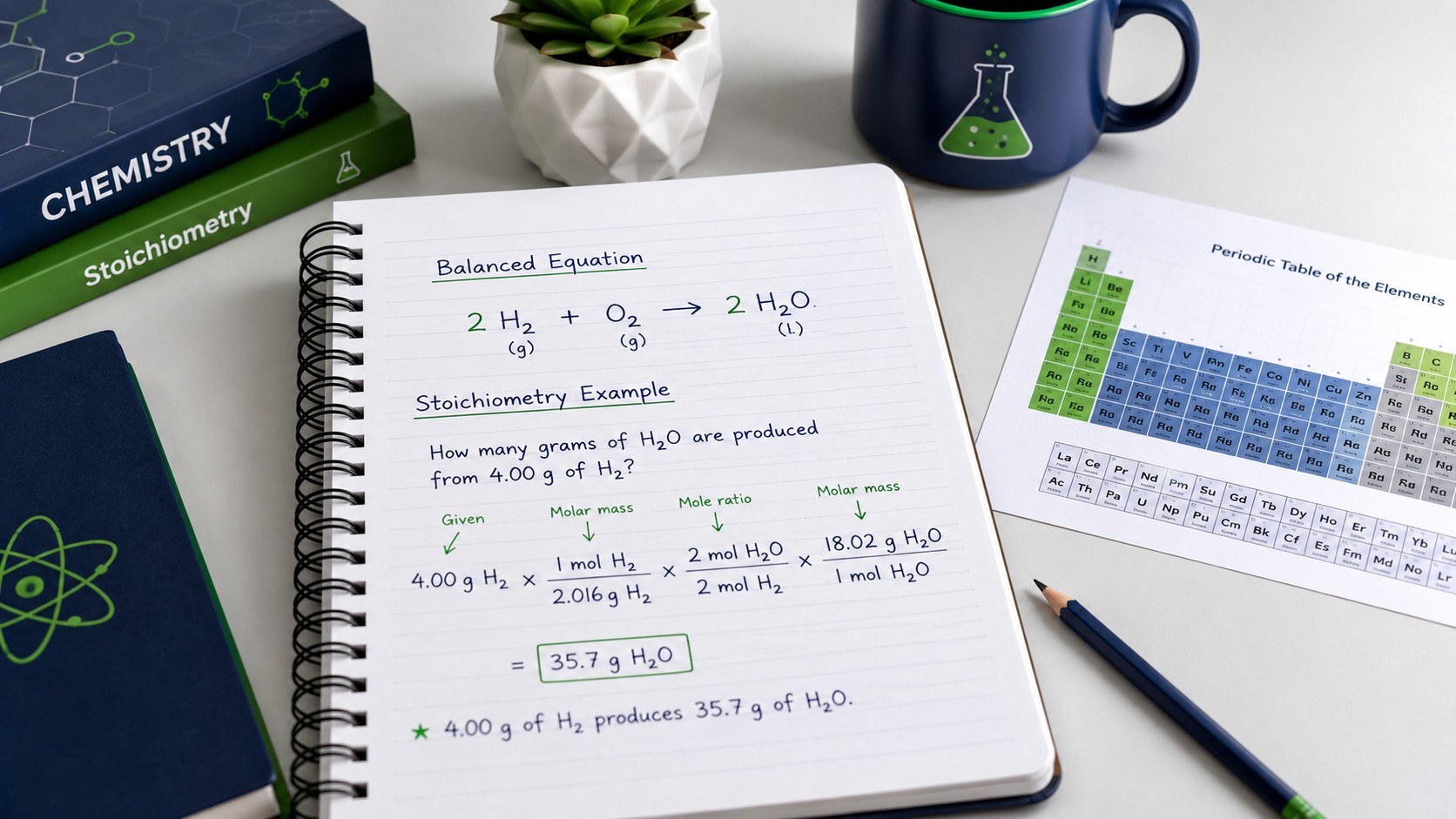
To see the framework in action, consider a classic problem: how many grams of water form when 8 grams of hydrogen gas react completely with oxygen? Walking through it slowly shows how the steps connect.
First, write the balanced equation. Hydrogen and oxygen form water, and balancing gives two molecules of hydrogen reacting with one molecule of oxygen to form two molecules of water. Second, convert the 8 grams of hydrogen to moles using its molar mass of about 2 grams per mole, giving roughly 4 moles of hydrogen. Third, use the mole ratio from the balanced equation, where hydrogen and water appear in a one to one ratio, so 4 moles of hydrogen produce 4 moles of water. Fourth, convert those 4 moles of water to grams using water's molar mass of about 18 grams per mole, giving about 72 grams of water. Finally, check the answer: mass is conserved, the number is positive and reasonable, and the units worked out correctly.
Notice how none of these steps required a leap of intuition. Each one followed logically from the last. That predictability is exactly why step by step chemistry homework help builds real skill: it trains you to trust a process rather than hunt for a trick.
Stuck on a Chemistry Problem Right Now?
Send us the exact question and get a clear, step by step solution you can actually learn from, not just a final number. Our team explains the reasoning at every stage.
Comparing Ways to Get Chemistry Homework Help
Students have several options when they get stuck, and each has trade-offs. Understanding them helps you pick the right resource for the moment, whether you have five minutes before class or a full weekend to study.
| Option | Best For | Strengths | Limitations |
|---|---|---|---|
| Textbook and class notes | Reviewing fundamentals | Reliable, aligned to your syllabus | Slow to search, few worked examples |
| Online problem libraries | Practicing similar questions | Many examples, instant access | Quality varies, may skip steps |
| Study groups | Discussing concepts | Different perspectives, motivating | Can drift off topic, mixed accuracy |
| Professional homework help | Complex or urgent problems | Full step by step solutions, tailored | Best used as a learning aid, not a shortcut |
The most effective students rarely rely on a single option. They use worked solutions to understand a method, then practice similar problems until the process feels natural. A professional step by step solution is most valuable when you treat it as a worked example to study, comparing your own attempt against it to find where your reasoning broke down.
How to Get the Most From Step by Step Chemistry Help
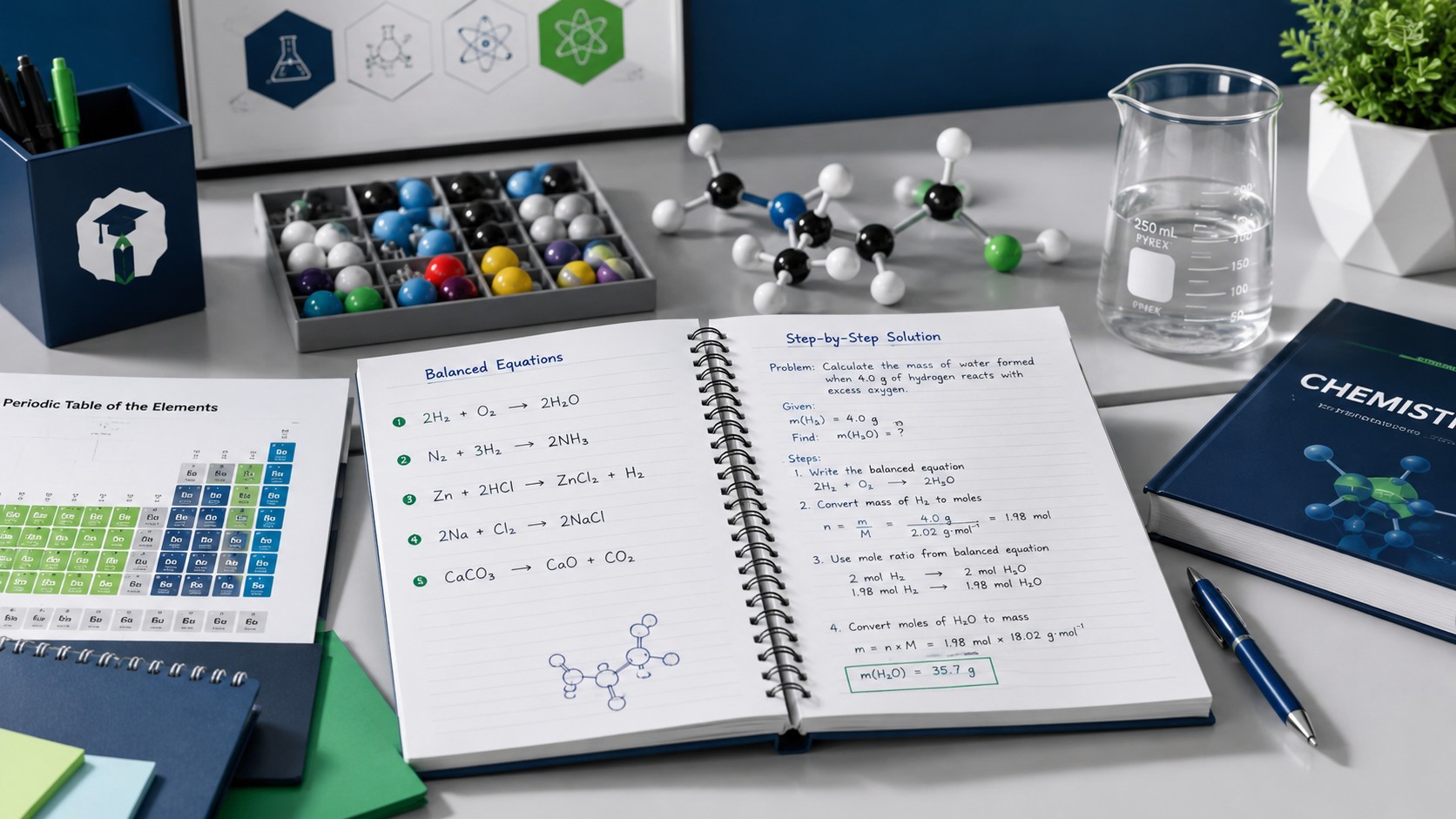
A worked solution is only as useful as what you do with it. Passive reading rarely sticks. To turn help into lasting understanding, engage with each solution actively.
- Attempt the problem yourself first, even if you only get partway, so you know where you got stuck.
- Read the solution one step at a time and pause to predict the next step before revealing it.
- Rewrite the solution in your own words, explaining why each step was taken rather than just what was done.
- Cover the solution and try the same problem again from scratch a day later.
- Find two or three similar problems and apply the same method without looking back.
This active approach transforms a single answer into a repeatable skill. The aim is never to have someone solve chemistry for you forever, but to reach the point where you no longer need the help at all.
Use help responsibly: Always follow your school's academic integrity policy. Worked solutions are learning tools to help you understand a method. Submitting work you do not understand undermines your own progress and may breach your institution's rules.
Building Long Term Confidence in Chemistry
Beyond any single assignment, the real prize is confidence. Chemistry becomes far less intimidating once you have a dependable method and a habit of checking your own reasoning. Students who consistently work through problems step by step start to recognize patterns across topics: the same conversion logic that solves a stoichiometry question also underpins gas law and solution problems.
Consistency matters more than intensity. Working carefully through a handful of problems every few days, fully understanding each one, builds more durable skill than cramming a hundred problems the night before an exam. Step by step help fits naturally into this rhythm, giving you a clear model to imitate whenever you get stuck, so your practice stays productive instead of frustrating.
Over a semester, these small habits compound. The equations that once looked like a foreign language become routine, the mechanisms that seemed arbitrary reveal their internal logic, and the calculations you once feared become almost mechanical. That is the quiet payoff of learning the process rather than memorizing answers.
What to Look For in Quality Chemistry Homework Help
Not all help is created equal. When you seek chemistry homework help with step by step answers, look for solutions that genuinely teach rather than simply deliver a result. The best support shares a few common features that make it worth your time.
Complete Reasoning
Every step is shown and explained, with no unexplained jumps between lines. You can follow the logic from the first given value to the final answer.
Correct Units and Figures
Units are tracked throughout and significant figures are respected, modeling the careful habits that earn full marks on exams.
Clear Explanations
Concepts are explained in plain language, not just symbols, so you understand why each step is taken and not only how.
Relevant to Your Level
Help is matched to your course, whether high school, introductory college, or advanced university chemistry, so it fits what you are expected to know.
When help meets these standards, it does more than fix one assignment. It quietly upgrades your entire approach to the subject, giving you a mental template you can carry into every future problem and, eventually, into your exams.
Frequently Asked Questions
What does chemistry homework help with step by step answers include?
It includes a full worked solution for each problem, showing the balanced equation, every conversion or calculation with units, the reasoning behind each step, and a final checked answer. The goal is for you to understand the method, not just receive a number.
Which chemistry topics can you help with?
Support covers all major branches, including general chemistry, stoichiometry, redox and balancing, organic mechanisms, thermodynamics, equilibrium, kinetics, and more, from high school through university level.
Will step by step solutions actually help me learn?
Yes, if you use them actively. Attempt each problem first, study the worked steps, then redo the problem on your own and try similar ones. Used this way, step by step answers build a method you can apply independently.
How do I get started?
Simply send us the exact question or assignment along with your course level and deadline. You can request a free quote or talk to support to explain what you need, and we will prepare a clear, step by step solution.
Ready for Chemistry Homework Help That Teaches You the Method?
Get step by step answers that explain every stage clearly, so your next problem is easier than the last. Understanding, not just answers.