

Step by Step Calculus Assignment Help for College Students
Calculus is where a lot of college students hit their first real math wall. Limits feel abstract, derivatives pile up, and integrals seem to have a rule for every situation. The good news: calculus is one of the most learnable subjects once you approach every problem with a repeatable, step by step method.
This guide walks you through how to read a calculus problem, choose the right tool, work cleanly, and check your answer, plus study habits and support options for when a deadline is closing in and you are still stuck.
Why Calculus Feels Hard (and Why It Does Not Have to Be)
Most students do not actually struggle with calculus itself. They struggle with the algebra and trigonometry underneath it. When you cannot factor quickly, simplify fractions confidently, or recall that the derivative of sine is cosine, every calculus problem takes twice as long and feels twice as confusing. Calculus stacks new ideas on top of skills you were supposed to master earlier, so a shaky foundation shows up loudly.
The second reason calculus feels hard is that it introduces genuinely new ways of thinking. Limits ask you to reason about what happens as you approach a value rather than what happens at it. Derivatives ask you to think about instantaneous rates of change. Integrals ask you to add up infinitely many tiny pieces. These ideas are powerful, but they are unfamiliar, and unfamiliar always feels difficult at first.
The encouraging part is that calculus is unusually systematic. Once you learn the pattern for a type of problem, that pattern works almost every time. This is why a step by step approach is so effective here: you are not memorizing hundreds of unrelated tricks, you are learning a small number of reliable procedures and knowing when to apply each one.
Mindset shift: Treat every calculus problem as a decision tree. First identify what kind of problem it is, then pick the matching tool, then execute carefully. Most wrong answers come from choosing the wrong tool or rushing the algebra, not from misunderstanding calculus.
The Core Building Blocks You Need to Master First
Before diving into a step by step problem-solving method, it helps to know the terrain. College calculus is usually split into three courses, and each builds on the last. If you understand where a specific assignment sits, you can predict which tools it will require.
Limits and Continuity
Limits are the foundation of everything that follows. A limit describes the value a function approaches as the input gets close to some number. You will learn to evaluate limits by direct substitution, by factoring and canceling, by rationalizing, and by recognizing indeterminate forms like zero over zero. Continuity simply asks whether a function has any breaks, jumps, or holes. Most early assignment mistakes come from skipping the check for whether direct substitution even works before reaching for a fancier technique.
Derivatives
A derivative measures how fast something is changing. In practice, most derivative work is about recognizing which rule applies: the power rule for simple polynomials, the product rule when two functions are multiplied, the quotient rule for fractions, and the chain rule when one function is nested inside another. The chain rule trips up more students than any other single topic, usually because they forget to multiply by the derivative of the inside function.
Integrals
Integration is the reverse of differentiation, and it is where many students slow down. Basic integrals follow directly from the derivative rules run backward. Harder ones require techniques such as substitution, integration by parts, and partial fractions. Definite integrals then use those antiderivatives to compute areas, volumes, and totals. Integration rewards pattern recognition more than any other calculus topic, so practice variety matters.
A Step by Step Method for Solving Any Calculus Problem
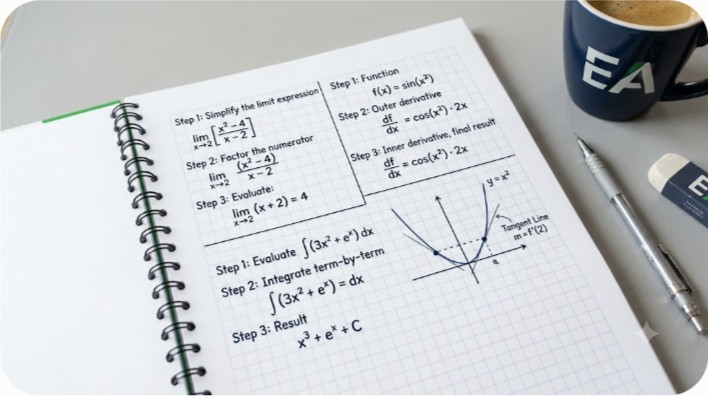
Here is the exact process you can apply to almost any calculus assignment question. It works whether you are computing a limit, taking a derivative, or evaluating an integral. The point is to slow down at the start so you can speed up safely later.
Step 1: Read the Problem and Identify the Type
Before writing anything, decide what category the problem belongs to. Is it a limit, a derivative, an integral, an optimization problem, or a related rates word problem? Circle the key words. Words like "rate," "how fast," or "slope" point to derivatives. Words like "area," "total," or "accumulated" point to integrals. This single habit prevents the most common error: solving the wrong kind of problem correctly.
Step 2: Write Down What You Know and What You Need
List the given function, the point or interval, and exactly what the question is asking for. For word problems, translate the sentences into variables and an equation before touching any calculus. Many students lose points not because their calculus is wrong but because they never set the problem up correctly. A clean setup is half the solution.
Step 3: Choose the Right Rule or Technique
Now match the problem to a tool. If it is a derivative of a nested function, you need the chain rule. If it is an integral with a function and its own derivative both present, try substitution. Naming the technique out loud, or on paper, forces you to commit to a plan instead of guessing your way forward.
Step 4: Execute One Line at a Time
Work in small, clearly separated steps. Do not combine three algebra moves into one line. Each line should do one thing so that if something goes wrong, you can see exactly where. This discipline feels slow, but it saves enormous time because you rarely have to restart from scratch.
Step 5: Simplify and Check Your Answer
Simplify fully, then sanity-check. For derivatives, does the answer have the right form? For definite integrals, is the number reasonable given the graph? You can often verify by estimating, by plugging in a value, or by differentiating your integral answer to see if you get back the original function. Checking catches the small sign and arithmetic errors that cause most lost marks.
Watch out: The single most common calculus mistake is a dropped or flipped negative sign, especially inside the chain rule, when integrating, or when applying limits of integration. Before you submit, trace every minus sign through your work. It takes thirty seconds and saves whole points.
Matching the Problem Type to the Right Tool
Because calculus is so systematic, a quick reference table can dramatically speed up your homework. Use this as a mental checklist when you first read a question, so you spend your energy solving rather than deciding.
| Problem Signal | Likely Topic | Go-To Technique |
|---|---|---|
| "Approaches," value near a point, 0/0 form | Limits | Substitute, then factor or rationalize |
| "Rate," "slope," "how fast" | Derivatives | Power, product, quotient, or chain rule |
| Nested function inside another | Derivatives | Chain rule (outside times inside) |
| "Area," "total," "accumulated" | Integrals | Antiderivative, then evaluate bounds |
| Function and its derivative both present | Integrals | u-substitution |
| Product of two unrelated functions | Integrals | Integration by parts |
| "Maximum," "minimum," "largest," "least" | Applications | Optimization with derivatives |
| Two changing quantities linked over time | Applications | Related rates |
Stuck on a Calculus Problem Set Tonight?
When the deadline is close and you need clear, step by step worked solutions you can actually learn from, our team can help you make sense of the tough questions.
Study Habits That Make Calculus Assignments Easier
Getting good at calculus is less about raw talent and more about the way you practice. A few deliberate habits will lower your homework stress and raise your grades over a full semester.
- Practice actively, not passively. Rewatching a solved example feels productive but teaches you little. Cover the solution and try the problem yourself, then compare. Struggling first is how the method sticks.
- Do a little every day. Calculus rewards spaced repetition. Twenty focused minutes daily beats a single panicked cram session, because the rules need time to move into long-term memory.
- Keep an error log. Write down every mistake you make and why. Most students repeat the same three or four errors constantly. Naming them is the fastest way to stop making them.
- Master the prerequisites. If algebra or trig is slowing you down, spend a weekend refreshing those skills. It pays back many times over across the whole course.
- Explain problems out loud. Teaching a concept to a classmate, or even to an empty room, exposes the gaps in your understanding faster than anything else.
- Use graphs to build intuition. Sketching a function helps you predict whether an answer is reasonable, which turns abstract symbols into something you can picture.
Common Calculus Mistakes and How to Avoid Them
Certain errors show up on calculus assignments again and again. Knowing them in advance means you can build quick checks into your routine and stop losing easy points.
Forgetting the Chain Rule
When a function is nested, you must multiply by the derivative of the inside. Skipping this is the top derivative error, so always ask whether there is an inside function.
Losing the Constant of Integration
Indefinite integrals need a plus C. It is a small thing, but on many assignments it is worth real marks, so make adding it automatic.
Rushing the Algebra
Most wrong answers are algebra slips, not calculus errors. Slowing down on factoring and fractions fixes more mistakes than any single calculus concept.
Ignoring the Domain
Limits, logs, and square roots all have domain rules. Check whether your answer even makes sense for the values allowed before you commit to it.
How to Structure Your Calculus Homework Sessions
The way you organize a study session can make a long problem set feel manageable instead of overwhelming. A little structure removes the temptation to procrastinate and keeps momentum going once you start.
Begin by scanning the entire assignment and sorting problems into three groups: ones you can clearly do, ones you can probably do with effort, and ones you are unsure about. Start with the ones you know. Early wins build confidence and warm up the exact skills the harder problems will need. Save the toughest questions for the middle of your session, when you are focused but not yet tired, and leave routine problems for the end.
Work in focused blocks with short breaks. A common approach is to work for a set stretch, then rest briefly, which keeps your attention sharp across a long problem set. When you hit a wall on a single problem, give it a genuine attempt, but set a limit. If you have spent more than ten or fifteen minutes with no progress, mark it, move on, and return later with fresh eyes. Staring at the same problem rarely produces a breakthrough, and it drains time you could spend finishing the rest.

When to Get Extra Calculus Assignment Help
There is no shame in asking for support. Calculus builds so tightly on itself that a single misunderstood concept early on can quietly undermine everything after it. Getting help early, before a small gap becomes a large one, is one of the smartest academic decisions you can make.
Good first stops are always your own resources: your professor's office hours, your school's tutoring center, study groups with classmates, and the worked examples in your textbook. These are free, tailored to your exact course, and often the fastest way to fix a specific confusion. Explaining where you are stuck to a real person frequently untangles the problem before they even answer.
Sometimes, though, you need more than a hint. Maybe several assignments are due at once, maybe you missed the class where a key technique was introduced, or maybe you simply want to see a difficult problem worked cleanly from start to finish so you can learn the pattern. In those moments, a service like EasyAssignments can provide detailed, step by step solutions you can study from, so the next similar problem becomes one you can handle on your own.
Use help to learn, not to skip: The best way to benefit from any worked solution is to study the reasoning, then redo the problem yourself without looking. Understanding the method is what carries you through exams, where no help is available.
Putting It All Together
Calculus rewards structure more than almost any other college subject. When you read each problem carefully, identify its type, choose the matching tool, work one clean line at a time, and check your answer, the subject stops feeling like a wall of mysterious symbols and starts feeling like a set of solvable puzzles. Layer on steady daily practice, a habit of logging your mistakes, and a solid grip on the algebra and trig underneath, and steady improvement follows naturally.
And when a deadline is tight or a concept refuses to click, reaching out for step by step calculus assignment help is a strategy, not a weakness. The goal is always the same: to understand the method well enough that next time, you can do it yourself.
Frequently Asked Questions
What is the best way to start a calculus assignment when I feel completely lost?
Start by identifying what type each problem is, a limit, derivative, or integral, before trying to solve anything. Sort the problem set into easy, medium, and hard, then begin with the ones you can already do. Early wins warm up the exact skills the harder problems need, and getting step by step calculus assignment help on one tough example often unlocks the rest.
Why do I keep getting derivatives wrong even when I understand the concept?
Almost always it is the chain rule or an algebra slip rather than a conceptual gap. Check whether there is an inside function you forgot to differentiate, and slow down on the factoring and simplifying. Writing one small step per line makes these errors easy to catch before you submit.
How much should I practice calculus each week?
Short, frequent sessions beat occasional long ones. Aiming for a focused block most days, rather than a single cram before the deadline, gives the rules time to move into long-term memory. Consistency matters far more than the total number of hours.
Is it okay to use a calculus help service for my homework?
Using detailed worked solutions to learn a method is a legitimate and effective study strategy. Study the reasoning, then redo the problem yourself without looking so the skill is truly yours. That way the help builds real understanding you can rely on during exams.
Get Step by Step Calculus Assignment Help Today
Turn a confusing problem set into clear, worked solutions you can actually learn from. Reach out and get moving before your deadline.