
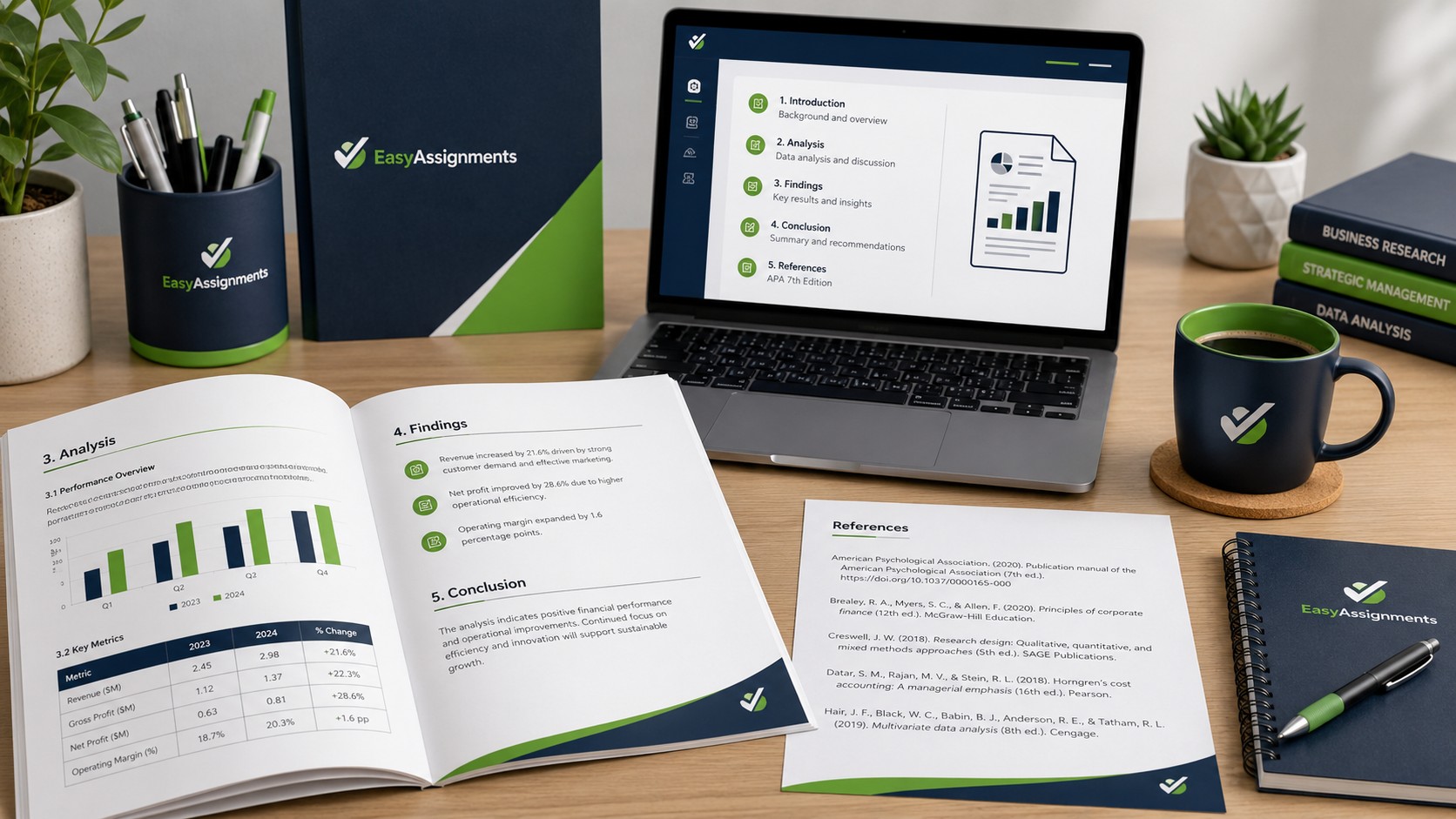
How to Write a Business Report Assignment with APA References
Learning how to write a business report assignment with APA references is one of the most useful skills you can build at university. A strong report shows that you can analyse a real situation, back your points with credible evidence, and present your findings in a clear, professional format.
This guide walks you through the whole process, from understanding the brief to formatting your final reference list. By the end, you will know how to structure each section, cite sources correctly in APA style, and avoid the common mistakes that cost easy marks.
What a Business Report Assignment Actually Is
A business report is a structured document that investigates a specific problem, opportunity, or situation and then presents findings, analysis, and recommendations to a defined audience. When you write a business report assignment with APA references, you are being tested on two things at once: your ability to reason about a real business scenario, and your ability to support that reasoning with credible, properly cited evidence.
Unlike an essay, which flows as continuous argument, a business report is built from clearly labelled sections that a busy reader can navigate quickly. A manager should be able to open your report, read the executive summary, and understand the core recommendation without reading every page. That reader-first mindset shapes everything about how you write, format, and reference the document.
Business reports come in several common forms. You might be asked to write an analytical report that examines why something is happening, a recommendation report that proposes a course of action, a feasibility report that tests whether an idea is workable, or a research report that summarises findings on a topic. The structure below adapts to all of these, but always read your brief carefully because your lecturer may ask for a specific format or a particular set of headings.
Step 1: Break Down the Brief Before You Write Anything
The single biggest reason students lose marks is answering a question that was never asked. Before you research or write, slow down and interrogate the assignment brief. Highlight the command words such as analyse, evaluate, recommend, or compare, because each one asks for a different kind of thinking. To evaluate means to weigh strengths against weaknesses and reach a judgement; to recommend means to move from analysis to a clear proposed action.
As you read the brief, note the practical constraints too. Identify the word count, the due date, the required number of sources, the referencing style, and any specified sections. If a marking rubric is provided, treat it as a map of where the marks live and make sure every criterion is addressed somewhere in your report.
It also helps to identify your audience and purpose early. A report written for a company board reads differently from one written for a marketing team. Knowing who you are writing for tells you how much background to include, how technical your language can be, and which recommendations will feel realistic to that reader.
Quick tip: Turn the brief into a one-sentence purpose statement, for example, "This report analyses declining customer retention at Company X and recommends three practical strategies to improve it." If you cannot write that sentence clearly, you are not yet ready to start drafting.

Step 2: Understand the Standard Business Report Structure
Most business reports follow a recognisable structure. Using the expected sections signals to your marker that you understand professional report conventions, and it makes your analysis far easier to follow. Below is the typical order, though your brief may add, remove, or rename sections.
Title Page
The title page carries the report title, your name and student number, the module or unit title, your lecturer's name, and the submission date. In APA 7th edition student format, the title page also usually includes the course name and institution. Keep it clean and follow any template your university provides.
Executive Summary
The executive summary is a short standalone overview of the entire report, usually a single page or less. It states the purpose, the key findings, and the main recommendations so that a reader can grasp the essentials without reading further. Write it last, once you know exactly what your report concludes, but place it near the front.
Table of Contents
For longer reports, a table of contents lists each section and its page number. Use your word processor's automatic contents feature so that headings and page numbers stay accurate when you edit.
Introduction
The introduction sets the scene. It explains the background to the problem, states the purpose and scope of the report, and outlines how the report is organised. This is where you make clear what the report will and will not cover, which protects you from being marked down for omitting something outside your defined scope.
Body and Analysis
The body is the heart of the report and where most of your marks are earned. Here you present your findings and analyse them, using clearly labelled sub-headings for each theme or issue. This is also where the bulk of your APA in-text citations will appear, because every claim, statistic, or theory you draw on should be traced back to a credible source.
Conclusions and Recommendations
Conclusions summarise what your analysis has shown without introducing new information. Recommendations then translate those conclusions into specific, actionable steps. Strong recommendations are concrete and realistic: they say who should do what, and ideally why it will help, rather than offering vague suggestions.
Reference List and Appendices
The reference list contains full APA entries for every source cited in the report. Appendices hold supporting material that would clutter the main body, such as detailed tables, survey questions, or raw data. Anything in an appendix should be referred to at least once in the main text.
| Section | Purpose | Rough length |
|---|---|---|
| Executive Summary | Overview of findings and recommendations | Up to one page |
| Introduction | Background, purpose, and scope | 10 to 15% of the report |
| Body and Analysis | Findings, evidence, and interpretation | 50 to 60% of the report |
| Conclusions | Summary of what the analysis shows | 10% of the report |
| Recommendations | Actionable, evidence-based steps | 10 to 15% of the report |
| Reference List | Full APA entries for all sources | As needed |
Step 3: Research and Gather Credible Sources
A business report is only as strong as the evidence behind it. Before you draft, gather a set of credible sources that you can cite in APA style. The quality of your sources directly affects both your analysis and your marks, so choose carefully.
Aim for a mix of source types. Academic journal articles give you peer-reviewed theory and research; industry reports and reputable news outlets provide current data and real-world context; books offer foundational models and frameworks; and official company or government publications supply primary information. Whenever possible, favour recent sources, especially for fast-moving topics such as technology or market trends.
As you research, keep a running record of every source in the exact form you will need for your reference list. Note the author, year, title, publisher or journal, and any web address or DOI at the moment you find the source. This small habit saves enormous time later and prevents the panic of trying to relocate a half-remembered article the night before submission.
Watch out: Avoid over-relying on unverified web pages, personal blogs, or content with no clear author or date. If you cannot identify who wrote something and when, it is difficult to cite properly in APA and it weakens your credibility with the marker.
Step 4: Master APA In-Text Citations
APA style uses an author-date system for in-text citations. Every time you use an idea, fact, or quotation from a source, you signal it in the text and then provide the full details in the reference list. Getting this right is central to writing a business report assignment with APA references, because consistent citation is what separates a credible report from one that looks unsupported.
Paraphrasing
Most of your citations will be paraphrases, where you express someone else's idea in your own words. For a paraphrase, include the author's surname and the year, either woven into the sentence or placed in brackets at the end. For example, in narrative form you might write that Porter (1985) argued competitive advantage stems from either cost leadership or differentiation. In parenthetical form the same point ends with the citation in brackets, such as (Porter, 1985).
Direct Quotations
When you quote exact words, you must include a page number alongside the author and year, for example (Kotler, 2017, p. 42). Use direct quotations sparingly in business reports; markers usually value your ability to paraphrase and analyse over your ability to copy phrases. Reserve quotes for definitions or wording that would lose meaning if reworded.
Multiple Authors
For a work with two authors, cite both surnames every time, joined by an ampersand inside brackets, for example (Johnson & Lee, 2020). For three or more authors, cite the first author followed by "et al." from the first mention, such as (Ahmed et al., 2019). When you cite several sources at once, list them alphabetically inside the same brackets, separated by semicolons.
Sources With No Author or Date
If a source has no named author, use a shortened version of the title in place of the author. If there is no date, use the abbreviation "n.d." meaning no date. These situations are common with organisational web pages, so know the rules before you rely on such sources.
Short on Time for Your Report?
If deadlines are stacking up, our team can help you plan, structure, and reference your business report so it meets your brief and your marking rubric. Get clear, original support from writers who know academic conventions.
Step 5: Build a Correct APA Reference List
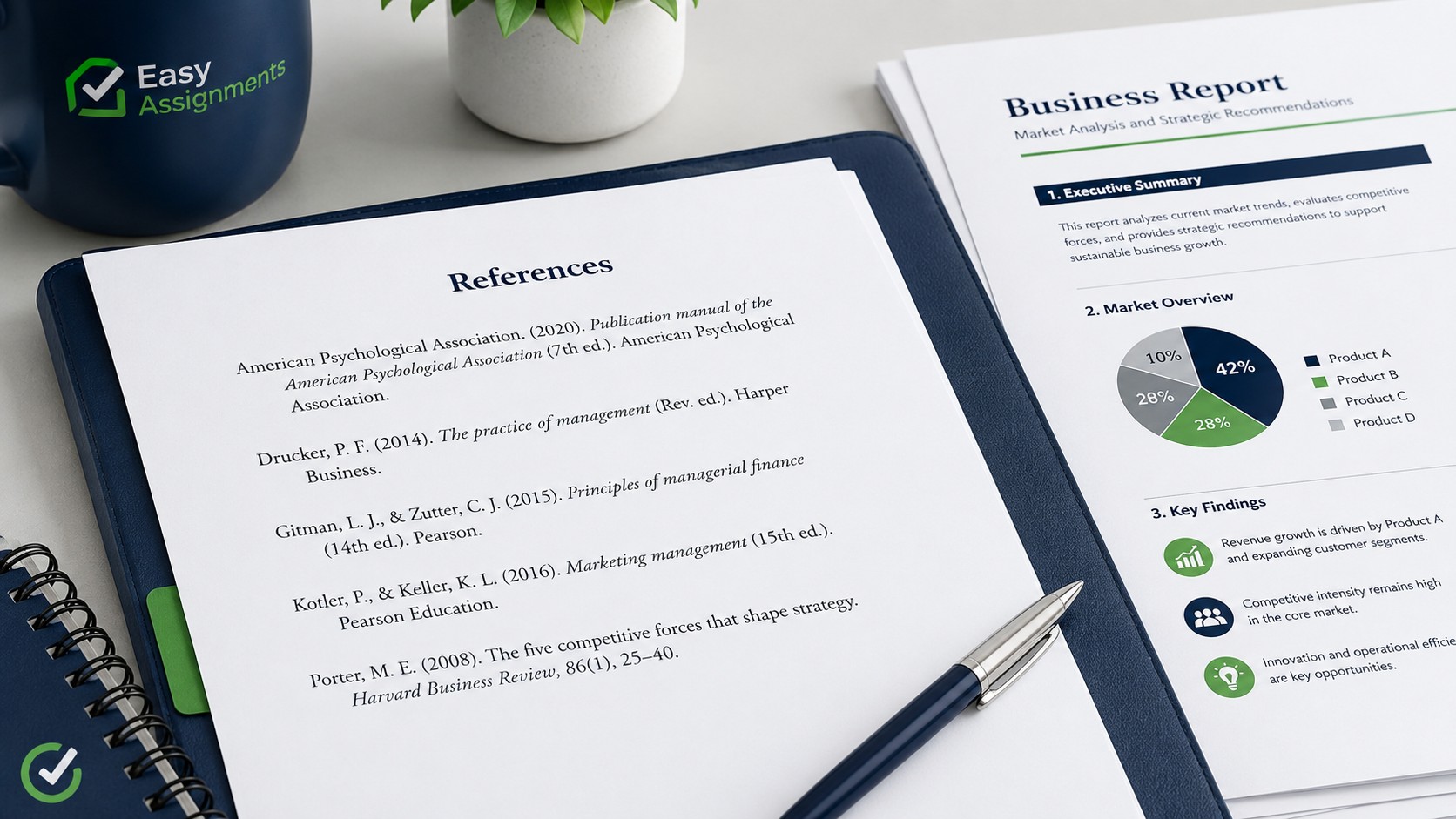
The reference list appears at the end of your report and gives full details for every source you cited in the text. The golden rule is that the two must match exactly: every in-text citation needs a matching reference list entry, and every entry must have been cited somewhere in the text. Markers frequently cross-check these, and mismatches are an easy way to lose marks.
APA reference lists follow consistent formatting rules. Entries are arranged alphabetically by the first author's surname. Each entry uses a hanging indent, where the first line sits at the margin and subsequent lines are indented. Titles of articles and books use sentence case, meaning only the first word, the first word after a colon, and proper nouns are capitalised, while journal names use title case and are italicised.
Common APA Reference Formats
Different source types follow slightly different patterns. The table below shows the general shape of the most common entries you will use in a business report. Always check the latest official APA guidance for edge cases, and use a reliable university library guide for confirmation.
| Source type | General APA 7th format |
|---|---|
| Journal article | Author, A. A. (Year). Title of article. Journal Name, Volume(Issue), pages. DOI |
| Book | Author, A. A. (Year). Title of book (edition). Publisher. |
| Chapter in edited book | Author, A. A. (Year). Chapter title. In E. Editor (Ed.), Book title (pages). Publisher. |
| Web page | Author or Organisation. (Year). Title of page. Site Name. URL |
| Report | Organisation. (Year). Title of report (Report No. if any). Publisher. URL |
Notice that all of these place the author first and the year second, which mirrors the author-date logic of your in-text citations. This consistency is what lets a reader move smoothly from a citation in your body text to the full source at the back of the report.
Step 6: Write in a Clear, Professional Style
Business writing values clarity above all. Your reader wants to understand your point quickly, so favour plain language, short paragraphs, and precise vocabulary. Avoid padding your sentences with filler and resist the temptation to sound impressive at the cost of being understood.
Keep your tone formal and objective. Business reports generally avoid casual language and, in many cases, avoid the first person, though some briefs allow it. Present your analysis based on evidence rather than personal opinion, and let your cited sources carry the weight of your argument.
Use headings and sub-headings generously so that readers can scan the document. Where you present data, consider a table or figure, and always refer to and interpret it in the surrounding text rather than leaving it to speak for itself. Consistency matters too: keep formatting, terminology, and citation style uniform throughout.
Things That Strengthen a Business Report
- A sharp, specific purpose statement in the introduction.
- Analysis that explains why findings matter, not just what they are.
- Recommendations tied directly to the evidence you presented.
- Well-integrated citations that support claims without disrupting flow.
- A logical structure with signposting between sections.
Step 7: Edit, Proofread, and Check Your References
A polished report is the product of careful revision, not a single draft. Once you have finished writing, step away for a while, then return with fresh eyes. Read your report against the brief and rubric to confirm you have answered every part of the question and hit each marking criterion.
During editing, tighten your writing by removing repetition and cutting sentences that do not add value. Check that every section flows logically into the next and that your recommendations clearly follow from your analysis. Then proofread separately for spelling, grammar, and punctuation, ideally reading aloud to catch awkward phrasing.
Finally, run a dedicated reference check. Go through the report and confirm that every in-text citation has a matching reference list entry and vice versa. Verify author names, years, titles, and formatting details such as italics and hanging indents. This last pass often recovers marks that would otherwise be lost to small, avoidable errors.
Match Your Citations
Confirm every in-text citation has a reference entry and every entry is cited in the text.
Check the Rubric
Read your report against the marking criteria to make sure each one is clearly addressed.
Format Consistently
Apply the same headings, spacing, and APA rules throughout the whole document.
Proofread Slowly
Read aloud to catch typos, awkward sentences, and missing words before you submit.
Common Mistakes to Avoid
Even capable students lose marks to a handful of recurring errors. Being aware of them in advance is the easiest way to protect your grade.
- Writing the report as one continuous essay instead of using labelled sections.
- Leaving out the executive summary or writing it before the analysis is finalised.
- Making claims without citing evidence, which reads as unsupported opinion.
- Mixing referencing styles or applying APA rules inconsistently.
- Adding an appendix that is never referred to in the main text.
- Ignoring the word count or the specific structure the brief requested.
Remember: The goal of learning how to write a business report assignment with APA references is not just to pass one assignment. These skills, structured thinking, evidence-based argument, and clean referencing, carry directly into professional workplaces where clear reporting is highly valued.
Frequently Asked Questions
How is a business report different from an essay?
A business report uses clearly labelled sections such as an executive summary, findings, and recommendations, and is written for a practical audience who may only read parts of it. An essay flows as one continuous argument. When you write a business report assignment with APA references, the structure and reader-first formatting are just as important as the content.
Which APA edition should I use?
Most universities currently use APA 7th edition. Always confirm with your lecturer or module guide, since some institutions still specify particular local variations. When in doubt, follow your university's own referencing guide, as it reflects exactly how your work will be marked.
How many references does a business report need?
There is no single correct number, and it depends on the word count and the depth expected. A good approach is to support every major claim with credible evidence and to check whether your brief or rubric specifies a minimum. Quality and relevance of sources matter more than raw quantity.
Do I need to cite sources in the executive summary?
Generally, the executive summary should stand alone and summarise your own report rather than introduce new cited material. Save your citations for the introduction, body, and analysis where you present and discuss evidence. If you mention a specific finding drawn from a source, make sure it is cited where it appears in full in the body.
Ready to Submit a Report You Are Proud Of?
From planning and structure to flawless APA references, EasyAssignments can help you produce a clear, original business report that meets your brief. Get started with a free quote today.