

Political Science Assignment Help That Raises Your Grades
Political science assignments test more than what you remember. They reward clear arguments, credible evidence, and disciplined structure across theory, comparative politics, and international relations. Getting reliable political science assignment help means turning dense readings and tight deadlines into work you can submit with confidence.
This complete guide walks through every major assignment type, the mistakes that quietly cost marks, and a repeatable method for building stronger essays. Whether you are stuck on a policy memo, a theory essay, or a full dissertation chapter, you will leave with a clearer plan.
Why Political Science Assignment Help Is in Such High Demand
Political science sits at the crossroads of history, philosophy, economics, law, and sociology. That breadth is exactly what makes the subject fascinating, and also what makes assignments harder than students expect. A single essay might ask you to weave together a normative argument from political theory, empirical data from comparative politics, and an institutional analysis of how a government actually behaves. Doing all of that well, under a deadline, is a genuine skill.
Reliable political science assignment help exists because the gap between reading widely and writing precisely is real. Many students understand the material in class discussions yet lose marks when they try to build a tight written argument. The problem is rarely intelligence. It is usually structure, evidence, and the discipline of answering the exact question set rather than the question you wish had been set.
Demand also grows because the discipline is reading heavy. A typical week might involve several journal articles, a book chapter, and primary sources like constitutions, treaties, or party manifestos. When three modules assign work in the same fortnight, even strong students run short on time. Support that helps you plan, structure, and refine your writing can be the difference between a rushed pass and a considered upper grade.
The Main Types of Political Science Assignments
Political science is not one kind of task. Each assignment type has its own logic, and knowing which one you are facing changes how you prepare. Below are the most common formats you will meet across a degree.
The Argumentative Essay
This is the backbone of the discipline. You are given a debatable question and asked to take a position, defend it with evidence, and address counterarguments fairly. A common failure here is description without argument. Summarising three theories of the state is not the same as arguing which best explains a particular outcome. Markers want to see a thesis in the introduction, a logical line of reasoning, and a conclusion that follows from the body rather than introducing new claims.
The Comparative Analysis
Comparative politics asks you to hold two or more cases side by side: two electoral systems, two revolutions, two welfare states. The skill is choosing a clear basis for comparison and staying consistent. Weak comparative essays describe Country A for three pages and Country B for three pages, then stop. Strong ones organise around themes, so each section compares both cases on a single dimension such as party competition, executive power, or civil society strength.
The Policy Memo or Briefing
Increasingly common in public policy and international relations modules, the policy memo mimics real professional writing. It is short, direct, and reader focused. You state a problem, present options, and recommend a course of action, usually for a busy decision maker. The tone is different from an essay: less exploratory, more decisive. Students trained only in essays often struggle to be this concise.
The Theory Essay
Here you engage directly with thinkers and traditions, from classical figures to contemporary debates. Precision matters enormously. Misreading a concept like sovereignty, hegemony, or the general will can undermine an entire argument. These essays reward close reading of primary texts and careful use of secondary literature to show how interpretations differ.
Quick tip: Before you write a single paragraph, rewrite the assignment question in your own words. If you cannot restate it clearly, you are not yet ready to answer it. This one habit prevents the most common cause of low marks: answering a slightly different question than the one that was set.

The Literature Review
Often the first major component of a dissertation, a literature review maps what scholars have already said about a question and where the gaps lie. It is not a list of summaries. A good review groups sources by theme or school of thought, shows how debates have evolved, and positions your own project within that landscape. Many students underestimate how much analytical judgement this requires.
The Research Proposal and Dissertation
At the top of the ladder sits the extended independent project. A research proposal defines a question, justifies its significance, reviews the relevant literature, and sets out a method. The dissertation then delivers on that plan over many thousands of words. These projects fail more often from poor scoping than from poor writing. A question that is too broad becomes impossible to answer within the word limit and the timeframe.
Common Mistakes That Cost Political Science Students Marks
Across thousands of scripts, the same errors recur. Recognising them in your own drafts is one of the fastest ways to improve. Here are the ones markers see most.
- Confusing opinion with argument. Political science rewards reasoned positions backed by evidence, not personal preference stated confidently.
- Ignoring counterarguments. An essay that never acknowledges the other side looks naive. Engaging with the strongest opposing view makes your own case more persuasive.
- Weak or missing evidence. Claims about how institutions behave need support from data, cases, or credible scholarship rather than assertion.
- Descriptive drift. Narrating events or summarising theories at length, without ever connecting them back to the question, wastes precious words.
- Inconsistent referencing. Political science uses several citation systems, and mixing them or citing carelessly signals a lack of rigour.
- Vague concepts. Terms like democracy, power, and legitimacy are contested. Using them loosely, without defining what you mean, weakens the whole analysis.
Watch out: Contested concepts are traps. Words such as freedom, justice, and the state carry different meanings across theoretical traditions. If you use one without saying which definition you are working with, a careful marker will notice, and your argument may collapse under a single well-aimed question.
How to Structure a Strong Political Science Essay
A dependable structure frees you to focus on thinking rather than scrambling for a shape at midnight. The framework below works for most argumentative and theory essays and can be adapted for comparative work.
Introduction
State the question, signal your position, and preview the argument in a few sentences. Avoid long throat-clearing about how important or complex the topic is. Markers want to know your thesis quickly. A precise, argumentative opening sets the tone for everything that follows.
The Body
Each paragraph should advance one clear point that serves the overall argument. A useful test is whether the first sentence of each paragraph, read in sequence, tells the story of your essay on its own. If those topic sentences already make your case, the structure is sound. Within each paragraph, present evidence, explain how it supports the point, and link back to the question.
Engaging Counterarguments
Devote real space to the strongest objection to your view, then explain why your position still holds. This is not a weakness to hide. It is a marker of mature analysis and one of the clearest ways to move from a middling grade to a strong one.
Conclusion
Draw the threads together and state what your argument has established. Do not introduce new evidence or new claims here. A good conclusion leaves the reader convinced that the question has been answered directly and honestly.
Stuck on a deadline you cannot move?
Share your brief and marking rubric, and get structured political science assignment help tailored to your exact question, level, and citation style.
Choosing the Right Citation Style
Referencing is where careful students separate themselves from careless ones. Political science departments vary in which style they require, and some accept more than one as long as you are consistent. The table below summarises the systems you are most likely to encounter and where each tends to appear.
| Style | In-text format | Common in | Watch for |
|---|---|---|---|
| APA | Author, year | Empirical and quantitative work | Correct handling of multiple authors and dates |
| Chicago (notes) | Footnotes | Theory, history, qualitative work | Full versus shortened note forms |
| MLA | Author, page | Humanities-leaning modules | Works cited formatting details |
| Harvard | Author, year | Many UK and Commonwealth programmes | Institution-specific variations |
Whatever style you use, the golden rule is consistency. Check your department handbook first, because local variations are common, and a style that is technically correct but not the one your programme requires can still lose marks. Reference management tools help, but always proofread the output, since automated citations frequently contain small errors.
Building Better Arguments With Evidence
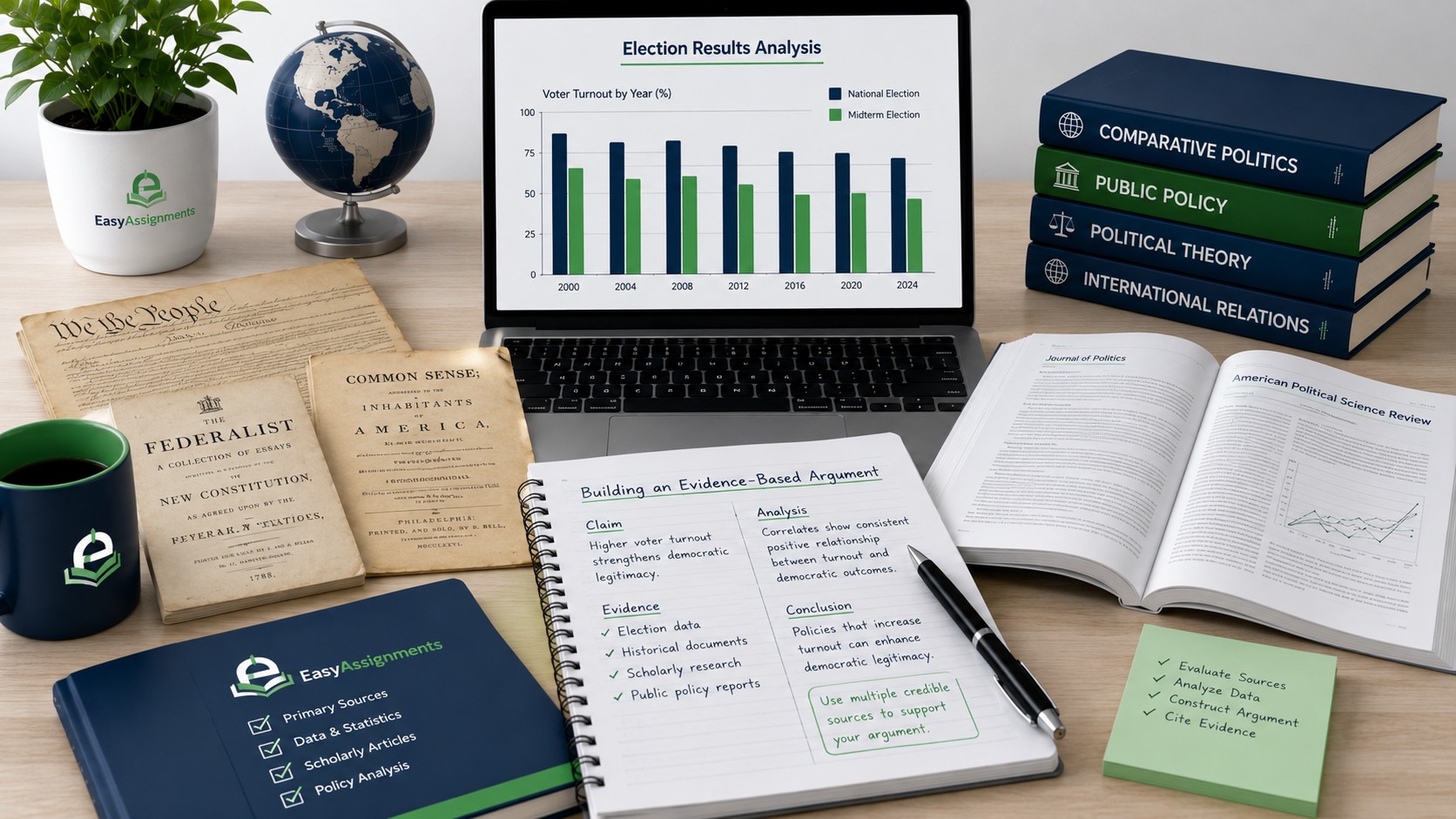
The heart of political science is the disciplined use of evidence to support claims. Evidence comes in several forms, and strong essays usually combine more than one. Primary sources such as legislation, speeches, treaties, and official statistics give you direct material. Secondary sources, mainly peer-reviewed articles and scholarly books, provide interpretation and debate. Data, whether from surveys, election results, or economic indicators, lets you test general claims against reality.
The skill is not simply gathering evidence but selecting and deploying it. A single well-chosen case study, analysed in depth, often persuades more than a scattergun list of examples mentioned in passing. When you cite data, be honest about its limits. Correlation is not causation, samples can be unrepresentative, and official figures sometimes carry political motives. Showing that you understand these limits demonstrates the critical maturity markers look for.
Managing Deadlines and Reading Loads
Time pressure is the quiet enemy of good political science writing. The reading is heavy, the arguments are demanding, and modules rarely coordinate their due dates. A few practical habits make the difference between steady progress and last-minute panic.
- Start with the question, not the reading. Knowing what you are looking for makes your reading far more efficient and stops you drowning in material that never makes it into the essay.
- Read actively. Note the argument, the evidence, and your reaction to each source, so you are not rereading everything when you finally sit down to write.
- Draft early and roughly. A messy first draft you can improve beats a perfect paragraph you never finish. Getting words down reveals gaps in your argument sooner.
- Build in a proofreading day. Small errors in citation, grammar, and structure add up. A final pass with fresh eyes often recovers marks you would otherwise lose.
When deadlines genuinely become unmanageable, structured support helps you stay on track. That might mean a clear outline to work from, a model answer to learn structure from, or careful feedback on a draft you have already written. The goal is always to strengthen your own understanding, not to sidestep it.
What Good Political Science Assignment Help Looks Like
Not all support is equal. The kind worth choosing improves your skills and protects your academic standing at the same time. Here is what distinguishes genuinely helpful support from the rest.
Original, argument-led work
Every piece is built around a clear thesis and reasoned analysis, written from scratch to match your specific question and rubric.
Subject specialists
Support from people who understand political theory, comparative politics, and international relations, not generalists guessing at the field.
Correct referencing
Careful handling of APA, MLA, Chicago, or Harvard so your citations reinforce your credibility rather than undermining it.
Clear communication
Responsive support that keeps you informed, welcomes your feedback, and delivers drafts in time for you to review them.
Used well, support like this is a learning tool. Studying a well-structured model answer, or acting on precise feedback, teaches you how to build arguments you can reproduce independently in exams and future essays. That is the real return: not one better grade, but a durable improvement in how you think and write.
A Simple Workflow for Your Next Assignment
To pull everything together, here is a practical sequence you can follow for almost any political science task. It turns a vague brief into a finished, defensible piece of writing.
- Decode the question. Restate it in your own words and identify exactly what is being asked and which command word (analyse, evaluate, compare) governs it.
- Plan your position. Decide your thesis before you read widely, then read to test and refine it rather than to fill pages.
- Gather targeted evidence. Collect primary sources, scholarship, and data that speak directly to your argument, and note the strongest counterexamples.
- Outline before writing. Draft your topic sentences first, so the argument holds together before you commit to full paragraphs.
- Write, then revise. Get a rough draft down quickly, then sharpen the argument, tighten the prose, and check every reference.
- Proofread against the rubric. Read your marking criteria one last time and confirm your essay does what each line asks.
Frequently Asked Questions
Is political science assignment help suitable for all levels?
Yes. Support ranges from foundational undergraduate essays to advanced postgraduate dissertations. The right help meets you where you are, whether you need structure for a first-year essay or method guidance for a PhD chapter, and always aims to build your own capability.
Will the work match my specific citation style?
It should. Good support asks for your required style upfront, whether APA, MLA, Chicago, or Harvard, and applies it consistently. Always share your department handbook, since programmes often use their own variations of a standard system.
How do I use support without harming my learning?
Treat models and feedback as teaching tools. Study how an argument is built, why sources are chosen, and how the structure holds, then apply those lessons in your own writing and in exams where no support is available.
Can you help with tight deadlines?
Yes, though earlier is always better for quality. Share your brief, rubric, and deadline as soon as you can. Even limited time allows for a solid outline, targeted feedback, or a focused draft you can build on.
Ready to turn a tough brief into a strong submission?
Send us your question, level, and deadline. We will help you plan, structure, and polish work you can hand in with confidence.