
Plagiarism Definition: What Every College Student Must Know
A clear plagiarism definition is one of the first things every college student needs before submitting a first research paper, and it is one of the most commonly misunderstood concepts in higher education. Many students who face academic dishonesty charges never intended to cheat at all.
This guide covers what plagiarism actually means, every major form it takes, how colleges detect and enforce their policies, and the concrete habits that keep an academic record clean, even under deadline pressure when mistakes are most likely to happen.
Plagiarism Definition: What It Really Means
So what is plagiarism, exactly? At its core, the plagiarism definition describes taking the ideas or words of another person and passing them off as your own, or using another's work without crediting the source. That is the foundation, and every major dictionary agrees on the essentials. Two conditions have to be true at the same time for something to count as plagiarism. First, the content originated somewhere other than the writer's own mind. Second, the reader is led to believe that it did not. No citation means no credit to the original author, and that single omission is where the overwhelming majority of violations begin.
The scope of this definition is broader than most students realize. It covers words, ideas, data, images, charts, and any other form of intellectual output. In fields where code and software are submitted as academic work, it covers those too. You do not have to copy a sentence word for word to plagiarize. Using someone's original argument, research finding, methodology, or creative structure without attribution is enough to qualify under virtually any institutional policy.
Think of it this way. Every claim you make in an academic paper falls into one of two categories. Either it is your own original thinking, or it came from somewhere else. Anything in the second category needs a source attached to it. That is the entire principle, stated as simply as it can be. The complexity comes only from the many different ways students accidentally fail to attach that source.
Why intent does not decide whether a violation occurred
Here is the point that surprises students most. Intent matters for determining the severity of a penalty, but it plays no role at all in deciding whether a violation actually occurred. Accidental plagiarism from sloppy note-taking, a forgotten citation, or a genuine misunderstanding of the rules still counts as plagiarism under most institutional policies. The phrase "I did not mean to" is not a defense. It may influence how understanding a professor is, but it does not change the classification of the act.
Colleges treat it this way for a reason. The harm to academic integrity is identical regardless of what the student intended. The original author still does not receive credit for their work, and the student still receives credit for material that is not fully their own. This is why understanding the rules in advance matters so much. Ignorance genuinely is not protection, and hoping a professor will be lenient is a poor substitute for simply doing it right.
The reassuring takeaway: Avoiding plagiarism is not about proving your good character after the fact. It is about building mechanical habits that make accidental omissions nearly impossible. Once those habits are in place, intent becomes irrelevant because the mistakes simply do not happen.
The Major Types of Plagiarism Every Student Should Recognize
Plagiarism is not a single act. It is a category that contains several distinct forms, some obvious and some subtle enough that many students commit them without ever realizing it. Understanding each type by name makes it far easier to catch yourself before submission, because you can check your work against a concrete checklist rather than a vague sense of unease.
Direct or verbatim plagiarism
This is the most straightforward form and the one everyone already recognizes. Direct plagiarism means copying text word for word from a source and presenting it as your own, with no quotation marks and no citation. It is also the easiest for detection software to catch, because the matched text is identical to something already in a database. There is no ambiguity here, and no reasonable student misunderstands that this is a violation.
Mosaic plagiarism and patchwriting
This is where things get subtle, and where well-meaning students most often go wrong. Mosaic plagiarism, sometimes called patchwriting, happens when a writer takes phrases and sentence structures from a source and stitches them together with a few of their own words scattered throughout. The student swaps in synonyms, rearranges a clause or two, and produces something that looks superficially different from the original while remaining structurally identical to it.
Many students genuinely believe this counts as paraphrasing. It does not. If the underlying sentence architecture belongs to the source and only the surface vocabulary has changed, the passage is still plagiarized. Professors who taught the material recognize this pattern quickly, often faster than any software, because the rhythm and logic of the writing does not match how the student writes elsewhere in the paper.
Paraphrasing without citation
A student can genuinely rewrite an idea in completely fresh language, with entirely new sentence structure, and still commit plagiarism if they do not credit where the idea came from. Rewording is only half the job. The other half is attribution. Putting an idea into your own words does not make the idea yours. If you learned a fact, an argument, or an interpretation from a source, that source needs a citation even when not a single word of the original text appears in your paper. The citation credits the thinking, not just the wording.
Self-plagiarism and reusing your own work
Self-plagiarism occurs when a student submits their own previously graded work, in whole or in part, for a new assignment without permission from the instructor. It feels wrong to call this plagiarism, because you wrote it. But academic institutions treat each assignment as a fresh demonstration of learning, and recycling old work misrepresents when and for what purpose that work was produced. If you want to build on your own earlier work, ask the instructor first. Many will allow it with proper acknowledgment, but the permission has to be explicit.
Source-based and accidental plagiarism
Source-based plagiarism covers a cluster of citation errors: citing a source that does not exist, attributing information to the wrong source, or relying on a secondary source while pretending to have consulted the original. Accidental plagiarism, meanwhile, is less a distinct type than a description of how most of the other forms actually happen in practice. The fact that it was accidental does not change its classification, but it does mean the solution is procedural rather than moral. Better habits, not better intentions, are what prevent it.
Contract cheating and why it is treated most severely
Contract cheating means having someone else complete an assignment for you and then submitting that work as your own. Unlike patchwriting or a forgotten citation, this is never accidental. Legitimate academic support helps you produce your own work more effectively: it explains concepts, points you toward better sources, and improves your understanding. Contract cheating replaces your work with someone else's entirely. The first strengthens you as a student. The second hollows out the very thing a degree is supposed to certify.
| Type | What it looks like | Usually accidental? |
|---|---|---|
| Direct / verbatim | Copied word for word, no quotes or citation | No |
| Mosaic / patchwriting | Source structure kept, only vocabulary swapped | Often |
| Paraphrase without citation | Idea reworded fully but source not credited | Often |
| Self-plagiarism | Reusing your own graded work without permission | Sometimes |
| Source-based | Fake, wrong, or misattributed citations | Often |
| Contract cheating | Someone else produces the work you submit | Never |
Collaboration and AI writing tools
Collaboration occupies a genuinely tricky middle ground. On many assignments, working with classmates is encouraged; on others, the same behavior counts as a violation. The difference lies entirely in what the instructor has permitted. The safest approach is to treat every assignment as individual unless the instructor has explicitly stated otherwise, and when collaboration is allowed, clarify exactly what is permitted in writing.
Generative writing tools raise a similar question, and policies vary widely and are still evolving. The underlying principle has not changed: if you submit text you did not write as though you wrote it, you are misrepresenting the authorship of your work. The only reliable approach is to learn your specific instructor's policy for each course and follow it exactly. Never treat silence in a syllabus as permission.
Stuck on a tricky assignment?
EasyAssignments helps you produce your own strong, original work with proper citations and clear structure. Get guidance that strengthens your understanding, not shortcuts that put your record at risk.
How Colleges Detect and Enforce Plagiarism Policies
Most universities run submitted work through similarity-detection software, of which Turnitin is the best known. The software compares a submission against an enormous database of internet sources, published material, and previously submitted student papers, then highlights any overlapping text and calculates a similarity percentage.
That percentage is not a plagiarism score. It is a similarity score, and the distinction is crucial. A properly quoted and cited passage will still register as matched text, and a paper heavy with legitimate direct quotations from primary sources can produce a high number while being entirely clean. The number is a starting point for a human being, not a verdict. An instructor reviews the flagged matches and decides, based on context, whether they represent proper citation, common academic phrasing, or actual plagiarism.
Do not try to game the software. Detection tools cannot catch every source, but the human reading your paper is far harder to fool than the algorithm. A professor who taught the course material recognizes mosaic patchwriting manually, often faster than any percentage would suggest. Genuinely original work, not clever disguising, is the only reliable protection.
What the enforcement process looks like
When an instructor suspects a violation, they typically raise the concern with the student first or refer the matter to an academic integrity office, and the student is generally given a chance to respond. Minor or clearly accidental cases might result in a required revision, a reduced grade, or a mandatory integrity workshop. More serious cases or repeat offenses can lead to a failing grade for the course, a notation on the academic record, suspension, or in the most severe situations, expulsion. This is where intent finally becomes relevant: not in deciding whether a violation occurred, but in determining how the institution responds to it.
Why the permanent record matters more than the immediate grade
For many students, the most damaging consequence is not the grade on a single assignment but the lasting mark on their academic record. An integrity violation can appear on transcripts and in disciplinary files that follow a student well beyond the course. These records can affect graduate school admissions, professional licensing, scholarship eligibility, and even certain employment background checks. A five-point discussion post is not worth a permanent notation, yet students occasionally jeopardize years of work over exactly that kind of trivial task.
Common Scenarios Where Students Trip Up
Abstract rules are useful, but plagiarism happens in specific, recognizable moments. Walking through the situations where students most often go wrong makes the principles concrete and gives you a set of warning signs to watch for in your own work.
The rushed research paper
Copied passages pasted into a working file the night before, meant to be rewritten later, slip into the final draft barely changed and uncited. The shortcut of pasting raw source text without marking it is what set the trap.
The confident paraphraser
Rewriting while glancing back and forth at the original produces textbook patchwriting, structurally identical to the source with only a cosmetic vocabulary swap.
The recycler
Submitting a revised version of an old paper from a previous course, shocked to learn that self-plagiarism is a violation. A quick request to the instructor would have resolved it.
The over-quoter
Terrified of plagiarism, quoting everything and citing meticulously, producing a paper of stitched-together quotations with no original analysis. Technically clean, but poor writing.

Practical Steps to Keep Every Submission Genuinely Original
Understanding the theory of plagiarism is necessary, but it is the practical habits that actually keep you safe. Avoiding plagiarism is almost entirely a matter of process. Build the right routines into how you research and write, and the risk of an accidental violation drops close to zero.
Smart note-taking and citation habits
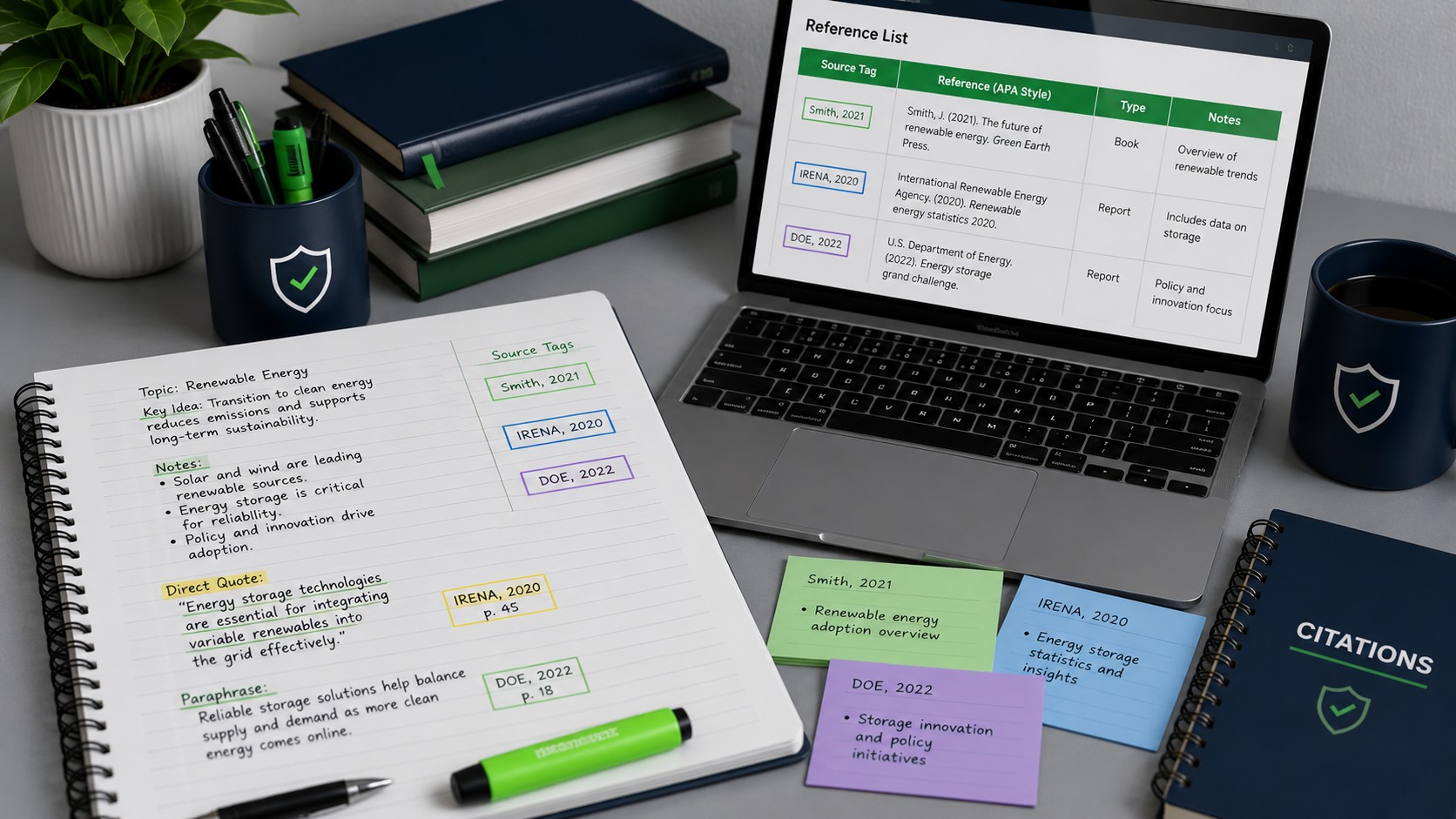
The single most valuable habit is to mark every note with its source immediately, at the moment you write it down, rather than at the end of a research session when your memory has already blurred which idea came from where. Put quotation marks around any text you copy word for word into your notes, even rough working notes no one else will see, and record all citation details directly in the note itself, including author, title, date, and page number.
- Choose a citation format that matches your discipline: APA for the social and behavioral sciences, MLA across the humanities, and Chicago in history, business, and some fine arts programs.
- Apply that format consistently from the very first draft, since switching partway through creates errors that look like carelessness.
- Keep author name, title, date, and page number attached to every note so a missing page number never becomes a midnight crisis.
The right way to paraphrase
The most reliable technique is the read, understand, close, rewrite method. Read the passage fully until you understand the idea. Then close or minimize the source so it is no longer in front of you. Now write the concept from memory, in your own words. Because you cannot see the source, you cannot accidentally borrow its sentence structure. Afterward, compare your version against the original, and if the structure still mirrors the source or more than a few words match, rewrite it again before adding the citation.
A pre-submission checklist
Before you submit any significant assignment, run through a short checklist that takes only a few minutes and prevents most last-minute disasters:
- Verify that all direct quotes are marked with quotation marks and cited.
- Confirm every paraphrased idea has a source attached, even when fully reworded.
- Cross-check that your reference list matches every in-text citation.
- Run your own similarity check in advance if your institution provides access, so you see the score before your instructor does.
- Review any passage that stayed close to a source and rewrite it from memory if needed.
When you genuinely need help, get the right kind
There is nothing wrong with seeking support when an assignment is difficult or a deadline is tight. The distinction that matters is between help that strengthens your own understanding and shortcuts that substitute someone else's work for your own. Legitimate support includes your institution's writing center, library research staff, professor office hours, citation-management tools, and tutoring that explains concepts and guides you toward producing your own work. The line to protect is authorship: as long as the final ideas, arguments, and words are genuinely yours, and every borrowed idea is credited, you are on solid ground no matter how much guidance you sought.
Frequently Asked Questions About Plagiarism
Do I need to cite common knowledge?
No. Facts that are widely known and easily verifiable across many sources, such as the year of a well-known historical event, do not require citation. The tricky part is judging what counts, since it varies by field and audience. When you are unsure whether something qualifies, the safer choice is always to cite it. An unnecessary citation is harmless, while a missing one can be a violation.
Is it plagiarism if I cite the source but keep the wording too close?
Yes, it can still be a problem. Adding a citation credits the idea, but if your wording closely mirrors the original without quotation marks, you are presenting the source's specific expression as your own paraphrase. Proper practice requires either quoting the exact wording inside quotation marks with a citation, or genuinely rewriting the passage in your own structure and then citing it.
Can I get in trouble for plagiarism I committed accidentally?
Yes. Intent affects how an institution responds and how severe the penalty is, but it does not change whether a violation occurred. This is not meant to frighten you. It is meant to redirect your energy toward prevention rather than after-the-fact explanation. Because accidental plagiarism still counts, the smart move is to build habits that make accidents nearly impossible.
How much can I safely quote directly?
There is no fixed percentage, and chasing a magic number misses the point. Direct quotation is appropriate when the exact wording matters, such as a precise legal definition or a memorable phrase you intend to analyze. A paper should be driven by your own thinking, with quotations used deliberately and sparingly. If quotations are carrying most of your paper, the issue is not plagiarism but a lack of original engagement with the material.
Your Academic Record Is Worth Protecting
Plagiarism is not limited to copying text. It includes mosaic patchwriting, paraphrasing without citation, reusing your own work, and a range of citation errors that are easy to make when rushing. Each can be avoided with consistent, deliberate habits, and EasyAssignments can help you build them.