

Maths Coursework Help That Turns Panic Into Progress
Maths coursework help is what stands between a blank page full of half-remembered formulas and a polished submission that actually earns marks. Whether you are wrestling with statistics, calculus, linear algebra, or a proof-heavy assignment that refuses to make sense, structured support can transform how you approach the entire task.
This guide walks you through every stage of producing strong maths coursework, from decoding the brief to presenting your final working. You will learn practical strategies you can use tonight, plus how to recognise when reaching out for expert help is the smartest move you can make.
What Maths Coursework Actually Demands From You
Maths coursework help begins with a clear-eyed understanding of what your assignment is really asking. Unlike a timed exam, coursework rewards depth, presentation, and reasoning that unfolds over several pages. A tutor grading your work is not only checking whether you arrived at the right number. They are looking at whether your logic holds together, whether your notation is consistent, and whether you communicated your mathematical thinking clearly enough that a reader could follow it without guessing.
That distinction matters more than most students realise. In an exam, a correct final answer often earns the majority of the marks even if your working is messy. In coursework, the working frequently carries as much weight as the result. You can reach the correct answer and still lose significant marks if you skipped steps, misused symbols, or failed to justify a key assumption. Conversely, a small arithmetic slip near the end of a well-structured, clearly reasoned solution may cost you very little, because the assessor can see that your method was sound.
Maths coursework also tends to blend several skills at once. A single statistics assignment might require you to collect or clean data, choose an appropriate test, run calculations, interpret the output, and then write a paragraph explaining what your results mean in plain language. A calculus task might ask you to model a real situation, differentiate or integrate to find a rate or an area, and then reflect on the limitations of your model. This mixture of technical computation and written explanation is exactly where many capable students stumble, not because they cannot do the maths, but because they underestimate the communication side.
The three layers every assignment is graded on
It helps to picture your coursework as three stacked layers. The first is correctness: are the calculations right? The second is method: did you choose sensible techniques and apply them properly? The third is communication: can a reader understand what you did and why? Weak coursework often nails the first layer and neglects the other two. Strong coursework treats all three as equally important, and that balance is what separates a middling grade from an excellent one.
Decode the Brief Before You Calculate Anything
The single most common reason maths coursework loses marks has nothing to do with mathematical ability. It is misreading the question. Students dive into calculations before they have fully understood what the brief wants, and by the time they realise they answered a slightly different question, they have run out of time to fix it. Slowing down at the start saves you far more time later.
Start by reading the entire brief twice. On the first pass, simply absorb the shape of the task. On the second pass, mark it up actively. Underline the command words that tell you what to do, such as prove, evaluate, estimate, model, compare, or justify. Each of these demands a different kind of response. Proving something requires rigorous logical steps. Estimating invites a reasoned approximation with stated assumptions. Justifying means you must explain why your choice or result is valid, not just state it.
Next, separate the task into its component parts. Many maths coursework briefs bundle several sub-tasks into one dense paragraph. Break these apart into a numbered list so nothing gets lost. Then identify the deliverables: does the brief want a report, a set of worked solutions, a poster, a spreadsheet, or some combination? Check the marking criteria or rubric if one is provided, because it tells you exactly where the marks live. If the rubric awards a third of the marks for interpretation and communication, that is a clear signal not to hand in bare calculations.
Quick win: Before you write a single equation, draft a one-line summary of what each part of the coursework is asking in your own words. If you cannot summarise a section, you do not yet understand it well enough to answer it, and that is the moment to ask a tutor or reach out for help.
Pay particular attention to constraints and conditions buried in the wording. Phrases like assume the population is normally distributed, to three significant figures, for positive integer values only, or without using a calculator completely change how you should proceed. Missing one of these can invalidate an otherwise perfect solution. Circle every constraint you find and keep the list visible while you work.

Build a Plan You Can Actually Follow
Once you understand the brief, resist the urge to start solving immediately. A short planning phase pays for itself many times over. Sketch the route from the question to the answer before you commit ink to paper. For each sub-task, note which technique you expect to use, what tools you will need, and roughly how long you think it will take. This rough map keeps you from wandering down dead ends and helps you spot early on if part of the task is beyond your current knowledge, which is useful information rather than a cause for panic.
Effective planning also means budgeting your time realistically. Maths coursework almost always takes longer than students expect, partly because you will hit at least one step that does not work the first time. Build in slack. If the deadline is a week away, aim to have a complete rough draft several days early, leaving room to check, refine, and format. The final polish stage, where you tidy notation and improve explanations, is where a lot of marks are quietly won, and it is the first thing to get squeezed out when you run late.
Gather your toolkit in advance
Nothing breaks concentration like stopping mid-problem to hunt for a formula sheet or figure out how to make your software produce a graph. Before you begin the heavy lifting, assemble everything you will need. This might include your lecture notes, a reliable formula reference, graphing software, a spreadsheet program for data, and any statistical tables the brief expects you to use. Having your toolkit ready means you stay in flow once the real work starts.
- Lecture notes and worked examples from class, which show the exact methods your assessor expects
- A formula reference so you are not reconstructing standard results from memory under pressure
- Graphing and plotting software for clear, labelled visuals
- A spreadsheet for organising data, running repeated calculations, and reducing arithmetic errors
- Statistical tables or the correct calculator functions for tests and distributions
- The marking rubric, kept open so you can check your work against it as you go
Show Your Working the Way Markers Want to See It
If there is one habit that consistently lifts maths coursework grades, it is showing complete, legible working. Markers cannot award method marks for steps they cannot see. A jump from one line to an answer three lines later, with the intermediate reasoning happening only in your head, forces the assessor to either guess your method or assume you got lucky. Neither helps you.
Aim for working that a fellow student could read and reproduce. Each line should follow logically from the one above it, and where you apply a rule or theorem, name it briefly. Writing by the chain rule or using the central limit theorem next to the relevant step signals that you understand not just how to compute but why the computation is valid. This is precisely the kind of communication that separates strong coursework from merely correct coursework.
Consistency of notation is another quiet mark-winner. Decide early how you will denote your variables and stick to it throughout. Do not let x mean one thing on page two and something else on page five. Keep units attached to quantities where they apply, and state the units of your final answer explicitly. When you round, say what you are rounding to and do it only at the end, carrying full precision through intermediate steps to avoid compounding errors.
Common pitfall: Rounding too early is one of the most frequent silent mistakes in maths coursework. If you round intermediate values and then keep calculating, the small errors accumulate and your final answer can drift far enough to look wrong even when your method is perfect. Carry full precision until the very last step.
Different Topics, Different Strategies
Maths coursework help is not one-size-fits-all, because the branches of mathematics reward different approaches. Understanding what each topic emphasises lets you focus your energy where the marks are.
| Topic | What it usually assesses | Where students lose marks | Focus your effort on |
|---|---|---|---|
| Statistics | Choosing and running the right test, interpreting results | Picking an inappropriate test, misreading significance | Justifying your test choice and explaining what the numbers mean |
| Calculus | Differentiation, integration, modelling change | Sign errors, forgetting the constant, skipped steps | Neat step-by-step working and checking answers by reversing |
| Linear algebra | Matrices, vectors, systems of equations | Arithmetic slips in large calculations, dimension mismatches | Organised layout and verifying dimensions at each stage |
| Proof and pure maths | Logical rigour and clear argument structure | Gaps in reasoning, assuming what you need to prove | Making every logical step explicit and justified |
| Applied and modelling | Translating a real situation into maths and back | Ignoring assumptions and limitations | Stating assumptions clearly and reflecting on model validity |
Statistics coursework
Statistics coursework often involves a data set that you must summarise, analyse, and interpret. The technical calculations are usually the easy part once you know the formula. The marks tend to concentrate in the decisions around the calculations: why you chose a particular measure of spread, why a specific hypothesis test suits your data, and what your p-value or confidence interval actually implies for the original question. Always tie your statistical conclusion back to the real-world context. A result is not just significant or not significant; it means something specific about the phenomenon you were studying, and saying so earns marks.
Calculus coursework
Calculus assignments reward careful, systematic working more than almost any other topic. Differentiation and integration involve chains of small steps where a single dropped sign or forgotten constant of integration derails everything downstream. Slow down, write every line, and use the powerful habit of checking your answer by reversing the operation: differentiate your integral to confirm it returns the original function, or integrate your derivative. This self-check catches a surprising number of errors before your marker ever sees them.
Proof and pure mathematics
Proof-based coursework is where communication becomes indistinguishable from correctness. A proof is only complete if every step follows logically from established results or your stated assumptions. The classic failure is a hidden gap, a moment where you assume something that has not been justified, often the very thing you are meant to be proving. Read your proof back as a skeptical reader who accepts nothing without justification, and fill any gap you find. Clear, well-signposted proofs that a reader can follow line by line consistently earn top marks.
Stuck on a Section You Cannot Crack?
You do not have to grind through a wall alone. Our team can talk through the tricky part, check your working, or take on a whole assignment built around your brief and deadline. Reach out and get a clear plan in minutes.
Presentation: The Marks Hiding in Plain Sight
Two students can perform identical calculations and receive noticeably different grades purely because of how they presented their work. Presentation is not decoration; it is a genuine assessment criterion in most maths coursework, and it is one of the easiest places to gain marks with a little care.
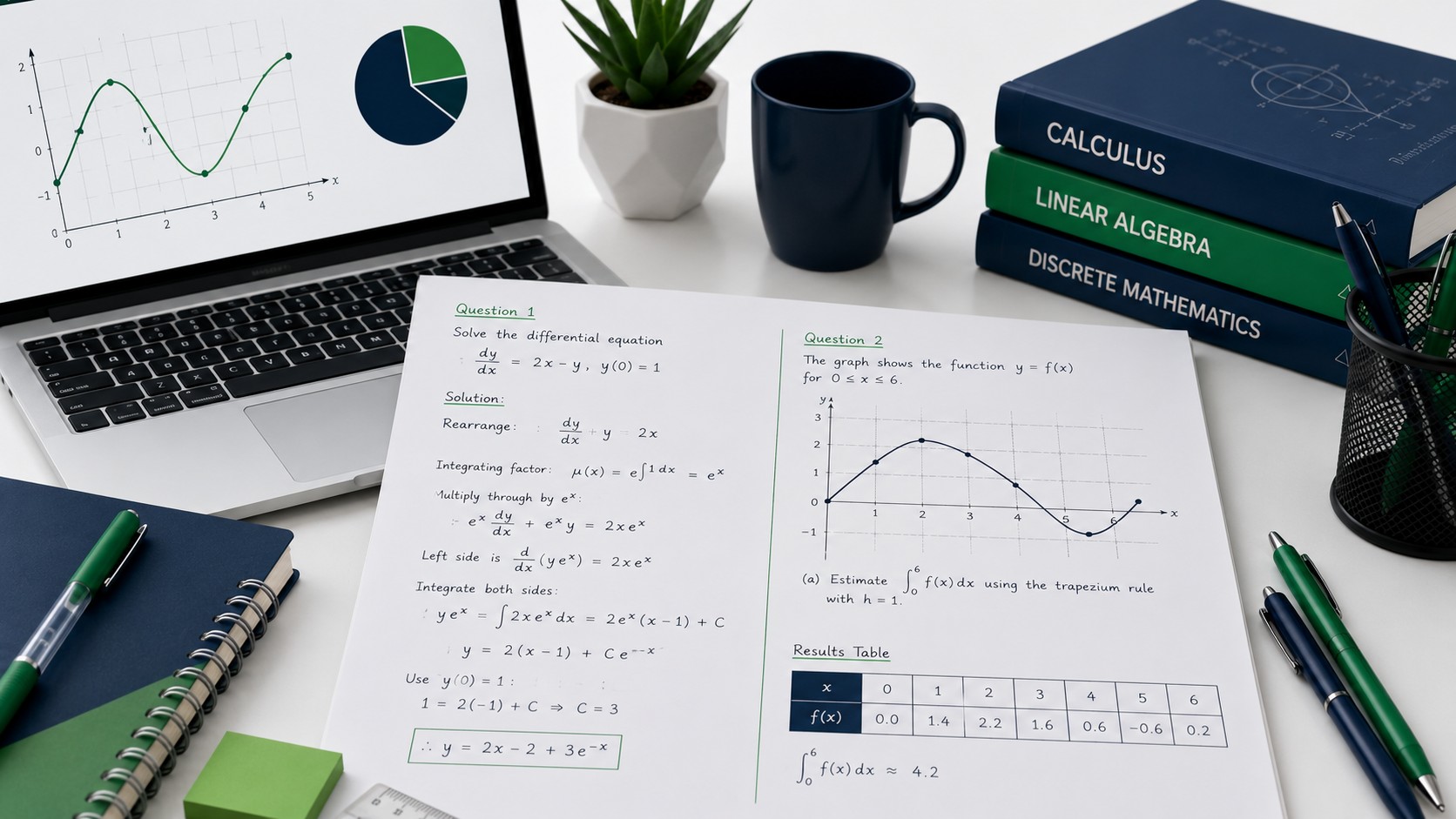
Structure your submission so a reader can navigate it. Use clear headings for each section or sub-task, keep related working together, and number your equations if you refer back to them. When you produce a graph, label both axes with quantities and units, give it a title, and reference it in your text so the reader knows why it is there. A graph dropped into a document with no explanation adds little; a graph you actively interpret in the surrounding paragraph adds real value.
Tables deserve the same discipline. A well-organised table of results, with clear column headings and consistent decimal places, communicates far more efficiently than the same numbers scattered through prose. Where you use software output, do not simply paste a raw screenshot and move on. Explain what the output shows and pull out the specific figures that answer the question.
Write the linking prose
Maths coursework is rarely just a wall of equations. The sentences that connect your calculations, explaining what you are about to do and what you just found, are where you demonstrate understanding. A short sentence before a calculation setting up your approach, and a short sentence after interpreting the result, frames your working and shows the assessor you are in command of the material rather than mechanically following a recipe. Aim for concise, precise prose. You are not writing an essay, but you are writing enough that your reasoning is never left implicit.
Check, Verify, and Refine Before You Submit
The gap between a good grade and a great one often lives entirely in the checking phase, which is exactly the phase students skip when they leave things to the last minute. Building in time to verify your work is one of the highest-return habits in all of maths coursework.
Start with sanity checks. Does your answer have a plausible size and sign? A probability greater than one, a negative area, or a length of several thousand metres for something that should be a few centimetres are all signals that something went wrong. These common-sense checks catch gross errors instantly, before you waste time hunting through fine detail.
Then verify by an independent route where you can. If you solved an equation, substitute your solution back in. If you integrated, differentiate the result. If you ran a statistical test by hand, confirm it with software, or the reverse. Approaching the same problem two ways and getting the same answer gives you real confidence that the result is right, not just a feeling that it might be.
Pro tip: Read your finished coursework as if you were the marker who has never seen it before. If any step makes you pause and think how did they get there, add a line of working or a sentence of explanation. Every pause you remove for the reader is a mark protected.
Finally, proofread the written portions. Mathematical notation errors, inconsistent symbols, mislabelled axes, and typos in your interpretation all chip away at the professional impression your work makes. A tidy, coherent submission signals competence and makes the marker inclined to read generously. A messy one invites doubt about even your correct answers.
When to Get Maths Coursework Help
Reaching out for support is not a sign of weakness; it is a strategic decision that strong students make all the time. The key is recognising the right moment. There is a difference between the productive struggle that builds understanding and the unproductive stall that just burns your deadline. Learning to tell them apart protects both your grades and your wellbeing.
Some situations where getting help makes clear sense include when you have genuinely tried a problem, consulted your notes and resources, and still cannot see a way forward; when the coursework covers material your course assumed you already knew but never fully taught; when several deadlines have collided and time, not ability, is your real constraint; or when you understand the maths but are unsure how to present it to the standard the rubric demands. In all of these, targeted help can unblock you quickly and, done well, leave you understanding the topic better than before.
Concept coaching
A tricky topic explained clearly, from a fresh angle, until it finally clicks and you can apply it to the rest of the assignment yourself.
Working reviewed
A careful check of your solutions that flags errors, gaps in reasoning, and presentation issues before your marker ever sees them.
Full assignment support
A complete, worked response built around your exact brief, deadline, and level, with clear working you can learn from.
Deadline rescue
Fast, focused help when several tasks land at once and time is the thing you are short of, not understanding.
Whatever kind of help you choose, use it as a learning tool. The goal is not just to hand in one assignment, but to understand the methods well enough that the next one comes easier. Well-presented worked solutions, with every step shown and explained, are among the best study resources you can have, because they model exactly the standard you are aiming for.
Building Habits That Make the Next One Easier
Every piece of maths coursework you complete is also a chance to get better at the next one. The students who find coursework progressively less stressful are the ones who turn each assignment into a small lesson about their own process. After you submit, take five minutes to note what went smoothly and what caused friction. Did you underestimate the time? Did one topic trip you up repeatedly? Did your notation slip when you were tired? These small observations compound.
Keep a running reference of the formulas, methods, and worked examples you find yourself reaching for again and again. Over a term, this becomes a personalised toolkit that is far more useful than any generic textbook, because it is tuned to exactly the kind of problems your course sets. Revisit the feedback your markers give you and look for patterns; the same comment appearing twice is a clear instruction about where to focus next time.
Above all, treat maths as a skill built through consistent practice rather than a talent you either have or lack. Regular, unhurried engagement with problems, spaced out rather than crammed, builds the fluency that makes coursework feel manageable. Combine that steady practice with smart use of support when you need it, and you will find that assignments which once felt overwhelming become simply another task you know how to handle.
Frequently Asked Questions
How does maths coursework help actually work?
Maths coursework help ranges from explaining a single concept you are stuck on, to reviewing your working for errors, to producing a complete worked solution built around your brief and deadline. You share the assignment details and your current level, and support is tailored to what you need. The best help always shows full working so you can learn the method, not just copy an answer.
Which maths topics can I get help with?
Support covers the full range, including statistics, calculus, algebra, linear algebra, probability, discrete maths, proof-based pure mathematics, and applied modelling. It also spans levels from secondary school through to undergraduate and postgraduate work, so whether you are tackling a first-year problem set or a specialised final-year project, help is available for your specific topic.
Will I actually understand the maths afterwards?
That is the whole point of good support. Quality maths coursework help includes clear, step-by-step working and explanations of why each method is used, so the solution doubles as a study resource. Used well, it leaves you better equipped to tackle the next assignment on your own rather than dependent on help every time.
How quickly can I get help before a deadline?
Timelines are built around your deadline. The earlier you reach out, the more room there is to plan, refine, and check the work thoroughly, but focused support is available for tight turnarounds too. The best step is to get in touch with your brief and deadline so you can get a clear plan straight away.
Ready to Turn Your Maths Coursework Around?
Whether you need a single concept unlocked or a full assignment handled to deadline, help is one message away. Share your brief and get a clear plan you can act on today.