
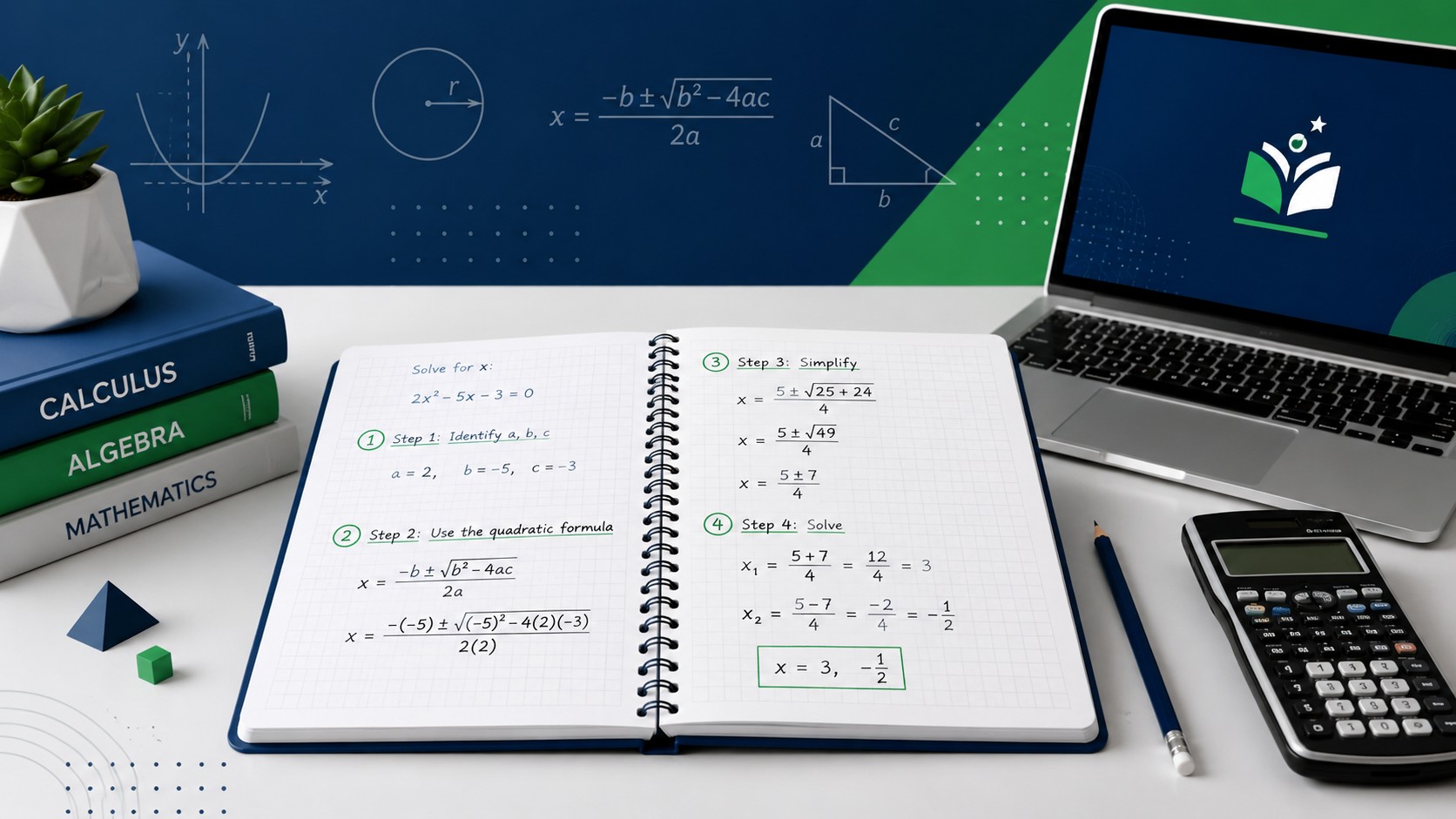
Math Homework Help With Step by Step Solutions
Math homework help with step by step solutions turns a page of confusing symbols into a clear, repeatable method you can actually follow. Instead of staring at an answer you cannot explain, you learn the reasoning behind each move, so the next problem feels less like a wall and more like a checklist.
This guide walks through why step by step work matters, how to break down problems across algebra, calculus, statistics, and geometry, common mistakes to avoid, and when reaching out for extra support is the smart move. Everything here is designed to help you understand your own homework, not just finish it.
Why Step by Step Solutions Beat Final Answers Every Time
If you have ever copied a correct answer from the back of a textbook and still felt completely lost, you already understand the core problem with math homework. A single number at the end of a question tells you almost nothing about how to get there. The value in math homework help with step by step solutions is that it exposes the reasoning: the choice of method, the order of operations, the algebra that moves one line to the next, and the checks that confirm the result makes sense.
Math is a subject where understanding compounds. Fractions feed into algebra, algebra feeds into functions, functions feed into calculus, and so on. When you skip the reasoning on early topics, the gaps do not stay hidden. They resurface later as confusion that feels bigger than it really is. Step by step work closes those gaps because it forces every hidden assumption into the open where you can see it, question it, and remember it.
There is also a practical exam benefit. Most math teachers and professors award partial credit for correct methods even when the final answer is wrong. If you can show a clean, logical sequence of steps, you protect your grade against small arithmetic slips. Learning to write out your work is not busywork. It is a habit that pays off directly on tests, quizzes, and graded assignments.
The core idea: A final answer tells you what. Step by step solutions tell you why and how, and the why and how are what let you solve the next problem on your own.
Think of a worked solution as a map rather than a destination. Anyone can point at a destination, but a map shows you the roads, the turns, and the landmarks. Once you have followed the same kind of map a few times, you start recognizing the route before you even reach the intersections. That recognition is the real goal of practicing math, and step by step solutions are how you build it.
A Universal Framework for Solving Any Math Problem
Before diving into specific subjects, it helps to have a general method that works for nearly any math problem. Strong students rarely jump straight to calculations. They follow a loose but consistent routine that keeps them from getting lost. You can adapt this framework to arithmetic word problems, algebra, and advanced calculus alike.
Step 1: Read and restate the problem
Read the question twice. On the second pass, restate it in your own words and identify exactly what is being asked. Underline or list the quantities you are given and the quantity you need to find. Many wrong answers come not from bad math but from solving a slightly different problem than the one on the page.
Step 2: Choose a strategy before calculating
Ask which tool fits. Is this a factoring problem, a system of equations, a derivative, a probability calculation? Naming the method first prevents you from randomly manipulating symbols and hoping something works. If you are unsure, recall similar problems you have solved and what worked there.
Step 3: Work in small, labeled steps
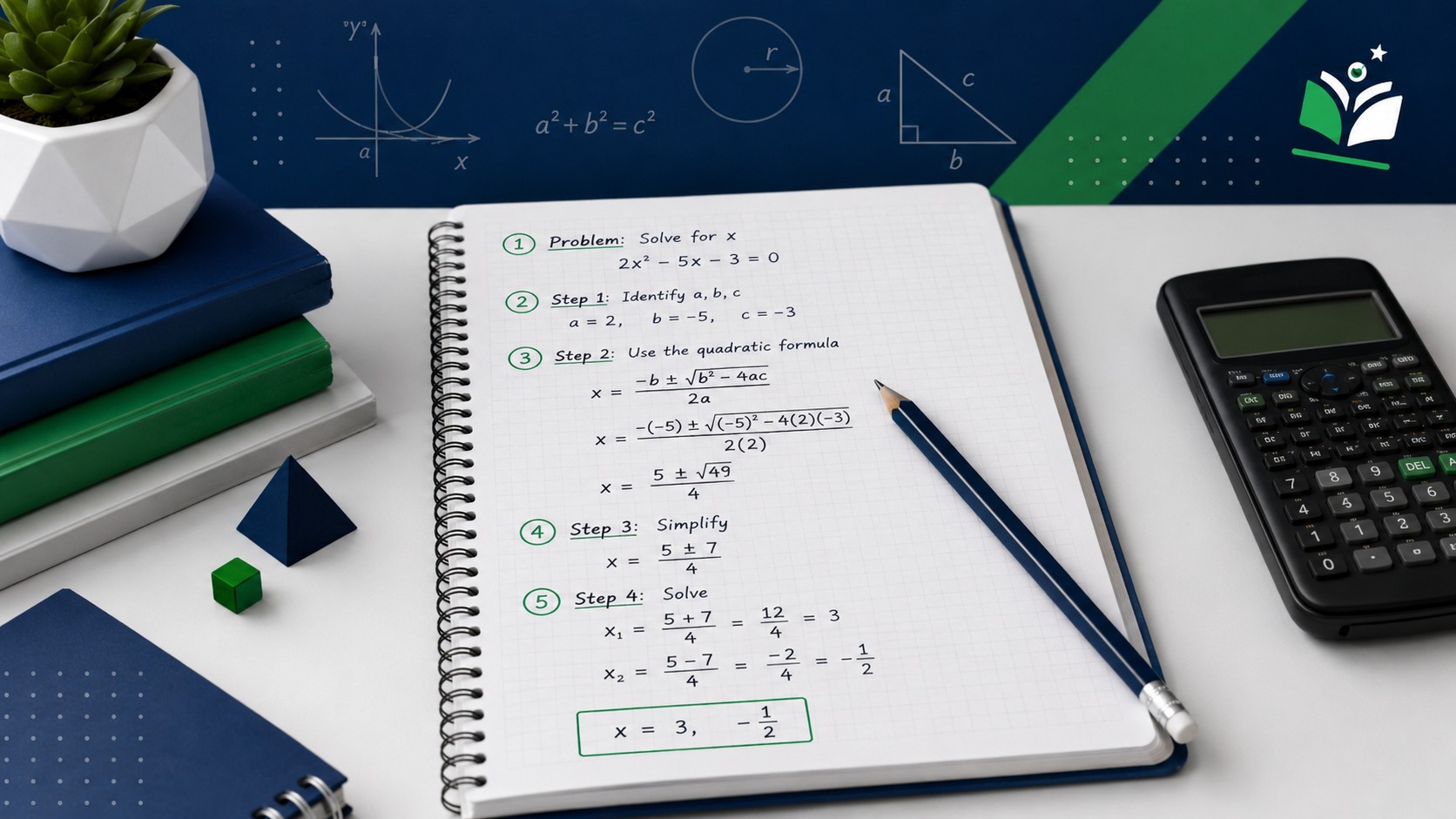
Write one operation per line. Keep equals signs aligned and never do two moves at once in your head when you are still learning a topic. Small steps are easier to check, easier to correct, and far easier to explain if a teacher asks you to walk through your reasoning.
Step 4: Check the result
Substitute your answer back into the original equation, estimate whether the size makes sense, and confirm the units are right. A checked answer is worth far more than a fast one. This final step is the difference between hoping you are correct and knowing it.
Try this: On your next assignment, write the strategy name at the top of each problem before you calculate anything. That single habit dramatically reduces careless mistakes.
Step by Step Solutions Across Different Math Subjects
The universal framework stays the same, but each branch of math has its own patterns and traps. Here is how step by step thinking applies to the subjects that generate the most homework questions.
Algebra: isolate, simplify, verify
Algebra is largely about isolating a variable through balanced operations. Whatever you do to one side of an equation, you must do to the other. A clean step by step algebra solution shows each balancing move on its own line: distribute, combine like terms, move terms across the equals sign, and finally divide or multiply to isolate the variable. When you reach an answer, plug it back in. If both sides match, you are done.
Common algebra homework covers linear equations, quadratics, systems of equations, inequalities, exponents, and factoring. For quadratics especially, showing your work matters, because there are multiple valid paths: factoring, completing the square, and the quadratic formula. Writing the steps clarifies which method you chose and why.
Geometry: draw, label, reason
Geometry rewards a good diagram. The first step in almost every geometry problem is to sketch the figure and label every known length, angle, and relationship. From there, you connect what you know to what you want through theorems: the Pythagorean theorem, angle relationships, congruence, similarity, and area or volume formulas. A strong step by step geometry solution reads almost like a short logical argument, with each statement justified by a rule.
Trigonometry: identify the relationship
Trigonometry problems usually hinge on choosing the right ratio or identity. Step one is deciding whether you need sine, cosine, tangent, or one of the identities. Then you set up the equation, solve for the unknown, and confirm your answer falls in a sensible range. Because angles and reference frames cause so much confusion, labeling each step keeps you oriented.
Calculus: set up before you compute
Calculus intimidates many students, but step by step work makes it manageable. Whether the task is a limit, a derivative, or an integral, the reasoning splits cleanly into setup and computation. For derivatives, identify which rule applies, the power rule, product rule, quotient rule, or chain rule, then apply it carefully. For integrals, recognize the form and choose a technique such as substitution. Writing the rule name beside each step keeps a long problem from turning into a tangle.
Statistics: define what you are measuring
Statistics homework often fails at the setup stage, not the arithmetic. Before you calculate a mean, standard deviation, probability, or confidence interval, define your variables and the exact question. A step by step statistics solution states the formula, substitutes the numbers clearly, and then interprets the result in plain language, because a number without interpretation rarely earns full marks.
| Subject | First Step | Common Trap | Final Check |
|---|---|---|---|
| Algebra | Isolate the variable with balanced moves | Sign errors when moving terms | Substitute the answer back in |
| Geometry | Draw and label the figure | Assuming unstated relationships | Confirm each step has a reason |
| Trigonometry | Pick the correct ratio or identity | Degree versus radian mix-ups | Check the answer range |
| Calculus | Name the rule or technique | Forgetting the chain rule | Differentiate or estimate to verify |
| Statistics | Define variables and the question | Skipping interpretation | Sanity-check the size of the result |
Stuck on a Problem Set Tonight?
If a deadline is looming and the steps still are not clicking, EasyAssignments can walk you through worked solutions so you understand the method, not just the answer.
Common Mistakes That Wreck Math Homework
Most lost marks in math come from a small set of recurring errors rather than deep conceptual gaps. Recognizing these patterns is half the battle. Watch for the following:
- Sign errors, especially when distributing a negative or moving terms across an equals sign.
- Order of operations slips, where multiplication or exponents are handled out of sequence.
- Skipping steps mentally and losing track of a term, which is easy to do under time pressure.
- Copying a number incorrectly from one line to the next, a surprisingly common source of wrong answers.
- Forgetting units in applied problems, which can cost marks even when the arithmetic is perfect.
- Not checking the answer, so a small mistake goes undetected until it appears again on a graded exam.
Watch out: Copying full solutions without understanding them is the most common trap of all. It might finish tonight's assignment, but it leaves you exposed on the next quiz. Always make sure you can reproduce the steps yourself before moving on.
A useful discipline is to keep an error log. Each time you get a problem wrong, write down the type of mistake in a notebook. Within a couple of weeks you will notice your personal patterns, and simply being aware of them reduces how often they happen. Math improvement is rarely about talent. It is about noticing and correcting the same handful of slips.

How to Study Math So the Steps Actually Stick
Reading worked solutions is helpful, but it is not the same as learning. To turn step by step examples into real skill, you have to engage with them actively. The methods below consistently produce better results than passive rereading.
Rework solved examples without looking
Study a worked example, then cover it and try to reproduce every step from scratch. If you get stuck, peek at just the next line, then cover it again. This forces recall rather than recognition, and recall is what builds durable memory. It is one of the most effective study techniques for math.
Explain the steps out loud
Teaching is one of the fastest ways to learn. Explain a solution out loud as if you were tutoring a friend, naming the rule behind each step. If you cannot explain why a step happens, you have found the exact spot where your understanding breaks down. That spot is where to focus your review.
Space your practice
Doing forty problems in one night is far less effective than doing ten problems on four different days. Spaced practice signals to your brain that the material matters and needs to be retained. It also mimics how exams test you, days or weeks after you first learned a topic.
Mix problem types
Once you are comfortable with a topic, shuffle problems from several topics together. Textbooks group problems by section, which trains you to expect a certain method. Real exams do not. Practicing a mixed set teaches you to identify which method a problem calls for, which is often the hardest part.
Active recall
Cover the solution and rebuild it yourself. Retrieving steps from memory beats rereading them every time.
Error tracking
Log every mistake by type. Patterns reveal themselves quickly and awareness alone reduces repeat errors.
Spaced sessions
Short, frequent practice sessions outperform a single long cram before the deadline or exam.
Teach it back
Explain each step aloud. If you cannot justify a move, you have found exactly what to review next.
When to Get Extra Math Homework Help
Working through problems yourself is the goal, but there are moments when outside support is the sensible choice rather than a shortcut. Recognizing those moments early can save your grade and your stress levels.
Consider getting help when you have genuinely tried a problem, reviewed your notes and examples, and still cannot find where the reasoning breaks down. Ask for support when a deadline is close and one confusing topic is blocking an entire assignment. Reach out when you keep making the same mistake and cannot see why, or when a foundational gap from an earlier course is quietly making everything harder now.
The most valuable kind of help does not just hand you answers. It provides step by step solutions you can study, so you understand the method well enough to handle similar problems on your own next time. That is the difference between a crutch and a genuine learning tool. When you review a clear worked solution, trace each line, ask why it follows from the one before, and try a similar problem unaided afterward.
Use help wisely: The goal of any math homework help is to make you more independent, not less. Treat every worked solution as a lesson to absorb, then test yourself on a fresh problem to confirm it stuck.
If you decide professional support fits your situation, EasyAssignments provides math homework help with detailed step by step solutions across levels and topics, from high school algebra to university calculus and statistics. You can get a free quote or talk to support to explain exactly what you are stuck on and what kind of guidance you need.
Frequently Asked Questions
How does math homework help with step by step solutions actually work?
You share the problem or assignment, and you receive a fully worked solution that shows each stage of the reasoning: the method chosen, every calculation, and the final check. The point is to let you follow and understand the process, so you can apply the same approach to similar problems yourself.
Which math subjects can be covered?
Step by step solutions work across the full range of school and university math, including arithmetic, algebra, geometry, trigonometry, precalculus, calculus, statistics, and probability. The framework of reading carefully, choosing a method, working in small steps, and checking the result applies to all of them.
Will step by step solutions help me on exams, not just homework?
Yes. Exams often award partial credit for correct methods, so showing clean steps protects your grade against small slips. More importantly, learning the reasoning behind each step builds the understanding you need to solve unfamiliar problems under exam conditions.
How do I get math homework help from EasyAssignments?
You can request a free quote through the order page or contact support directly to describe your assignment, deadline, and the topics you find difficult. From there you receive worked solutions you can study to strengthen your own understanding.
Understand Your Math, One Step at a Time
Get math homework help with step by step solutions that teach the method, so the next problem feels easier than the last. Tell us what you are stuck on and we will show you the way through.