
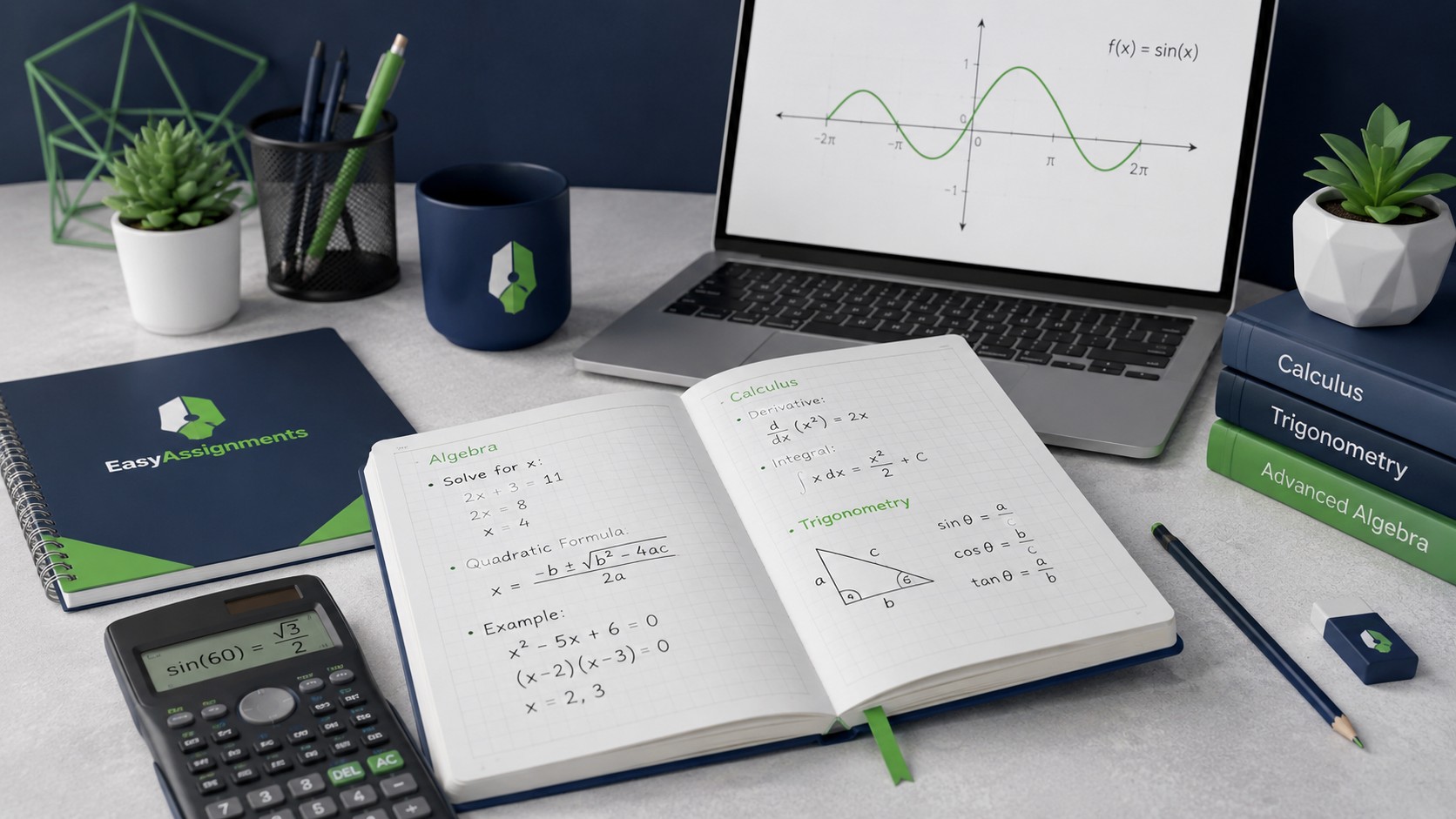
Your Trusted Math Assignment Helper for Homework That Actually Makes Sense
A good math assignment helper does not just spit out a final number. It walks you through the method, shows every step, and leaves you able to solve the next problem on your own. That is the difference between a quick fix and real progress.
Whether you are stuck on algebra, drowning in calculus, or staring at a statistics dataset with no idea where to start, this guide explains how math help works, how to choose it wisely, and how to get the most value from every session.
What a Math Assignment Helper Really Does
When most students search for a math assignment helper, they picture someone who simply gives them the answers. The reality of good help is more useful than that. A capable helper treats each problem as a teaching moment: it identifies which concept the question is testing, chooses the right method, and lays out every step so you can follow the logic from the first line to the final result.
This distinction matters because math is cumulative. If you do not understand why a derivative is calculated a certain way, the next chapter on integration will feel impossible. A worked solution that shows the reasoning gives you a template you can reuse, while a bare answer leaves you exactly as stuck as you were before, only with a completed assignment you cannot defend if a teacher asks you to explain it.
Math help spans a wide range of formats. Some students need a full assignment completed and explained. Others just want one tricky problem broken down. Some want a live tutor to talk them through a concept in real time, and some want detailed written solutions they can study at their own pace. A strong service adapts to what you actually need rather than forcing one approach on everyone.
The core idea: the best math assignment help is measured not by how fast you get an answer, but by how much better you can handle the next problem on your own. Learning is the real deliverable.
There is also a quiet confidence benefit. Math anxiety is real, and it compounds. A student who falls behind early often stops asking questions in class because they feel embarrassed, which makes the gap wider. Getting clear, patient help on the exact points where you are stuck breaks that cycle. Once a topic clicks, the fear attached to it tends to fade, and you approach the next assignment with far less dread.
Which Math Topics You Can Get Help With
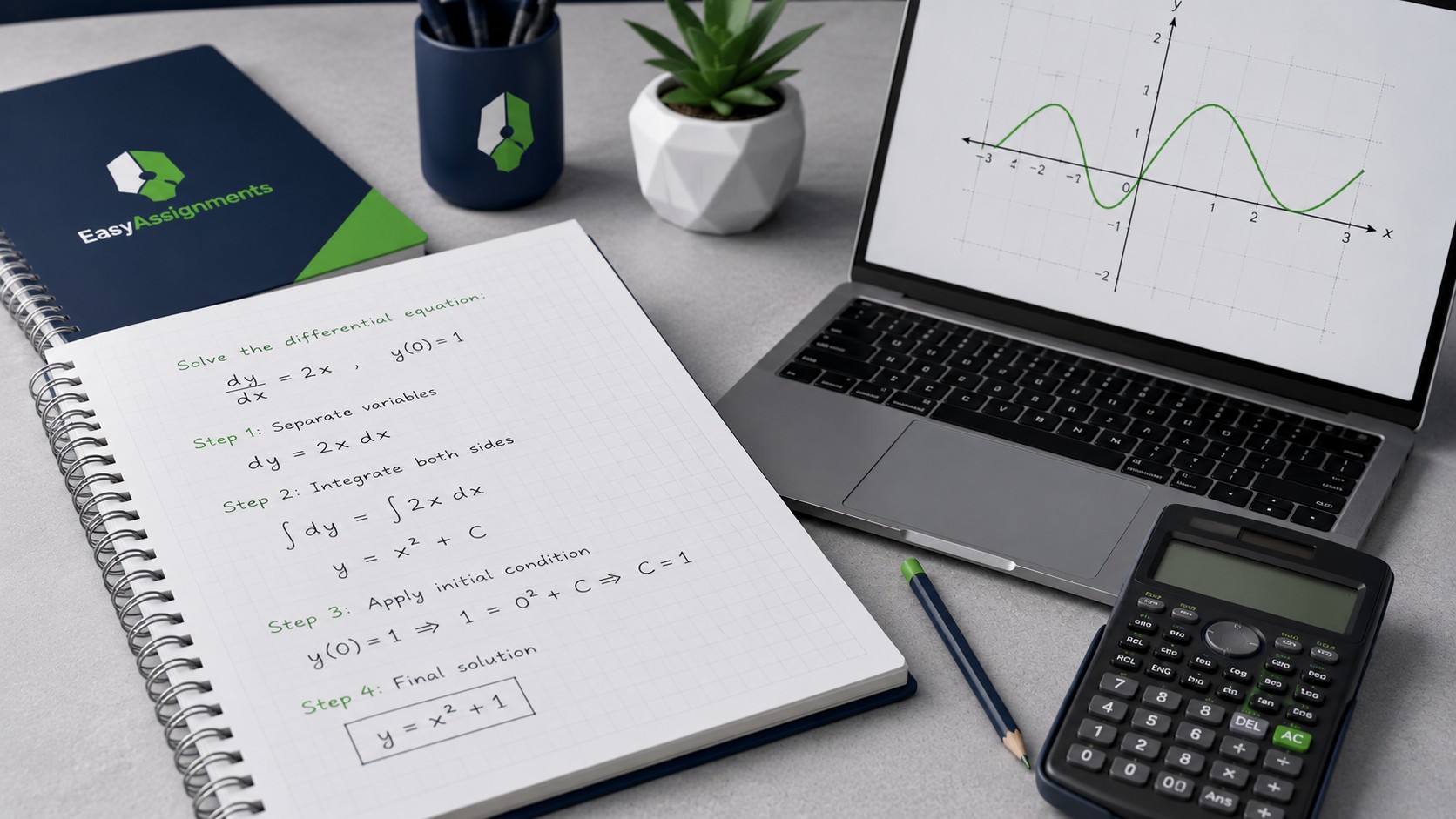
Mathematics is not one subject. It is a family of related fields, each with its own vocabulary, methods, and common sticking points. A well rounded math assignment helper covers the full spread, from the basics that trip up first year students to the advanced work that shows up in engineering, economics, and science degrees.
Algebra and Pre-Calculus
Algebra is the grammar of higher math, and gaps here follow students for years. Common requests include solving linear and quadratic equations, factoring polynomials, working with functions and their graphs, handling inequalities, and simplifying complex expressions. Pre-calculus adds trigonometric identities, logarithms, exponential functions, and sequences and series. Getting a firm grip on these topics removes most of the friction students later feel in calculus.
Calculus
Calculus is where many students hit their first serious wall. Limits, continuity, derivatives, and integrals each require a shift in thinking rather than just more arithmetic. Typical help covers differentiation rules such as the product, quotient, and chain rules, applications like optimization and related rates, techniques of integration including substitution and integration by parts, and multivariable topics such as partial derivatives and double integrals. Because calculus is so procedural, clear step by step solutions are especially valuable here.
Statistics and Probability
Statistics assignments often mix computation with interpretation, which is what makes them tricky. You might calculate a mean and standard deviation, then have to explain what the result means in context. Common areas include probability distributions, hypothesis testing, confidence intervals, regression analysis, and reading or producing data visualisations. Many statistics courses also require software such as Excel, SPSS, or R, so help that covers both the math and the tool is doubly useful.
Discrete Math, Linear Algebra, and Beyond
Computer science and engineering students frequently need help with discrete mathematics, including logic, set theory, combinatorics, graph theory, and proofs. Linear algebra brings matrices, determinants, eigenvalues, and vector spaces. Higher level courses might involve differential equations, real analysis, or numerical methods. The key point is that no matter how specialised the topic, the same principles of clear methods and honest working apply.
- Arithmetic and number theory fundamentals
- Algebra, quadratics, and functions
- Geometry and trigonometry
- Single and multivariable calculus
- Probability and statistical inference
- Linear algebra and matrix methods
- Discrete math, logic, and proofs
- Differential equations and applied math
How to Choose a Reliable Math Assignment Helper
Not all help is equal, and the wrong choice can cost you money, marks, and trust. Because you often cannot see the working until after you have committed, it pays to know what separates a dependable math assignment helper from a risky one. A few clear signals make the decision easier.
Look for Shown Working, Not Just Final Answers
The single most important feature is whether the help shows its process. A trustworthy solution walks through each step, names the rule or theorem being applied, and explains any leap that is not obvious. If a service only hands you a final figure, you have no way to verify it and nothing to learn from. Always favour help that treats the working as the main product.
Check Subject and Level Coverage
A helper who is comfortable with high school algebra may not be the right fit for graduate level real analysis. Before you commit, confirm that the person or service genuinely handles your specific topic and academic level. Vague promises to do "all math" are less reassuring than a clear description of the fields and levels covered.
Consider Turnaround and Communication
Deadlines are the whole reason many students seek help, so realistic turnaround matters. Equally important is communication: can you ask a follow up question if a step is unclear? Can you request a revision if something looks off? A helper who disappears the moment the file is delivered is far less useful than one who stays available to make sure you understand the result.
A word of caution: be wary of any service that guarantees a specific grade, promises to bypass your school's rules, or refuses to show any working. Honest help supports your learning and respects your institution's academic integrity policies. Use worked solutions as study material, not as something to submit blindly.
Read the Terms Around Revisions and Privacy
Before you pay, understand the practical terms. Does the service offer free revisions if the solution does not match the question requirements? How is your personal and payment information handled? A reputable helper is transparent about these things and does not hide them in fine print. Clear terms are a strong indicator of a service that plans to be around for the long run.
Stuck on a Math Assignment Right Now?
Send us the problem set, the deadline, and any instructions from your professor. You will get a clear quote and step by step solutions you can actually learn from.
Comparing Your Math Help Options
There are several ways to get math help, and each suits a different situation, budget, and learning style. The table below lays out the common options so you can match the right approach to your needs. Many students actually blend two or three of these over the course of a semester.
| Option | Best For | Strengths | Limitations |
|---|---|---|---|
| Assignment help service | Full assignments with tight deadlines | Complete worked solutions, deadline focused, covers advanced topics | Costs more than self study; quality varies by provider |
| Live online tutor | Understanding a concept in real time | Interactive, immediate questions and answers, personalised pace | Requires scheduling; hourly cost adds up |
| Solver apps and calculators | Quick single problems and checking answers | Fast, cheap or free, available anytime | Limited explanation, weak on word problems and proofs |
| Video lessons and courses | Learning a topic from scratch | Structured, reusable, builds foundations | Not tailored to your exact assignment |
| Campus tutoring center | Free, in person support on basics | No cost, aligned with your course | Limited hours; may not cover advanced topics |
The best choice depends on your goal. If you need to understand a topic deeply, a tutor or a structured course wins. If you are checking your own work, a solver app is quick and cheap. If you are facing a full assignment with a hard deadline and complex problems, a dedicated math assignment helper that delivers complete, explained solutions is usually the most efficient path.
How to Get the Most From Your Math Help
Getting help is only half the equation. What you do with it determines whether your marks and your understanding actually improve. A little effort on your side turns a one time solution into lasting skill, and it also makes the help itself faster and more accurate.
Provide Complete Information Up Front
The quality of any solution depends on the quality of the question you supply. Share the exact problem wording, any professor instructions, the formatting requirements, the level of your course, and the methods your class has covered. A helper who knows you must use the substitution method rather than a shortcut will give you a solution that actually matches what your grader expects.
Study the Solution, Do Not Just Store It
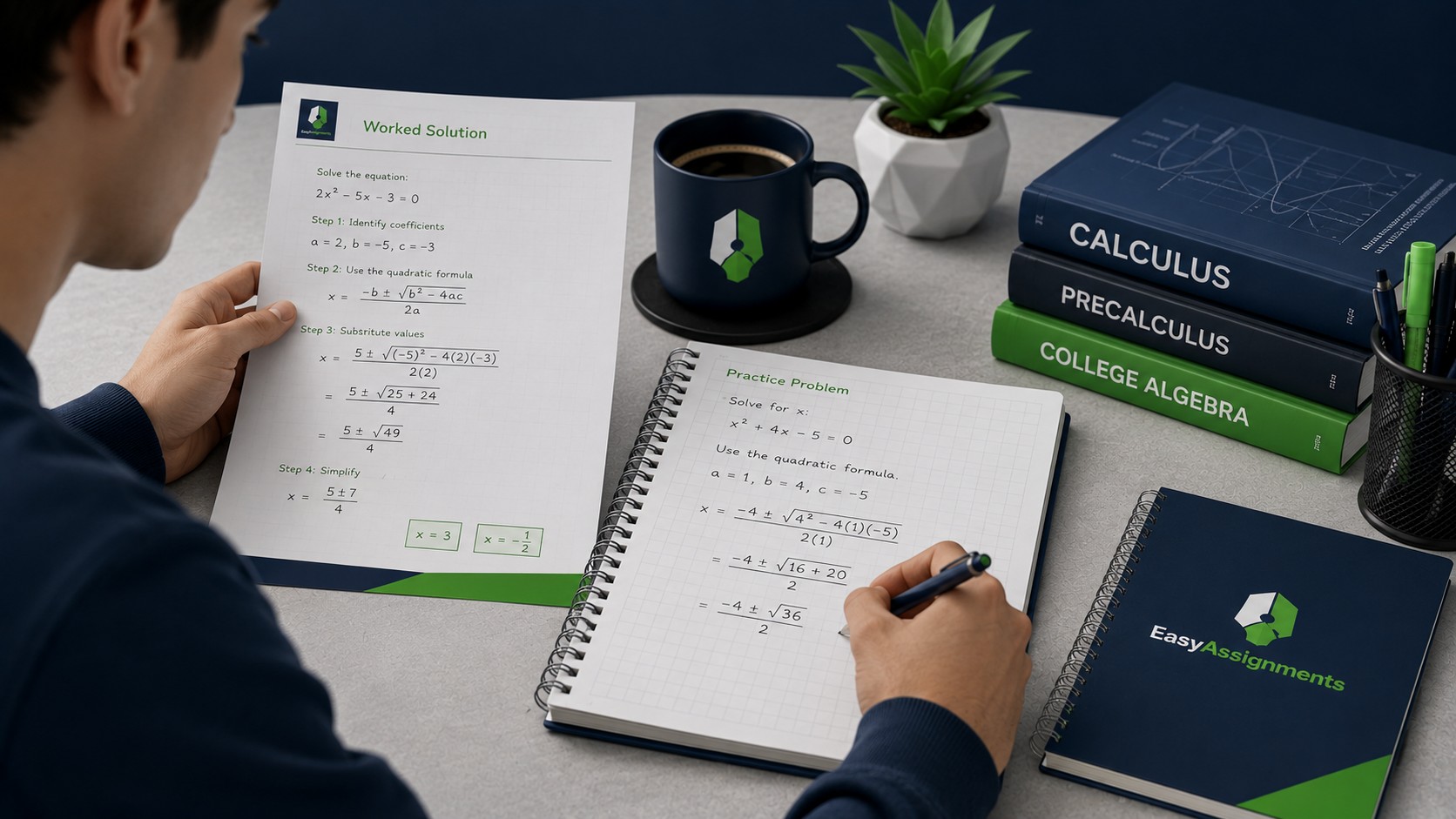
When you receive worked solutions, resist the temptation to file them away and move on. Read through each step and ask yourself why it was taken. Then cover the solution and try to reproduce it on a blank page. If you can rebuild the working from memory, you have learned the method. If you get stuck, you have found exactly where you need more practice.
Practice Similar Problems Immediately
Math is a skill, and skills fade without use. After you understand a worked example, find two or three similar problems and solve them yourself. This active practice is where the real learning happens, and it is the difference between a topic that feels shaky at exam time and one that feels automatic.
Keep a Running Error Log
One of the most effective habits in math is tracking your own mistakes. When help reveals that you keep dropping negative signs, forgetting to apply the chain rule, or mixing up formulas, write it down. A short list of your recurring errors, reviewed before each assignment or exam, catches problems before they cost you marks. Over a semester, this simple habit can raise your grade more than any single tutoring session.
Why Students Choose EasyAssignments for Math Help
EasyAssignments approaches math the way a good teacher would. The goal is never to leave you with an answer you cannot explain. Every solution is built to be studied, with clear steps, named methods, and enough explanation that the logic holds together on its own. Here is what that looks like in practice.
Full Working Every Time
You receive complete step by step solutions, not just final answers, so you can follow the method and reuse it on your own problems.
Broad Subject Coverage
From basic algebra to calculus, statistics, and linear algebra, help is available across the full range of math topics and levels.
Deadline Focused
Turnaround is built around your due date, so you get your solutions with enough time left to review and understand them.
Support and Revisions
If a step is unclear or a requirement was missed, you can ask questions and request revisions until the work matches your assignment.
The result is help that respects both your time and your learning. You meet your deadline, you understand the material better, and you build the confidence to tackle the next assignment with less stress. To get started, you can request a free quote or talk to the support team about exactly what you need.
Frequently Asked Questions
Can a math assignment helper handle advanced university-level topics?
Yes. A strong math assignment helper covers everything from high school algebra to university and postgraduate topics such as multivariable calculus, linear algebra, differential equations, and advanced statistics. When you place an order, describe your exact topic and academic level so the solution is matched to your course.
Will I get step by step solutions or just the answers?
You should always get full working. Reputable math help shows every step, names the rules or theorems used, and explains any part that is not obvious. This lets you verify the result and, more importantly, learn the method so you can solve similar problems yourself.
How quickly can I get help with a math assignment?
Turnaround depends on the length and difficulty of the work, but most math help is built around your deadline. The best approach is to send the problem set and due date as early as possible so you have time to review the solutions and ask follow up questions before submitting.
Is using a math assignment helper allowed by my school?
Policies vary by institution, so you should always follow your school's academic integrity rules. The safe and honest way to use math help is as study material and guided practice: learn from the worked solutions, understand the methods, and apply them to your own work rather than submitting solutions blindly.
Get a Math Assignment Helper Who Explains Every Step
Stop staring at problems that will not budge. Send us your assignment and deadline, and get clear, step by step solutions built to help you understand the math, not just finish it.