
How Does a Turnitin Check Work? A Student's Guide
The moment before you submit a major assignment, a familiar dread sets in. What if a Turnitin check flags your paper, the score comes back high, and you have no idea why? For most students the report feels like a black box. That anxiety is understandable, but it is mostly built on a misunderstanding of how the tool actually works.
Here is the single most important thing to know up front: a Turnitin check is not a pass or fail test. It does not detect plagiarism directly and it does not make academic judgments. Once you understand what is really being measured, most similarity issues become fixable well before the deadline.
What a Turnitin Check Actually Measures
A Turnitin check compares your submitted text against a very large database that includes internet sources, previously submitted student papers from institutions worldwide, and published content such as books and journal articles. Wherever your text matches something already in that database, Turnitin highlights the passage and calculates the percentage of your submission that overlaps with existing material. That percentage is your similarity score, and the crucial point is that it reflects matched text, not misconduct.
The report itself makes no judgment about why the text matches. It simply surfaces the overlap and leaves the interpretation to a human being. An instructor then decides whether those matches represent legitimate citations, common academic phrasing that naturally recurs across many papers, or actual plagiarism. This is why the same thirty percent score can be entirely clean on one assignment and genuinely problematic on another. The context behind the number is what matters, and context is exactly what the software cannot evaluate.
Internalizing this distinction removes most of the fear. The similarity score is not an accusation. It is a map of where your text overlaps with other sources, and overlap is often completely legitimate. Properly quoted material, correctly cited passages, standard terminology in your field, and common phrases all register as matches even when nothing about your work is improper. The score is a starting point for review, never a verdict on its own.
Key takeaway: A Turnitin check does not decide whether you plagiarized. It surfaces overlap and hands the interpretation to your instructor, who is the only one who can judge whether a match is a problem.
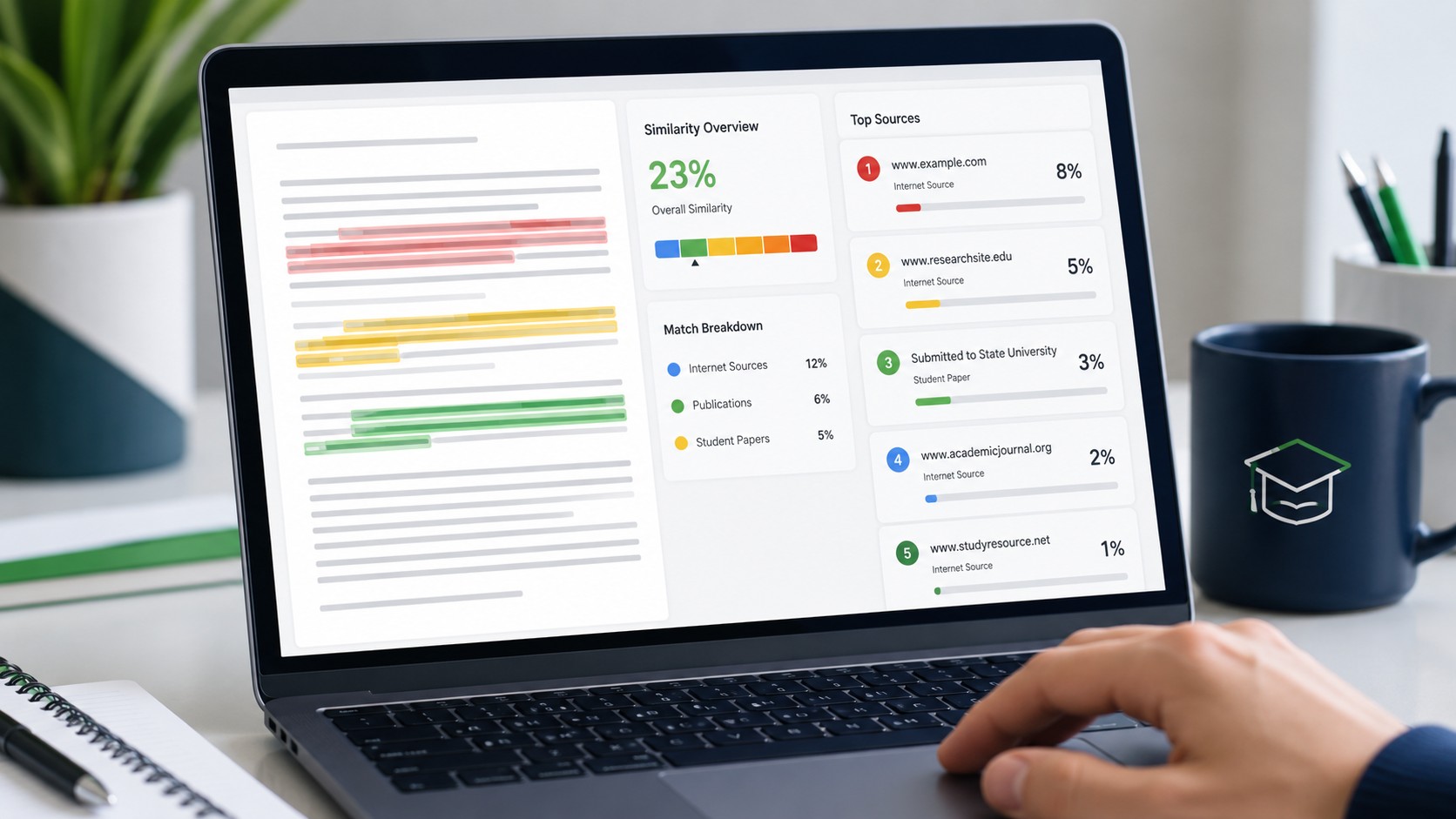
The percentage score and what the color bands mean
Turnitin uses five color bands to indicate score ranges at a glance, and knowing them helps you interpret your report immediately. Blue means no matching text was found at all. Green covers one to twenty-four percent, which is typically the target range for most assignments. Yellow runs from twenty-five to forty-nine percent. Orange covers fifty to seventy-four percent. Red covers seventy-five to one hundred percent.
None of these colors indicate guilt on their own. A paper with heavy direct quotation from primary sources, all properly cited and marked, can land in the yellow range and still be entirely acceptable. As a general benchmark, many universities in the United States consider scores under fifteen percent ideal, and scores up to twenty-five percent are often acceptable when the matching text is properly attributed. These are guidelines rather than hard rules, and your syllabus or instructor can confirm the specific threshold that applies to your course. Always defer to that stated threshold over any general figure.
| Color band | Similarity range | What it usually means |
|---|---|---|
| Blue | No matching text | Nothing overlapped with the database |
| Green | 1 to 24 percent | Typical target range for most assignments |
| Yellow | 25 to 49 percent | Review needed, but can still be legitimate |
| Orange | 50 to 74 percent | Higher overlap that warrants close attention |
| Red | 75 to 100 percent | Substantial overlap, review the sources carefully |
It is also worth understanding that context can matter more than the raw percentage. A score of eighteen percent where a single source accounts for twelve percent of the matches often raises more concern than a score of thirty-five percent spread thinly across twenty-five different sources at one or two percent each. A concentrated match from one place suggests a passage may lean too heavily on a single source. A diffuse pattern of small matches usually reflects ordinary academic phrasing and citation. Instructors read the distribution, not just the total.
How matches and sources are displayed
Inside the report, each matched passage is highlighted and linked to a source card that shows the source name, the matched word count, and the exact location within your paper. This makes it easy to trace any single match back to what it overlaps with. Turnitin groups these matches into four categories, and understanding them tells you where an instructor will actually focus their attention.
The four categories are Cited and Quoted, Missing Citation, Missing Quotation, and Not Cited or Quoted. The first category is generally fine, since the overlap is properly attributed. The real scrutiny falls on the last two, Missing Quotation and Not Cited or Quoted, because these are the passages where your text matches a source but the proper attribution appears to be absent. When you review your own report, these are the categories to examine first and fix before submission.
Instructors also have the option to exclude bibliographies, reference lists, and properly formatted quotations from the calculation. A reference list alone can add several percentage points to an otherwise clean submission, simply because citations naturally match the same citations in other papers. If your score looks inflated, it is entirely reasonable to ask your instructor whether those filters have been applied. In many cases they can be, and that single adjustment can drop your score noticeably without you changing a word of your actual writing.
What sits inside the database, and why it matters
Understanding what Turnitin compares your work against helps explain why matches appear where they do. The database has three broad components. The first is a vast index of publicly available internet content, which is why quoting a popular website or common online explanation reliably produces a match. The second is a huge archive of previously submitted student papers from institutions around the world, which is why reusing your own earlier work, or work that resembles a widely submitted assignment, can trigger overlap. The third is a large collection of published academic and commercial content, including journal articles and books, which is why citing a heavily used source produces matches on the standard phrasings everyone quotes.
Knowing this composition demystifies a lot of confusing results. If you paraphrase a famous passage that thousands of students have also paraphrased, some residual overlap is almost inevitable, because the source and its common rephrasings are all in the index. If you quote a standard definition, it will match. None of this is a sign of wrongdoing. It is simply the predictable result of writing about the same widely available material that many others have written about, and it is exactly why the human review step exists to separate ordinary overlap from genuine copying.
Timing warning: A first report usually appears within minutes, but if you resubmit the same assignment to the same slot, later reports can be delayed by up to a day. If you plan to revise based on the report, do not leave your final resubmission until the last hour, or you may run out of time to act on it.
Facing a deadline and an unclear report?
EasyAssignments can help you review your citations, tighten your paraphrasing, and submit with confidence. Get a fast, no obligation quote and talk to a real person about your assignment.
Turnitin's AI Writing Detection and Its Real Limits
Separate from the similarity report, Turnitin now generates a writing report that flags text segments its model predicts were produced or paraphrased using generative writing tools. Cyan highlights mark text the model considers likely machine generated, while purple marks text that appears to have been paraphrased afterward. This report runs independently of the similarity score and requires an instructor to specifically enable it for a given assignment, so it does not appear on every submission.
The most important thing to understand about this report is that it is a probability signal, not a verdict. Instructors are specifically advised not to use the percentage as the sole basis for any academic action. Guidance from educational institutions consistently recommends treating these detection results with caution and corroborating any concern with additional evidence rather than acting on a number alone. Knowing this helps you respond calmly if your work is ever questioned, because the report by itself is not proof of anything.
What gets flagged, and the built-in caution
According to Turnitin's published documentation, the system sets a very high confidence threshold, around ninety-eight percent, before it assigns a percentage to any submission. This means the tool is deliberately tuned to miss some genuinely machine generated content in order to reduce false accusations. That trade-off is intentional: the designers would rather under-report than wrongly accuse a human writer. Scores in the low range, roughly between one and nineteen percent, are flagged with an asterisk rather than a specific number, because Turnitin considers results in that range too unreliable to report as a figure.
The detection also works most reliably for English-language submissions. Support for some other languages has expanded over time, but paraphrase detection in particular has remained largely English-focused. These limits are not loopholes to exploit. They are simply an honest reflection of a tool that is still maturing and that its own maker acknowledges is imperfect.
False positives and who is most at risk
False positives are a real and well-documented problem, and this is where the tool's limitations have genuine consequences for honest students. A widely cited 2023 Stanford study found that a substantial share of entirely human-written papers by non-native English speakers were incorrectly flagged across multiple detection tools. The risk is not evenly distributed. Non-native English speakers, neurodivergent writers, and students who lean on grammar-assistance tools are all at elevated risk, because their writing can pattern similarly in ways the model struggles to distinguish.
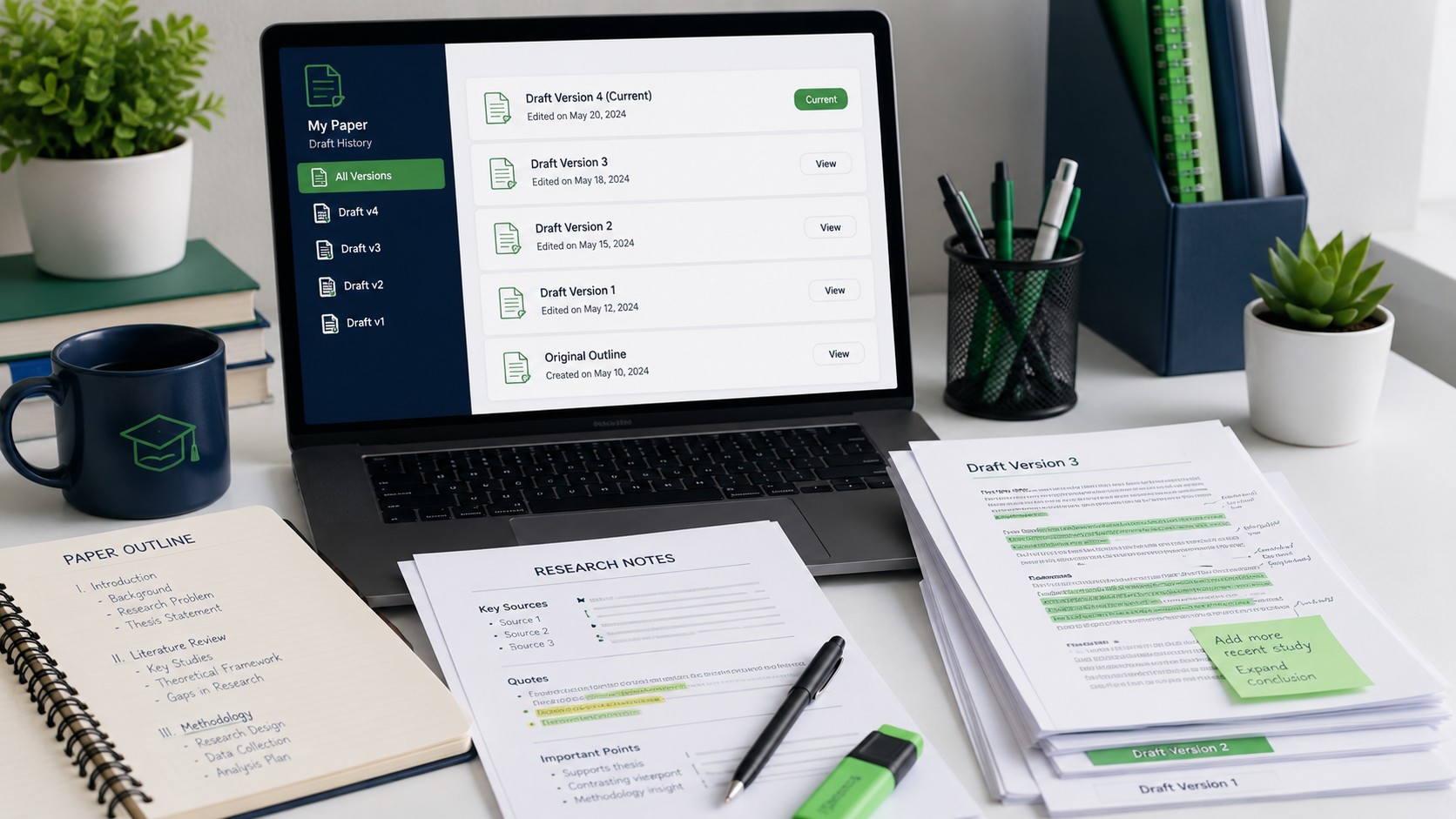
Certain kinds of text have also historically triggered false flags, including highly standardized passages and straightforward bibliography entries, simply because that kind of writing is formulaic by nature. If you are ever flagged and you know your work is genuinely your own, the single most powerful thing you can do is show your process:
- Save your draft versions as you write so you can show how the paper evolved.
- Keep your research notes and any outlines you worked from.
- Preserve your revision history rather than overwriting a single file.
- Be ready to walk an instructor through your paper from outline to final draft.
That paper trail is your best protection, and it costs nothing to maintain if you build the habit early.
How to Run a Turnitin Check Before You Submit
One of the most useful things you can do to reduce submission anxiety is to see your report before your instructor does. That way you find and fix any legitimate issue while you still have time. The challenge is that Turnitin is not a public plagiarism checker you can simply sign up for. It is licensed to educational institutions, and students normally access it only through learning platforms such as Canvas, Blackboard, or Moodle. There is no general individual registration option in most cases.
There is one partial exception worth knowing about. Some institutions enable a feature called Draft Coach, available through Microsoft Word for the web and Google Docs, which lets students run their own similarity checks on drafts. Coverage is inconsistent, however, so you cannot assume it is available. The reliable way to find out is to check with your writing center or IT department, or review the official Draft Coach documentation, to confirm whether your school has turned it on for students.
Options through your institution
The cleanest pre-submission path is to ask your instructor to create a draft submission slot that does not store your paper in the global repository. Not every instructor will do this, but many are genuinely willing when asked directly and politely. It costs them little and helps you produce better work, which is in everyone's interest. This is often the single best option because it uses the real Turnitin database and avoids the storage complications discussed later in this guide.
Some university writing centers also run papers through Turnitin under staff credentials and return a report, often as a PDF within a day. If your writing center offers this, it is an excellent resource. Whenever you use any institutional option, always confirm one specific thing before uploading: whether the paper will be stored permanently in the repository. That single question matters for reasons that become clear in the section on what happens after submission.
What to do when you do not have institutional access
If you have no institutional route to a pre-submission check, a couple of third-party tools can give you directional feedback, though none of them match Turnitin's database exactly. Some services offer a free scan for short papers, and others do not require an academic email address. These will not reproduce Turnitin's exact result, but they can catch obvious overlaps that you would want to fix regardless of which checker your school uses. For a longer paper, you can split the document into sections and run each one separately through a free tier to stay within length limits.
Critical warning: Avoid unofficial websites that claim to offer a Turnitin check online. Uploading your paper can add your text to a third-party database. When you later submit the same work through your institution, the tool may flag it as matching your own previously stored paper, creating a suspicious-looking similarity hit even though you wrote every word.
Practical Ways to Lower Your Similarity Score
Here is a reassuring truth that reframes the whole exercise. Most students with a high similarity score do not actually have a plagiarism problem. They have a paraphrasing and citation problem, and both are entirely correctable before the deadline. Once you know what is driving your score, fixing it is usually straightforward and does not require rewriting your paper from scratch.
Fix your paraphrasing first
The most common cause of a legitimately high score is paraphrasing that stayed too close to the original source. If you rewrote a passage while looking at it, you likely absorbed its sentence structure without realizing, producing text that matches the source even though you changed some words. The fix is to genuinely rewrite from understanding rather than from the page. Read the passage until you grasp the idea, set the source aside so it is no longer in front of you, and then write the concept in your own words from memory. Afterward, compare your version to the original, and if the structure still mirrors the source or too many words match, rewrite it again before adding your citation.
Fix your citations and quotations
Missing or mismatched citations are a major source of avoidable flags, and they are easy to correct. Every paraphrased idea needs an in-text citation placed immediately after the relevant sentence. Every direct quote needs both quotation marks and a citation together. When either element is missing, Turnitin categorizes the passage under Missing Citation or Missing Quotation, which draws instructor attention even when the underlying overlap would otherwise be acceptable. Going through your paper and confirming that every borrowed idea and every quoted phrase carries the correct pair of markers often clears up a large share of flagged passages.
For long quoted passages, consider paraphrasing instead of quoting, since a block of quoted text will always register as matched even when perfectly cited. And if your reference list is inflating your score, ask your instructor whether bibliographies can be excluded from the calculation. In most cases they can be, and that adjustment alone can drop a score by several points without changing a single word of your actual writing.
Structural habits that keep scores naturally low
Beyond fixing individual passages, a few writing habits keep your similarity scores low from the start, so you spend less time cleaning up reports later:
- Lead with your own analysis in each paragraph and bring in sources to support your point, rather than opening with a quotation and building around it.
- Synthesize multiple sources in your own words instead of walking through them one at a time, which forces genuine rephrasing.
- Reserve direct quotation for moments when the exact wording truly matters, such as a precise definition or a phrase you intend to analyze closely.
- Keep a running reference list as you write rather than reconstructing it at the end, which prevents last-minute citation gaps.
These habits do not just lower a number. They produce stronger, more original academic writing, which is the real goal that a low similarity score simply reflects.
What Happens to Your Paper After Submission
Many students never think about where their paper goes after they hit submit, but it is worth understanding, because the default behavior has real consequences. By default, Turnitin stores every submitted paper in its global repository, where it can be compared against future submissions from any institution worldwide. That stored copy remains in the database unless an instructor or administrator specifically requests its removal. Access to your paper is limited to instructors and administrators at your submitting institution, not the general public.
Instructors do have the ability to enable a Do Not Store setting that scans a paper without saving it to the repository, but this is not the default behavior. If storage matters to you, it is worth confirming with your instructor whether that setting has been activated for your assignment before you submit. Do not assume it has been.
The self-matching risk most students do not know about
This is one of the most important and least understood pitfalls, so it deserves careful attention. If you run your paper through a standard Turnitin account that stores documents, and you do this before submitting it for a grade, the stored copy becomes part of the database. Then, when you submit the same paper officially, Turnitin flags it as matching your own previously stored work. The result is a similarity hit that looks suspicious even though you personally wrote every word of it.
The way to avoid this trap is simple. Always use a Do Not Store or draft mode option for any pre-submission check, and confirm with your institution or writing center that this setting is genuinely active before you upload your work. This single precaution prevents a frustrating and entirely avoidable situation where your own careful preparation ends up working against you.
A Step-by-Step Way to Read Your Own Report
When you finally get a similarity report in front of you, it can feel overwhelming to know where to look first. A simple, repeatable routine turns that wall of highlights into a short list of things to check and fix. Work through these steps in order every time, and reviewing a report becomes a five-minute task rather than a source of dread.
- Note the overall score and its color band, but treat it only as a rough first impression rather than a conclusion.
- Look at how the matches are distributed, checking whether one source dominates or whether the matches are spread thinly across many sources.
- Filter your view to the Missing Citation and Not Cited or Quoted categories first, because those are the passages an instructor will scrutinize most.
- For each flagged passage, decide whether it needs a citation added, quotation marks added, or a genuine rewrite from your own understanding.
- Check whether your reference list is inflating the score, and if so, ask whether bibliographies can be excluded from the calculation.
- Fix the real issues, then, if you have access, run one more check to confirm the corrections worked before you submit.
Notice what this routine does. It moves your attention away from the intimidating headline number and toward the specific, fixable details that actually determine whether your submission is clean. Most of the time, working through this list reveals that a scary-looking score comes down to a handful of missing citations and a reference list that was never excluded, both of which are quick to resolve.
When to leave a match alone: If a passage is a direct quotation you have properly enclosed in quotation marks and cited, it is doing exactly what it should. The same is true of standard terminology, required formatting, and correctly cited references. The aim is an honest report, not a zero.
Common Turnitin Myths That Cause Needless Panic
A great deal of student stress around Turnitin comes from myths that circulate widely and sound plausible but are simply not true. Clearing these up removes a layer of unnecessary fear and helps you focus your energy on the things that actually matter.
A high score means an accusation
False. A high score measures overlap, which can be completely legitimate. Literature reviews and quote-heavy papers can score high while being entirely honest. The instructor reviews context before drawing any conclusion.
Turnitin detects plagiarism
It detects textual similarity, not plagiarism. Plagiarism is a judgment about intent and attribution that only a human can make, while similarity is a mechanical measurement a machine produces.
Swapping synonyms beats it
The system responds to structure, not individual words, and a human reader spots patchwriting even faster. Effort spent gaming the tool is better spent producing genuinely original work.
Hidden characters trick the system
These tricks are unreliable and frequently detected, and deliberately manipulating a submission is itself a serious integrity violation, often treated more harshly than the original problem.
One more myth is worth naming: that quotes and references always count against you. Properly formatted quotations and reference lists can often be excluded from the calculation at the instructor's discretion, so legitimate scholarly practice does not have to inflate your score. This is one more reason the raw number should never be taken at face value without understanding what is included in it.
Frequently Asked Questions About a Turnitin Check
Is a high similarity score always bad?
No. A high score means a large portion of your text matched existing sources, but it says nothing about whether that overlap is legitimate. A paper full of properly quoted and cited primary-source material can score high and be entirely acceptable. Focus on the categories of matches, especially Missing Citation and Not Cited or Quoted, rather than the headline number.
Can a Turnitin check detect paraphrasing?
It can detect paraphrasing that stayed too close to the source, because the residual overlap in wording and structure still shows up as matched text. It cannot reliably tell whether a genuine paraphrase is original thinking. Superficial synonym-swapping does not defeat the check, so the reliable path is real paraphrasing built from your own understanding.
Will I be accused if my writing is flagged?
Not automatically. The writing report is a probability signal with well-documented false positive risks, and responsible instructors are advised not to act on it as the sole evidence. If your work is genuinely your own, your drafting history is your strongest defense, because saved drafts, notes, and revision records show how your paper came together.
Can I check my own paper without my school's Turnitin?
Not through Turnitin itself in most cases, since it is licensed to institutions rather than individuals. You can get directional feedback from reputable third-party checkers, and you may have access to Draft Coach if your school has enabled it. Above all, avoid unofficial sites that store your text, because doing so can cause your own paper to be flagged against itself.
Submit with confidence: A Turnitin check measures matched text, not misconduct. Most similarity issues trace back to paraphrasing technique and citation gaps, both of which are fixable before the deadline. Understand what the report measures, review the categories rather than the raw percentage, keep a clear drafting trail, and fix real issues while you still have time.
Walk Into Every Deadline Knowing Where You Stand
You should never have to submit blindly. Let EasyAssignments help you understand your report, correct real issues, and hand in work that reflects the honest effort you put in.