
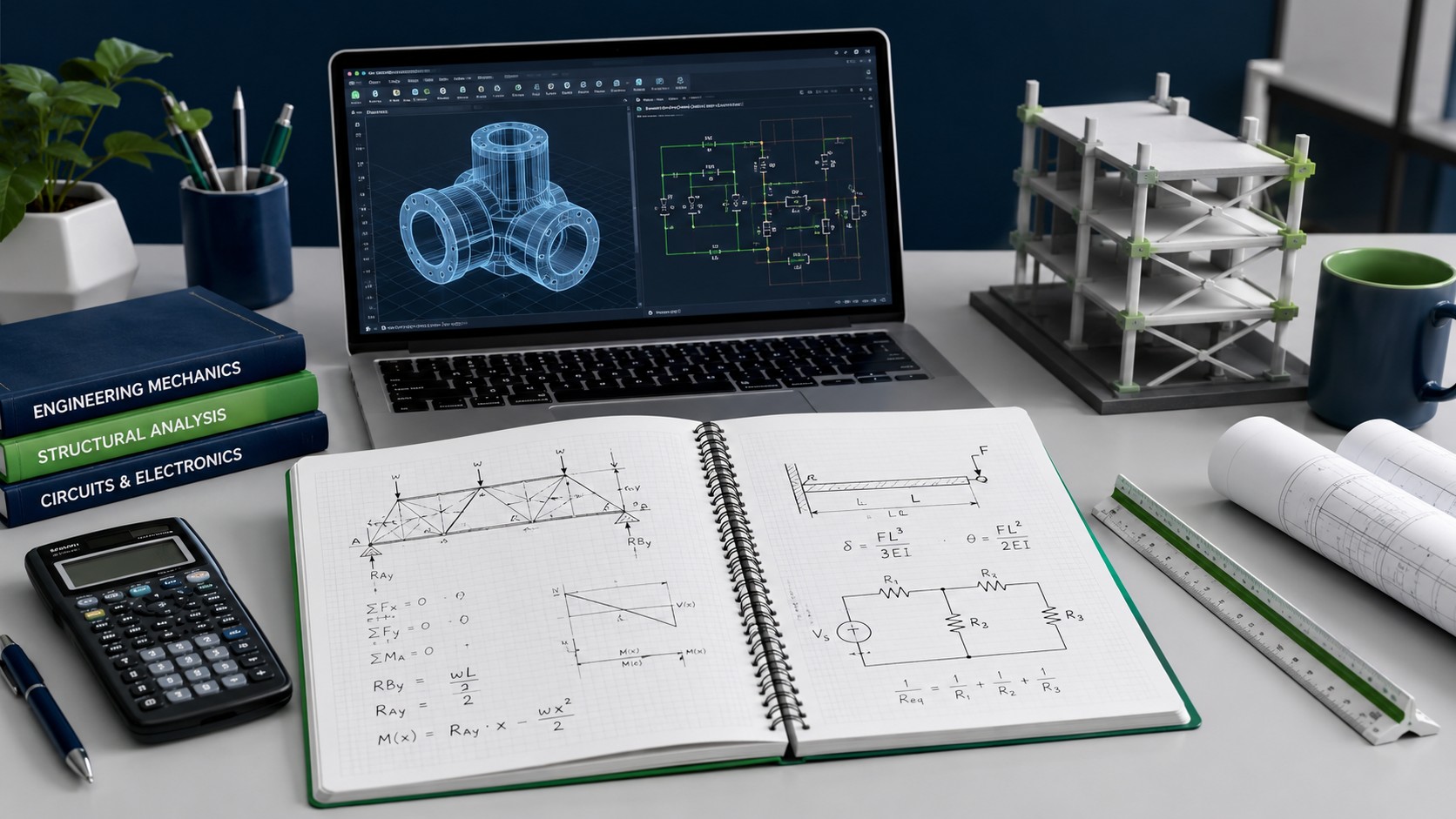
Reliable Help With Engineering Assignments for Every Discipline
Engineering coursework moves fast, stacks up quickly, and rarely forgives a missed deadline. If you are searching for dependable help with engineering assignments, this guide walks you through the strategies, tools, and support options that actually move the needle on your grades.
From statics and thermodynamics to circuits, CAD, and code, we break down how to work smarter across every major branch of engineering, and how expert support fits into a healthy study routine without replacing your own learning.
Why Engineering Assignments Feel So Demanding
Getting quality help with engineering assignments starts with understanding why they are so challenging in the first place. Engineering is not a subject you can memorize your way through. It rewards a specific combination of mathematical fluency, conceptual understanding, and disciplined problem structuring. A single assignment can ask you to model a physical system, apply the correct governing equations, run a numerical solution, interpret the results, and then communicate everything clearly in a formal report. That is several distinct skill sets bundled into one deadline.
The workload compounds too. Most engineering programs run multiple technical modules in parallel, each with its own problem sets, lab reports, and design tasks. When three assignments land in the same week, even strong students feel the squeeze. Add part-time work, commuting, and the steep learning curve of professional software, and it becomes clear why so many learners look for structured support rather than trying to brute-force everything alone.
There is also the precision problem. In an essay-based subject, a slightly weaker argument still earns partial credit. In engineering, a sign error in the third line of a derivation can invalidate an entire answer. Unit mistakes, incorrect assumptions, and misread diagrams cascade through the whole solution. This unforgiving nature is exactly why careful method, clear checking, and occasional expert review matter so much.
The most common pain points students report
- Not knowing which formula or principle applies to a given problem.
- Running out of time to learn software like MATLAB, AutoCAD, SolidWorks, or ANSYS before it is needed.
- Struggling to translate a messy real-world scenario into a clean, solvable model.
- Losing marks on presentation, referencing, and report structure despite correct calculations.
- Getting stuck on one step with no one available to explain the reasoning behind it.
Key idea: The goal of good assignment help is never to skip the learning. It is to remove the blockers, model the correct method, and give you clean, worked examples you can actually understand and reproduce in an exam.
Types of Engineering Assignments and How to Approach Each
Engineering assignments are not all the same, and the smartest approach changes depending on what is being asked. Recognizing the type of task in front of you is the first step toward tackling it efficiently. Below are the most common formats you will encounter across a typical degree, along with practical guidance for each.
Problem sets and numerical calculations
These are the bread and butter of engineering education. You are given a scenario, a set of values, and asked to find an answer using the correct principles. The temptation is to jump straight to plugging numbers into a formula, but the students who consistently score well slow down at the start. They sketch the system, label every known and unknown, note the assumptions, and only then select the governing equations. Working symbolically for as long as possible, then substituting numbers at the end, dramatically reduces arithmetic errors and makes your logic easy for a marker to follow.
Derivations and proofs
Some assignments ask you to derive a relationship from first principles rather than simply apply it. Here, presentation is everything. Each line must follow logically from the one before, with a short justification where a non-obvious step occurs. If you can explain in words why you moved from one line to the next, you understand the derivation well enough to reproduce it under exam pressure. This is an area where reviewing a clean, expertly worked example can be transformative, because it shows you the intended path rather than leaving you to guess.
Lab reports
Lab reports test whether you can connect theory to measured reality. A strong report states the objective, describes the method concisely, presents data in clear tables and graphs, and, most importantly, analyzes discrepancies between expected and observed results. Markers reward genuine engineering reasoning about sources of error and their likely magnitude far more than a report that simply claims everything went perfectly. Formatting, correct units, uncertainty analysis, and properly captioned figures all carry marks that many students leave on the table.
Design and project work
Open-ended design tasks reward creativity balanced against constraints. You may need to justify material choices, run calculations to prove your design is safe, and document trade-offs between cost, weight, performance, and manufacturability. These assignments are as much about clear communication and reasoned decision-making as they are about raw calculation.
Watch out: Always check your assignment brief against your institution's academic integrity policy. Support should help you learn and produce your own original work. Submitting work you cannot explain or defend is both a learning failure and a policy risk.

Discipline-by-Discipline Support
Each branch of engineering has its own vocabulary, core tools, and typical assignment traps. Understanding what your specific field demands helps you target your effort and know exactly where to ask for help with engineering assignments when you need it.
Mechanical engineering
Mechanical modules lean heavily on statics, dynamics, thermodynamics, fluid mechanics, and materials science. Assignments often involve free body diagrams, stress and strain analysis, heat transfer calculations, and increasingly, CAD modeling in tools like SolidWorks or Fusion. The classic stumbling blocks are setting up equilibrium equations correctly and keeping units consistent across a long calculation. A methodical, diagram-first approach pays off enormously here.
Electrical and electronic engineering
Circuit analysis, signals and systems, control theory, and digital logic dominate this field. Students frequently wrestle with applying Kirchhoff's laws to complex networks, working in the frequency domain, and interpreting Bode plots. Simulation tools such as SPICE variants and MATLAB Simulink are common. Because so much of the work is abstract and mathematical, seeing a fully worked example of, say, a transient circuit response can unlock understanding that pages of theory cannot.
Civil and structural engineering
Civil assignments emphasize structural analysis, geotechnics, hydraulics, and materials like concrete and steel. Expect load calculations, bending moment and shear force diagrams, and design checks against standards and codes. Precision and correct interpretation of design codes are critical, since real structures depend on them. Neat, clearly labeled diagrams are not optional here, they are half the answer.
Chemical and process engineering
Mass and energy balances form the backbone of chemical engineering coursework, alongside reaction engineering, thermodynamics, and transport phenomena. Assignments demand rigorous bookkeeping: every stream, every component, every unit must be tracked carefully. A single mislabeled flow can derail an entire balance, so systematic tabulation is a lifesaver.
Software, computer, and mechatronics engineering
These fields blend programming, embedded systems, algorithms, and hardware interfacing. Assignments might require code in C, C++, Python, or MATLAB, along with clear documentation and testing. The best submissions are not just functional, they are readable, well-commented, and demonstrate that the author understands the underlying logic rather than having merely produced something that runs.
| Discipline | Core Topics | Common Tools | Frequent Trap |
|---|---|---|---|
| Mechanical | Statics, dynamics, thermo, fluids | SolidWorks, MATLAB, ANSYS | Sign and unit errors in long calculations |
| Electrical | Circuits, signals, control, logic | SPICE, Simulink, MATLAB | Frequency-domain confusion |
| Civil | Structures, geotech, hydraulics | AutoCAD, structural software | Misreading design codes |
| Chemical | Mass/energy balances, reactions | Aspen, MATLAB, Excel | Untracked streams and components |
| Software | Programming, algorithms, systems | Python, C/C++, Git | Working code with unclear logic |
Stuck on a Deadline Right Now?
Whether it is a single tricky derivation or a full design report, our team can review your work or help you build a clean, original solution from scratch. Share your brief and get a free, no-obligation quote today.
A Reliable Method for Solving Any Engineering Problem
One of the most valuable things you can develop is a repeatable process that works regardless of the specific topic. When you always follow the same structure, you stop staring at a blank page and start making progress immediately. Here is a framework that applies across nearly every quantitative engineering assignment.
Step one: understand and restate the problem
Read the question twice. Then, in your own words, write down exactly what you are being asked to find and what information you have been given. This simple act surfaces hidden assumptions and stops you from solving the wrong problem, which is one of the most common and costly mistakes.
Step two: draw and label a diagram
Almost every engineering problem benefits from a sketch. A free body diagram, circuit schematic, control volume, or process flow diagram forces you to make your assumptions explicit and gives you a reference point for every equation that follows. If you cannot draw it, you probably do not yet understand it.
Step three: list knowns, unknowns, and assumptions
Write out every given value with its units, mark what you are solving for, and state your simplifying assumptions clearly. Markers award credit for reasonable, well-justified assumptions even when the final number is imperfect.
Step four: select and apply the governing principles
Now choose the equations that connect your knowns to your unknowns. Keep the algebra symbolic for as long as you can. This keeps the work clean, makes errors easier to spot, and shows the marker that you understand the underlying relationships rather than just number-crunching.
Step five: substitute, solve, and sanity-check
Only now do you plug in numbers, carrying units throughout. Once you have an answer, ask whether it is physically reasonable. Is the order of magnitude sensible? Do the units come out correctly? A quick sanity check catches a surprising number of errors before submission.
Pro tip: Keep a personal formula sheet organized by module. Over a semester it becomes a powerful revision tool, and building it forces you to understand where each equation comes from and when it applies.
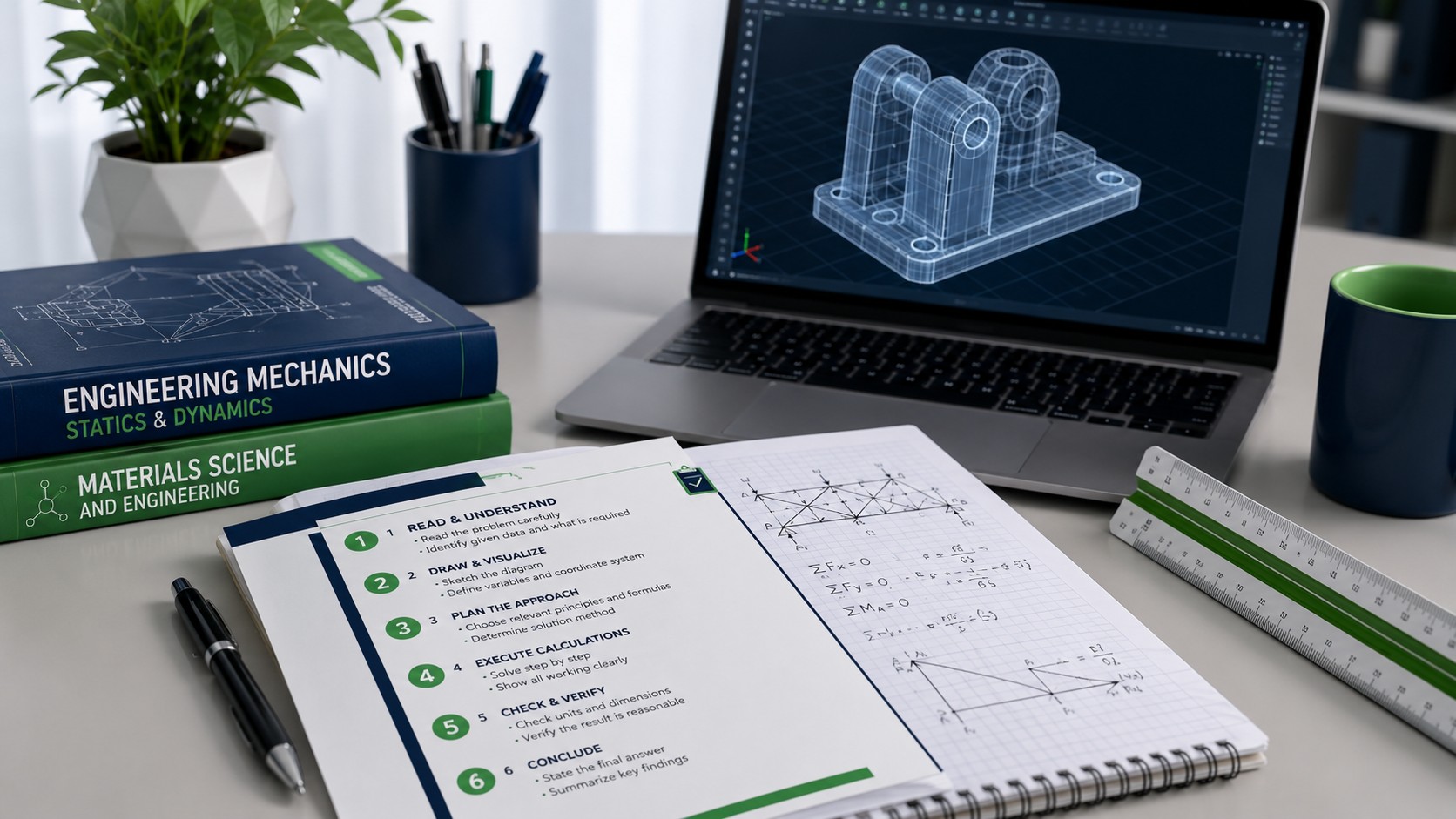
Mastering the Software Behind Modern Engineering
Modern engineering assignments increasingly expect proficiency with professional tools, and the learning curve is one of the biggest sources of stress. You are often asked to use software you have had little time to practice with, all while a deadline looms. Knowing which tool does what, and where to focus your limited practice time, makes a real difference.
MATLAB and its Simulink environment appear across almost every discipline for numerical computation, data analysis, and system modeling. Building comfort with basic scripting, matrix operations, and plotting will serve you in module after module. CAD packages such as AutoCAD, SolidWorks, and Fusion are essential for mechanical and civil work, while simulation suites like ANSYS handle finite element and computational fluid dynamics analysis. Electrical students rely on circuit simulators, and chemical engineers often work in process simulators and spreadsheets.
The key insight is that you do not need to master every feature of these enormous programs. You need the specific subset your assignment requires. When a task calls for a tool you barely know, a short, targeted walkthrough of exactly the workflow you need is far more efficient than trying to learn the whole platform. This is one area where guided help with engineering assignments saves an enormous amount of time.
- Focus practice on the specific commands and workflows your current assignment demands, not the entire toolset.
- Save reusable scripts, templates, and part files so you are not starting from zero each time.
- Always verify software output against a quick hand calculation, because a tool will happily give you a confidently wrong answer if your setup is flawed.
- Document your process so you can reproduce and explain it, which matters both for marks and for exams.
Writing Engineering Reports That Score Well
Even a technically flawless solution can lose marks if it is communicated poorly. Engineering is a profession built on clear documentation, and your assignments are training for that reality. Strong technical writing is a skill you can deliberately develop, and it consistently separates good grades from great ones.
A well-structured report guides the reader logically from objective to conclusion. Use clear headings, present data in properly labeled tables and figures, and reference every figure in the text. Keep your language precise and objective, avoiding vague phrases in favor of specific, quantified statements. Where you make an assumption or a design decision, justify it briefly so the reader understands your reasoning.
Common report mistakes that cost marks
- Graphs and tables with missing axis labels, units, or captions.
- Results presented with no analysis or interpretation of what they mean.
- Inconsistent significant figures and unit formatting throughout the document.
- Weak or missing discussion of experimental error and its likely sources.
- Incorrect or inconsistent referencing style for sources and standards.
Referencing deserves particular attention. Engineering work often cites design standards, datasheets, and technical literature. Using the citation style your department requires, consistently and accurately, is an easy way to secure marks that many students overlook entirely.
How to Choose the Right Assignment Help
Not all support is created equal, and choosing wisely matters. The best help deepens your understanding and produces work you can stand behind, while poor help leaves you with something you cannot explain. When evaluating your options, keep a few principles in mind.
Subject Expertise
Look for support from people who genuinely understand your discipline, not generalists guessing at technical content. Engineering demands specific knowledge.
Clear Explanations
Good help shows the method and reasoning, not just a final number. You should come away able to reproduce the solution yourself.
Original Work
Every solution should be produced from scratch for your specific brief, correctly referenced, and free of recycled or copied material.
Reliable Delivery
Deadlines in engineering are firm. Dependable, on-time delivery and responsive communication are non-negotiable.
At EasyAssignments, the aim is to combine all four of these qualities into support that respects both your deadlines and your learning. Whether you need a difficult problem set worked through clearly, a lab report structured and polished, or a second pair of expert eyes on a design project, the focus is on original, well-explained work delivered on time. You can get a free quote or talk to the support team whenever you are ready.
Building Skills So You Need Less Help Over Time
The ultimate goal of any good support is to make itself less necessary. As you progress, you want to become a more independent, confident engineer who reaches for help strategically rather than constantly. A few habits accelerate that growth dramatically.
Space out your work instead of cramming. Engineering concepts build on each other, and consistent, spaced practice cements understanding far better than a last-minute marathon. Rework the examples given in lectures without looking at the solution, then compare, because active recall reveals exactly where your understanding is thin. Form or join a study group where you explain concepts to peers, since teaching something is one of the fastest ways to discover whether you truly understand it.
Keep every assignment you complete as a reference. Over time you build a personal library of worked problems that becomes invaluable during revision. And when you do use expert help, treat it as a learning resource: study the method, annotate the reasoning, and make sure you could produce something similar on your own next time.
Remember: The students who improve fastest are not the ones who never need help. They are the ones who use help deliberately, learn from every worked example, and gradually turn borrowed understanding into their own.
Frequently Asked Questions
Can you help with engineering assignments in any discipline?
Yes. EasyAssignments supports the full range of engineering fields, including mechanical, electrical, civil, chemical, software, and mechatronics. Support covers problem sets, derivations, lab reports, design projects, and the software workflows that go with them. Share your brief and we will match your task to relevant expertise.
Will I actually understand the work I receive?
That is the whole point. Good support shows the full method, the assumptions, and the reasoning behind each step, not just a final answer. You should be able to follow the logic, reproduce it, and explain it, which is exactly what you need for exams and for your own development.
How do you handle tight deadlines?
On-time delivery is a core priority, because engineering deadlines rarely bend. When you request help, you agree the scope and timeline upfront, and communication stays open throughout so there are no surprises. For urgent tasks, share your requirements as early as you can for the smoothest turnaround.
Is using assignment help allowed by my university?
Policies vary by institution, so always check your own academic integrity guidelines. Legitimate support helps you learn, models correct methods, and produces original material you can understand and build on. It should never involve submitting work you cannot explain or defend as your own.
Get Expert Help With Engineering Assignments Today
Stop wrestling with impossible deadlines alone. Get clear, original, on-time support tailored to your exact brief, and submit work you understand and can be proud of.