
Help Me With This Assignment: A Complete Survival Guide
If you have ever opened a brief, read it twice, and thought "please, someone help me with this assignment," you are in good company. Almost every student hits that wall where the task feels bigger than the time and energy they have left.
This guide walks you through exactly what to do next: how to decode any brief, build a realistic plan, structure strong writing, avoid the traps that cost marks, and get trustworthy support when you truly need a hand.
Why "Help Me With This Assignment" Is a Smart Thought, Not a Weak One
Asking for help with an assignment is not a sign that you are behind or incapable. It is usually a sign that you are taking the work seriously enough to want to do it properly. The students who struggle most are often the ones who stay silent, guess at what the brief wants, and hope for the best. The ones who thrive know when to pause, ask a clear question, and get the guidance that unblocks them.
There are many honest reasons a task stalls. Sometimes the wording of the brief is genuinely confusing. Sometimes you understand the topic but cannot see how to organise it into a coherent argument. Sometimes deadlines have stacked up across several modules at once, and the maths of the week simply does not work. Occasionally you are strong in your subject but writing in a second language, so expressing your ideas in academic English takes extra effort. None of these situations means you are a poor student. They mean you are a normal one.
The goal of this guide is not to do your thinking for you. It is to give you a repeatable process so that the next time you think "help me with this assignment," you already know the first three moves to make. Understanding how good work gets built is the foundation of getting better at building it yourself.
Key idea: Help is most valuable when it teaches you the method, not just the answer. Learn the process once and you can reuse it for every module, every semester, for the rest of your studies.
Step One: Decode the Assignment Brief Before You Write a Word
More marks are lost to misreading the brief than to weak writing. Students often produce polished, well referenced work that quietly answers a slightly different question from the one that was set. Before you research or draft anything, spend real time understanding exactly what is being asked.
Find the command words
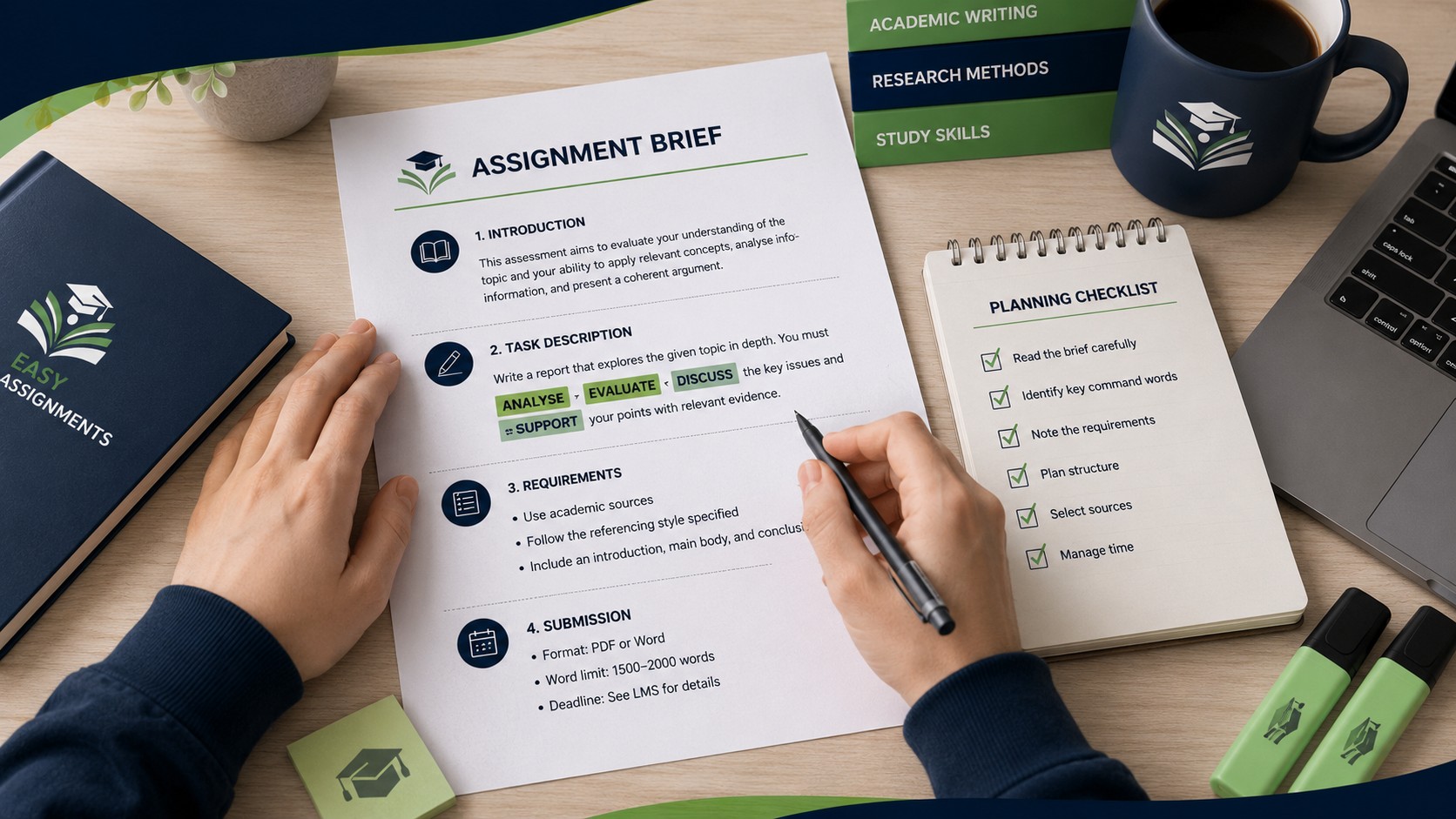
Command words tell you what kind of thinking the marker wants. "Describe" asks you to lay out features clearly. "Explain" asks you to show how or why something happens. "Analyse" asks you to break something into parts and examine how they relate. "Evaluate" or "critically assess" asks you to weigh strengths and weaknesses and reach a judgement. "Compare" asks for similarities and differences. If your brief says "evaluate" and you only "describe," you can write beautifully and still miss the point of the task entirely.
Identify the scope and limits
Look for the boundaries of the question. Is it asking about a specific country, time period, theory, case study, or population? A brief that says "discuss the impact of remote work on employee wellbeing in small businesses" is not the same as "discuss remote work." The words "employee wellbeing" and "small businesses" narrow your scope, and staying inside those lines keeps your answer focused and relevant.
Note the practical requirements
The unglamorous details matter for your grade. Confirm the word count and how strictly it is applied. Check the required referencing style, whether that is APA, Harvard, MLA, or something your department uses. Note the formatting rules, the number of sources expected, the submission format, and the exact deadline including the time of day. Missing a formatting rule or a referencing convention can cost easy marks that have nothing to do with the quality of your ideas.
Watch out: Always read your module's marking rubric if one is provided. The rubric tells you precisely where the marks live. If it awards heavy weighting to "critical analysis," a summary of facts will never reach the top band, no matter how neat it looks.
Step Two: Build a Plan That Fits Your Real Life
Once you know what the brief wants, resist the urge to open a blank document and start writing full sentences immediately. That is where many students freeze. A plan turns one enormous, intimidating task into a series of small jobs that each feel manageable.
Work backwards from the deadline
Start at the submission date and move backwards. Leave a buffer day at the end for final proofreading and formatting, because something always takes longer than expected. Then block out time for drafting, for research, and for planning, in that reverse order. Working backwards shows you honestly how much time you really have, which is often less than it first appears once lectures, work shifts, and life are accounted for.
Break the task into stages
A typical assignment breaks down into clear phases: understanding the brief, gathering and reading sources, outlining your argument, writing a rough first draft, revising for structure and clarity, and finally editing and proofreading. Treating these as separate stages stops you from trying to research, think, and polish all at the same time, which is exhausting and slow. Each stage has one job, and finishing one gives you momentum for the next.
Use short, focused work sessions
Long unbroken study marathons tend to produce diminishing returns. Many students find that focused sessions of around twenty five to forty five minutes, followed by a short break, keep their concentration fresh. The exact numbers matter less than the principle: protect a block of time, remove distractions, do one thing, then rest briefly before the next block.
- Set one clear goal per session, such as "outline the three main arguments" rather than the vague "work on essay."
- Put your phone in another room or use a focus setting so notifications do not pull you away.
- Keep a scrap note open for stray thoughts so you can capture them without breaking flow.
- Reward finishing a stage, even in a small way, so the process feels less like punishment.
Step Three: Research Efficiently and Take Usable Notes
Research is where hours disappear if you are not careful. The trap is endless reading that never turns into writing. The fix is to research with your argument in mind, not to read everything ever written on the topic and hope a structure appears.
Start with the right kind of sources
For most academic assignments, your strongest sources are peer reviewed journal articles, academic books, and reputable institutional reports. Your university library and its databases are built exactly for this and are almost always more reliable than a general web search. Save quick web pages for background orientation, then move to scholarly sources for the material you will actually cite.
Take notes that link to your argument
As you read, do not simply copy passages. For each useful point, write down the idea in your own words, the full source details, and a short note on how it connects to your question. This habit does three things at once: it deepens your understanding, it builds your reference list as you go, and it dramatically reduces the risk of accidental plagiarism later, because you never end up staring at a block of pasted text wondering whether you wrote it or copied it.
Time saver: Keep a running reference list from the very first source you read. Chasing down citation details at 2 a.m. the night before submission is one of the most avoidable stresses in student life.
Step Four: Structure Your Assignment So the Argument Is Clear
Structure is what separates a pile of correct facts from a persuasive piece of academic work. A reader, and a marker, should be able to follow your thinking without effort. Most assignment types share the same underlying skeleton, even when the labels differ.
The universal three-part shape
Nearly every assignment has an introduction that sets up the question and signposts your approach, a main body that develops your argument in a logical order, and a conclusion that draws the threads together and answers the question directly. The body is where the real work happens, and it should move in a deliberate sequence rather than jumping between ideas at random.
Make each paragraph earn its place
A reliable pattern for body paragraphs is to open with a clear point, support it with evidence from your sources, explain how that evidence backs your point, and then link forward to the next idea. If a paragraph does not make a point that serves your overall argument, it probably belongs somewhere else or nowhere at all. Ruthless paragraphs make for a strong essay.
| Assignment Type | Core Purpose | Structure Focus |
|---|---|---|
| Essay | Argue a position or answer a question | Thesis, developed argument, evidence, conclusion |
| Report | Present findings on a topic or task | Headings, sections, findings, recommendations |
| Case Study | Apply theory to a real situation | Context, analysis, linked theory, outcomes |
| Reflection | Examine your own learning or experience | Experience, analysis, insight, future action |
| Literature Review | Survey existing research on a theme | Themes, comparisons, gaps, synthesis |
Stuck Halfway Through Your Assignment?
Sometimes a plan is not enough, and you just need a knowledgeable person to look at your brief with you. Our team can help you understand the task, structure your ideas, and get moving again.
Step Five: Write the First Draft Without Trying to Be Perfect
The single most useful mindset shift for finishing assignments is to separate writing from editing. When you try to produce flawless sentences on the first attempt, you tend to write one line, delete it, rewrite it, and stall. The blank page wins. Instead, give yourself permission to write a rough, imperfect draft whose only job is to exist.
Get the ideas down first
Write your argument through from start to finish, following your outline, without stopping to polish. If you cannot find the perfect word, leave a placeholder and move on. If a sentence is clumsy, let it be clumsy for now. Momentum matters more than elegance at this stage, because a complete rough draft is far easier to improve than a perfect first paragraph that never reaches the second.
Then switch into editing mode
Once the draft exists, come back to it, ideally after a break, and edit in passes. Look at structure first: does the argument flow logically? Then look at clarity: is each sentence saying one clear thing? Then look at accuracy: are your facts and references correct? Finally, proofread for grammar, spelling, and formatting. Trying to fix everything in one read is how errors slip through, so give each layer its own attention.

Step Six: Reference Correctly and Protect Your Academic Integrity
Referencing is not just a technical chore. It is how you show respect for the ideas you have built on, and how you prove that your argument rests on real evidence rather than opinion. Getting it right also keeps you safely on the correct side of academic integrity rules, which every institution takes seriously.
Cite as you write, not at the end
Whenever you use an idea, a statistic, or a direct quotation from a source, add the citation immediately. Leaving all citations until the end almost always leads to gaps, guesswork, and missed sources. Consistency in your chosen style, whether APA, Harvard, or MLA, signals care and professionalism to your marker.
Understand what plagiarism actually is
Plagiarism is presenting someone else's words or ideas as your own, whether deliberately or by accident. It includes copying text without quotation marks, paraphrasing too closely without credit, and reusing your own previously submitted work without permission, which is known as self plagiarism. The safest habit is to always write in your own words, always credit your sources, and always quote directly when you use exact wording.
Important: Legitimate assignment help supports your learning and your own work. It should never involve submitting someone else's work as your own. Use guidance, feedback, structure, and worked examples to strengthen the work that is genuinely yours.
Common Assignment Mistakes and How to Fix Them
Even capable students repeat the same avoidable errors under pressure. Recognising them in advance is half the battle.
Answering the wrong question
Fix it by rereading the brief after your first draft and checking every section against the command words and scope.
Leaving it too late
Fix it by starting with a fifteen minute planning session the day the brief is set, so the task is never a total unknown.
Description over analysis
Fix it by asking "so what?" after each point, pushing yourself to explain why it matters to the question.
Weak or missing references
Fix it by citing as you write and building your reference list from the first source you open.
When to Ask for Outside Help, and How to Do It Well
There is a difference between struggling productively and being genuinely stuck. Struggling productively means you are making slow progress and learning as you go. Being stuck means you have lost hours with nothing to show, the deadline is closing in, and stress is stopping you from thinking clearly. That second situation is exactly when reaching out is the sensible choice.
Start with the free support around you
Your university almost certainly offers resources designed for this moment. Academic skills or writing centres help with structure, argument, and referencing. Subject librarians help you find and evaluate sources. Your tutor or module leader can clarify the brief if you ask a specific, well prepared question. Study groups let you test your understanding against peers. These supports are free, and using them is precisely what they exist for.
Ask a sharp question, not a vague one
The quality of help you receive depends heavily on the quality of your question. "I don't get it" is hard to answer. "I understand the theory but I am not sure whether my introduction sets up the argument clearly, could you look at this paragraph?" is easy to answer and gets you a useful response. Bring your brief, your attempt so far, and a specific sticking point whenever you seek help.
Choosing a paid support service responsibly
If you decide to use a professional assignment help service such as EasyAssignments, treat it as you would any important decision. Look for clear communication, subject expertise, transparency about what the service does and does not include, and a focus on supporting your understanding rather than replacing it. Guidance, worked examples, structural feedback, and referencing help can genuinely strengthen the work you submit while keeping your own learning at the centre.
Remember: The best help leaves you more capable than before. If a source of support only ever hands you a finished product and teaches you nothing, it is not actually helping you become a stronger student.
A Simple Routine You Can Reuse for Every Assignment
Bringing the whole guide together, here is a lightweight routine you can run every single time a new brief lands, so that "help me with this assignment" becomes "I know exactly where to start."
- Read the brief slowly and highlight the command words, scope, and requirements.
- Check the marking rubric and note where the marks are concentrated.
- Work backwards from the deadline and block out time for each stage.
- Research with your argument in mind and take notes in your own words.
- Outline before you draft, then write a rough draft without editing.
- Edit in separate passes for structure, clarity, accuracy, and proofreading.
- Reference as you go and check everything against the brief one final time.
- Ask for help early and specifically whenever you get genuinely stuck.
None of these steps is complicated on its own. The power comes from doing them in order and doing them consistently. Over a semester, this routine turns assignments from last minute emergencies into predictable, manageable pieces of work, and it steadily builds skills that carry into your career long after the grades are forgotten.
Frequently Asked Questions
Is it okay to ask someone to help me with this assignment?
Yes, seeking help is a normal and responsible part of studying, as long as the help supports your own learning. Using tutors, writing centres, feedback, structural guidance, and worked examples strengthens your work. The line to respect is that the final submission must genuinely be your own work and properly referenced.
How do I start an assignment when I feel completely overwhelmed?
Start smaller than feels natural. Do not try to write the whole thing; just decode the brief and highlight the command words. Then break the task into stages and complete only the first one. Overwhelm usually comes from staring at the whole mountain, and it eases the moment you take one clear, concrete step.
How much time should I give myself for an assignment?
More than you think, and always with a buffer. Work backwards from the deadline, leave a full day at the end for proofreading and formatting, and allocate separate blocks for research, drafting, and editing. Starting a small planning session on the day the brief is set means the task is never a total unknown as the deadline approaches.
What is the difference between describing and analysing?
Describing tells the reader what something is, while analysing explains how or why it matters and how its parts relate. Most higher marks reward analysis over description. A useful test is to ask "so what?" after each point: if you can answer why it matters to the question, you are analysing rather than simply reporting facts.
Ready to Turn "Help Me With This Assignment" Into "Done"?
Send us your brief and deadline, and get clear, honest support that keeps your learning at the centre. You do the work; we help you do it well.