

Reliable Engineering Assignment Help for Every Discipline
Engineering assignment help gives students structured, technically accurate support when circuit analysis, thermodynamics, structural loads, and coding tasks all land in the same week. It is the difference between guessing at a solution and understanding exactly why each step works.
Whether you study mechanical, electrical, civil, chemical, or software engineering, the right support keeps your calculations correct, your reports professional, and your deadlines met without sacrificing what you actually learn.
Why Engineering Assignment Help Is Different
Engineering assignment help is not simply essay writing dressed up in technical language. Engineering coursework blends applied mathematics, physical laws, standardized methods, and precise reporting into every task. A single decimal error in a load calculation, a misread unit in a heat transfer problem, or a wrong sign in a circuit analysis can turn an otherwise strong submission into a failing one. That is why generic academic support rarely fits engineering students, and why specialized help matters so much.
Most engineering assignments ask you to do three things at once: apply the correct theory, carry out accurate quantitative work, and communicate the result in a professional, standards-aware format. You might derive an equation, solve it numerically, then present the outcome in a formal report with figures, tables, and referenced assumptions. Each layer has its own failure points, and each requires a different kind of attention. Good support addresses all three rather than just polishing the prose at the end.
There is also the reality of workload. Engineering programs are famous for stacking problem sets, lab reports, design projects, and exams into overlapping deadlines. When four modules all demand deliverables in the same fortnight, even capable students struggle to give each one the depth it deserves. Assignment help acts as a pressure valve, letting you protect the quality of your work across the whole semester instead of sacrificing one subject to save another.
The core idea: engineering assignment help should make you more confident with the material, not less. The best support explains the reasoning behind each step so you can reproduce it under exam conditions, defend it in a viva, and apply it to the next problem on your own.
It helps to think of this support as a tutor who also happens to be an experienced problem solver. When a worked solution is annotated with the assumptions made, the formula chosen, and the reason a particular method was preferred, you gain a template for your own thinking. That transferable understanding is what separates genuine academic help from a shortcut that leaves you no better prepared for the next deadline.

Engineering Disciplines Covered
Engineering is an umbrella term for a wide family of fields, each with its own tools, conventions, and problem types. Effective engineering assignment help spans these branches rather than treating them as interchangeable. Below are the major disciplines where students most often seek structured support, along with the kinds of tasks that come up in each.
Mechanical Engineering
Mechanical assignments frequently cover statics and dynamics, thermodynamics, fluid mechanics, machine design, and materials science. Students tackle free-body diagrams, stress and strain calculations, thermodynamic cycles, and heat transfer problems. Many tasks require software such as SolidWorks or MATLAB, and lab reports often accompany the theory. The emphasis is on correct physical modeling: choosing the right assumptions before any numbers are crunched.
Electrical and Electronics Engineering
Electrical coursework ranges from basic circuit analysis using Kirchhoff's laws to signal processing, control systems, power electronics, and digital logic design. Assignments may involve deriving transfer functions, plotting Bode diagrams, simulating circuits in tools like MATLAB or Multisim, or writing code for microcontrollers. Sign conventions, phasor notation, and unit consistency are common places where marks are lost, so careful checking matters.
Civil and Structural Engineering
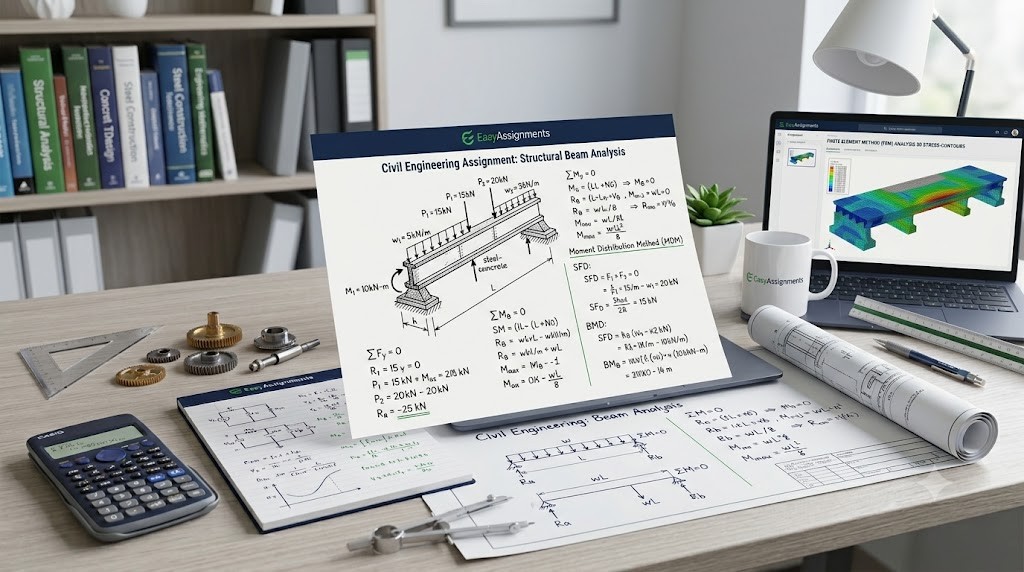
Civil assignments deal with structural analysis, reinforced concrete and steel design, geotechnics, hydraulics, and transportation. Students calculate bending moments, shear forces, and deflections, and apply design codes to size beams, columns, and foundations. Because civil work is heavily governed by standards, correct application of the relevant code is often as important as the arithmetic itself.
Chemical and Process Engineering
Chemical engineering tasks include mass and energy balances, reaction kinetics, thermodynamics, transport phenomena, and process design. Assignments often require setting up balance equations across a process unit, solving simultaneous equations, and interpreting the result in the context of a plant or reactor. Dimensional analysis and unit tracking are essential skills here.
Software and Computer Engineering
These assignments blend programming with engineering principles: data structures, algorithms, embedded systems, digital design, and computer architecture. Deliverables may be working code, documented algorithms, complexity analysis, or hardware description language projects. Clean, tested, well-commented work is valued as much as a correct final output.
A note on integrity: the goal of engineering assignment help is to support your learning, not to replace it. Use worked solutions as study material, always follow your institution's academic honesty policy, and make sure any submitted work reflects your genuine understanding.
Common Types of Engineering Assignments
Engineering programs assess students through a broad mix of task formats. Knowing what each one demands helps you plan your time and recognize where support adds the most value.
- Problem sets: numerical exercises that test whether you can apply formulas and methods correctly. Accuracy and clear working are everything here.
- Lab reports: structured documents describing an experiment, its method, results, and analysis. These reward professional formatting, honest error discussion, and clear graphs.
- Design projects: open-ended tasks where you must produce a solution to a stated requirement, often with drawings, calculations, and a justification of your choices.
- Technical reports: longer written pieces that combine research, analysis, and recommendation, usually with formal referencing.
- Simulations and modeling: tasks using software to model a system, interpret the output, and validate it against theory.
- CAD and drawing assignments: deliverables focused on producing accurate, standards-compliant technical drawings.
Each format has a different center of gravity. A problem set lives or dies on calculation accuracy, while a lab report is judged more on structure, interpretation, and how honestly you discuss sources of error. Matching your effort to what the task actually rewards is one of the quiet skills that separates strong students from the rest, and it is something good support can help you develop.
How Engineering Assignment Help Works
A reliable service follows a transparent process so you always know what you are getting and when. While details vary, the typical workflow looks like this.
| Stage | What Happens | What You Provide |
|---|---|---|
| 1. Brief and quote | You share the task; the requirements are reviewed and a price and deadline are confirmed. | Assignment brief, rubric, deadline, module notes. |
| 2. Assignment planning | The methods, formulas, and standards needed are identified and an approach is outlined. | Any lecturer instructions or preferred methods. |
| 3. Solution and drafting | Calculations, code, or reports are produced with clear, annotated working. | Data sets, lab readings, or software files if relevant. |
| 4. Review and checks | Work is checked for accuracy, formatting, and originality before delivery. | Feedback on the draft if a preview is offered. |
| 5. Delivery and revisions | You receive the completed work with time to request adjustments. | Revision notes within the agreed window. |
The most useful thing you can do at the start is over-communicate. Sending the exact rubric, the marking criteria, sample solutions from earlier weeks, and any specific method your lecturer insists on removes guesswork and dramatically improves how closely the finished work matches what your grader expects. Vague briefs produce vague results, so a few extra minutes gathering context at the outset pays off in the final grade.
Facing a Tough Engineering Deadline?
Share your brief and get a clear, no-pressure quote. Accurate working, professional reports, and on-time delivery across every engineering discipline.
What to Look For in a Reliable Service
Not all academic support is equal, and engineering raises the stakes because errors are so unforgiving. When choosing where to get help, weigh these factors carefully.
Subject-Matched Experts
Help should come from people with genuine engineering backgrounds who understand your discipline, not generalists guessing at technical content.
Transparent Working
Every calculation and design choice should be shown and explained, so you can follow the logic and learn from it rather than trusting a black box.
Originality Checks
Work should be produced from scratch and checked for plagiarism, protecting both your integrity and your grade.
Clear Communication
Responsive support, honest timelines, and a fair revision policy signal a service that respects your deadlines and your money.
Be especially wary of any offer that seems too cheap or too fast to be credible. Quality engineering work takes time because it must be checked and re-checked. A price far below the market, or a promise to deliver a complex design project in a couple of hours, usually signals corner-cutting that will show up in your grade. Reasonable turnaround, transparent pricing, and a willingness to explain the work are far better signals than dramatic guarantees.
Getting the Most From Engineering Support
Assignment help works best when you treat it as an active learning tool rather than a passive delivery service. A few habits make an enormous difference to how much you gain.
Study the working, not just the answer
When you receive a solution, do not skip to the final number. Read each step, note the assumptions, and try to reproduce the result yourself on a blank page. This turns a single completed assignment into genuine exam preparation, because engineering exams almost always test the same methods under time pressure.
Ask for annotations
Request that solutions include short notes explaining why a formula was chosen or where a common mistake usually happens. These margin comments are often more valuable than the answer itself, because they capture the judgment that textbooks leave out.
Build a personal method library
Keep a running document of worked examples organized by topic. Over a semester this becomes a personalized revision resource tuned to exactly the kinds of problems your course sets, which is far more efficient than re-reading entire textbooks before an exam.
Use support early, not only in a crisis
The most effective students seek help at the start of a difficult topic, not the night before it is due. Early support gives you time to absorb the reasoning, ask follow-up questions, and apply it to practice problems, all of which deepen your understanding and reduce last-minute stress.
Remember: the point of support is to make the next assignment easier to do on your own. Each time you engage with a worked solution actively, you are shrinking the gap between what you can do with help and what you can do independently.
Balancing Help With Real Learning
There is an honest tension at the heart of any academic support, and engineering students deserve a straight answer about it. Used well, assignment help accelerates your understanding, protects your grades during heavy weeks, and models the professional standard your reports should reach. Used poorly, it can become a crutch that leaves you unable to solve problems when it counts most, in exams, in a viva, or on the job.
The resolution is simple in principle: engage with the material. If you use every solution as a study object, work through the reasoning, and eventually reproduce it unaided, you come out ahead. Engineering is ultimately a practical discipline, and employers and examiners alike care whether you can actually solve problems, not whether you once submitted a polished report. Support that respects this, by explaining rather than merely delivering, is support worth having.
It also helps to be honest with yourself about which tasks you are outsourcing and why. Using help to understand a topic you find genuinely difficult is very different from avoiding practice on the fundamentals you will be examined on. Reserve your own effort for the core methods you must master, and lean on support for time management, formatting, and the occasional topic that has simply not clicked yet. That balance keeps you learning while keeping your workload sustainable.
Frequently Asked Questions
Can engineering assignment help cover any discipline?
Most established services cover the major branches, including mechanical, electrical, civil, chemical, and software engineering, along with sub-fields like structural, control systems, and thermodynamics. When you request help, always confirm that your specific discipline and topic are supported so the work is handled by someone with the right background.
Will I get worked solutions I can actually learn from?
Good engineering assignment help provides step-by-step working with the assumptions and formulas clearly shown, not just a final answer. This lets you follow the reasoning, reproduce the method yourself, and use the solution as revision material for exams and future problems.
How do I make sure the work matches my course requirements?
Share as much detail as possible up front: the full brief, the marking rubric, any preferred methods your lecturer requires, and relevant lecture notes or data. The more context you provide, the more closely the completed work will align with what your grader expects.
Is using assignment help against academic rules?
Policies vary between institutions, so you should always check your own academic honesty guidelines. Support is best used as a learning and study aid, and any work you submit should reflect your genuine understanding. When in doubt, treat solutions as tutoring material rather than final submissions.
Get Expert Engineering Assignment Help Today
Protect your grades and deepen your understanding across every engineering discipline. Share your brief for a clear quote and accurate, on-time support.