
Do My Economics Homework: The Complete Guide to Getting It Done Right
If you have ever stared at a demand curve at midnight and thought, please, someone just do my economics homework, you are far from alone. Economics is one of those subjects that looks simple in lecture and turns brutal the moment you sit down with a real problem set.
This guide walks you through every major branch of economics, the problem types that trip students up, the study habits that actually work, and how to get trustworthy help when a deadline is closing in. By the end you will know how to tackle the work yourself and when it makes sense to bring in support.
Why Economics Homework Feels So Hard
When students search for someone to do my economics homework, the frustration usually is not about laziness. Economics is a genuinely demanding subject because it asks you to juggle three different skill sets at once. You need the verbal reasoning of a social science, the visual logic of graphs and curves, and the quantitative precision of mathematics. Very few courses blend all three so tightly, and most students are strong in one area while weaker in another.
A typical assignment might ask you to explain, in words, why a price ceiling causes a shortage, then draw the supply and demand diagram that proves it, then calculate the exact size of the deadweight loss. If your writing is strong but your algebra is rusty, you stall on the last part. If you love numbers but freeze when asked to interpret them in plain English, the essay section becomes the wall. Economics punishes narrow strengths.
There is also the problem of abstraction. Terms like elasticity, marginal utility, opportunity cost, and general equilibrium describe things you cannot touch or see directly. Students often memorize definitions without truly understanding the mechanics underneath, and that gap shows up the instant a problem is phrased in an unfamiliar way. The homework is not testing whether you remember the definition of elasticity. It is testing whether you can use it.
Finally, economics builds relentlessly on itself. Miss the intuition behind marginal analysis in week three, and weeks five through twelve become progressively harder because nearly everything after that point assumes you already understand it. Unlike some subjects where each topic stands alone, economics is a tower. A weak floor early on threatens everything you try to stack on top.
The good news: economics is one of the most learnable hard subjects once you understand its internal logic. The concepts connect in predictable ways, and once a few core ideas click into place, huge sections of the course suddenly make sense at the same time.
The Main Branches of Economics You Will Encounter
Before you can conquer your homework, it helps to know exactly which territory you are standing in. Economics assignments fall into several distinct branches, each with its own vocabulary, tools, and typical question styles. Recognizing which one a problem belongs to is half the battle, because it tells you which mental toolkit to reach for.
Microeconomics
Microeconomics studies individual decision makers: households, firms, and single markets. This is where you meet supply and demand, consumer choice, elasticity, production costs, market structures like perfect competition and monopoly, and the behavior of firms trying to maximize profit. Homework here tends to be graph heavy and calculation heavy. You will shift curves, find equilibrium points, compute elasticities, and reason about how a single market responds to a tax, a subsidy, or a price control.
Microeconomics rewards precision. A curve shifted in the wrong direction or an elasticity calculated with the wrong base can send an entire multi part answer off the rails. Because the topics build so directly on one another, micro is often where students first realize they need help, and it is one of the most common reasons people look for someone to do my economics homework.
Macroeconomics
Macroeconomics zooms out to the whole economy. Here you study gross domestic product, inflation, unemployment, interest rates, fiscal and monetary policy, exchange rates, and economic growth. Instead of a single market, you analyze aggregate demand and aggregate supply, and you trace how a central bank raising interest rates ripples through investment, spending, and prices.
Macro homework often mixes conceptual essays with data interpretation and some calculation. You might explain the transmission mechanism of monetary policy in one question, then compute a multiplier or read a set of national accounts in the next. The challenge in macro is that the models are contested and interconnected, and small assumptions about how people and markets behave can lead to very different conclusions.
Econometrics and Quantitative Economics
Econometrics applies statistics to economic data. This branch trips up students who were comfortable with theory but never expected to run regressions, interpret coefficients, test hypotheses, or worry about problems like heteroskedasticity and multicollinearity. Assignments often involve software such as R, Stata, EViews, or Python, and they ask you not just to produce results but to interpret them correctly and defend your modeling choices.
Because econometrics sits at the intersection of economics, statistics, and coding, it is one of the most support intensive parts of any economics degree. A single assignment can require cleaning a dataset, choosing a model, running it, and writing up the findings in the careful, hedged language that empirical economics demands.
Applied and Specialized Fields
Beyond the core, economics branches into fields such as international trade, development economics, labor economics, environmental economics, behavioral economics, public finance, and game theory. Each carries its own frameworks. Game theory homework, for example, revolves around payoff matrices, Nash equilibria, and strategic reasoning, while environmental economics leans on externalities and the valuation of costs that markets ignore. Knowing which specialized lens a question uses keeps you from applying the wrong model.
Common Types of Economics Assignments
Economics homework is not one uniform thing. Understanding the format in front of you changes how you should approach it. Broadly, most economics tasks fall into a handful of recognizable categories, and each demands a slightly different strategy.
- Problem sets: the classic weekly grind of numerical and graphical questions. These reward systematic, step by step work and are where most students spend the bulk of their time.
- Graph and diagram tasks: questions that ask you to draw, shift, and label curves to illustrate a market outcome. Accuracy and clear labeling matter as much as the underlying logic.
- Essays and short written answers: conceptual questions asking you to explain a theory, evaluate a policy, or argue a position using economic reasoning and evidence.
- Case studies: real world scenarios where you apply theory to a specific company, market, or country, often blending analysis with recommendations.
- Data analysis and econometrics projects: assignments that hand you a dataset and ask you to model it, interpret the output, and write up your conclusions.
- Research reports and term papers: longer pieces requiring a literature review, a clear argument, proper referencing, and sustained analysis over many pages.
The mistake many students make is treating all of these the same way. A problem set rewards speed and accuracy in calculation. An essay rewards structure, evidence, and clear argument. A case study rewards judgment about which theory actually fits the messy real situation. Matching your effort to the format is one of the simplest ways to raise your grades without working more hours.
Step by Step: How to Tackle an Economics Problem Set
Most economics homework comes as a problem set, so it is worth having a reliable method. The following process works across microeconomics and macroeconomics and turns an intimidating page of questions into a series of manageable moves.
1. Read the whole set before writing anything
Skim every question first. Problem sets are often designed so that later parts depend on earlier ones, and understanding the arc of the assignment stops you from solving a question in a way that boxes you in later. You will also spot which questions are quick wins and which need real time, so you can budget accordingly.
2. Identify the branch and the model
For each question, name the topic. Is this a supply and demand problem, a cost curve problem, an aggregate demand and aggregate supply question, or a game theory setup? Naming the model tells you which formulas, diagrams, and assumptions apply. Half of all errors come from applying the right technique to the wrong kind of problem.
3. Draw the diagram first, then do the math
In economics, the picture usually leads the numbers. Sketching the graph before calculating clarifies what should happen: which way a curve shifts, whether price rises or falls, whether quantity expands or contracts. Once the diagram tells you the direction, the algebra just fills in the exact magnitude, and you have a built in check on whether your final number even makes sense.
4. Show every step of your working
Economics graders reward method, not just the final answer. Write out each line: the equation you start with, the substitution you make, the algebra you perform. If your final number is wrong but your logic is sound, you still capture most of the marks. Neat, sequential working also makes it far easier to find your own mistakes.
5. Interpret the result in words
A number alone rarely earns full credit. After you calculate an elasticity of 1.8, say what it means: demand is elastic, so a price rise reduces total revenue. This interpretation step is where economics separates itself from pure math, and it is exactly what many students skip when they rush.
Watch out: copying a worked answer without understanding it is the fastest route to failing the exam, where no one can do the problem for you. Any help you use, whether a tutor, a study group, or a service, should leave you able to reproduce the reasoning on your own.
Study Strategies That Actually Improve Your Grades
Wanting someone to do my economics homework is often a symptom of a study system that is not working, not a lack of ability. A few deliberate habits can turn economics from a source of dread into one of your stronger subjects.
Master the intuition before the equations
Every economic formula encodes a story about human behavior. Elasticity is really a story about how sensitive people are to price. The multiplier is a story about spending rippling through an economy. When you understand the story first, the equation becomes something you can rebuild from memory rather than a string of symbols to memorize. Students who chase intuition retain far more and panic far less in exams.
Practice actively, not passively
Rereading your notes feels productive but does very little. Economics is a doing subject. Work problems with the solutions covered, then check. Redraw graphs from a blank page. Explain a concept aloud as if teaching it. Active recall and repeated problem solving build the fluency that reading alone never will.
Build a personal formula and diagram sheet
Keep a running one page reference of every key formula, every standard diagram, and the conditions under which each applies. The act of building it reinforces the material, and the sheet becomes an invaluable revision tool. Include the traps: which base to use for elasticity, which curve shifts when a tax is imposed, and so on.
Connect topics deliberately
Because economics builds on itself, make the connections explicit. When you learn about price floors, tie them back to the supply and demand framework you already know. When you meet aggregate supply, relate it to the individual cost curves from micro. A web of connected ideas is far sturdier and far easier to recall than a pile of isolated facts.
Do not let confusion compound
The single most damaging habit in economics is pushing forward while confused. Because each topic underpins the next, a small gap in week four becomes a crisis by week eight. The moment something does not click, resolve it: revisit the earlier concept, ask in office hours, or get targeted help. Fixing confusion early is far cheaper than untangling a semester of it later.
Stuck on a Problem Set Tonight?
If a deadline is closing in and the concepts still are not clicking, you do not have to face it alone. Get a clear, worked solution you can actually learn from.
Should You Get Help With Your Economics Homework?
There is nothing wrong with getting help. Every serious student uses office hours, study groups, textbooks, and tutors. The real question is not whether to get help but which kind, and how to use it so it makes you stronger rather than dependent. The table below compares the common routes students take when they need someone to help with economics homework.
| Help Option | Best For | Strengths | Limitations |
|---|---|---|---|
| Professor office hours | Clarifying concepts and marking expectations | Free, authoritative, aligned with your exact course | Limited hours, can feel intimidating, not deadline friendly |
| Study groups | Working through problem sets together | Free, teaches you through explaining, builds accountability | Quality varies, can drift off task, shared confusion |
| Private tutor | Ongoing one on one weak spots | Personalized, builds long term understanding | Can be costly, requires scheduling, slower for urgent tasks |
| Homework help service | Tight deadlines and complex or unfamiliar tasks | Fast, worked solutions, handles the hardest formats | Must be used to learn from, not to bypass understanding |
The healthiest approach usually combines several of these. Use office hours and study groups for the everyday grind, lean on a tutor for persistent weak areas, and turn to a professional service when a deadline is brutal, the topic is unfamiliar, or you simply need a fully worked model answer to study from and understand. The key in every case is that the help leaves you more capable, not less.
How EasyAssignments Helps With Economics Homework
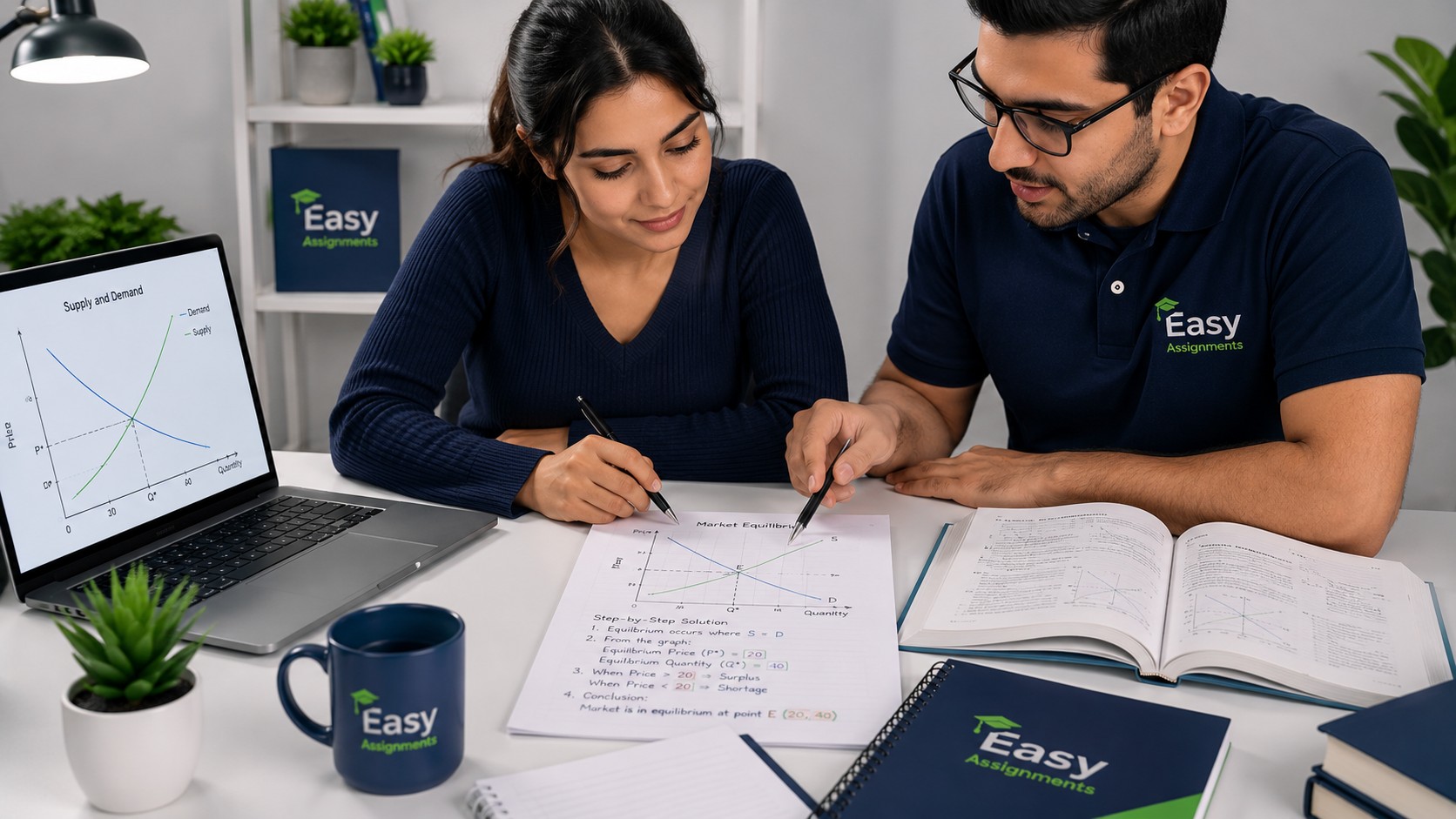
When you ask EasyAssignments to help do my economics homework, the goal is never to hand you a black box answer. It is to give you clear, correct, fully worked solutions that show the reasoning at every step, so the work doubles as a study resource for your exams. Economics is a subject where seeing the method done properly, once, can unlock a concept that lectures never quite made land.
Support spans the full range of economics coursework, from introductory microeconomics and macroeconomics through to advanced econometrics and specialized fields. Whether you are facing a routine problem set, a graph heavy diagram task, a policy essay, a data driven econometrics project, or a full research paper, the work is matched to your course level and to the specific instructions your professor set.
Micro and Macro Problem Sets
Step by step solutions to numerical and graphical questions, with the working shown so you can follow every move.
Graphs and Diagrams
Accurately drawn and clearly labeled curves that illustrate market outcomes exactly as your rubric expects.
Econometrics and Data
Model building, regression output, and careful interpretation using standard tools, written up in proper empirical style.
Essays and Reports
Well structured, properly referenced written work that applies economic theory to real policies and cases.
Every deliverable is built around your deadline and your exact requirements, and the emphasis stays on clarity you can learn from. If you have questions about your solution, you can raise them, because understanding the answer matters more than simply owning it. To get started, you can request a free quote or talk to the support team about what you need.
Avoiding Common Economics Homework Mistakes
Even strong students lose easy marks to a small set of recurring errors. Knowing them in advance is one of the cheapest grade boosts available.
- Shifting the wrong curve: confusing a shift of demand with a movement along it, or shifting supply when a determinant of demand changed, corrupts the entire answer.
- Ignoring units and bases: elasticity, growth rates, and index numbers all depend on getting the base right. A careless denominator produces a confident, wrong answer.
- Skipping the interpretation: stopping at a number without explaining its economic meaning leaves marks on the table in nearly every rubric.
- Memorizing instead of understanding: reciting a definition you cannot apply crumbles the moment the question is phrased in an unfamiliar way.
- Leaving graphs unlabeled: an unlabeled axis or curve can void an otherwise perfect diagram, because the grader cannot confirm you know what you drew.
- Starting too late: economics rewards thinking time. Rushed work compounds small errors, and a problem set attempted the night before it is due rarely reflects what you actually know.
A simple rule: if you cannot explain your answer out loud to a friend in plain English, you do not yet understand it well enough to reproduce it in an exam. Use that test on every problem you finish.
Building Long Term Confidence in Economics
Getting a single assignment done is a short term win. The deeper goal is to reach a point where the phrase do my economics homework stops being a plea and becomes a task you can handle with calm competence. That shift comes from consistency rather than intensity. Fifteen focused minutes of problem solving most days beats a single frantic multi hour session before a deadline.
Treat every assignment as practice for the exam, because that is exactly what it is. When you get help, use it as a worked example to study from, not as a substitute for your own thinking. Rebuild the solution yourself a day later from a blank page, and you will feel the concept move from something you recognized into something you own.
Economics has a reputation for being unforgiving, and for students who fall behind it can be. But it is also one of the most rewarding subjects to master, because it gives you a genuinely new way of seeing the world: the hidden trade offs behind every decision, the ripple effects of every policy, the quiet logic of markets. Push through the hard early weeks with good habits and the right support, and the subject that once felt impossible becomes one of the most interesting tools you will ever carry.
Frequently Asked Questions
Can you do my economics homework if it is due very soon?
Yes. Tight deadlines are one of the most common reasons students reach out, and work is built around your due date. Share the deadline and the exact requirements upfront through the free quote form so the timeline and scope can be confirmed before anything begins.
Do you cover both microeconomics and macroeconomics?
Both core branches are covered, along with econometrics and specialized fields such as international trade, labor, environmental economics, and game theory. Support spans everything from introductory courses to advanced postgraduate work.
Will I actually understand the solution, or just receive an answer?
Solutions are worked step by step with the reasoning and diagrams shown, so the deliverable doubles as a study resource. The aim is for you to be able to reproduce the method yourself, which is what protects you in closed book exams.
What kinds of economics assignments can you handle?
Problem sets, graph and diagram tasks, policy essays, case studies, econometrics and data projects, and longer research reports are all covered. If you are unsure whether your specific task fits, talk to the support team and describe what you need.
Ready to Get Your Economics Homework Done Right?
Whether you need a full worked solution tonight or steady support across the semester, EasyAssignments can help you understand the material and hit your deadline with confidence.