
Do My Economics Homework: Clear, Correct, and On Time
When you type "do my economics homework" into a search bar at 11pm the night before a deadline, you are usually looking for two things at once: a correct answer, and a way to understand how that answer was reached. This guide covers both, so you can hand in accurate work and actually learn from it.
Economics blends graphs, algebra, calculus, statistics, and written argument, which is exactly why it trips up so many students. Below you will find how quality economics help works, what to look for, common topics students struggle with, and how EasyAssignments approaches every order with clear, step by step solutions.
Why Students Search "Do My Economics Homework"
Economics has a reputation for being deceptively simple to read and genuinely hard to do. The lectures make intuitive sense, the textbook examples look tidy, and then the problem set arrives asking you to derive a demand function, solve for equilibrium under a price ceiling, and interpret the welfare loss, all before comparing it to a real world policy. That gap between reading and doing is where most students get stuck, and it is the single biggest reason people look for someone to help with their economics homework.
The subject sits at an awkward intersection. It is not pure math, so you cannot just crunch numbers and move on. It is not pure essay writing, so a well argued paragraph will not save you if your graph is wrong. And it is not pure statistics, yet upper level courses lean heavily on regression and data. To do economics homework well you often need all three skill sets working together in a single answer, which is a lot to ask of a student who is also juggling three other courses, a part time job, and a life.
There is also the pacing problem. Economics builds relentlessly. If you did not fully grasp elasticity in week three, then consumer surplus in week five feels shaky, and by the time tax incidence shows up in week eight you are quietly lost. Homework is where that accumulated confusion surfaces, usually under time pressure. Getting expert help on a tough assignment is often less about outsourcing and more about breaking a stuck point so the rest of the term does not collapse behind it.
The most common reasons students reach out
- A problem set is due in hours and one or two questions are blocking the whole thing.
- The graphs make sense in lecture but fall apart the moment you have to draw and shift them yourself.
- An econometrics assignment needs software, and the output means nothing without interpretation.
- English is a second language and the written analysis is harder than the economics itself.
- Several deadlines land in the same week and something has to give.
- You understand the concept but keep losing marks on presentation, structure, or referencing.
None of these are signs that you are bad at economics. They are ordinary, predictable friction points in a demanding subject. The goal of good homework help is to remove the friction while leaving you better equipped for the exam, where nobody can do the work for you.
The healthy way to use help: treat a completed, fully worked solution as a model answer. Read how the derivation flows, why each graph shifts the way it does, and how the conclusion connects back to the question. Used this way, one well explained assignment can teach you more than a week of re reading the textbook.

What "Do My Economics Homework" Should Actually Include
Not all help is equal. A dumped final answer with no working is close to useless: it will not survive a follow up question in class, it teaches you nothing, and it is easy for an instructor to spot. Quality economics homework help should read like the answer your best professor would write if they had time to be generous with explanation. Here is what that looks like in practice.
Fully worked solutions, not just answers
Every numerical result should show its steps. If the task is to find equilibrium price and quantity, you should see the demand and supply equations set equal, the algebra to isolate the variable, the substitution back to find the other, and a sentence confirming what the numbers mean. The working is the part you learn from, and it is the part that proves the answer is correct rather than guessed.
Clean, correctly labelled graphs
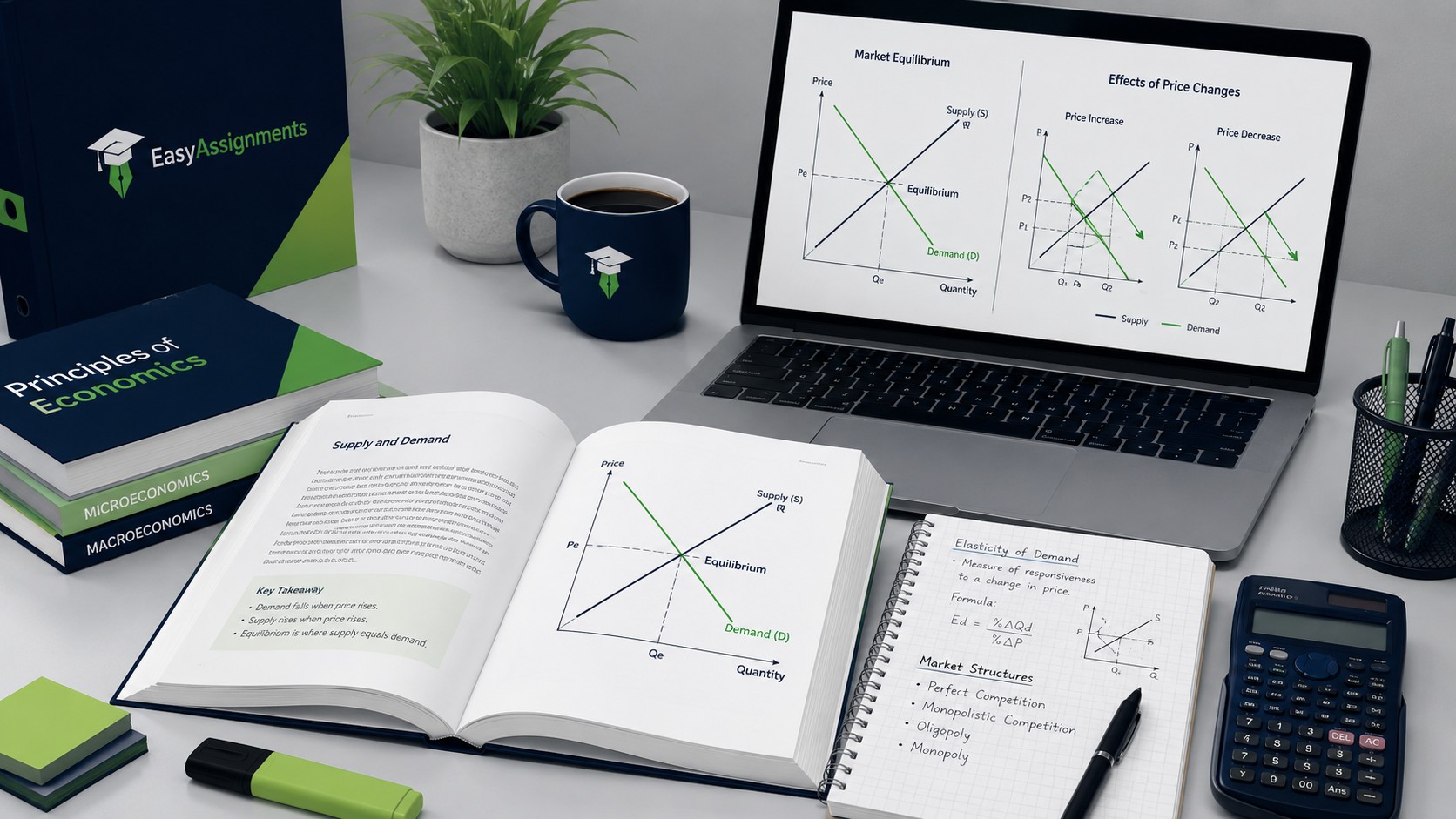
So much of economics is visual. A good solution includes graphs with labelled axes, clearly named curves, marked equilibrium points, and shaded areas for surplus, deadweight loss, or tax revenue where relevant. A shift should be shown as a distinct new curve with an arrow or a second label, not a vague redrawing. If your homework asks you to illustrate the effect of a subsidy, the graph should make that effect obvious at a glance.
Interpretation and written analysis
Numbers and graphs answer "what happened." Economics also demands "so what." Strong homework explains the intuition: why demand is inelastic for necessities, why a binding price ceiling creates shortage, why a country might run a trade deficit without economic disaster. This written layer is where marks are won or lost in essay style questions and it is the part students most often underdo.
Correct referencing and academic formatting
If your assignment cites data, theory, or policy, it needs proper referencing in the style your course requires, whether APA, Harvard, MLA, or Chicago. Figures should be numbered, tables captioned, and sources listed. Presentation marks are easy marks, and losing them on an otherwise correct answer is frustrating and avoidable.
A quick caution: always check your institution's academic integrity policy before submitting outside help as your own. Use worked solutions to learn, to check your own attempt, and to understand method. Passing off work you do not understand is risky and, more importantly, leaves you exposed in exams where you are on your own.
Economics Topics We Help With Most
Economics is a wide field, and the trouble spots tend to cluster around a predictable set of topics. Whatever your level, from introductory principles to a final year dissertation chapter, the core areas below are where most homework requests land.
Microeconomics
Microeconomics studies individual decision makers: consumers, firms, and markets. It is graph heavy and model driven, and small mistakes compound quickly. Common homework topics include:
- Supply, demand, and market equilibrium, including shifts and comparative statics.
- Elasticity of demand and supply, and how it drives revenue and tax burden.
- Consumer theory: utility, indifference curves, budget constraints, and optimisation.
- Production and cost curves, including short run and long run distinctions.
- Market structures: perfect competition, monopoly, oligopoly, and monopolistic competition.
- Welfare analysis: consumer and producer surplus, deadweight loss, price floors and ceilings.
- Game theory basics, including dominant strategies and Nash equilibrium.
Macroeconomics
Macroeconomics zooms out to the whole economy: growth, inflation, unemployment, and policy. It rewards students who can connect models to real world events. Frequent homework areas include:
- National income accounting and GDP calculation.
- Aggregate demand and aggregate supply, and shifts in each.
- The IS-LM model and its extensions.
- Fiscal and monetary policy, and how they interact.
- Inflation, the Phillips curve, and unemployment types.
- Exchange rates, balance of payments, and open economy models.
- Economic growth models, including the Solow framework.
Econometrics and quantitative methods
This is where many students hit a wall, because it combines statistics, software, and interpretation. Homework here often involves running models and, crucially, explaining what the output means. Typical requests cover:
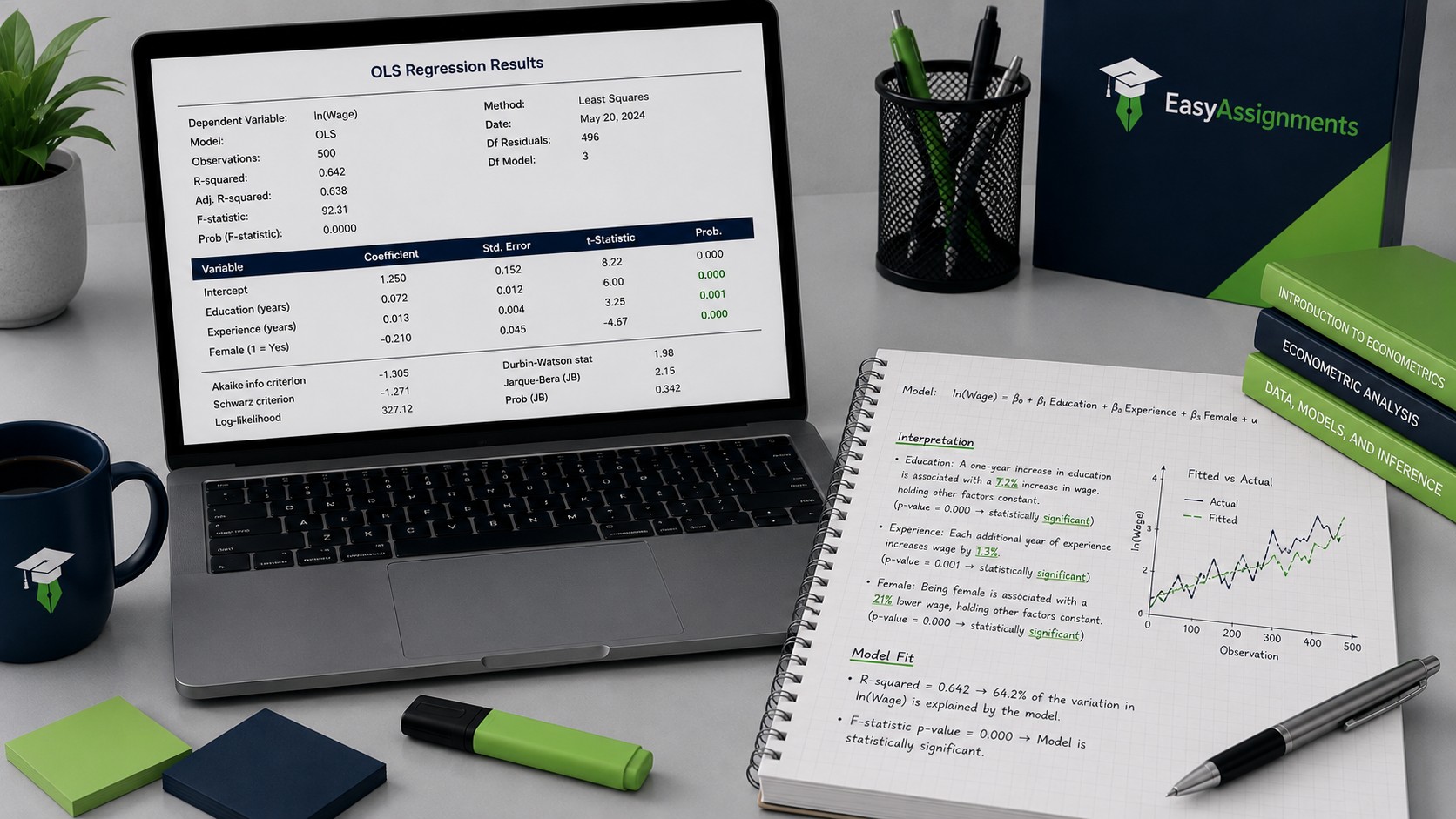
- Simple and multiple linear regression, including reading coefficients and p values.
- Hypothesis testing, confidence intervals, and statistical significance.
- Diagnosing and correcting heteroskedasticity, autocorrelation, and multicollinearity.
- Time series analysis and forecasting.
- Working in software such as Stata, R, EViews, SPSS, or Excel.
- Interpreting results in plain language and tying them back to economic theory.
Applied and specialist fields
Beyond the core three, coursework often branches into applied areas that carry their own vocabulary and models. These include international trade and finance, labour economics, public finance and taxation, environmental and resource economics, health economics, development economics, behavioural economics, and industrial organisation. Each has standard homework patterns, and help is most valuable when it shows how the general tools you already know apply to the specific field.
Stuck on a problem set tonight?
Send us the questions and your deadline, and get a clear quote with fully worked, explained solutions. No guesswork, no vague answers.
How the Process Works, Step by Step
Getting help should be simple and predictable, especially when a deadline is looming. A good workflow removes uncertainty so you know exactly what happens after you hit send. Here is the typical path from stuck to solved.
1. Share the details
Send the full assignment: every question, any data files, the marking rubric if you have one, the required referencing style, and your deadline. The more context you give, the more accurately the work can match what your instructor expects. A screenshot of a single question is fine for a quick check, but a full brief gets a full solution.
2. Get a clear quote
You should receive a transparent quote based on the length, difficulty, and turnaround, with no surprise charges added later. This is the moment to confirm scope: which questions are included, what format the deliverable takes, and when it lands.
3. Work gets done and checked
The solution is prepared with full working, labelled graphs, and written interpretation, then checked for accuracy and originality. Referencing is added where needed and formatting is cleaned up so the deliverable is ready to read.
4. Review and request revisions
You get the completed work with time to review it. If something is unclear or a question needs adjusting to match a specific lecture approach, you can ask for revisions. The aim is that you not only have the answer but understand it well enough to defend it.
Tip: the earlier you send an assignment, the cheaper and calmer the whole process is. Rush jobs cost more and leave no room for revision. If you can see a hard week coming, send the work as soon as it is set, not the night before it is due.
Doing It Yourself vs Getting Help
Sometimes you should push through a problem alone, and sometimes reaching out is the smarter move. The honest answer depends on why you are stuck, how much time you have, and what the assignment is worth. The table below lays out the trade offs.
| Situation | Do it yourself | Get expert help |
|---|---|---|
| Low stakes practice set, plenty of time | Best choice. This is how you learn and build exam readiness. | Not needed yet; try first, then ask about specific stuck points. |
| One or two questions blocking a full assignment | Risky if the deadline is close and you are truly stuck. | A worked model of the hard parts unblocks the rest fast. |
| Econometrics task needing software you barely know | Steep learning curve under deadline pressure. | Efficient; you get output plus the interpretation to learn from. |
| High weight assignment, multiple deadlines same week | Overload risk; quality drops across everything. | Frees time and protects your grade where it matters most. |
| You understand it but lose marks on structure | Fine, but you keep repeating the same avoidable errors. | A model answer shows the formatting and structure to copy. |
The theme across every row is the same. Help is most valuable when it is targeted and when you engage with the result. The worst outcome is submitting something you cannot explain. The best outcome is using a clear solution to close a specific gap so you can do the next one yourself.
What Makes a Good Economics Solution
If you are comparing options, or just want to know whether the help you received was any good, judge it against the qualities below. These are the marks of work that will hold up in class and teach you something.
Accuracy
The economics is correct, the algebra checks out, and the conclusions follow logically from the model. No shortcuts that fall apart under scrutiny.
Clarity
Steps are shown, graphs are labelled, and the reasoning is explained in plain language you can follow and reproduce yourself.
Originality
The work is written for your specific question, checked for plagiarism, and free of recycled boilerplate that graders recognise instantly.
On time
Delivered with enough margin to review, ask questions, and request a revision before your actual deadline arrives.
How to Get More From Every Assignment
Whether you do the work yourself or get support, a few habits turn homework from a chore into genuine exam preparation. Economics is a cumulative subject, so the effort you put in early pays off repeatedly later.
- Attempt each question yourself first, even partially, so you know exactly where your understanding breaks.
- When you receive a worked solution, redraw the graphs and redo the algebra by hand before moving on.
- Write a one line summary of the intuition for each problem, the "so what" in plain English.
- Keep a running list of the formulas and model results you keep forgetting, and review it before exams.
- Notice which topics you outsource repeatedly; that pattern points straight at your weak spots.
- Connect models to current events, because macro especially makes far more sense against a real backdrop.
Do this consistently and the payoff shows up where it counts. Come exam season, you will not be relearning the whole term, because you will have understood each piece as it arrived rather than filing it away unexamined.
Frequently Asked Questions
Can you do my economics homework by tonight?
Often yes, depending on length and difficulty. Short problem sets can turn around in a few hours, while longer or data heavy tasks need more lead time. Send the full brief and your deadline for an honest answer on what is realistic, rather than a promise that risks quality.
Will I get the working, or just the final answers?
You should always get full working: the steps, labelled graphs, and written interpretation, not just a number at the bottom. That is what lets you check the answer, learn the method, and defend the work if a question comes up in class.
Do you cover econometrics and software like Stata or R?
Yes. Econometrics help includes running the models in the software your course uses, then explaining the output in plain language: what each coefficient means, whether results are significant, and how it all ties back to economic theory.
Is using economics homework help allowed?
Policies vary by institution, so check your own academic integrity rules. Using worked solutions to learn, to check your own attempts, and to understand method is a sound study strategy. Always make sure any work you submit reflects your genuine understanding.
Get Your Economics Homework Done Right
Clear working, correct graphs, and explanations you can actually learn from. Send your assignment and deadline for a free quote today.