
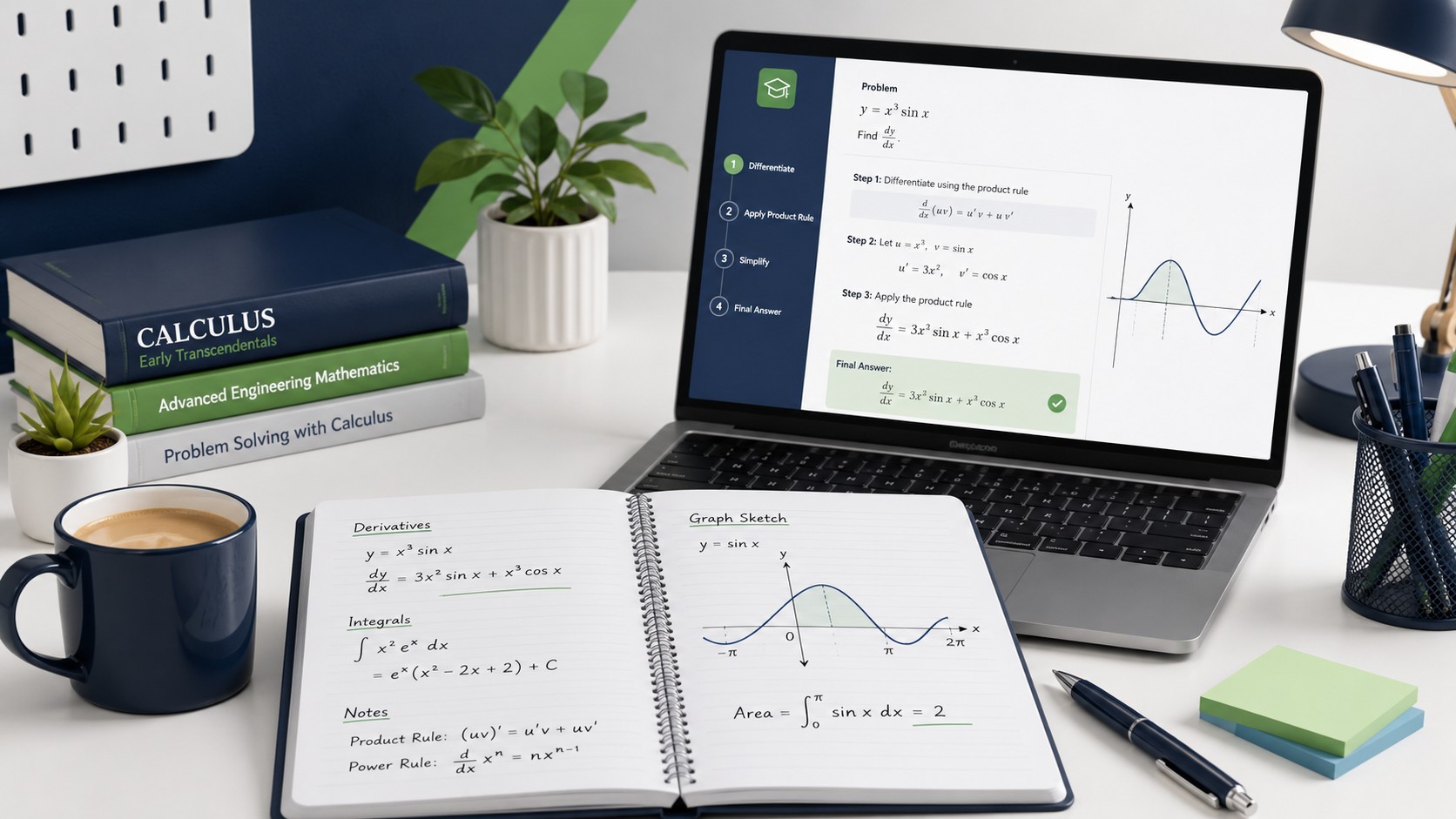
Calculus Assignment Help With Solved Examples
Limits, derivatives, and integrals can feel like a wall of symbols until someone shows you the pattern behind them. This guide delivers calculus assignment help with solved examples so you can see each method worked out step by step and apply it to your own homework.
Whether you are stuck on a single problem set or the whole course feels overwhelming, the strategies below are built to make calculus predictable, repeatable, and far less stressful.
Why Calculus Assignment Help With Solved Examples Actually Works
Most students do not fail calculus because they are bad at math. They struggle because the subject moves quickly, each new idea sits on top of the last, and a single missed concept can quietly undermine everything that follows. When your homework returns marked with red ink you rarely learn why the method was wrong, only that it was. That is the exact gap that calculus assignment help with solved examples is designed to close.
A solved example does something a formula sheet never can. It shows the reasoning between the lines: which rule was chosen, why it was chosen, and how each step connects to the next. Instead of memorizing an answer, you absorb a repeatable process. Once you can follow the logic of one worked problem, you can usually reproduce it on a dozen similar ones. That is the difference between cramming and genuine understanding.
Calculus is fundamentally the mathematics of change and accumulation. Differential calculus studies how quantities change at an instant, while integral calculus studies how small pieces add up to a whole. Nearly every topic you will meet, from optimization to area under a curve, is a variation on those two ideas. Keeping that big picture in mind makes individual problems feel less like isolated puzzles and more like familiar patterns.
Key idea: Do not just read a solved example. Cover the answer, attempt each step yourself, then reveal the next line to check. Active recall turns a passive example into real practice, and that is where the actual learning happens.
The Core Topics Your Calculus Assignments Will Cover
Almost every introductory calculus course follows the same skeleton. If you understand how these building blocks fit together, you can predict what kind of question is coming and which tool to reach for. Here are the pillars that show up in the majority of assignments.
Limits and Continuity
Limits describe what a function approaches as the input gets close to a particular value, even if the function is not defined exactly at that point. They are the foundation of the entire subject because both derivatives and integrals are defined using limits. Continuity simply asks whether you can draw the function without lifting your pen: no gaps, no jumps, no holes.
Derivatives and Differentiation
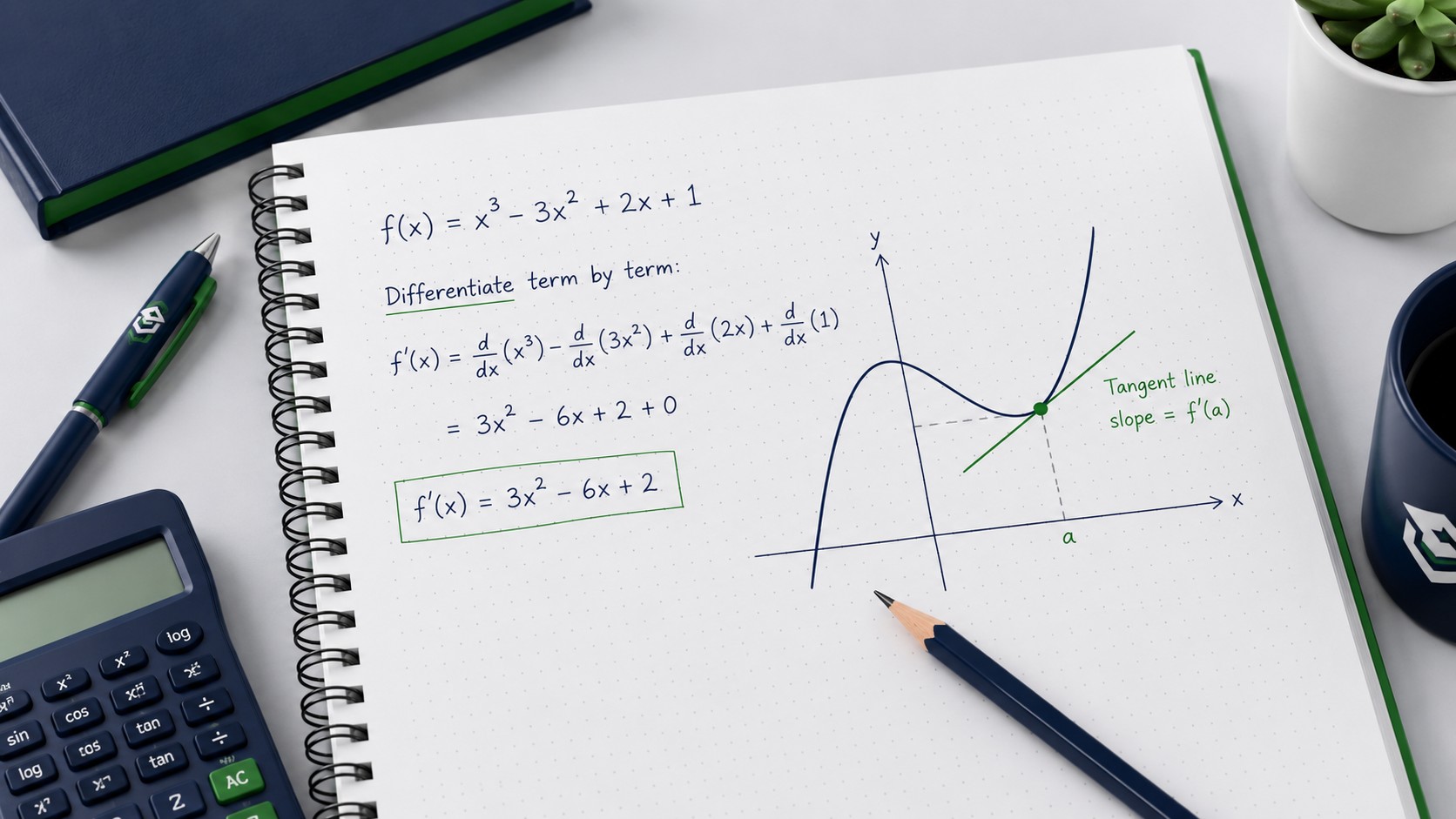
The derivative measures the instantaneous rate of change of a function, which geometrically is the slope of the tangent line at a point. This is the engine of differential calculus, and most of your early homework will be about learning the rules that let you differentiate quickly and correctly: the power rule, product rule, quotient rule, and chain rule.
Applications of Derivatives
Once you can differentiate, you unlock a whole class of practical problems. These include finding maximum and minimum values (optimization), analyzing where a function increases or decreases, locating points of inflection, and solving related rates questions where two changing quantities are linked.
Integrals and Integration
Integration is the reverse of differentiation and the heart of integral calculus. The indefinite integral recovers a function from its rate of change, while the definite integral computes accumulated quantities such as area under a curve, total distance, or volume. The Fundamental Theorem of Calculus is the bridge that ties differentiation and integration together into one coherent framework.
Solved Example 1: Finding a Limit
Consider the limit of the function f(x) = (x squared minus 4) divided by (x minus 2) as x approaches 2. If you substitute x = 2 directly, you get 0 divided by 0, which is an indeterminate form. That does not mean the limit fails to exist; it means you need to simplify first.
Start by factoring the numerator. The expression x squared minus 4 is a difference of squares, so it factors into (x minus 2) times (x plus 2). The function becomes (x minus 2)(x plus 2) divided by (x minus 2). Cancel the common factor of (x minus 2), and you are left with x plus 2. Now substitute x = 2 into the simplified expression to get 2 plus 2, which equals 4. The limit is 4.
The lesson here is universal: when direct substitution gives an indeterminate form, look for algebra to rescue you. Factoring, rationalizing, or simplifying complex fractions will usually reveal a limit that was hiding behind a removable discontinuity.
Solved Example 2: Applying the Chain Rule
Suppose you need the derivative of y = (3x plus 1) raised to the power of 5. This is a composite function, an outer power wrapped around an inner linear expression, so the chain rule applies. The chain rule says you differentiate the outer function while keeping the inside intact, then multiply by the derivative of the inside.
First, treat the whole bracket as a single unit and apply the power rule to the outside: bring down the exponent 5 and reduce the power by one, giving 5 times (3x plus 1) to the power of 4. Next, differentiate the inside expression 3x plus 1, whose derivative is simply 3. Multiply these together to get 15 times (3x plus 1) to the power of 4. That product is your final derivative.
Common mistake: Many students correctly differentiate the outer function but forget to multiply by the derivative of the inside. Skipping that final multiplication is one of the most frequent chain rule errors, so always ask yourself: did I account for the inside?
Solved Example 3: A Basic Integral
Now evaluate the indefinite integral of the function 6x squared plus 4x. Integration undoes differentiation, so for each term you raise the exponent by one and divide by the new exponent. For the term 6x squared, raise the power to 3 and divide by 3, which gives 2x cubed. For the term 4x, raise the power to 2 and divide by 2, which gives 2x squared.
Because the derivative of any constant is zero, indefinite integrals always carry a constant of integration, written as plus C, to account for every possible antiderivative. Putting it together, the integral of 6x squared plus 4x is 2x cubed plus 2x squared plus C. You can always verify an integral by differentiating your answer: differentiate 2x cubed plus 2x squared and you return to 6x squared plus 4x, confirming the result.
Pro tip: Every antiderivative can be checked by differentiating it. If you differentiate your answer and land back on the original integrand, your integration is correct. This self-check costs seconds and catches most errors before you submit.
A Step-by-Step Framework for Any Calculus Problem
Beyond individual techniques, the students who do well tend to share a consistent approach. When you sit down with an unfamiliar problem, working through a fixed sequence keeps panic away and reduces careless mistakes. Use the framework below as your default routine.
- Read the problem twice and identify exactly what is being asked: a value, a function, a rate, or an area.
- Classify the problem type so you know which family of methods applies, such as a limit, a derivative, or an integral.
- Choose the specific rule or technique, then write down the general form before plugging in numbers.
- Work in small, labeled steps so a grader can follow your reasoning and award partial credit.
- Simplify carefully and watch signs, exponents, and fractions, which is where most silent errors creep in.
- Verify your answer by substitution, differentiation, or a quick sanity check on the expected size and units.
Stuck on a Problem Set Tonight?
Send us the assignment and get a clear, worked solution you can actually learn from. Every step is explained so you understand the method, not just the answer.
Comparing the Main Branches of Calculus
Students often blur the line between differentiation and integration, which leads to reaching for the wrong tool under pressure. The table below lays the two branches side by side so you can quickly recognize which one a question is really asking for.
| Aspect | Differential Calculus | Integral Calculus |
|---|---|---|
| Core question | How fast is something changing right now? | How much accumulates over an interval? |
| Main operation | Differentiation (finding the derivative) | Integration (finding the antiderivative) |
| Geometric meaning | Slope of the tangent line | Area under the curve |
| Typical problems | Optimization, related rates, rate of change | Area, volume, total distance, average value |
| Key theorem | Definition via the limit of a difference quotient | Fundamental Theorem of Calculus |
Common Mistakes That Cost Students Easy Marks
A surprising amount of lost credit has nothing to do with not knowing calculus. It comes from small, avoidable slips that repeat across an entire assignment. Recognizing your own pattern of errors is one of the fastest ways to raise a grade.
Forgetting the Constant of Integration
Indefinite integrals always need a plus C. Dropping it is a classic error that graders notice immediately, and it signals a shaky grasp of what an antiderivative represents.
Mishandling the Chain Rule
Composite functions require differentiating the inside as well as the outside. Missing that inner derivative, or applying the chain rule when it is not needed, causes a large share of derivative mistakes.
Sign and Algebra Errors
A dropped negative sign or a mistyped exponent can derail an otherwise perfect solution. Because calculus problems are multi-step, one early algebra slip contaminates everything after it, so slow down on the arithmetic.
Skipping Steps
Jumping to the answer might feel efficient, but it removes the reasoning a grader needs to award partial credit and makes your own mistakes impossible to trace. Showing your work protects your marks.

How to Study Calculus So the Concepts Stick
Reading solutions is a starting point, but calculus rewards active, spaced practice more than almost any other subject. The habits below turn short study sessions into lasting understanding and steadier exam performance.
- Practice a mix of problem types every session rather than drilling a single method until it feels easy, since exams interleave topics.
- Rework problems you got wrong from scratch a day or two later, without looking at the solution, to confirm the method truly stuck.
- Explain a worked example out loud as if teaching a classmate; if you cannot narrate a step, you have found the gap to study.
- Keep a personal error log noting the mistakes you repeat, then review it before tests to catch your specific weak spots.
- Build fluency with the underlying algebra and trigonometry, because most calculus errors are actually pre-calculus errors in disguise.
What Good Calculus Assignment Help Looks Like
Not all help is equal. Copying a final answer teaches you nothing and puts you at risk when the same idea appears on a closed-book exam. The support worth having focuses on your understanding and your ability to reproduce the method independently. Here is what to look for.
Fully Worked Steps
Every solution should show the reasoning line by line, not just a boxed final answer, so you can learn the process and apply it yourself.
Clear Explanations
Good help explains why a particular rule was chosen at each stage, turning a one-off solution into a transferable skill.
Accuracy and Checking
Solutions should be verified, with derivatives and integrals checked by reversing the operation to confirm the result holds.
On-Time Delivery
Calculus homework is deadline-driven, so reliable, punctual delivery matters as much as the quality of the work itself.
At EasyAssignments, the goal is to hand back solutions you can genuinely learn from. That means every step is explained, every answer is checked, and the work is delivered on time so you have room to review it before your own deadline. If you would like a worked example tailored to your exact problem set, you can get a free quote or talk to support whenever you need it.
Frequently Asked Questions
Can I get calculus assignment help with solved examples for any topic?
Yes. Support covers the full range of introductory and advanced topics, including limits, derivatives, integrals, applications, sequences, series, and multivariable calculus. Each solution is worked out step by step so you can follow and reuse the method on similar problems.
Will the solutions actually help me learn, or just give me answers?
The aim is understanding, not just a final answer. Every solution is explained line by line, showing which rule was applied and why, so you can reproduce the approach yourself on an exam or the next assignment.
How do I check whether my own calculus answer is correct?
For derivatives, compare against the standard rules and re-derive carefully. For integrals, differentiate your answer: if you return to the original expression, your integration is right. This reverse-check catches most mistakes in seconds.
What is the fastest way to improve at calculus?
Practice a mix of problem types regularly, rework the problems you got wrong without looking at solutions, and shore up your algebra and trigonometry. Consistent, active practice beats last-minute cramming for a subject where each concept builds on the last.
Turn Confusing Calculus Into Clear, Confident Work
Get calculus assignment help with solved examples that explain every step, so you understand the method and hit your deadline with confidence.