Reliable C# Assignment Help for Programming Students
C# assignment help gives you a clear path through .NET projects, object-oriented programming, and the tricky logic problems that eat up your evenings. Whether you are just learning classes and objects or wrestling with LINQ, async code, and Entity Framework, expert guidance helps you submit clean, working code on time.
This guide explains what makes C# coursework hard, the concepts your instructors care about most, the mistakes that cost easy marks, and how EasyAssignments supports you from your first console app to a full WPF or ASP.NET project.
Why C# Assignment Help Matters for Students
C# is one of the most widely taught languages in computer science and software engineering programs, and for good reason. It sits at the center of Microsoft's .NET ecosystem and powers everything from desktop applications and web services to games built in Unity. That breadth is exactly why students seek C# assignment help: a single course can ask you to build a console calculator one week and a database-driven web app the next, with each project introducing new syntax, new libraries, and new ways for small mistakes to break the whole thing.
Unlike scripting languages that let you improvise, C# is strongly typed and object-oriented from the ground up. That structure rewards good design and punishes shortcuts. A missing semicolon, a mismatched type, or a misunderstood reference can turn a two-hour task into a two-day debugging marathon. When deadlines pile up across several courses, even capable students fall behind, not because they lack ability, but because they lack time to untangle every compiler error and edge case.
Getting expert help is not about skipping the learning. Done well, it is about seeing a correct, well-structured solution, understanding why it works, and carrying that understanding into your exams and future projects. A good solution is a teaching tool: readable variable names, sensible class boundaries, and comments that explain intent all show you how professionals actually write C#.
The goal is understanding, not just submission. Quality C# assignment help delivers code you can read, run, and explain, so the marks you earn reflect real learning you can repeat on your own.
Core C# Concepts That Trip Students Up
Most C# assignments test a handful of foundational ideas. If you can recognize which concept a task is really about, you are halfway to solving it. Below are the areas where students most often get stuck, and what your instructors are usually looking for when they grade.
Object-Oriented Programming Fundamentals
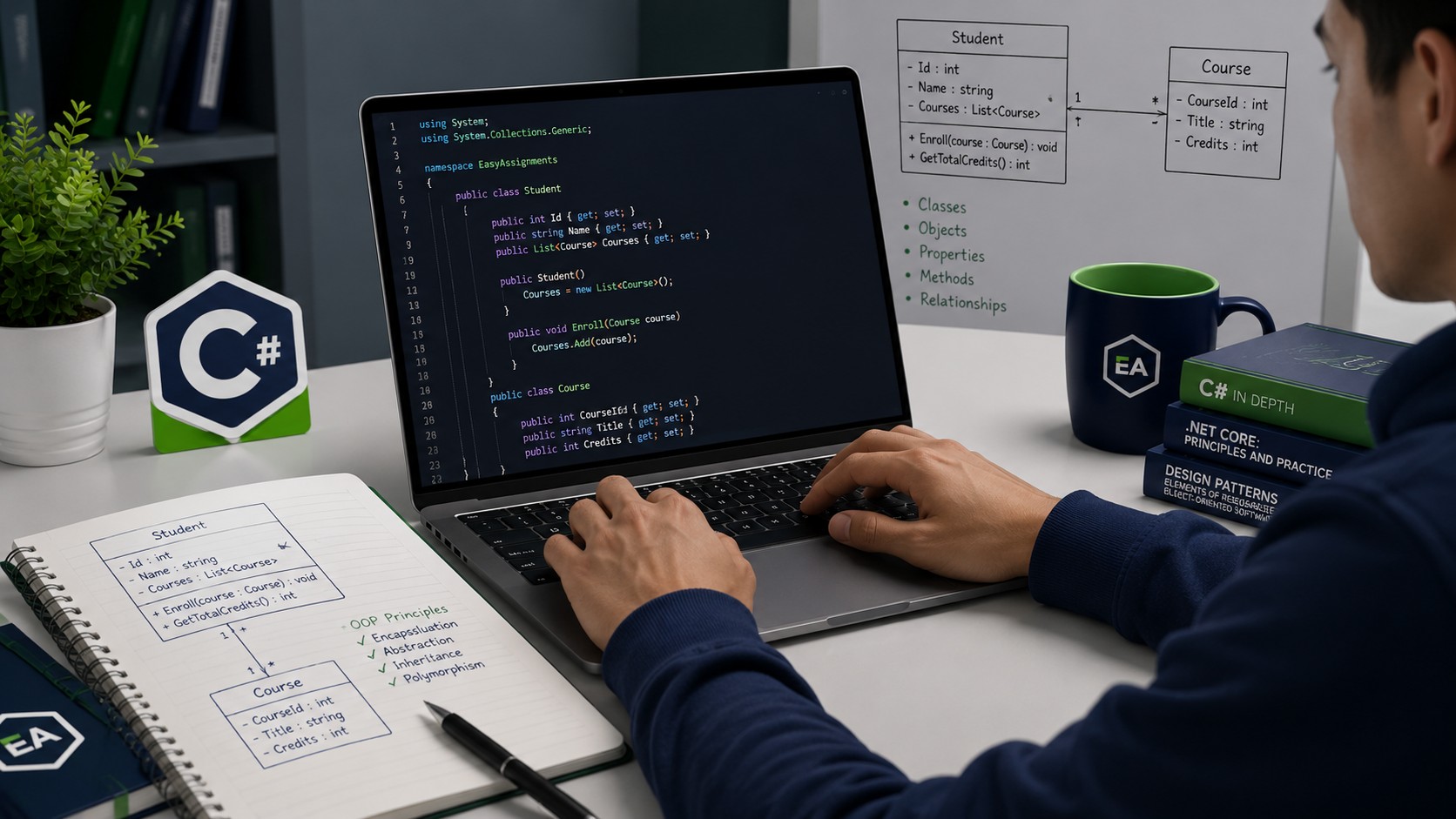
C# is built around classes and objects, and nearly every assignment beyond the basics expects you to model a problem with them. The four pillars of object-oriented programming, encapsulation, inheritance, polymorphism, and abstraction, appear again and again. Encapsulation means keeping fields private and exposing controlled access through properties and methods. Inheritance lets a class reuse and extend another class. Polymorphism allows objects of different types to be treated through a shared base type or interface. Abstraction hides messy detail behind a clean interface.
Students often lose marks not because they cannot write a class, but because their design is weak: everything crammed into one giant class, public fields exposed everywhere, or inheritance used where composition would be cleaner. Graders reward clear responsibilities, sensible naming, and code that would be easy for another developer to extend.
Value Types, Reference Types, and Memory
One of the most common sources of confusing bugs is the difference between value types and reference types. Structs and primitives like int and double are value types, copied when assigned. Classes are reference types, so two variables can point to the same object, and changing one changes the other. Misunderstanding this leads to bugs where data mutates unexpectedly. Understanding how the stack and heap work, and when objects are garbage collected, helps you reason about performance and avoid subtle errors.
Collections, Generics, and LINQ
Real programs manage lists of data, and C# offers a rich set of collections such as List, Dictionary, and arrays. Generics let you write type-safe reusable code, so a List holds only Product objects and the compiler catches mistakes early. LINQ, Language Integrated Query, is a favorite of instructors because it expresses filtering, sorting, and grouping in a compact, readable way. Assignments frequently ask you to query data with LINQ instead of writing long loops, and mastering it is a fast way to raise the quality of your submissions.
Exception Handling and Robust Code
Beginner code assumes everything goes right. Graded code has to handle the moment a user types letters into a number field or a file is missing. Proper use of try, catch, and finally blocks, along with meaningful error messages and validation, separates a passing submission from a strong one. Instructors often reserve marks specifically for input validation and graceful failure.
Asynchronous Programming
Modern C# leans heavily on async and await for tasks that involve waiting, such as reading files, calling web services, or querying databases. This trips up many students because the flow of execution is no longer strictly top to bottom. Understanding tasks, awaiting them correctly, and avoiding blocking calls is essential for web and desktop assignments, and it is a concept that rewards careful, patient study.
Common Types of C# Assignments
C# coursework spans an enormous range, which is why generic tutorials often fall short. Here are the categories students most often need C# assignment help with, from introductory tasks to advanced applications.
Console Applications
Early assignments focus on logic, loops, conditionals, and methods through text-based programs like calculators, number games, and simple menu systems that build core fluency.
OOP Design Projects
Mid-level tasks ask you to model real systems, such as a library, bank, or inventory, using classes, inheritance, interfaces, and clean separation of concerns.
Desktop Apps (WinForms/WPF)
Graphical applications add event handling, data binding, and user interface layout, blending logic with usability and often connecting to stored data.
Web and Database Projects
Advanced work uses ASP.NET, Entity Framework, and databases to build full applications with authentication, CRUD operations, and real data persistence.
Each category demands a different mix of skills. A console app is mostly logic, while a WPF or ASP.NET project asks you to coordinate many moving parts. Knowing which type of assignment you have helps you plan your time and identify exactly where you need support.
Common Mistakes That Cost Easy Marks
Many students lose marks on issues that have nothing to do with the difficulty of the problem. Avoiding these habits alone can lift a grade noticeably.
- Ignoring the rubric and building features that were not asked for while missing required ones.
- Poor naming, where variables like x, temp, and data hide the meaning of the code from anyone reading it.
- No input validation, so the program crashes the moment a grader enters unexpected input.
- Copying code without understanding it, which falls apart under follow-up questions and viva assessments.
- Skipping comments and documentation that explain design decisions and how to run the program.
- Leaving compiler warnings unaddressed and submitting code that barely runs instead of code that runs cleanly.
- Hardcoding values that should be flexible, making the program brittle and hard to test.
Always check your submission against the rubric before you hand it in. A working program that ignores half the requirements often scores lower than a simpler one that ticks every box the instructor listed.
How EasyAssignments Approaches C# Help
Effective C# assignment help is more than handing over a finished file. The most useful support treats your assignment as a chance to build skills you will keep. That means solutions written the way an experienced developer would write them, with structure and clarity that make the code easy to follow and explain.
Requirement Analysis First
Every good solution starts by reading the brief carefully. What is the program supposed to do? What inputs and outputs are specified? Which concepts must the code demonstrate, and how will it be graded? Aligning to the rubric from the start avoids wasted effort and missed marks.
Clean, Documented Code
Working code is only half the job. Readable code, with meaningful names, logical class structure, and comments that explain intent, is what earns full marks and helps you understand what you are submitting. Well-organized code also makes debugging far easier when something needs to change.
Testing and Debugging
Code should be tested against normal cases, edge cases, and invalid input before it is considered done. Catching a crash on empty input or a wrong result on a boundary value before submission is exactly what separates a polished assignment from a rushed one.
Explanations You Can Learn From
The real value comes when you can explain the solution yourself. Clear guidance on why a design choice was made, how a LINQ query works, or why an exception is handled a certain way turns a one-off submission into lasting understanding you can reuse in exams and later courses.
Stuck on a C# assignment right now?
Send us the brief and any starter files. We will review the requirements, tell you exactly what is involved, and give you a clear, no-obligation quote for expert C# assignment help.
C# vs Other Popular Languages
Students often wonder how C# compares to the other languages they are studying. Understanding the differences helps you appreciate why C# assignments look the way they do and where transferable skills apply.
| Feature | C# | Java | Python |
|---|---|---|---|
| Typing | Static, strongly typed | Static, strongly typed | Dynamic typing |
| Main ecosystem | .NET (Microsoft) | JVM | Broad, general purpose |
| Common uses | Desktop, web, games (Unity) | Enterprise, Android | Data, scripting, AI |
| Syntax style | C-family, curly braces | C-family, curly braces | Indentation based |
| Learning curve | Moderate | Moderate | Gentle at first |
| Standout features | LINQ, async/await, properties | Portability, mature libraries | Readability, fast prototyping |
C# and Java share a lot of syntax, so skills transfer easily between them. Python feels friendlier at first but leaves you without the compile-time safety net that catches many bugs in C#. The strong typing and rich tooling of C# are exactly why it is favored for large, maintainable applications, and why coursework emphasizes structure and design.
Tools You Should Know for C# Work
Part of doing well in C# is being comfortable with the tools professionals use. Familiarity with these makes your assignments faster to build and easier to debug.
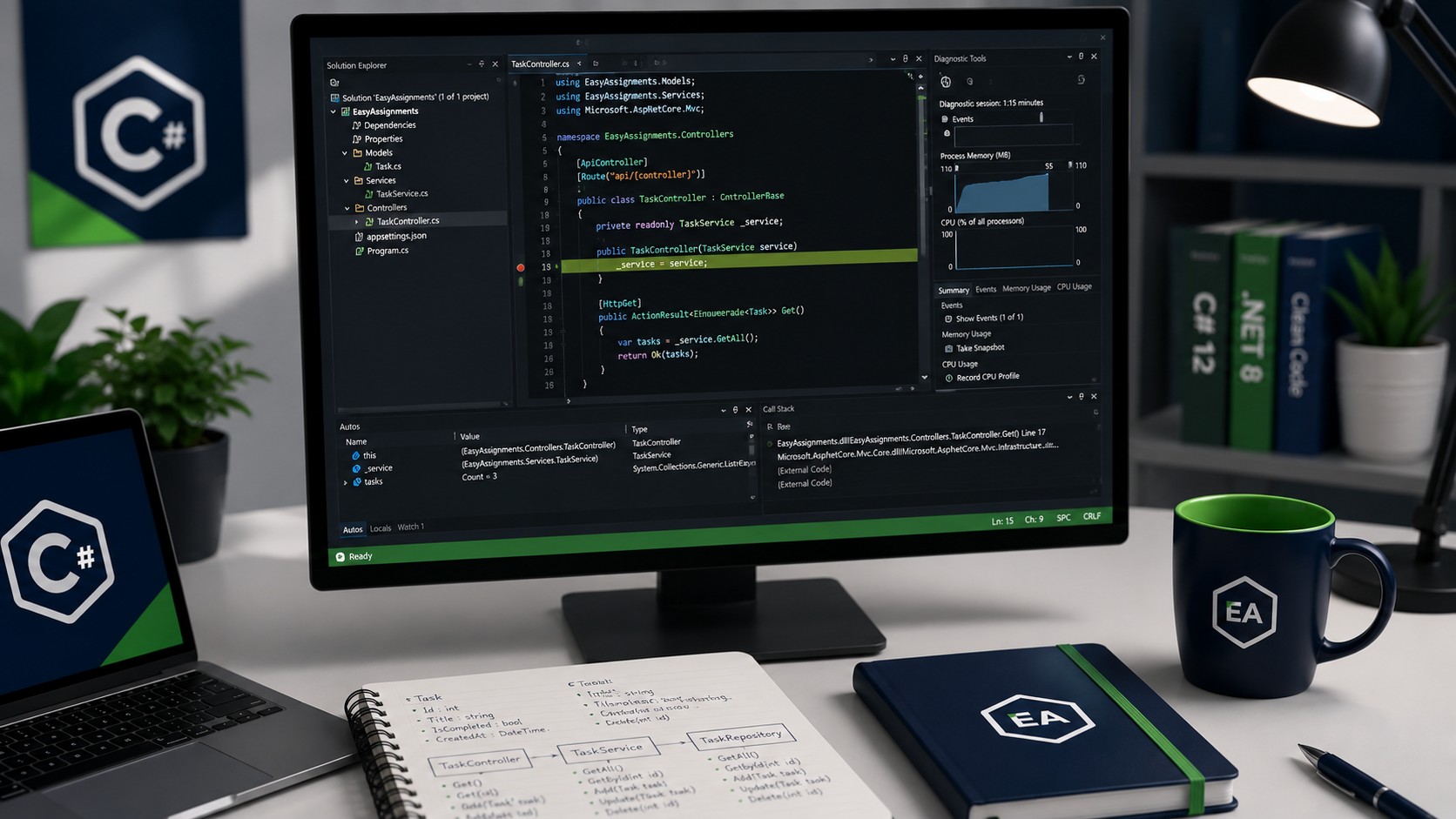
- Visual Studio, the full-featured IDE with powerful debugging, IntelliSense, and project templates for every kind of C# app.
- Visual Studio Code, a lighter editor popular for cross-platform .NET development with the C# extension.
- .NET SDK and the command-line tools for building, running, and testing projects outside the IDE.
- NuGet, the package manager that pulls in libraries such as Entity Framework or testing frameworks.
- The debugger, breakpoints, and watch windows, which are far more effective than scattering print statements through your code.
- Unit testing frameworks like xUnit or NUnit, which show graders that your code is verified, not just hopefully correct.
How to Get the Most From C# Assignment Help
Support works best when you engage with it actively. To turn help into lasting skill, follow a few simple habits every time you receive a solution.
- Read the completed solution line by line and make sure you understand each part before you rely on it.
- Run the program yourself, then change small pieces to see how the behavior shifts and deepen your grasp.
- Ask questions about anything unclear, from why an interface was used to how a loop was structured.
- Compare the solution to your own attempt to see exactly where your logic or design went wrong.
- Save well-written examples as references you can revisit when a similar problem appears in exams or later courses.
Treat every solution as a worked example. The students who improve fastest are the ones who study the reasoning behind the code, not just the output it produces.
Getting Started With EasyAssignments
Reaching out is straightforward. Share your assignment brief, any starter code, the deadline, and the concepts your course expects you to demonstrate. The more detail you provide, from the rubric to your instructor's specific instructions, the more precisely the solution can match what will earn you full marks. You can request a free quote through our order page or ask questions any time through support.
Whether you are staring at your first console program or a complex ASP.NET project due tomorrow, the right guidance helps you submit with confidence and actually understand what you handed in. C# rewards clear thinking and clean structure, and with expert help you can build both while keeping your grades on track.
Frequently Asked Questions
Is getting C# assignment help allowed by my university?
Using tutoring and guidance to learn is widely accepted, but every institution has its own academic integrity rules. Use the support to understand the material, learn from worked solutions, and improve your own skills rather than submitting work you cannot explain. When in doubt, check your course policy and use help as a learning aid.
What kinds of C# projects can you help with?
Support covers the full range, from beginner console applications and object-oriented design tasks to WinForms and WPF desktop apps, ASP.NET web projects, database work with Entity Framework, and even C# scripting in Unity. Whatever concept your course is testing, help is available for it.
Will the C# code actually run and be original?
Yes. Solutions are written to compile and run cleanly, tested against normal and edge cases, and produced originally for your specific brief. You receive readable, commented code you can run, study, and explain rather than copied fragments from elsewhere.
Can I get help with an urgent C# deadline?
Urgent requests are common and support is available around the clock. Send your brief as early as you can with the deadline clearly stated, and you will get a realistic quote and timeline. The sooner you reach out, the more room there is to deliver clean, well-tested work on time.
Ready to Master Your Next C# Assignment?
Get clean, working, well-explained C# code and the understanding to back it up. Reach out today for a free quote and expert C# assignment help.