
The Complete Assignment Writing Format for University Students
Every university submission is judged twice: once on what you say, and once on how it is presented. Getting the assignment writing format right is the fastest way to make sure your ideas are read the way you intended, and to avoid losing easy marks on structure, referencing, and layout.
This guide breaks the format down section by section, from the title page to the reference list, so you can hand in work that looks disciplined, reads clearly, and meets your department's expectations every single time.
Why the Assignment Writing Format Matters
When you submit work at university, your marker forms an impression before reading a single argument. A clean, correctly structured document signals that you understand academic conventions and respect the reader's time. A cluttered one, with inconsistent headings, missing citations, and no clear flow, makes even strong ideas harder to follow and easier to mark down. The assignment writing format is not decoration. It is the framework that carries your thinking from your head to the page in a way examiners can navigate quickly.
Formatting also protects you from avoidable penalties. Many departments deduct marks for missing reference lists, wrong citation styles, over-length submissions, or failure to follow a supplied template. These are marks you lose without ever being wrong about the subject. Learning the standard format once, and applying it consistently, removes a whole category of risk from every assignment you write for the rest of your degree.
There is a deeper benefit too. A well-structured document forces well-structured thinking. When you have to place a claim under a clear heading, support it in a dedicated paragraph, and tie it back to your central argument, weak or unsupported points become obvious. Good format is a thinking tool as much as a presentation tool, and the students who treat it seriously tend to produce sharper arguments as a result.
Understanding the Assignment Brief First
Before you format anything, read the brief closely. The single most common reason students lose marks is not poor writing but failure to answer the question that was actually set. Every instruction word carries weight. "Discuss" asks for balanced consideration of different views. "Analyse" asks you to break something into parts and examine how they relate. "Evaluate" asks for a judgement backed by evidence. "Compare and contrast" asks for similarities and differences, side by side. Formatting your answer around the wrong verb produces a well-presented document that misses the point.
Check the practical requirements as well. Note the word count and whether the reference list is included in it. Confirm the required referencing style, the accepted file format, the deadline and time zone, and whether your department provides a cover sheet or template. If a template exists, use it exactly as given. Fighting a required template to impose your own design almost never helps and often costs marks.
Quick tip: Turn the brief into a checklist before you start writing. List every requirement, including word count, referencing style, and file format, then tick each one off during your final review. This single habit prevents most format-related mark losses.
It also helps to identify the assignment type early, because format expectations differ. An essay flows as continuous prose with minimal headings. A report uses clearly labelled sections and sometimes numbered headings. A reflective piece may allow the first person and a more personal tone. A case study blends description with analysis. Knowing which shape your work should take stops you from applying essay conventions to a report, or vice versa.

The Standard Structure of a University Assignment
Most university assignments share a recognisable backbone: an introduction that sets up the task, a body that develops the argument, and a conclusion that draws it together. Around this core sit supporting elements such as a title page, contents page, and reference list. Understanding what each part does, and what belongs in it, lets you assemble any assignment quickly and confidently.
Title Page
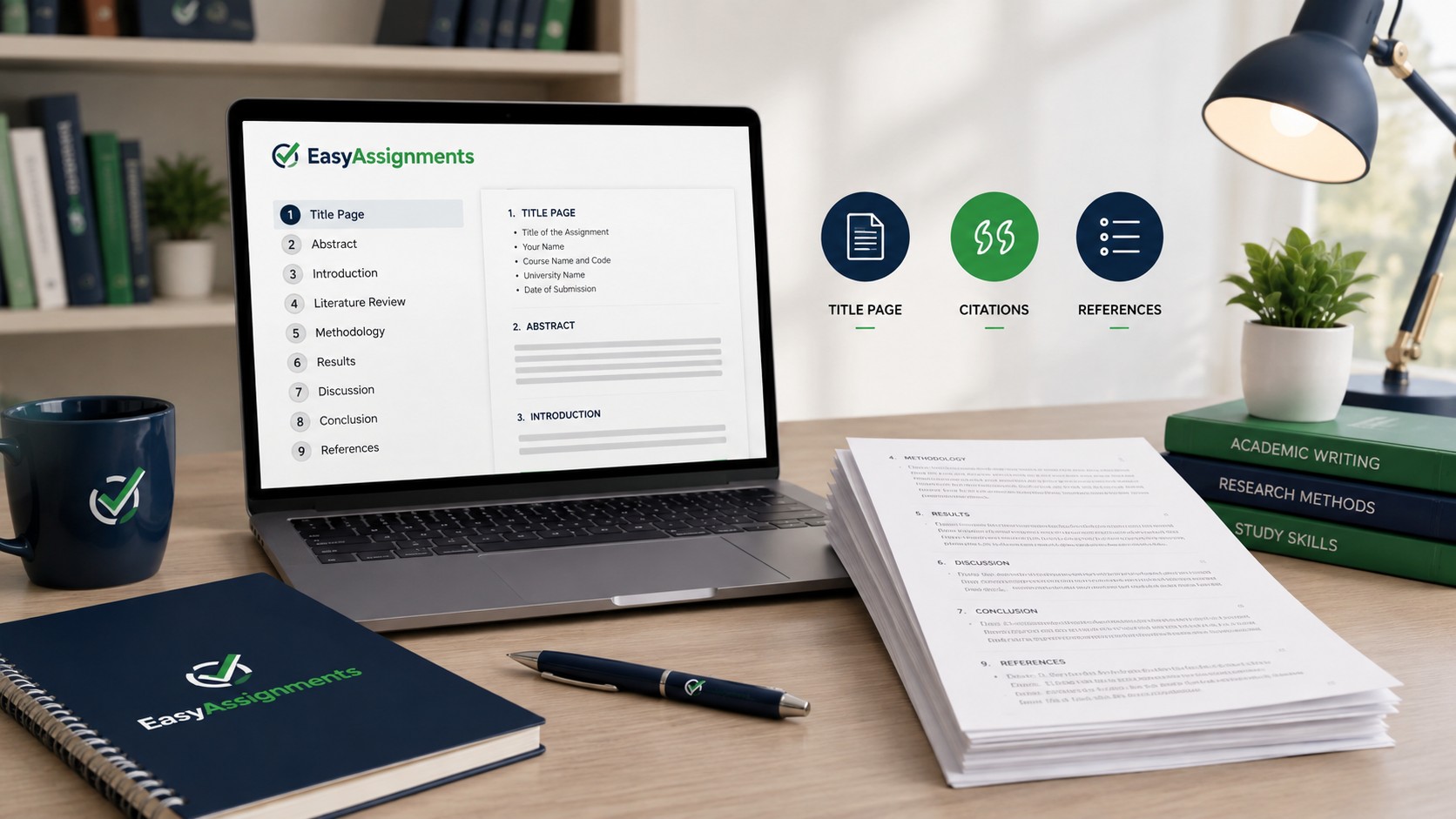
The title page is your first impression. At a minimum it should carry the assignment title, your name or student ID as required, the module or course code, the name of your tutor or marker, and the submission date. Some universities ask you to omit your name for anonymous marking and use only an ID number, so always follow local rules. Keep the layout clean and centred, avoid decorative fonts, and do not clutter the page with graphics.
Table of Contents
For longer assignments, especially reports and dissertations, a contents page helps the reader navigate. It lists your main headings and subheadings with page numbers. Generate it automatically from your heading styles rather than typing it by hand, so it stays accurate when your pagination changes. Short essays usually do not need one unless the brief asks for it.
Introduction
A strong introduction does three jobs. It introduces the topic and its relevance, it states the specific question or argument you will address, and it signposts how the assignment will unfold. Keep it focused and avoid drifting into general background that never connects to your task. As a rough guide, the introduction is often around ten percent of your total word count. End it with a clear thesis or purpose statement so the reader knows exactly what to expect.
Main Body
The body is where your argument lives, and it should be organised into logical paragraphs or sections, each dealing with one main idea. A reliable structure for each paragraph is a clear topic sentence, supporting evidence with citation, your own analysis of that evidence, and a link forward to the next point. For reports, the body is usually broken into labelled sections and subsections so the reader can move between themes easily. Whatever the format, every part of the body should visibly serve the central argument rather than wander off into loosely related material.
Conclusion
The conclusion draws your argument to a close. It restates your central answer in light of the evidence you presented, summarises the key points that support it, and, where appropriate, notes implications or areas for further study. A conclusion should not introduce brand new evidence or arguments. Its job is to leave the reader with a clear, confident sense of what your assignment established.
Reference List and Appendices
Every source you cited in the text must appear in the reference list, formatted in the required style and usually ordered alphabetically by author surname. Appendices hold supporting material that would interrupt the flow if placed in the body, such as raw data, questionnaires, or detailed tables. Refer to each appendix in the text so the reader knows why it is there.
| Section | Purpose | Rough Length Guide |
|---|---|---|
| Title Page | Identifies the work, author, module, and date | One page |
| Introduction | Sets up the topic, states the argument, signposts structure | Around 10% of word count |
| Main Body | Develops and supports the argument with evidence | Around 80% of word count |
| Conclusion | Restates the answer and summarises key points | Around 10% of word count |
| Reference List | Lists every cited source in the required style | As needed, usually excluded from count |
Page Layout and Formatting Standards
Presentation details are easy to get right and easy to forget under deadline pressure. Unless your brief says otherwise, a safe default is a clear, readable serif or sans-serif font such as Times New Roman or Arial at 11 or 12 point, with double or 1.5 line spacing. Set margins to around one inch on all sides, align text to the left rather than justifying it, which can create awkward gaps, and use consistent paragraph spacing throughout.
Number your pages, usually in the footer, and consider adding a simple header with your student ID or the module code if permitted. Use your word processor's built-in heading styles rather than manually enlarging and bolding text, because those styles keep formatting consistent, allow automatic contents generation, and make the document more accessible. Consistency is the guiding principle: pick your settings at the start and apply them across the whole document.
Watch out: If your department supplies a template or a specific style guide, it always overrides general advice like this. Check it first, and when the two conflict, follow your department. Ignoring a required template is one of the quickest ways to lose marks that have nothing to do with your actual writing.
Headings and Signposting
Headings guide the reader through your structure, but they work only when used consistently. Keep a clear hierarchy, with main headings for major sections and subheadings for the points within them, and format each level the same way throughout. Essays generally use few or no headings and rely on strong topic sentences to signal transitions, while reports lean on labelled and sometimes numbered headings. Signposting phrases within the text, such as noting that you will first examine one factor before turning to another, help the reader follow your reasoning without needing a heading at every turn.
Referencing and Citation Styles
Referencing is where format and academic integrity meet. Citing your sources correctly shows where your evidence comes from, lets readers trace your research, and protects you from accusations of plagiarism. The exact style you use depends on your discipline and your department's requirements, so always confirm which one applies before you start.
| Style | Common Fields | In-Text Approach |
|---|---|---|
| APA | Psychology, education, social sciences | Author and year in brackets |
| MLA | Humanities, literature, languages | Author and page number |
| Harvard | Business and many general programmes | Author and year in brackets |
| Chicago | History and some humanities | Footnotes or author and date |
| IEEE | Engineering and computing | Numbered references in brackets |
Two principles apply across every style. First, be consistent: never mix APA in-text citations with Harvard formatting in your list, or switch between styles halfway through. Second, match your in-text citations to your reference list exactly, so every source cited in the body appears in the list and nothing is listed that you did not cite. A reference manager can automate much of this, but you should still check the output, because these tools sometimes format entries incorrectly or miss required fields.
Struggling to Format a Complex Assignment?
Whether it is a lengthy report, a tricky referencing style, or a strict department template, EasyAssignments can help you structure and present your work to a professional standard. Reach out and get clear, tailored support.
Writing Clearly Within the Format
Format gives your work a skeleton, but clear writing brings it to life. Aim for academic language that is precise and objective without being needlessly complicated. Prefer clear, direct sentences over dense ones packed with jargon, and define technical terms the first time you use them. Unless the brief or assignment type invites reflection, write in the third person and keep the tone formal and measured.
Paragraphs are the building blocks of the body, and each should develop a single idea. Start with a topic sentence that states the point, support it with evidence and citation, analyse what that evidence means for your argument, and link forward to the next paragraph. This rhythm keeps your writing focused and makes it easy for the reader to follow your reasoning. Overly long paragraphs that cover several ideas at once are one of the most common structural weaknesses in student work.
Using Evidence and Avoiding Plagiarism
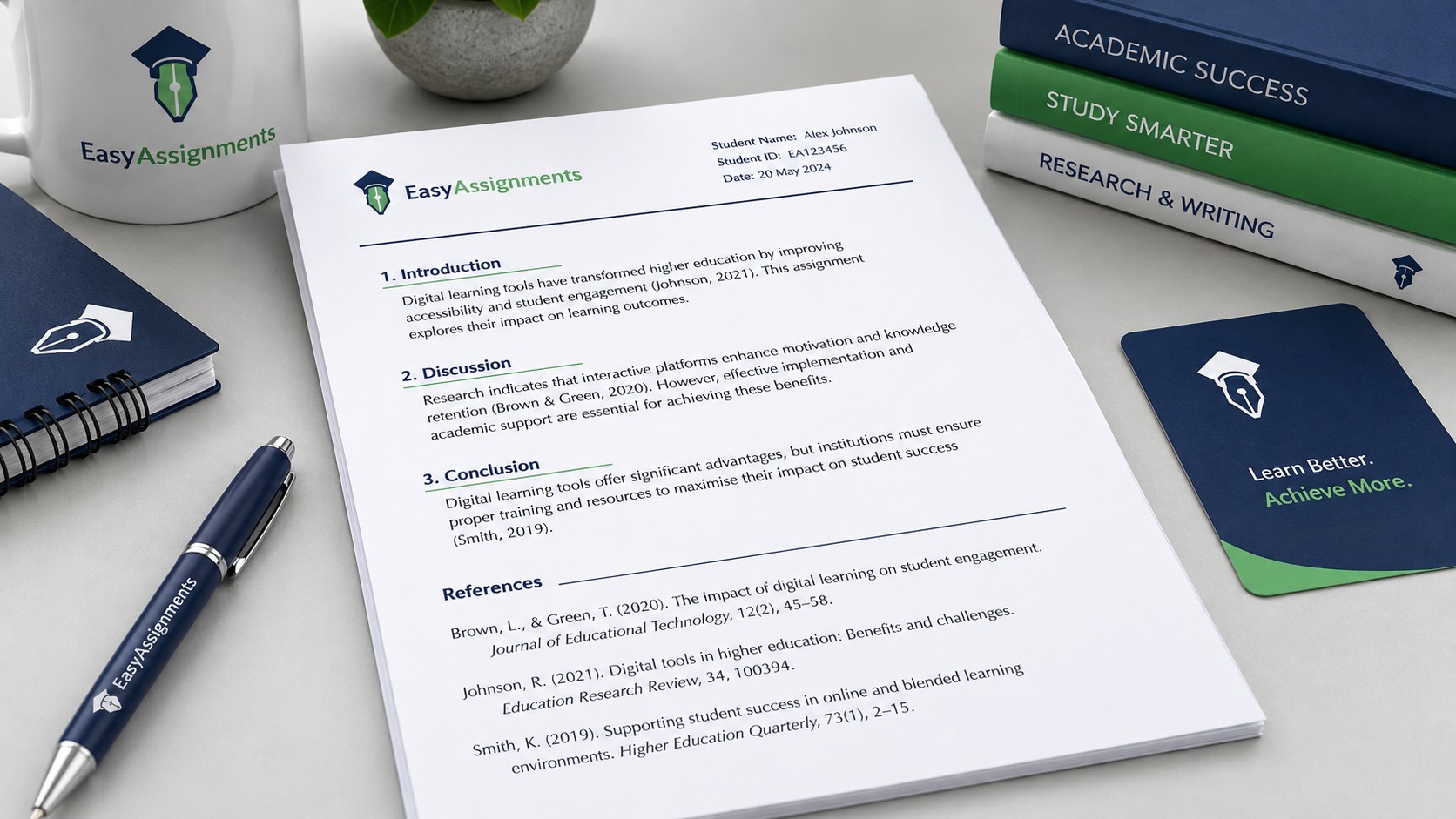
Strong assignments are built on evidence, but that evidence must be handled honestly. Every idea, statistic, or quotation that is not your own needs a citation. Paraphrasing in your own words is usually preferable to long direct quotations, because it shows you have understood the source, but even a paraphrase must be cited. When you do quote directly, keep quotations short and integrate them smoothly into your own sentences. Treat plagiarism as a serious risk to manage, not an afterthought, and give yourself time to check your citations before submitting.
Common Formatting Mistakes to Avoid
Even capable students lose marks to a small set of recurring format errors. Knowing them in advance is the easiest way to protect your grade.
- Ignoring the brief and answering a slightly different question than the one set.
- Missing or incomplete reference lists, or in-text citations that do not match the list.
- Inconsistent formatting, with headings, fonts, and spacing that change through the document.
- Weak or absent structure, where paragraphs run together without clear topic sentences.
- Going significantly over or under the word count without checking whether references are included.
- Submitting in the wrong file format or missing a required cover sheet or template.
- Leaving no time to proofread, so typos and layout slips reach the marker.
A Simple Workflow for Every Assignment
Bringing all of this together, a repeatable workflow makes formatting almost automatic. The details will vary by subject, but the sequence rarely does.
Plan and Research
Decode the brief, confirm the format and referencing style, then gather and organise your sources before you write a word.
Outline the Structure
Sketch your introduction, body sections, and conclusion so every paragraph has a clear job before drafting begins.
Draft and Cite
Write in focused paragraphs, add citations as you go, and apply heading styles from the start rather than at the end.
Review and Polish
Check against your brief checklist, proofread carefully, and confirm the reference list matches every in-text citation.
Following this routine turns formatting from a stressful last-minute scramble into a set of small, manageable steps spread across the writing process. Over a few assignments it becomes second nature, and the polished, professional look of your work stops being something you fight for and starts being your default.
Frequently Asked Questions
What is the correct assignment writing format for university students?
The correct assignment writing format for university students generally includes a title page, an introduction that sets up the argument, a well-organised main body, a conclusion, and a reference list in the required style. Always follow your department's specific brief or template, as local requirements override any general guide.
How long should the introduction and conclusion be?
As a rough guide, the introduction and conclusion each take up around ten percent of your total word count, leaving roughly eighty percent for the main body. These are guidelines rather than strict rules, so adjust them to suit the assignment and any instructions in your brief.
Which referencing style should I use?
The right referencing style depends on your discipline and department. Common styles include APA, MLA, Harvard, Chicago, and IEEE. Check your assignment brief or module handbook to confirm which one is required, then apply it consistently across both your in-text citations and your reference list.
What are the most common formatting mistakes to avoid?
The most frequent errors are ignoring the brief, missing or mismatched references, inconsistent fonts and headings, weak paragraph structure, breaching the word count, and leaving no time to proofread. Building a checklist from your brief and reviewing against it before submission prevents almost all of these.
Hand In Work That Looks the Part
You have done the thinking. Make sure the format does it justice. If you want a second pair of eyes on structure, referencing, or presentation, EasyAssignments is ready to help.