A Complete APA 7 Assignment Format Example for Students
Formatting eats up marks that have nothing to do with how good your ideas are. This guide gives you a clear APA 7 assignment format example, from the title page to the reference list, so you set your paper up correctly the first time.
You will see exactly what markers look for: margins, spacing, headings, in-text citations, and the reference list. Follow the walkthrough below and your next submission will look clean, consistent, and professional.
What Is APA 7 and Why Formatting Matters
The APA 7 assignment format example you are about to see follows the seventh edition of the Publication Manual of the American Psychological Association, released in 2019 and now the standard across most psychology, education, nursing, business, and social science courses. APA style controls how your paper looks and how you credit the sources you use, which keeps academic writing consistent and honest.
Formatting might feel like a minor detail next to your argument, but markers notice it immediately. A title page in the wrong place, single spacing where double spacing belongs, or a reference list that does not match your in-text citations all signal a rushed submission. Getting the format right is one of the easiest ways to protect the marks you have already earned through good thinking and research.
APA 7 also introduced a friendlier student version of the format. The manual now separates student papers from professional papers, and most coursework uses the student layout. That means you usually do not need a running head with a shortened title, and you do not need an author note. Knowing this one distinction saves a lot of confusion when you compare online examples that were written for journal articles.
Quick note: Always check your assignment brief or unit guide first. If your instructor gives specific formatting instructions that differ from standard APA 7, follow their instructions. Course requirements override the general manual every time.
General APA 7 Formatting Rules
Before we build a paper section by section, set up your document with the core rules that apply everywhere. These defaults stay the same across the entire assignment, so configuring them once at the start saves you from fixing formatting later.
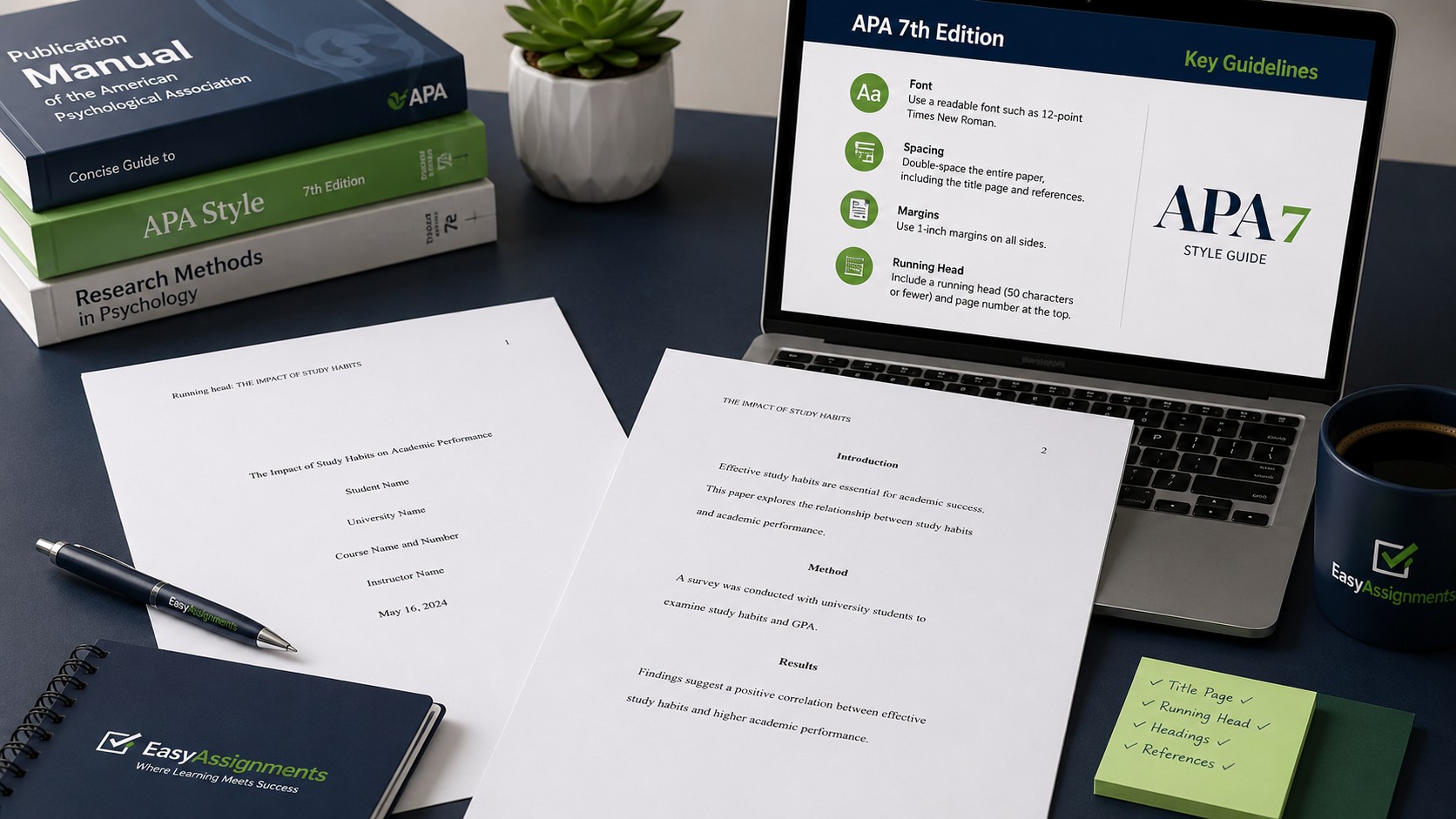
- Font: A readable, widely available font. Common accepted choices include 12 point Times New Roman, 11 point Calibri, 11 point Arial, or 11 point Georgia. Pick one and use it consistently.
- Margins: One inch on all four sides of the page.
- Spacing: Double spacing throughout the whole document, including the title page, block quotations, and the reference list. Do not add extra blank lines between paragraphs.
- Alignment: Left aligned text with a ragged right edge. Do not justify the text.
- Indentation: Indent the first line of every paragraph by half an inch, usually one press of the Tab key.
- Page numbers: A page number in the top right corner of every page, starting with the number 1 on the title page.
Setting these up in your word processor before you write anything means the whole document inherits the correct look. If you are working in a template, double check each of these because templates often reset spacing or margins in unexpected ways.
The APA 7 Title Page (Student Version)
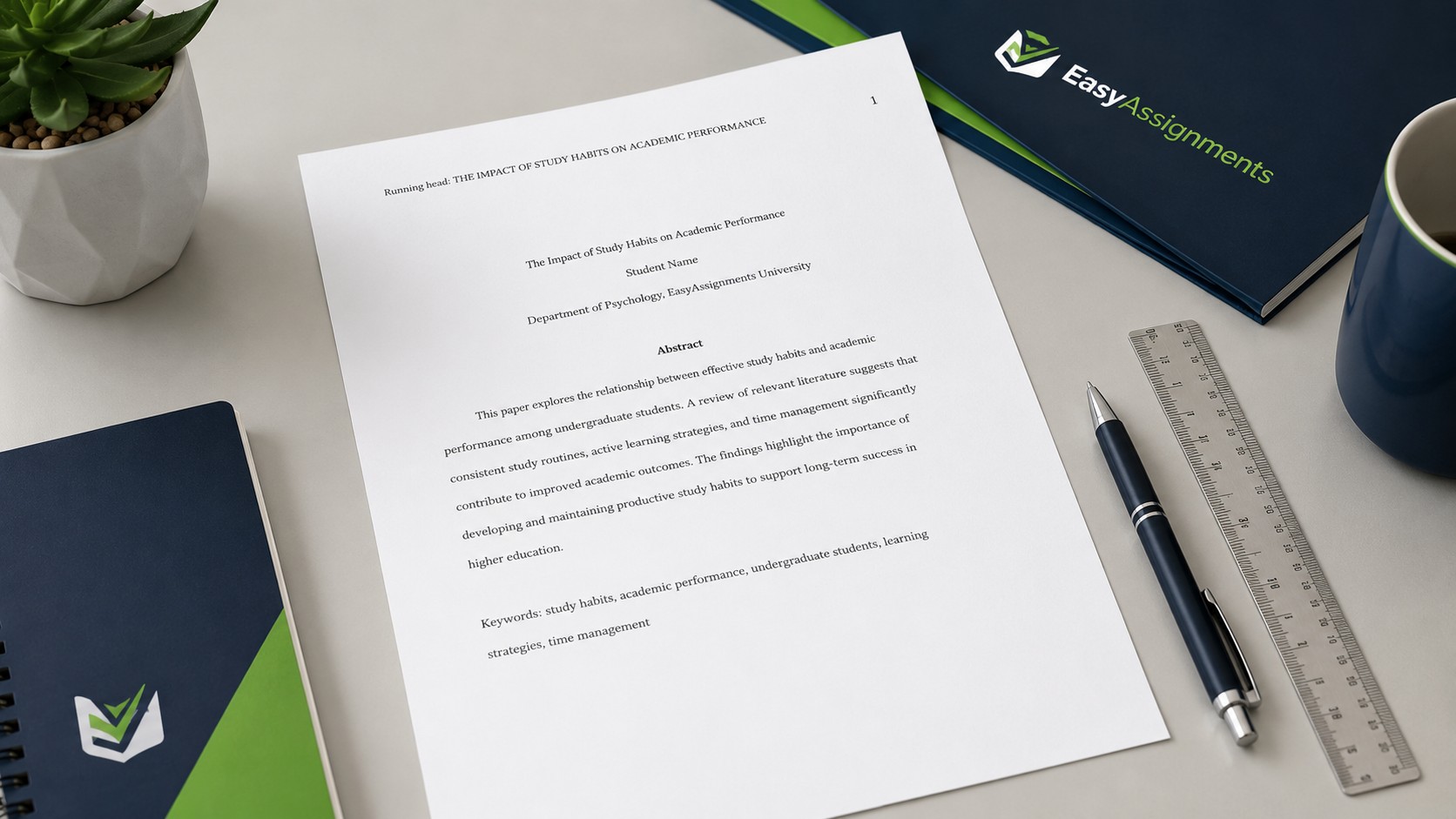
The title page is the first thing your marker sees, so it is worth getting exactly right. For a student paper, the title page is centred and includes a specific set of elements in a specific order. The page number sits in the top right corner as usual.
Work down the centre of the page and include the following, each on its own line and double spaced:
- Paper title: Bold, centred, in title case, positioned in the upper half of the page. Aim to place it roughly three or four lines down from the top margin.
- Author name: Your full name, with no title such as Dr or Mr and no degree letters after it.
- Affiliation: The department and the name of your university or college, for example, Department of Psychology, University of Melbourne.
- Course: The course number and course name exactly as they appear in your enrolment, for example, PSY 101: Introduction to Psychology.
- Instructor: Your instructor's name, formatted the way they prefer.
- Due date: The assignment due date, written out in full, for example, 8 August 2026.
Leave a few blank double spaced lines between the title and the block of author details so the title clearly sits in the upper half of the page. Keep everything centred and avoid adding logos, borders, or decorative fonts. APA title pages are deliberately plain.
Common mistake: Students often copy a professional APA title page from an online sample and add a running head with a shortened title in capitals. Student papers usually do not need this. Adding it makes your paper look like a journal submission rather than coursework, so leave it off unless your instructor asks for it.
Headings in APA 7
APA 7 uses five levels of heading to organise longer papers. Most student assignments only need the first two or three levels, but knowing the full system helps you keep structure clear and consistent. Headings are not numbered in APA style, and you never label them as Level 1 or Level 2 on the page; the formatting itself signals the level.
| Level | Format | Where the text starts |
|---|---|---|
| Level 1 | Centred, Bold, Title Case | Text begins as a new paragraph below |
| Level 2 | Left aligned, Bold, Title Case | Text begins as a new paragraph below |
| Level 3 | Left aligned, Bold Italic, Title Case | Text begins as a new paragraph below |
| Level 4 | Indented, Bold, Title Case, ends with a period | Text begins on the same line as the heading |
| Level 5 | Indented, Bold Italic, Title Case, ends with a period | Text begins on the same line as the heading |
One important rule: the title of your paper on the first page of the body acts as a de facto Level 1 heading, so you do not need to add a heading that simply says Introduction. Start your introduction directly under the repeated paper title. Use headings sparingly and only where they genuinely help the reader follow your structure. A short essay may need no headings at all beyond the title.
In-Text Citations in APA 7
In-text citations are how you point to a source inside your writing. APA uses the author and date system, which means every citation includes the author's surname and the year of publication. You have two ways to present them, and good writing usually mixes both.
Parenthetical citations
Here the author and year sit together inside brackets at the end of the sentence, before the full stop. For example: Regular study breaks can improve memory retention (Smith, 2020). This works well when the source supports your point but you do not need to name the author in the flow of your sentence.
Narrative citations
Here the author's name becomes part of your sentence and only the year sits in brackets. For example: Smith (2020) found that regular study breaks can improve memory retention. This works well when the author is important to your argument or when you are comparing several researchers.
Direct quotations and page numbers
When you quote a source word for word, you must include a page number. For a short quotation, place it in quotation marks and add the page: (Smith, 2020, p. 45). For a source with two authors, name both every time and join them with an ampersand inside brackets or the word and in narrative form: (Smith & Jones, 2020) or Smith and Jones (2020). For three or more authors, name the first author followed by et al. from the very first citation: (Smith et al., 2020).
Golden rule: Every source you cite in the text must appear in your reference list, and every entry in your reference list must be cited at least once in the text. If the two do not match, you will lose marks even when your writing is strong.
Running out of time before your deadline?
Formatting a full APA 7 paper takes patience, especially when the deadline is close. If you would rather focus on the ideas and hand the formatting to someone else, our team can help.
The APA 7 Reference List
The reference list appears on a new page at the end of your assignment. It gives the full publication details of every source you cited so a reader could find each one. This is where many students lose easy marks through small inconsistencies, so slow down and follow the pattern carefully.
Set up your reference page with these rules:
- New page: Start the reference list on its own page after the body of your paper.
- Title: The word References, bold and centred, at the top of the page.
- Order: Alphabetical by the first author's surname. If you have two works by the same author, order them by year, earliest first.
- Hanging indent: The first line of each entry sits at the left margin, and every following line of that entry is indented half an inch.
- Spacing: Double spaced throughout, with no extra blank lines between entries.
Common reference formats
Each source type has a slightly different pattern, but they all follow the same logic: author, date, title, and source. The examples below use placeholder details to show the structure.
| Source type | Reference structure |
|---|---|
| Book | Author, A. A. (Year). Title of the book (Edition). Publisher. |
| Journal article | Author, A. A. (Year). Title of the article. Title of the Journal, Volume(Issue), page range. DOI or URL. |
| Web page | Author, A. A. (Year, Month Day). Title of the page. Site Name. URL. |
| Chapter in an edited book | Author, A. A. (Year). Title of the chapter. In E. E. Editor (Ed.), Title of the book (pp. range). Publisher. |
Pay close attention to capitalisation. In titles of articles, chapters, and books, use sentence case, meaning you capitalise only the first word, the first word after a colon, and any proper nouns. Journal titles, however, use title case with each major word capitalised. Italicise book titles and journal titles, but not article or chapter titles. These small differences are exactly what a careful marker checks.
Putting It All Together: A Sample Structure
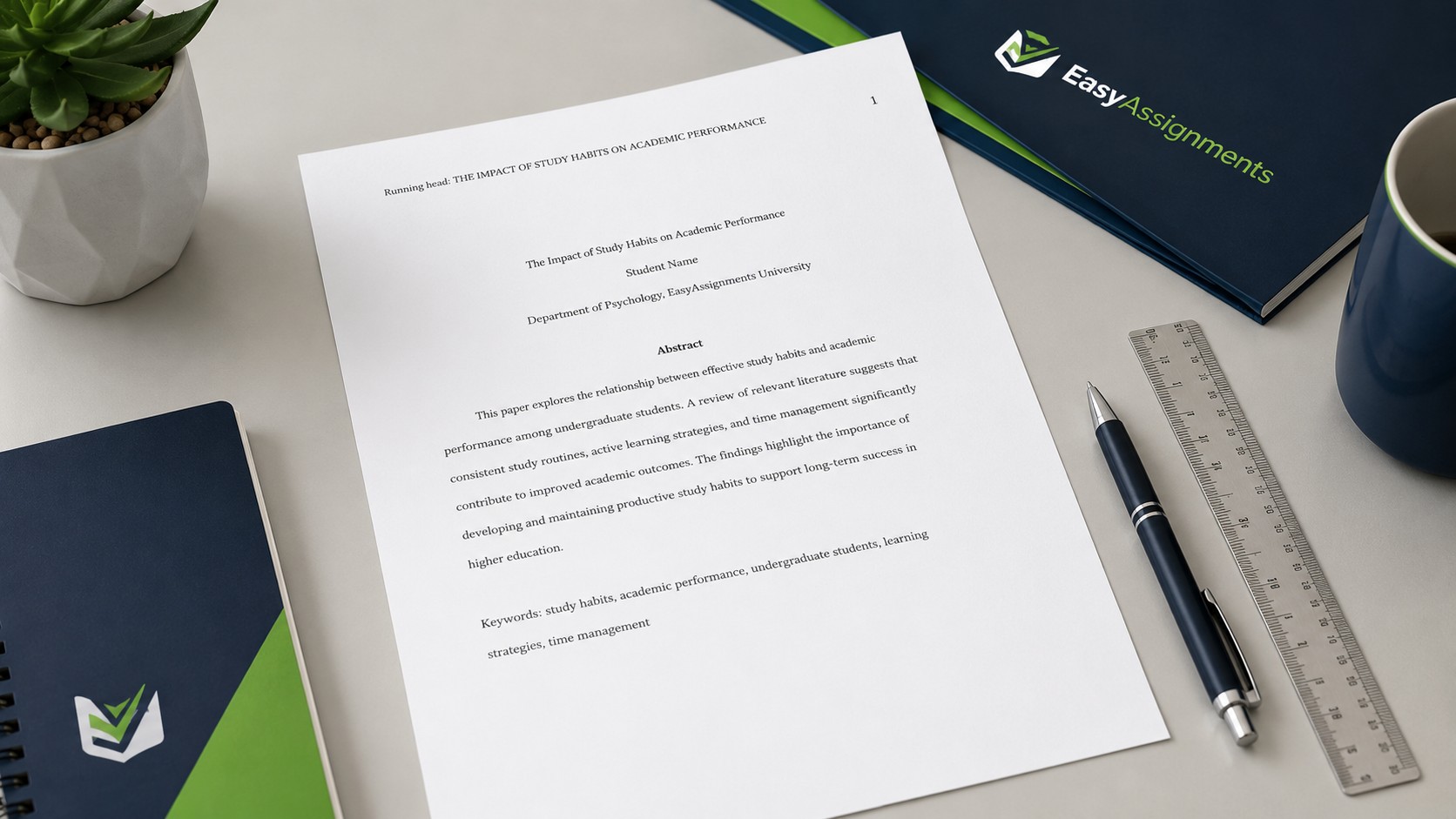
Now that you know each part, here is how a typical APA 7 student assignment fits together from front to back. Not every assignment needs every section, so adapt this to your task. An essay may skip the abstract and methods entirely, while a full research report will use them all.
- Title page: Centred title, your name, affiliation, course, instructor, and due date.
- Abstract: Only if required. A short summary of around 150 to 250 words on its own page, with the heading Abstract, bold and centred.
- Body: The repeated paper title at the top of the first body page, followed by your introduction, main argument, and analysis, organised with headings where helpful.
- Reference list: A new page titled References with every source you cited, alphabetised and formatted with a hanging indent.
- Appendices: Only if needed, for material such as tables, questionnaires, or raw data that supports but does not belong in the body.
The official APA Style website is a reliable place to confirm any detail you are unsure about. You can explore their guidance and sample papers at https://apastyle.apa.org, which is maintained by the American Psychological Association itself.
Quick Wins to Polish Your APA 7 Paper
Once the structure is in place, a short round of checks catches the errors that most commonly cost marks. Run through these before you submit.
Match your citations
Cross check that every in-text citation has a matching reference entry, and that no reference is left uncited in the body of the paper.
Check your spacing
Confirm the entire document is double spaced with no stray blank lines, including the title page and reference list.
Verify capitalisation
Use sentence case for article and book titles, title case for journal names, and italics only where they belong.
Confirm the hanging indent
Make sure every reference entry uses a proper hanging indent rather than manual spaces or tabs, which break when text reflows.
A final read out loud helps too. It catches awkward phrasing and missing citations that your eyes skim over on screen. Give yourself a short break between finishing and proofreading so you read the paper fresh rather than from memory.
Frequently Asked Questions
Do I need an abstract in my APA 7 assignment?
Not always. An abstract is usually required for research reports and longer papers, but most short essays and standard coursework do not need one. Follow this APA 7 assignment format example and your brief: include an abstract only if your instructor or the assignment guidelines ask for it.
What font should I use for an APA 7 paper?
APA 7 accepts several readable fonts, so you have flexibility. Common accepted choices are 12 point Times New Roman, 11 point Calibri, 11 point Arial, and 11 point Georgia. Choose one and apply it consistently across the whole document, including the title page and reference list.
How do I cite a source with no author or no date?
If there is no author, move the title into the author position of your citation. If there is no date, use the abbreviation n.d. in place of the year, for example (Study Skills Guide, n.d.). Keep the same logic in both the in-text citation and the reference list entry.
Does a student paper need a running head?
No. Student papers in APA 7 do not need a running head with a shortened title. You only need a page number in the top right corner of every page. The running head is a feature of professional papers submitted to journals, so leave it off unless your instructor specifically requests it.
Get Your APA 7 Assignment Done Right
Whether you need a full paper formatted from scratch or a careful check of your APA style, EasyAssignments can help you submit with confidence.