

Biology Assignment Questions and Answers PDF: The Complete Study Guide
A well-built biology assignment questions and answers PDF is one of the most efficient revision tools you can keep on your device. Instead of scattering notes across textbooks, slides, and browser tabs, you get organized practice questions with clear model answers in a single portable file.
This guide shows you how to use these PDFs the right way, which core topics you should prioritize, and how to turn passive reading into active recall that actually sticks. Whether you are studying cell biology, genetics, ecology, or human physiology, the same principles apply.
Why a Biology Assignment Questions and Answers PDF Works So Well
Biology is a subject built on layers. You cannot fully understand respiration until you understand the cell, and genetics makes far more sense once photosynthesis and cellular processes are clear in your mind. A good biology assignment questions and answers PDF respects this structure. It groups questions by topic, moves from basic recall to applied reasoning, and pairs every question with an answer that explains the reasoning rather than simply stating a fact.
The portability matters more than most students realize. A single PDF opens on a phone, tablet, or laptop without an internet connection, which means you can revise on a commute, between lectures, or during a quiet ten minutes before an exam. Unlike a bulky textbook, a focused question bank strips away the padding and leaves you with exactly what you need to practice.
There is also a psychological advantage. Facing a question forces your brain to retrieve information, and retrieval is what builds durable memory. Reading a chapter feels productive, but answering questions is what reveals the gaps. When the answer is right there for you to check, you close the feedback loop immediately instead of waiting days for a marked assignment to come back.
Key idea: A question bank is not a shortcut to skip learning. It is a diagnostic tool. Every question you get wrong is a signpost pointing to a topic that needs more of your time.
Used well, a questions and answers PDF becomes the backbone of a revision cycle: read the concept, attempt the questions, check the model answers, note your mistakes, and revisit the weak areas a few days later. This cycle beats highlighting notes for hours, because it is active, measurable, and honest about what you do and do not know.
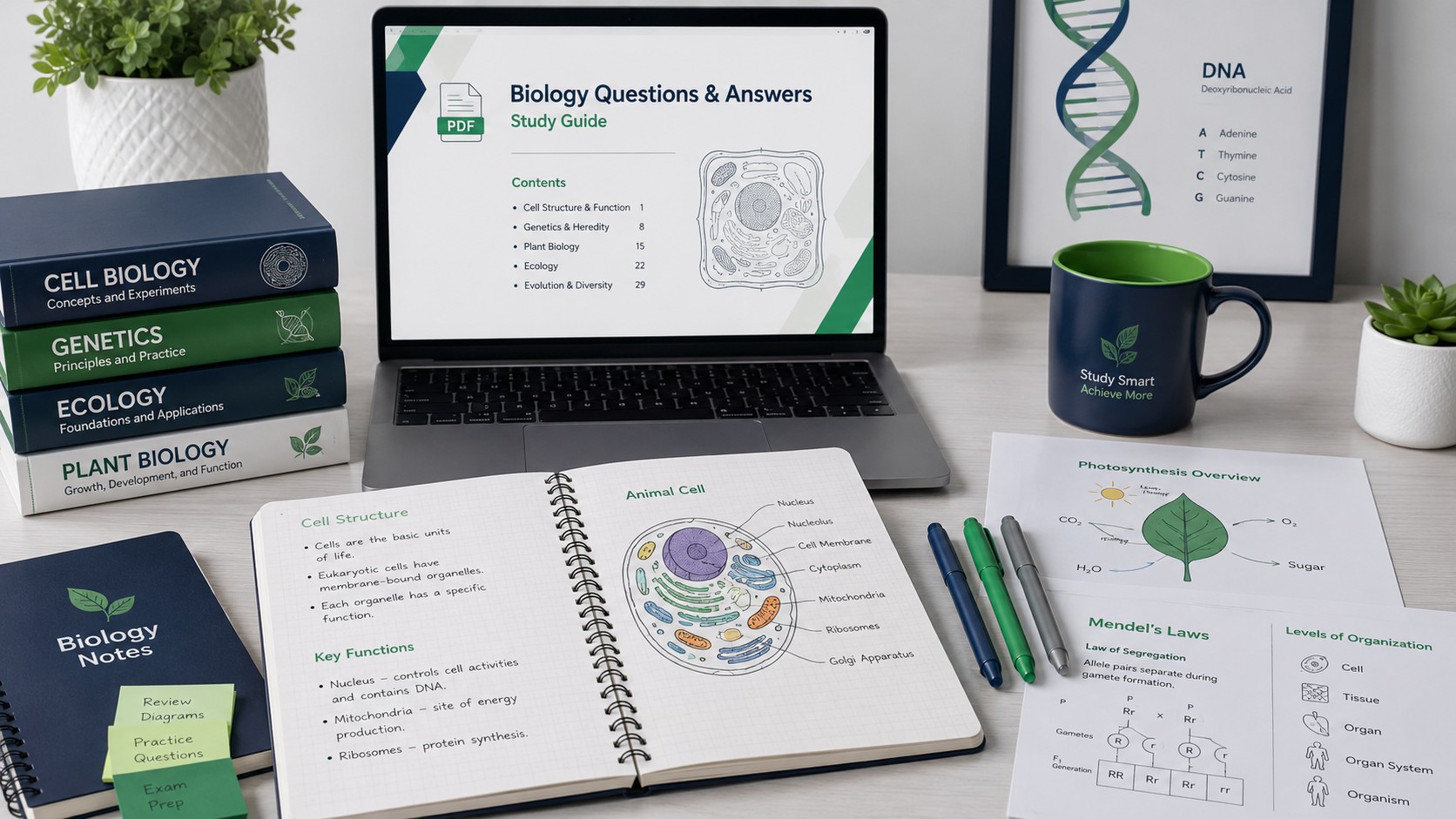
Core Biology Topics Your Question Bank Should Cover
A complete biology resource should reflect the syllabus you are actually studying, but most curricula share a common foundation. Whether you follow a high school program, an A-level or equivalent course, or a first-year university module, the following themes appear again and again. A strong questions and answers PDF will include practice across all of them.
Cell Biology and Biochemistry
Everything in biology starts with the cell. Expect questions on cell structure, the differences between prokaryotic and eukaryotic cells, organelle functions, and the roles of the plasma membrane. Biochemistry adds the molecules of life: carbohydrates, lipids, proteins, and nucleic acids, along with enzyme action and the factors that affect reaction rates such as temperature and pH. Diagram labeling is common here, so practice identifying organelles from unlabeled images, not just describing them in words.
Genetics and Molecular Biology
This is often the section students find most demanding because it mixes memory with problem solving. Topics include DNA structure and replication, transcription and translation, Mendelian inheritance, Punnett squares, monohybrid and dihybrid crosses, and modern concepts like mutations and gene expression. Genetics questions frequently ask you to calculate ratios or interpret pedigrees, so a good PDF should include worked examples that show every step of the reasoning.
Human Physiology and Body Systems
Physiology covers how living systems function: the circulatory, respiratory, digestive, nervous, and excretory systems, along with homeostasis and the endocrine system. Questions often ask you to trace a process from start to finish, for example the path of a red blood cell through the heart or the journey of glucose after a meal. Understanding these as connected systems rather than isolated facts is what separates a strong answer from a shallow one.
Ecology, Evolution, and the Environment
Ecology examines relationships between organisms and their environment: food chains and webs, energy flow, nutrient cycles, population dynamics, and ecosystems. Evolution brings in natural selection, adaptation, speciation, and evidence for common descent. These topics reward clear cause-and-effect thinking and often appear in extended-response questions where you must build an argument rather than recall a single fact.
Watch out: Many students memorize definitions but freeze when a question is worded differently from what they revised. Practice explaining each concept in your own words. If you can teach it simply, you understand it. If you can only recite it, you do not yet.
Types of Questions You Will Encounter
Not all biology questions test the same skill, and a good study PDF mixes formats so you are ready for anything. Recognizing the type of question tells you how to structure your answer and how much detail the marker expects.
| Question Type | What It Tests | How to Approach It |
|---|---|---|
| Multiple choice (MCQ) | Quick recall and recognition | Eliminate wrong options first, then choose the best remaining answer. |
| Short answer | Precise definitions and key facts | Be concise and use correct terminology; answer exactly what is asked. |
| Diagram labeling | Visual identification of structures | Learn diagrams by drawing them yourself, not just reading labels. |
| Data interpretation | Reading graphs, tables, and results | Describe the trend first, then explain the biology behind it. |
| Extended response | Reasoning, links, and argument | Plan a short structure, use connectives, and cover every mark point. |
When you work through a questions and answers PDF, pay attention to the command words in each prompt. A question that says "state" wants a brief fact, while "explain" wants reasoning, and "evaluate" wants you to weigh evidence on both sides. Answering a "describe" question with a full evaluation wastes time, and answering an "explain" question with a single word loses marks. The model answers in a quality PDF should demonstrate these differences clearly.
Marks and depth: matching your answer to the question
The number of marks a question carries is a direct instruction about how much to write. A two-mark question usually needs two distinct points, while a six-mark extended response expects a structured, developed answer. Practicing with a PDF that shows model answers alongside mark allocations trains you to judge depth instinctively, so you never write a paragraph where a sentence would do, or a sentence where a paragraph is required.
Stuck on a tricky biology assignment?
Our team can help you understand the concepts behind the questions, structure strong answers, and hit every mark point with confidence. Get clear, guided support whenever you need it.
How to Study Effectively With a Questions and Answers PDF
Owning a strong resource is only half the job. The way you use it decides whether it changes your grades or just sits in your downloads folder. The methods below turn a static file into an active revision system.
Attempt before you check
The single most common mistake is reading the answer first. This feels comfortable but teaches you almost nothing, because recognizing a correct answer is far easier than producing one. Always attempt the question honestly before you look. Cover the answer, write your response, and only then compare. The gap between your answer and the model answer is where the real learning happens.
Use spaced repetition
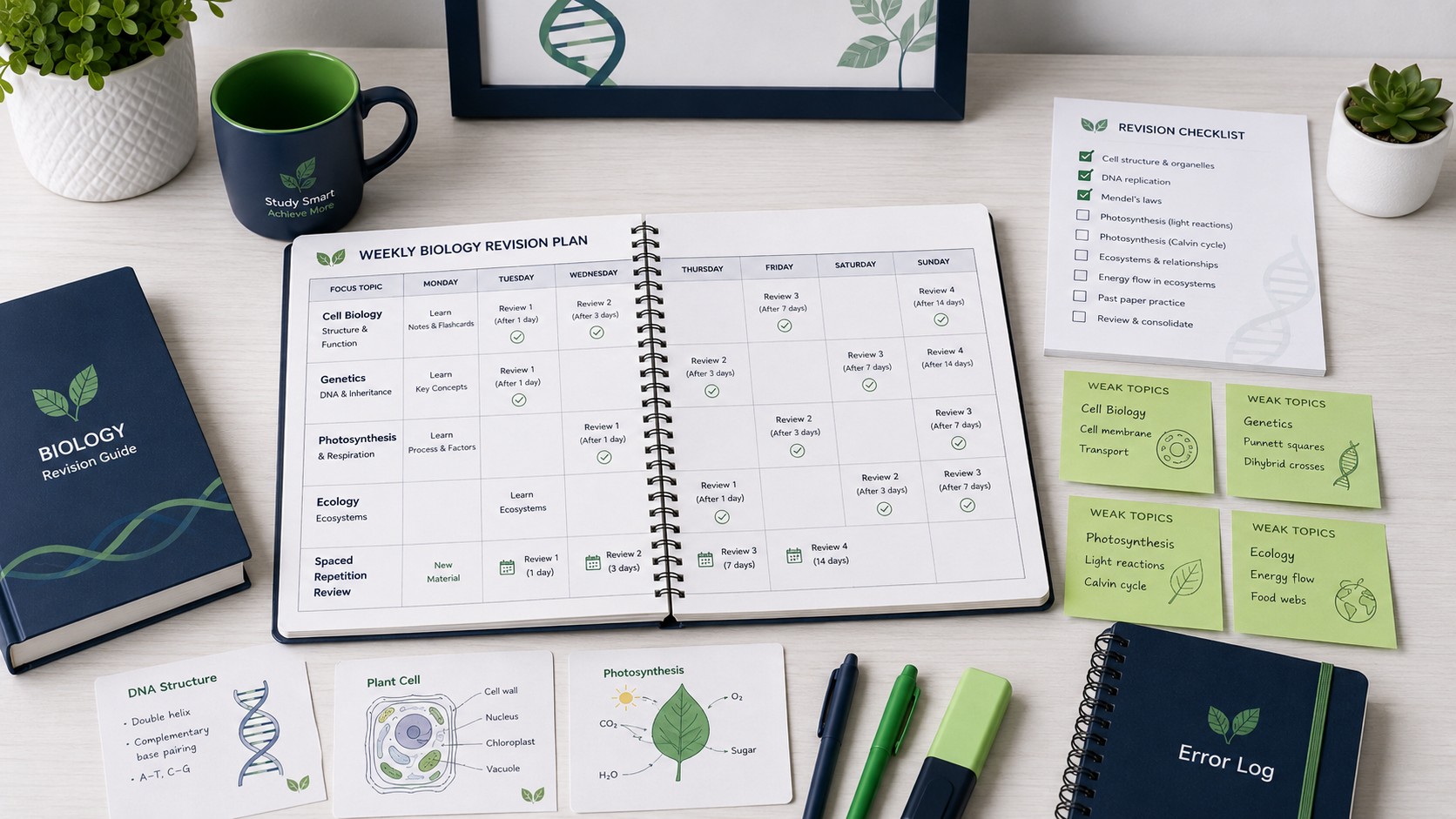
Cramming a whole PDF in one sitting produces a short-lived memory spike that fades within days. Instead, spread your practice across time. Work through a topic, then return to it two or three days later, then again after a week. Each time you revisit, your recall gets faster and more secure. Spacing your sessions is one of the most reliably effective study techniques there is.
Interleave your topics
Rather than grinding through only genetics for three hours, mix in cell biology and ecology questions in the same session. Interleaving feels harder because your brain keeps switching context, but that difficulty is productive. It mirrors real exam conditions, where questions jump between topics, and it strengthens your ability to recognize which concept a question is actually testing.
Turn wrong answers into a personal error log
Keep a simple list of every question you got wrong, the topic it belonged to, and why you missed it. Over a few weeks, patterns emerge. Maybe you consistently confuse mitosis and meiosis, or you lose marks on data questions by forgetting to quote figures. Your error log becomes a personalized study plan that targets exactly what you need, rather than revising things you already know.
Try this: After finishing a topic in your PDF, close it and write down everything you remember on a blank page. This "brain dump" reveals what stuck and what slipped, and it takes only five minutes.
Building Your Own Biology Question Bank
Downloaded PDFs are useful, but the most powerful question bank is often the one you build yourself. The act of writing questions forces you to think about what a marker would ask and why. It flips you from a passive learner into someone who understands the structure of the subject.
Start with your lecture notes or textbook chapters and, for each key idea, write one or two questions in different formats: a quick recall question, an application question, and where possible an extended-response prompt. Then write model answers using your notes, correct terminology, and clear reasoning. Save it all as a single PDF organized by topic, and you have a resource tailored exactly to your course.
Group by topic
Keep cell biology, genetics, physiology, and ecology in separate sections so you can target weak areas fast.
Include mark schemes
Write down the key points each answer must hit, so you can mark yourself fairly and consistently.
Add real exam questions
Blend past-paper style questions with your own to match the tone and difficulty of your actual assessment.
Update it often
Add new questions from each lecture so the bank grows with your course instead of going stale.
If you find that building answers or explaining concepts is where you get stuck, that is exactly the point where guided support helps most. Understanding why an answer is correct is what carries over to the next question, and to the exam itself.
Common Mistakes to Avoid
Even with a great resource, a few habits quietly hold students back. Being aware of them is often enough to fix them.
- Reading answers passively without attempting the question first, which builds false confidence.
- Memorizing definitions word for word instead of understanding the underlying concept.
- Ignoring command words, so a "describe" answer is written for an "explain" question or vice versa.
- Skipping diagrams because they feel time-consuming, even though they carry easy marks.
- Revising only the topics you enjoy while avoiding the ones you find difficult.
- Cramming everything the night before instead of spacing practice across weeks.
None of these mistakes are about ability. They are about method, which means every one of them is fixable with a small change in how you approach your study sessions. Swap passive reading for active recall, respect command words, and give your weakest topics the most attention, and your results will follow.
Turning Practice Into Better Grades
The final piece is making sure your practice mirrors your real assessment as closely as possible. Once you have worked through your questions and answers PDF several times, test yourself under exam conditions: set a timer, close your notes, and answer a full set of questions in one sitting. This builds the stamina and time management that a comfortable, open-book study session never will.
Afterward, mark your work honestly against the model answers, log your errors, and revisit those specific topics before your next practice run. Over a few cycles, you will notice your accuracy climbing and your answers becoming more precise. That steady, measurable improvement is the whole point of using a question bank in the first place, and it is far more reassuring than hoping a single read-through will be enough.
Frequently Asked Questions
Where can I find a good biology assignment questions and answers PDF?
Strong resources come from your own course materials, past papers provided by your institution, and reputable educational publishers. The best approach is often to combine a downloaded question bank with one you build from your own lecture notes, so it matches your exact syllabus and command-word style.
Are questions and answers PDFs enough to pass biology on their own?
They are a powerful revision tool, but they work best alongside your notes and textbook, not instead of them. Use the PDF to test and reinforce understanding after you have learned a concept, and treat every wrong answer as a prompt to go back and study that topic more deeply.
How often should I use a biology question bank?
Short, frequent sessions beat long, occasional ones. Aim to practice a little most days, revisit each topic several times across the weeks, and use spaced repetition so that older material keeps coming back before you forget it.
What if I keep getting the same type of question wrong?
Keep an error log to spot the pattern, then focus your next few sessions on that specific weakness. If a concept stays confusing after honest effort, that is the right moment to ask for guided help so you understand the reasoning rather than just memorizing the answer.
Master Biology One Question at a Time
Turn your biology assignment questions and answers PDF into real understanding with guided, reliable support from EasyAssignments. Get started today.