How to Cite Sources in APA 7 for College Assignments
Learning how to cite sources in APA 7 is one of the most reliable ways to protect your grade, avoid plagiarism, and make your college assignments look polished and professional. Once you understand the patterns, the rules stop feeling like a maze and start feeling like a simple checklist you can apply to any source.
This complete guide walks you through in-text citations, the reference list, and the trickiest source types students face, from journal articles and websites to videos, e-books, and sources with no author. By the end, you will know exactly how to format your citations correctly every time.
Why APA 7 Matters for Your College Assignments
APA style, created by the American Psychological Association, is the citation format used across psychology, education, nursing, business, social sciences, and many other college programs. The seventh edition, released in 2019, updated older rules to reflect how students actually find and use sources today, including digital-first materials, e-books, and online media. If your instructor asks for APA, they almost always mean APA 7.
When you cite sources in APA 7 correctly, you do three things at once. You give proper credit to the researchers and authors whose ideas you are building on, you give your reader a clear trail to find those sources themselves, and you show your instructor that your work is credible and carefully done. Sloppy or missing citations, on the other hand, can look like carelessness at best and plagiarism at worst.
The good news is that APA is a system of repeatable patterns, not a random collection of rules. Almost every citation is built from the same four ingredients: who wrote it, when it was published, what it is called, and where you can find it. Learn how those four pieces rearrange for different source types, and you can cite almost anything.
Core idea: Every APA 7 citation answers four questions: Who? When? What? Where? Master that pattern and the specific formats become far easier to remember.
The Two Parts of Every APA 7 Citation
APA uses what is called an author-date system, and it always has two connected parts that work as a team. Getting both parts to match is one of the most common places students lose marks, so it helps to understand them clearly from the start.
In-text citations
An in-text citation is the short note you place inside your sentence or at the end of it, right where you use someone else's idea, data, or words. It contains just enough information to point your reader to the full entry in your reference list. In APA 7, that means the author's last name and the year of publication, plus a page number when you quote directly.
There are two ways to write an in-text citation, and both are correct. A parenthetical citation puts everything in brackets at the end: the research shows a clear effect (Okafor, 2021). A narrative citation weaves the author into the sentence itself: Okafor (2021) found a clear effect. Use narrative citations when the author is the focus of your sentence, and parenthetical citations when the idea matters more than who said it.
The reference list
The reference list appears at the very end of your assignment on its own page, titled References, centered and bold. It contains one full entry for every source you cited in the text, and only those sources. Each entry gives the complete details a reader needs to locate the original work. Every in-text citation must have a matching reference entry, and every reference entry must be cited at least once in the text. If one side is missing its partner, something has gone wrong.
Quick rule: In-text citations are short and live in your paragraphs. Reference entries are detailed and live on the References page. They must always match up one to one.
How to Write APA 7 In-Text Citations
In-text citations change slightly depending on how many authors a source has and whether you are quoting or paraphrasing. Learning these small variations is what separates a clean paper from one covered in correction marks.
One or two authors
For a single author, use the last name and year, such as (Rivera, 2020). For two authors, name both every time you cite them, joined by an ampersand inside parentheses or the word "and" in narrative form: (Rivera & Chen, 2020) or, in a sentence, Rivera and Chen (2020) argued that the effect was small.
Three or more authors
This is a big change from older APA versions and a frequent source of errors. When a source has three or more authors, you use only the first author's last name followed by "et al." from the very first citation onward. So a paper by five authors becomes (Adeyemi et al., 2022) every single time. You no longer list all the authors on the first mention.
Direct quotations and page numbers
Whenever you quote the exact words of a source, you must add a page number so your reader can find the precise passage. For a printed page, use "p." for one page or "pp." for a range: (Rivera, 2020, p. 47). For sources without page numbers, such as websites, use another locator like a paragraph number, a section heading, or a timestamp: (Okafor, 2021, para. 3).
No author or no date
When a source has no named author, move the title into the author position of the citation, using the first few words. Italicize titles of longer works and put article or page titles in quotation marks. When there is no publication date, use the abbreviation "n.d." which stands for "no date," as in (National Health Institute, n.d.).
- One author: (Rivera, 2020)
- Two authors: (Rivera & Chen, 2020)
- Three or more authors: (Adeyemi et al., 2022)
- Direct quote: (Rivera, 2020, p. 47)
- Organization as author: (World Health Organization, 2021)
- No date: (Okafor, n.d.)
Common mistake: Forgetting the page number on a direct quotation, or listing all authors on the first mention of a source with three or more authors. Both are easy marks to lose and easy habits to fix.
Building the APA 7 Reference List
The reference list is where students most often stumble, because each source type has its own arrangement of the four core ingredients. Before we look at specific formats, it helps to lock in the formatting rules that apply to the whole page.
Formatting rules for the References page
- Start the reference list on a new page after the main text.
- Title the page References, centered and in bold at the top.
- Double-space every entry, with no extra blank lines between them.
- Use a hanging indent: the first line of each entry sits at the left margin, and every following line is indented.
- Alphabetize entries by the first author's last name, or by the first significant word of the title when there is no author.
Author names, dates, and titles
Author names are inverted, so you write the last name first followed by initials: Rivera, T. A. List up to twenty authors in a single reference before using an ellipsis. The date goes in parentheses right after the author. Titles of articles and chapters use sentence case, meaning you capitalize only the first word, the first word after a colon, and proper nouns. Titles of whole works like books and journals are italicized, and journal names keep title case with major words capitalized.
| Source type | Reference list pattern | Key detail |
|---|---|---|
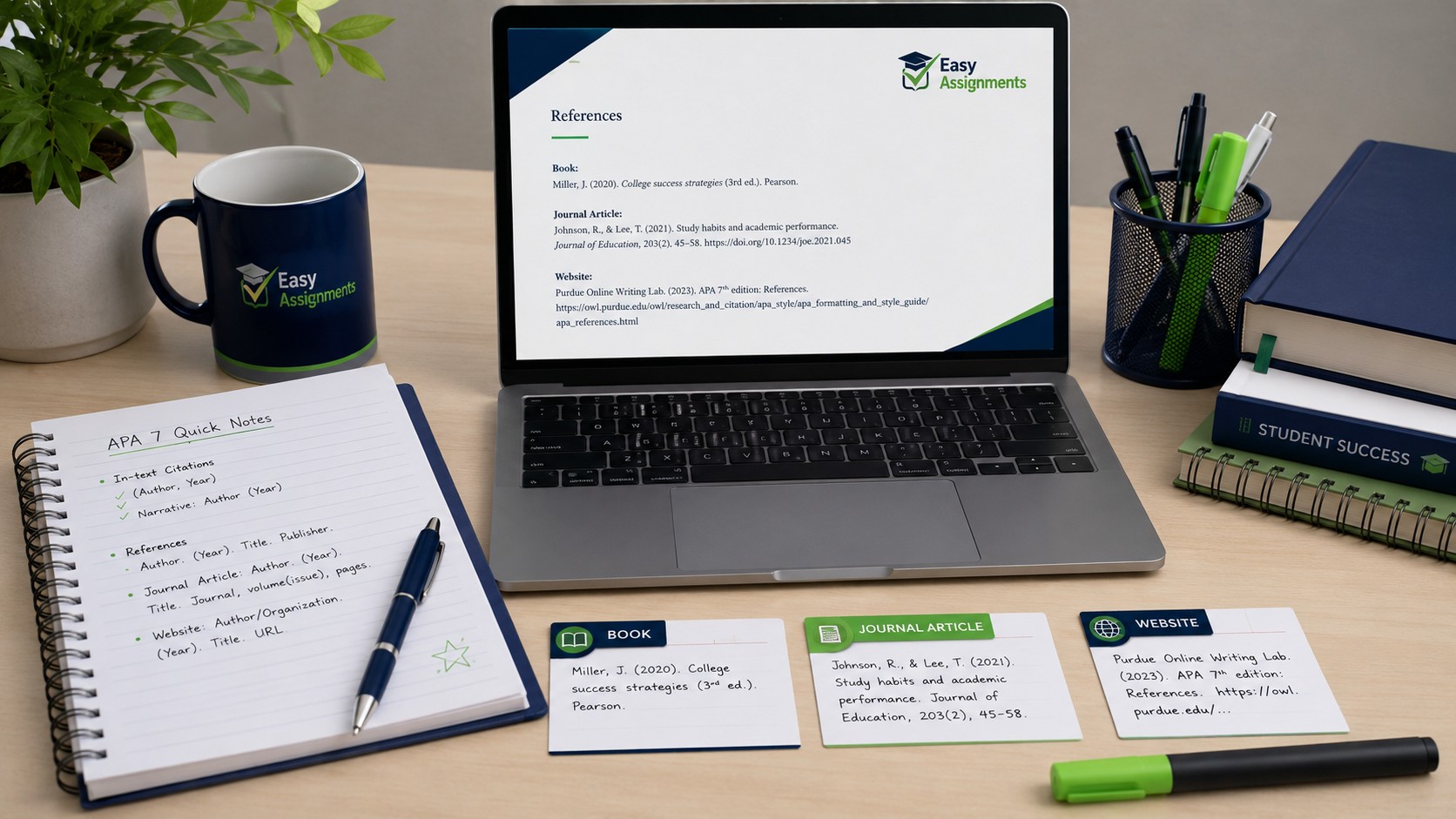
| Journal article | Author, A. A. (Year). Title of article. Journal Name, Volume(Issue), pages. https://doi.org/xxxx | Include the DOI as a live link when available. |
| Book | Author, A. A. (Year). Title of book. Publisher. | No publisher location is needed in APA 7. |
| Book chapter | Author, A. A. (Year). Title of chapter. In E. Editor (Ed.), Book title (pp. xx–xx). Publisher. | Editor initials come before the surname. |
| Website page | Author or Org. (Year, Month Day). Title of page. Site Name. URL | Add a retrieval date only if content may change. |
| Online video | Uploader. (Year, Month Day). Title of video [Video]. Platform. URL | The person or channel that uploaded is the author. |
Running Out of Time on Your References?
Formatting an entire reference list correctly takes patience most students do not have during exam season. Our academic writing experts can format, proofread, or build your assignment to strict APA 7 standards.
Citing the Most Common Source Types
Below are worked patterns for the sources you will meet most often in college assignments. Notice how each one is just a rearrangement of author, date, title, and location.
Journal articles
Academic journal articles are the backbone of most college research, so this is the format worth memorizing first. The pattern is author, year, article title in sentence case, italicized journal name and volume, issue number in parentheses, page range, and finally the DOI as a full link. If there is no DOI, include the URL of the article's landing page instead. The DOI is a permanent digital identifier, and in APA 7 it is presented as a clickable link beginning with https://doi.org.
Books and e-books
For a whole book, list the author, year, italicized title in sentence case, and publisher. APA 7 dropped the requirement to include the publisher's city, which simplifies things. For an e-book that you read online, you generally format it just like a print book. You only add a DOI or URL if the version you used is different in a meaningful way or lives on a specific platform. You no longer need to note the file format such as Kindle.
Websites and web pages
Web pages are where students most often improvise and get it wrong. The pattern is the author or organization, the full date if available, the page title in italics and sentence case, the name of the website, and the URL. If the author and the website name are the same, such as a government agency, you can skip repeating the site name. Add a retrieval date only when the content is designed to change over time, like a live statistics dashboard.
Videos, podcasts, and social media
Media sources follow the same logic with a bracketed description added. For an online video, the channel or person who uploaded it is treated as the author, followed by the date, the italicized title, a bracketed "[Video]" label, the platform, and the URL. Podcasts, social media posts, and other digital media all use this same approach of adding a descriptive label in square brackets so the reader knows the format.
Tricky Cases That Trip Students Up
Once you have the common formats down, a handful of edge cases still cause confusion. Handling these well is often what separates a strong paper from an average one.
Secondary sources
Sometimes you want to cite an idea from an author you did not read directly, because you found it quoted in another source. APA prefers that you find and read the original whenever possible. When you truly cannot, you cite it as a secondary source: name the original author in your sentence, then add "as cited in" with the source you actually read in the parentheses, like (as cited in Rivera, 2020). Only the source you read goes in your reference list.
Multiple works by the same author
When you cite several works by the same author, order them by year in the reference list, oldest first. If two were published in the same year, add lowercase letters after the year to tell them apart: (2021a) and (2021b), assigned alphabetically by title. Use those same letters in your in-text citations so the reader can match them.
Organizations and group authors
Many reliable sources, such as government departments, universities, and health bodies, are authored by an organization rather than a person. Use the full name of the organization as the author. If the group is widely known by an abbreviation, you can introduce it on first use and then use the abbreviation afterward, for example spelling out World Health Organization the first time and using WHO in later citations.
Watch out: Citation generators are helpful but not perfect. They often miss sentence case, mishandle group authors, or drop the DOI. Always proofread every generated entry against the actual rules before you submit.
A Simple Workflow to Stay Organized
Most citation stress comes from leaving references until the last minute, then trying to reconstruct where every fact came from. A little organization while you research saves hours later and reduces mistakes.
- Record the full source details the moment you decide to use a source, not after you finish writing.
- Keep a running reference list in your document and add each entry as you cite it.
- Cross-check that every in-text citation has a matching reference entry, and the reverse, before you submit.
- Alphabetize the reference list only once at the very end, after all sources are added.
- Read your reference page line by line against a trusted APA 7 guide for punctuation and italics.
Match every pair
Confirm each in-text citation has one reference entry and each entry is cited in the text.
Check the authors rule
Use et al. from the first mention for any source with three or more authors.
Get the case right
Sentence case for article and book titles, title case for journal names.
Link your DOIs
Present DOIs and URLs as clean, live links with no "Retrieved from" text.
Frequently Asked Questions
How do I cite sources in APA 7 when there is no author?
Move the title into the author position of both your in-text citation and reference entry. Use the first few words of the title in the in-text citation, italicize titles of longer works, and put shorter titles like articles in quotation marks. If there is also no date, add "n.d." in place of the year.
Do I need a page number for every APA 7 in-text citation?
No. You only need a page number when you quote a source word for word. For paraphrased ideas, the author and year are enough, although adding a location can still help your reader. When a quoted source has no page numbers, use a paragraph number, heading, or timestamp instead.
What changed between APA 6 and APA 7?
Several practical rules changed. You now use et al. from the first citation for three or more authors, publisher locations are no longer required for books, DOIs appear as full links without "Retrieved from," and e-book format notes like Kindle are dropped. APA 7 also added clearer, student-friendly formatting guidance.
Can I use a citation generator for APA 7?
Yes, generators can save time, but treat their output as a draft rather than a finished product. They frequently miss sentence case, handle group authors poorly, and drop DOIs. Always check every generated entry against the real APA 7 rules, or ask a qualified proofreader to review your reference list.
Want Your Citations Done Right the First Time?
If APA 7 formatting is eating into time you need for actual research, let our academic writing team handle the details so your assignment is accurate, consistent, and submission-ready.
Cite With Confidence on Every Assignment
APA 7 stops feeling intimidating once you see it as a set of repeatable patterns. If you would rather focus on your ideas and leave the formatting to specialists, EasyAssignments is ready to help.