

Algebra Assignment Help Step by Step for High School Students
Algebra assignment help step by step is exactly what you need when the variables start piling up and every problem looks like a puzzle with missing pieces. This guide gives high school students a clear, repeatable method for solving equations, factoring expressions, and cracking word problems without the panic.
You will learn the core skills teachers actually test, the mistakes that quietly cost points, and a proven order of operations for tackling any homework set. When a deadline gets tight or a topic refuses to click, you will also know exactly when expert support is worth it.
Why Algebra Feels Hard (and Why It Really Is Not)
Algebra is often the first math class where students stop counting real objects and start working with symbols that stand for unknown numbers. That shift can feel jarring. A letter like x is not a mystery to be feared: it is simply a placeholder for a value you are trying to find. Once you accept that every algebra problem is a small logic puzzle with fixed rules, the subject becomes far more predictable than it first appears.
The reason algebra assignment help step by step works so well is that algebra rewards structure. Unlike an essay, where there are many acceptable answers, most algebra problems have one correct solution and a limited set of valid paths to reach it. When you follow a consistent method, you make fewer errors, you spot your mistakes faster, and you build the muscle memory that turns hard problems into routine ones.
Many students believe they are simply bad at math. In reality, they are usually missing one or two foundational skills, such as working with negative numbers, handling fractions, or understanding the order of operations. Fix those gaps and the rest of algebra tends to fall into place. This guide is built to help you find and close those gaps while giving you a reliable process to lean on.
The core idea: Every algebra equation is a balanced scale. Whatever you do to one side, you must do to the other. Keep the scale balanced and you will never lose the answer.
The Building Blocks You Must Master First
Before you can breeze through an assignment, a handful of foundational skills need to be second nature. Skipping these is the single biggest reason students struggle later, so it is worth a quick, honest self-check.
Integers and Signed Numbers
Adding, subtracting, multiplying, and dividing positive and negative numbers appears in almost every algebra problem. A common trap is sign errors: forgetting that subtracting a negative is the same as adding, or that a negative times a negative gives a positive. When your final answer is off by only a sign, this is usually the culprit.
Fractions and Decimals
Algebra loves fractions. You will add them, multiply them, and cancel them inside larger expressions. If finding a common denominator or simplifying a fraction slows you down, spend an evening reviewing it. That single review session pays off across dozens of future problems.
Order of Operations
Parentheses, exponents, multiplication and division, then addition and subtraction: this order is non-negotiable. Many wrong answers come not from a lack of understanding but from performing steps in the wrong sequence. Slow down and respect the order every single time.
Combining Like Terms
Terms that share the same variable and exponent can be combined. For example, 3x and 5x add up to 8x, but 3x and 5x squared cannot be combined because they are different kinds of terms. Being confident here keeps your expressions clean and your work readable.
Watch out: Rushing through the basics to reach the harder problems almost always backfires. If any building block above feels shaky, strengthen it first. A few minutes of review saves hours of frustration later.

The Step by Step Method for Solving Any Algebra Problem
Here is a dependable process you can apply to almost any homework question. It looks simple, and that is the point. Consistency beats cleverness in algebra. Read each problem with this framework in mind and your work will become organized, accurate, and easy to check.
Step 1: Read and Understand the Problem
Before touching a pencil, identify what the problem is asking. What is the unknown? What information are you given? For word problems especially, underline the numbers and circle the question. A surprising number of mistakes come from solving the wrong thing correctly.
Step 2: Write Down What You Know
Translate the situation into math. Assign a variable to the unknown, usually x, and write out any equation or expression the problem gives you. Getting the setup right is more than half the battle: a clean starting equation makes every later step easier.
Step 3: Simplify Before You Solve
Combine like terms, clear parentheses using the distributive property, and get rid of fractions where you can by multiplying through by a common denominator. A tidy equation is far less likely to produce errors than a cluttered one.
Step 4: Isolate the Variable
Use inverse operations to get the variable alone on one side. Undo addition with subtraction, undo multiplication with division, and always apply the same operation to both sides. Move one thing at a time and write out each line rather than doing several steps in your head.
Step 5: Solve and Simplify
Once the variable is isolated, calculate the value carefully. Reduce fractions and double-check any arithmetic, paying close attention to signs. This is where small slips turn a correct method into a wrong answer, so slow down for the final calculation.
Step 6: Check Your Answer
Substitute your solution back into the original equation. If both sides are equal, you are done and you can move on with confidence. If they are not, you have caught a mistake before it costs you a grade. This one habit separates confident students from anxious ones.
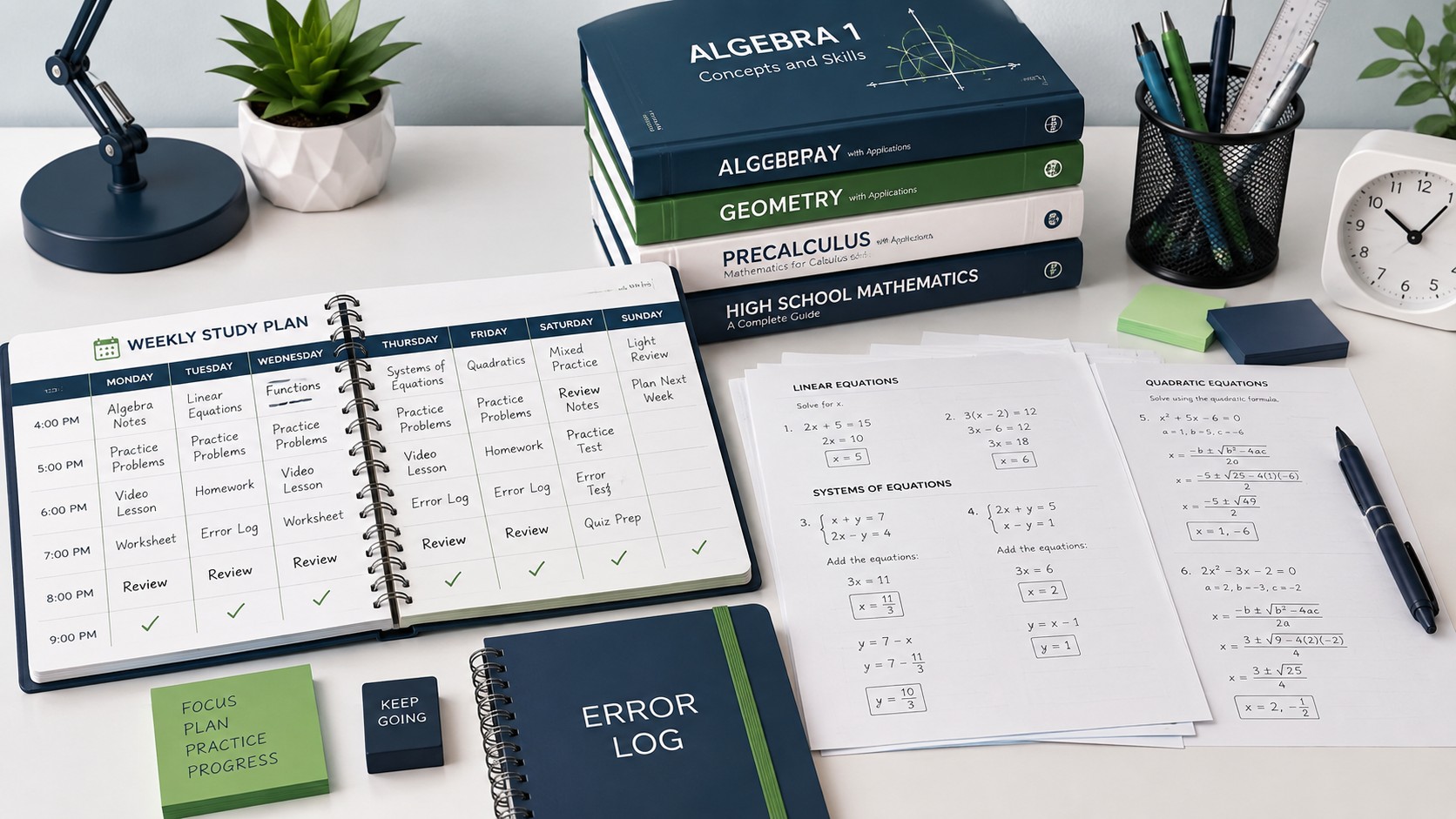
Try it on a simple example: To solve 2x + 5 = 15, subtract 5 from both sides to get 2x = 10, then divide both sides by 2 to get x = 5. Check it: 2 times 5 plus 5 equals 15. The scale balances, so the answer is correct.
Solving the Main Types of Algebra Problems
High school algebra tends to revolve around a handful of problem types. Once you recognize which type you are facing, you know which tools to reach for. Here is how the method above applies to the most common categories.
Linear Equations
These are the bread and butter of Algebra 1. The variable appears to the first power only, with no squares or square roots. Your goal is always to isolate the variable using inverse operations. Equations like 3x minus 7 equals 11 fall neatly into the six-step process, and mastering them builds the foundation for everything else.
Systems of Equations
When you have two equations and two unknowns, you can solve them by substitution or elimination. Substitution means solving one equation for a variable and plugging it into the other. Elimination means adding or subtracting the equations to cancel a variable. Pick whichever method makes the numbers cleaner, and remember that a system has one solution where the two lines cross.
Factoring and Quadratics
Quadratic equations contain a squared variable, such as x squared plus 5x plus 6 equals 0. You can often solve these by factoring into two binomials, in this case (x + 2)(x + 3) = 0, which gives x equals negative 2 or negative 3. When factoring is not obvious, the quadratic formula always works. Learning to recognize which approach fits a given quadratic is a major step up in confidence.
Word Problems
Word problems intimidate students more than any other type, yet they follow the same steps. The trick is translation: turn the sentences into an equation before you solve. Look for keywords like sum, difference, product, and per, which signal specific operations. Once the equation is written, the algebra is usually straightforward.
| Problem Type | Best First Move | Common Mistake to Avoid |
|---|---|---|
| Linear equation | Isolate the variable with inverse operations | Forgetting to apply an operation to both sides |
| System of equations | Choose substitution or elimination | Losing a negative sign during elimination |
| Quadratic equation | Try factoring, then the quadratic formula | Ignoring one of the two possible solutions |
| Word problem | Translate the words into an equation first | Solving before defining the variable clearly |
| Rational expression | Find a common denominator, then simplify | Cancelling terms that are not common factors |
Stuck on a Tricky Assignment Tonight?
You do not have to figure it out alone at midnight. Our team can walk you through the exact steps or provide a clean, worked solution you can learn from.
Common Algebra Mistakes and How to Avoid Them
Most lost points in algebra come from a short list of predictable errors. If you learn to watch for these, your accuracy improves almost immediately, often without learning any new math at all.
- Sign errors: Dropping or flipping a negative sign is the most common mistake of all. Write each sign clearly and double-check when moving terms across the equals sign.
- Distributing incorrectly: When you multiply a number across parentheses, it must hit every term inside. Forgetting the second term is a frequent slip.
- Combining unlike terms: Only terms with the same variable and exponent can be added. Mixing x with x squared produces nonsense.
- Skipping the check: Not substituting your answer back into the original equation means you never catch mistakes until the grade comes back.
- Doing too much in your head: Writing out each step feels slow but prevents the small errors that come from mental shortcuts.
- Ignoring the second solution: Quadratics usually have two answers. Make a habit of asking whether a problem could have more than one valid result.
A quick rule of thumb: If your answer looks strange, such as a fraction where you expected a whole number, do not assume it is wrong, but do check your arithmetic and signs before submitting. Strange answers are sometimes correct and sometimes a warning sign.
How to Build a Study Routine That Actually Works
Algebra is a skill, and like any skill it improves with steady, focused practice rather than last-minute cramming. A little each day beats a marathon the night before a test. Here is a simple routine you can follow that fits around a busy high school schedule.
Practice a Few Problems Daily
Short, regular sessions build fluency faster than occasional long ones. Even fifteen focused minutes a day keeps concepts fresh and gradually turns difficult problem types into familiar ones. Consistency is the quiet secret behind most students who seem naturally good at math.
Keep an Error Log
Whenever you get a problem wrong, write down what went wrong and why. Over a few weeks you will notice patterns, perhaps you always slip on distributing negatives or forget to check your work. Once you see the pattern, you can target it directly.
Explain Problems Out Loud
Teaching a concept, even to an empty room or a patient friend, forces you to understand it deeply. If you can explain each step and why it works, you truly know the material. If you stumble, you have found exactly what to review.
Use Quality Practice Resources
Free, reputable resources can supplement your textbook and homework. For extra worked examples and practice sets, platforms like Khan Academy offer step by step video lessons across every algebra topic, which pairs well with the method in this guide.
When to Get Algebra Assignment Help
Working through problems yourself is the best way to learn, but there are moments when outside help is the smart choice rather than a shortcut. Knowing the difference protects both your grade and your understanding.
Reach for support when a deadline is closing in and you are stuck on a concept you cannot unlock on your own, when you have tried the steps repeatedly and keep landing on the wrong answer without knowing why, or when a single confusing topic is holding back an entire assignment. In these situations, a clear worked solution you can study is far more valuable than a blank page and rising stress.
The goal of good help is always to make you more capable, not less. A strong tutor or service should show the full method, explain each step in plain language, and leave you able to solve the next problem on your own. That is exactly how EasyAssignments approaches algebra support: worked, explained, and built for learning.
Step by Step Solutions
Every answer is fully worked so you can follow the logic and reproduce it on similar problems yourself.
All Algebra Levels
From Algebra 1 basics to systems, quadratics, and pre-calculus foundations, support scales with your course.
Deadline Friendly
Tight timeline tonight? Fast turnaround means you can meet the deadline without sacrificing quality.
Clear Explanations
Plain-language reasoning behind each step so the concept sticks well beyond the current assignment.
Putting It All Together
Algebra assignment help step by step comes down to a simple truth: with a reliable method, strong fundamentals, and steady practice, almost any high school student can turn algebra from a source of stress into a subject they can handle. Master the building blocks, apply the six-step process to every problem, watch for the common mistakes, and build a routine of small, consistent practice.
When a deadline or a stubborn topic gets in the way, remember that thoughtful help is a tool for learning, not a crutch. Use it to see the method clearly, then make that method your own. Do that, and the variables stop looking like mysteries and start looking like problems you already know how to solve.
Frequently Asked Questions
How does algebra assignment help step by step actually improve my grades?
It works by showing the full reasoning behind each answer rather than just the result. When you can see every step, you learn the method and can repeat it on your own problems, which improves both homework scores and test performance over time.
What is the fastest way to get better at solving algebra equations?
Practice a few problems every day using a consistent step by step method, keep an error log of your mistakes, and always check your answers by substituting them back into the original equation. Short, regular practice builds fluency faster than occasional cramming.
Is it okay to get algebra homework help, or is that cheating?
Getting help is not cheating when you use it to understand the material. A worked, explained solution you study and learn from makes you more capable. The goal is always to be able to solve similar problems yourself afterward.
Which algebra topics do students struggle with most?
The most common trouble spots are sign errors with negative numbers, factoring quadratics, and translating word problems into equations. Strengthening the fundamentals and using a clear method for each problem type resolves most of these struggles.
Turn Algebra Stress Into Confidence
Get step by step, fully explained algebra assignment help whenever you need it, on any topic and any deadline.